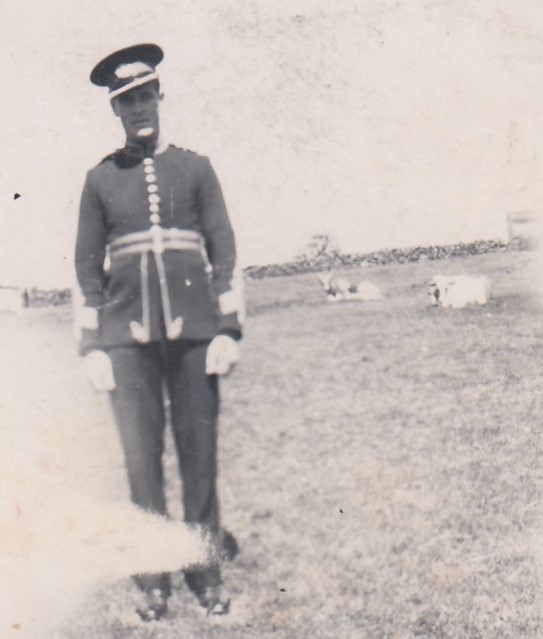
George Houseman in the uniform of the Darley Silver Band, own collection
We are not exactly what I would call a musical family. One of my sisters played the guitar for a while at middle school and another learned the cornet for a year and that was about it. Even mandatory recorder lessors were a trial for me, and I suspect they were even more of an ordeal for those forced to listen as I practiced……So it’s almost a surprise that the Houseman family was a core part of the musical scene in Darley, Yorkshire for at least a couple of generations. This is their story.
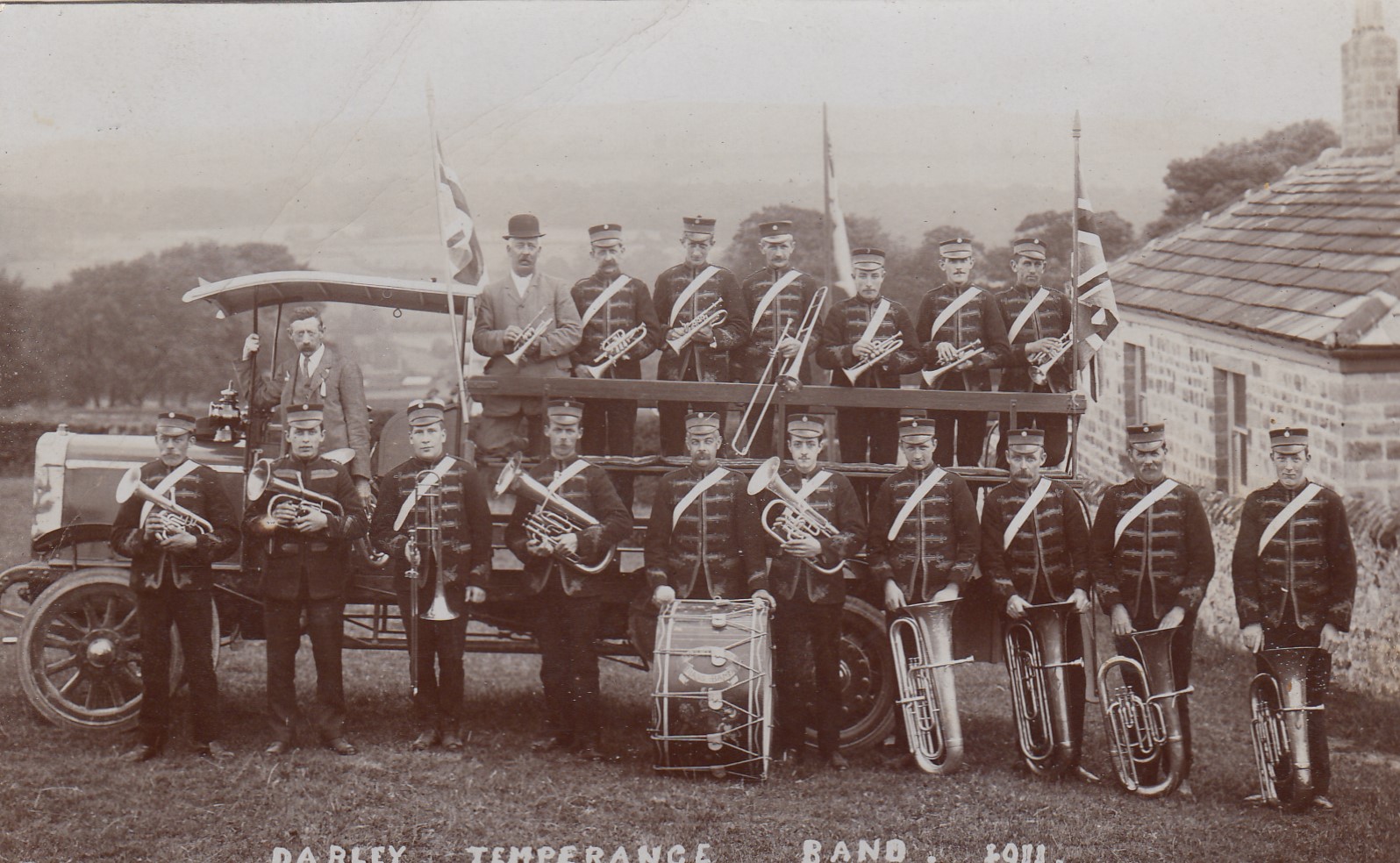
Our known family association starts with the Darley Temperance Band which was formed in 1901 as a successor to the original Darley String Band.
My paternal Great Grandfather, George Houseman (b. 1868) and his two brothers Fred (b. 1876) and Willie (b. 1870) were regular players, with George playing the cornet. The three are pictured on this 1911 photo, George is the one player not in uniform on the back row, Fred is stood on his right. Willie is named as being in the photo, but not identified and I don’t have a photo to compare.
Photo of Darley Temperance Band, 1911, featuring my Great Grandfather George and his two brothers, own collection.
The Darley Temperance Band quickly became popular in the area, with a particular favourite being the “Hospital Sunday” concerts where the band played at services and led the march between the two chapels and the church to help raise funds for the sick and destitute to pay their medical bills.
The band eventually became the known as the Darley Silver Band and by the 1930’s, my great, great Uncle Fred and his sons John Robert, William, Charlie & Ted were all stalwart members. My Great Grandfather, George, appears to have retired, replaced by his eldest sons Thomas & William.
My Grandad, also George, was the youngest of George’s Houseman’s children, born when Great Grandfather George was 52. Although Grandad was just fifteen when his father died there must have been plenty of time for musical education before then as at some point my Grandad, cornet in hand, joined his brothers in the band.
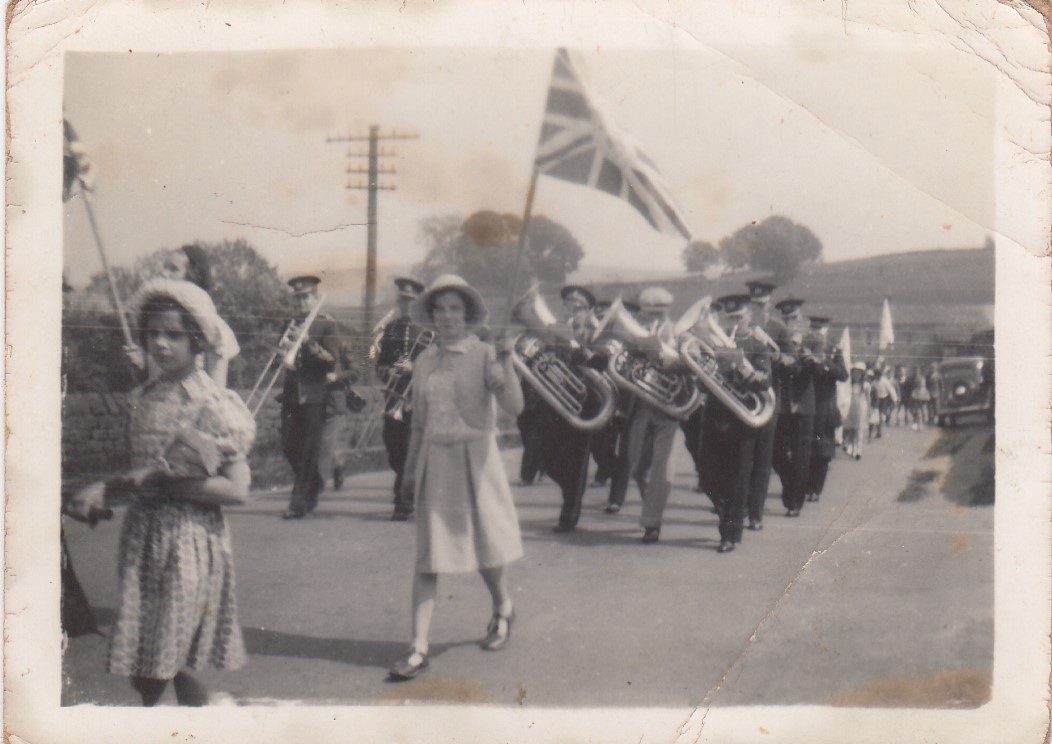
The Darley Silver Band continued to take part in the main festivities and ceremonial occasions in the village through the forties and fifties and headed up the fancy dress parade as part of Darley Thanksgiving Week at the end of the second world war.
Photo from own collection of a Darley Silver Band parade
Perhaps it was the trim blue, red & gold uniforms that appealed to my Grandma. In any event the band continued to be an important part of my Grandad’s life even after they married. As my Grandma wrote in her memoirs:
“George often went back to Darley to the band practice and other occasions. I liked to go and hear the band play they all had uniform trimmed with red and gold braid which looked very smart. George played a cornet, but not quite as good as Thomas and Arthur”.
That quote helps to demonstrate quite how much of a family affair the band was, with Thomas being George’s eldest brother and Arthur being his brother-in-law, married to George’s sister, Hilda. His cousins, John Robert & George Edwin rounded out the Houseman contribution to Darley’s musical life.
Photo from Summerbridge & Dacre Silver Band collection featuring (seated): my Grandad, George (second from the right), Arthur, husband of my Great Aunt (fourth from the right) and Thomas, my Great Uncle (fifth from the right).
Sadly, I have no memories of my Grandad playing. He was 54 when I was born and had long since ceased to play with the band. Darley Silver Band was disbanded in 1959 and although many members joined the Summerbridge and Dacre Silver Band this may have been when Grandad hung up his cornet. It was his love of cricket that I remembered him for. He died in 1987, when I was twelve, following two years of illness which left him bed bound for much of the time. Yet, who knows, through photos and stories maybe the musical tradition just might live on in our next generation.
With much gratitude to George Houseman (my paternal Grandad) and his father, George for their musical pursuits. Thanks also to the Summerbridge and Dacre Silver Band for their history page that enabled me to learn much more about my family and to Amy Johnson Crow whose 52 ancestors in 52 weeks challenge encouraged me to publish this series of stories.
My ancestors’ occupations were that of smallholder farmer, miner, weaver, charwoman, servant and other assorted rural labours. The occasional blacksmith or farmer of a few hundred acres hints at a steady income a step above the labouring poor, but we are not a family with a story of vast wealth. The rural poor leave little documentary trace. The daughters, sisters, wives and mothers, women in other words, don’t always even leave a record of their name. Yet without many of these women I would not exist.
Consequently, instead of using weeks #52ancestors theme of “fortune” as a prompt to tell the story of a fractionally wealthier (male) ancestor, I have taken it as an opportunity to document the lives of three women who were the exact opposite. It is a pleasure to introduce you to three of my maternal ancestors: Nanny Sidgewick, Martha Bottom and Widow Swinden.
Agnes (Nanny) Sidgewick
Litton is a remote village high up in Craven District in North Yorkshire. It’s a beautiful, fertile village which was apparently “notorious in the 18th century for its cockpit, situated between the village and the River Skirfare, where cock fighting and badger baiting took place.” It was here, c. 1773, that Agnes was born, the second child of Leonard Sidgewick & Dorothy Ashworth. Leonard died in 1778 leaving Dorothy to raise their four young children alone.
Agnes was 25 and John Preston, 29, when they married in Litton on 21 April 1798. Together they had five children, my great, great, great grandmother, Isabella, being the youngest. In the children’s baptism records Agnes’s name is listed as Nanny – one of those tiny snippets of detail which has survived the years.
By 1841 Agnes & John were living in Conistone, a village about seven miles downriver from Litton. This one census tells a story of their poverty. Agnes was living in one house in the village, still working, at the age of 68, as a farm servant. John, by then an invalid, was living in a different property with their daughter Isabella and died later that year of “natural decay.”
The last eleven years of Agnes’ life would have been tough. Isabella married and moved away in 1843 and Agnes was left alone. In her seventies, she would have struggled to survive. As Ian H Waller (My ancestor was an agricultural labourer) puts it so succinctly “In any rural community, labourers had to work while they could. Age was no deterrent and there was a not a pension. No work, no pay, no food.”
1851 census – Agnes Preston (nee Sidgewick)
In 1851 we come across Agnes again living alone in Conistone, with her “rank, profession or occupation” listed simply as “pauper.” She died of consumption, aged almost 80, on 17 February 1852.
Martha Bottom
Moving fifty miles south to Thornhill, near Wakefield we meet Martha Bottom.
Martha’s earlier life is hard to evidence. Later documents (the 1841 & 1851 censuses & her death certificate) suggest she was born c. 1781 but I’ve been unable to trace a baptism record.
In contrast the banns of marriage between Martha & her husband, Joseph Hall, appear to have been recorded twice, the first time on 28 January, 4 February & 11 February 1798 and second time on 27 January, 3 February & 10 February 1799. Possibly there were two sets of Martha Bottoms & Joseph Halls marrying in Thornhill in quick succession. Possibly the banns were duplicated. However, my favourite theory is the inconvenient arrival of a new born right before the wedding was due to take place causing the actual ceremony to be postponed.
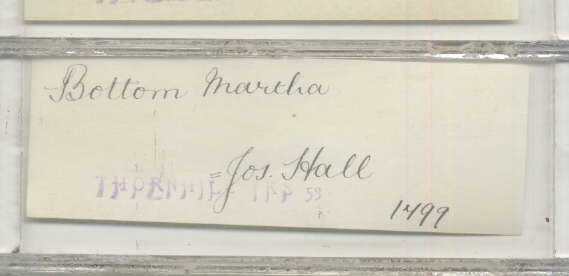
Pallots marriage record
Martha & Joseph went on to have eleven legitimate children between 1799 and 1820: that’s a twenty-year span of pregnancy and childbirth…. Rachel, their tenth child born in 1817, was my great, great, great, great grandmother. The family lived in the township of Shitlington with different documents referencing the specific villages of Netherton, Overton and Midgely.
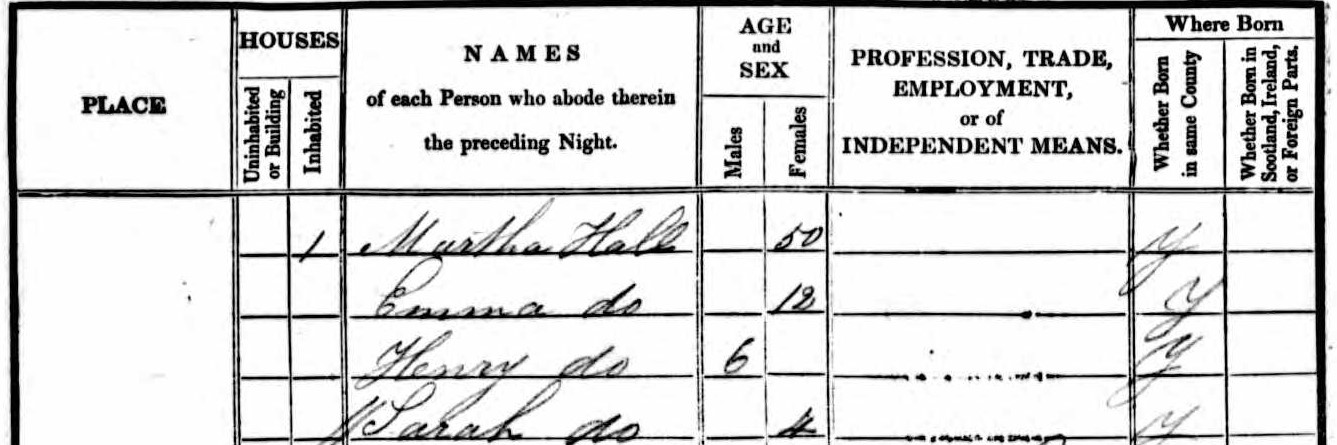
All of Martha & Joseph’s surviving children had left home by the time Joseph died in early 1841. However, the 60 year old Martha’s child rearing days had not ended. Her daughter, Mary, had had four illegitimate children before dying in 1839. Three of those four children (Henry, Emma & Sarah) were living with Martha in Midgely in 1841, with one having also died.
1841 census for Midgely village, Shitlington showing Martha (nee Bottom) and her three grandchildren
The 1840s would have been tough for an older widow with three small children to support as this extract from a book by Philip Ahier vividly illustrates.
“Conditions in Netherton, as well as elsewhere, during the “Hungry Forties” were very bad for the majority of the workers. Mr John Oldfield, in his “Recollections,” in a few terse sentences paints graphic word-pictures of these times:-
“Our food was nearly all porridge. Ebenezer Parkin made oatbread, and I have often sat by the back stone and eaten the shavings made. In 1845, my father played a whole winter and never earned a penny. When I was getting 4/6 weekly at Lord’s Mill, flour was 4/6 to 5/10 a stone, and I was nearly clammed to death. I used to take a meal dumpling for dinner and to eat it at breakfast time, and then walk and clam til I got home at night, when I had porridge. I have pined many a score of days after eating my dinner at breakfast time, and then having had to wait till night.””
Martha is still living in Midgely in 1851, at this point on her own, described as a pauper although several of her children were living in Midgely or nearby villages. She died aged 74 of apoplexy (or stroke) on 27 February 1855.
Widow Swinden
The evidence of my 7th great grandmother’s existence is slim and mostly circumstantial. Yet exist she must, less I wouldn’t.
Joseph Swinden married Ann Green on 27 December 1744 in St Michaels & All Angels church, Thornhill, Yorkshire. The following year, an Ann, wife of Joseph Swinden, was buried in the same church. Joseph went on to have had seven children baptised in the same church between 1748 and 1764, the eldest, Ann, being the mother of Martha Bottom described above. There is no evidence of a second marriage. Equally there is no evidence of any other Swindens whose wives could have died in Thornhill at the time and Joseph had to have had those seven children with someone. This leads me to believe that it was indeed Ann Green who died in 1745 and that at some point before 1748 Joseph married my 7th great grandmother, and, together with Joseph, had at least seven children.
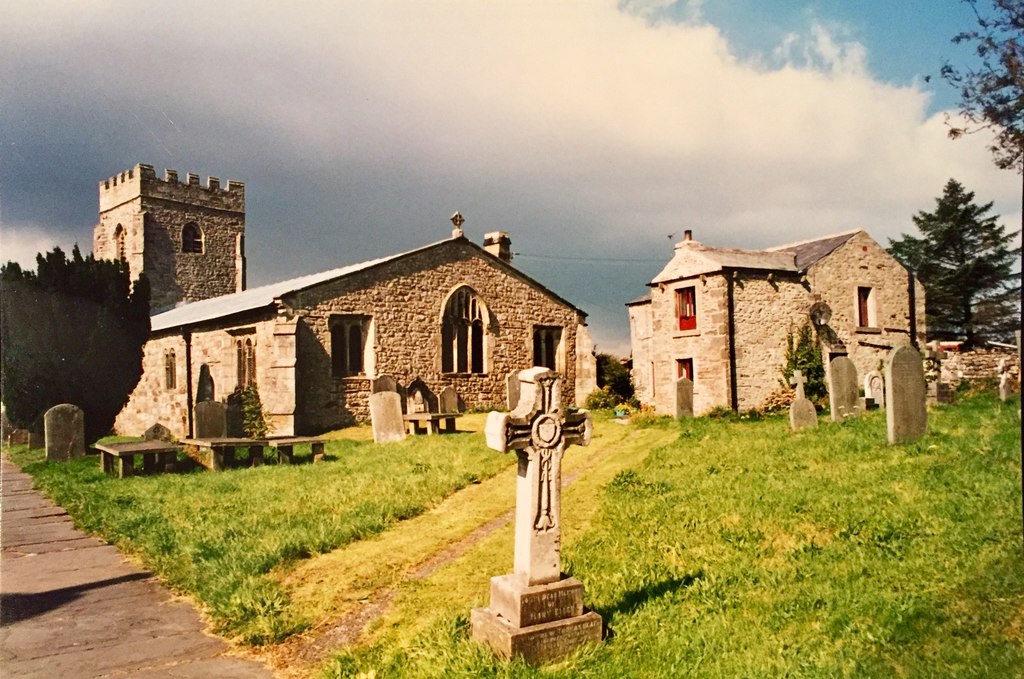
In the baptism records, Joseph was described as being from Thornhill Edge. Joseph was buried on 14 May 1768, again at Thornhill, with his burial record describing him as “of the Lees, pauper” so we can assume this is also where my 7th great grandmother lived for the majority if not all of her life.
Finally, we come to the end of her life and the sole documentary evidence of my 7th great grandmother, a burial record from Thornhill in 1771 reading simply “Wid Swinden buried” – it’s not even possible to decipher the month in the copy of the record. Even in death she exists only in relation to another, her husband.
From Thornhill parish records, 1771
I’ve written this blog to give life to Widow Swinden, Martha and Agnes. I’ll never know what they looked like, what made them laugh or cry, whether they loved their husbands or merely tolerated them. Yet I do know that they were all daughters, wives, mothers and grandmothers and that in itself is worth celebrating.
Later note: I shared Wid Swinden’s story on a podcast which then inspired a poem.
With much gratitude to Agnes Sidgewick, Martha Bottom and Widow Swinden without whom I wouldn’t exist. Thanks also wharefegen.info for their incredible research into Wharfedale families and to Amy Johnson Crow whose 52 ancestors in 52 weeks challenge encouraged me to publish this series of stories.
Receipt from Staffa nursing home for the birth of George Christopher Houseman
Two and a half days is such a short period of time. Sixty hours. 3,600 minutes. Take a moment. Think back over the last two days or even the last week – what did you do, think, learn or feel? I’ve been content in lock down winter to treat each day as a new one, to let the hours and days flow past waiting for the year to start. I barely notice one day after the next.
George Christopher Houseman lived just two and a half days.
He was the first son of Mary & George Houseman. Born in Staffa nursing home in Harrogate on 25 February 1946. (Incidentally only seven months after Mary & George were married). He died two and a half days later.
Grandma (Mary Houseman) was the family story keeper. Being of Yorkshire heritage she wasn’t one to shy away from plain speaking. So, the facts she told were – George Christopher existed, he was born and a few days later he died, but she didn’t seem to want to share more – it was a sad memory.
That could have been the end of his story. It wasn’t.
Mary & George had a wonderful daughter, Christine Mary, born in 1947 and then a second son in 1950 who they also named George Christopher. This same named child was my father. The first George Christopher my Uncle.
I have a fascination with the siblings of my ancestors who remain unwed, or who married and didn’t have children. Without any descendants they tend to be less well researched, somewhat ethereal and in danger of being forgotten. Yet they often have fascinating stories much more likely to pop up on censuses with other relatives and have wills that help connect. I want George Christopher to be more than a memory (mine) of another’s memory (my Grandma’s) and so this blog is written.
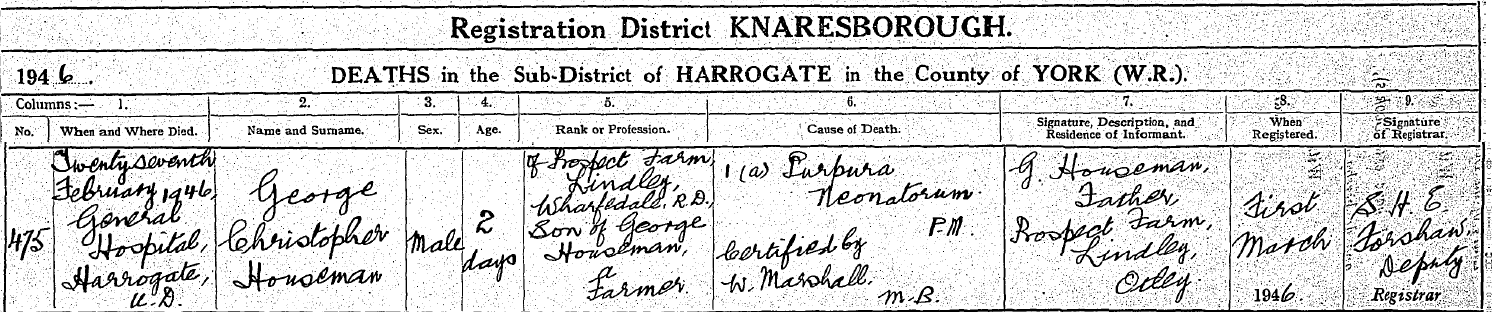
George Christopher now exists for me in three documents: a receipt, my Grandma’s autobiography and his death certificate.
I found the receipt for the nursing home stay carefully folded up in a small wallet when I inherited Grandma’s papers. Staffa nursing home was popular with mothers in the 1940s in the years before the NHS came into existence and was where my own father was born too. It was the only document she had of her life.
My Grandma’s autobiography, the Changing Years, tells us more about the love she bore for her first son.
MOTHER FOR TWO DAYS
We have had so much sadness in our lives that I find it hard writing about it in detail but I can not overlook it as I spend many sad hours thinking about so many of my family that I loved so much and meant so much to me during my life. We were both heart broken when we lost our first baby, a little boy that we had very much looked forward to having in our family. I know that Dad and Mother were so pleased to have a little Grandson in the Houseman family. He was born on the 25th of February 1946 and only lived two and a half days and is buried at Dacre Top Cemetery. It took an awful lot of courage after a long three days in labour for me to get over it. But I was very well looked after at the Staffa Nursing Home in Harrogate and was soon able to come home and get back into my routine. The doctor told me that the only way I would get over it was to look forward to having another baby.
And finally, I ordered his death certificate. George Christopher died on 27 February 1946 at Harrogate General Hospital of purpura neonatorum, blood spots and discolouration of the skin resulting from coagulation in the small blood vessels. I have no way of knowing if he was a premature honeymoon baby or a pre-marriage full term. There doesn’t seem to be a particular increased incidence of purpura in premature babies but I can imagine a seven month pregnancy resulting in a weaker child much more than I can Grandma being pregnant when she married!
Two and a half days may not seem like a very long time but I hope this blog demonstrates it’s long enough to leave a legacy.
With much gratitude to George Christopher Houseman (1946 – 1946), and thanks also to Amy Johnson Crow whose 52 ancestors in 52 weeks challenge encouraged me to publish this series of stories.