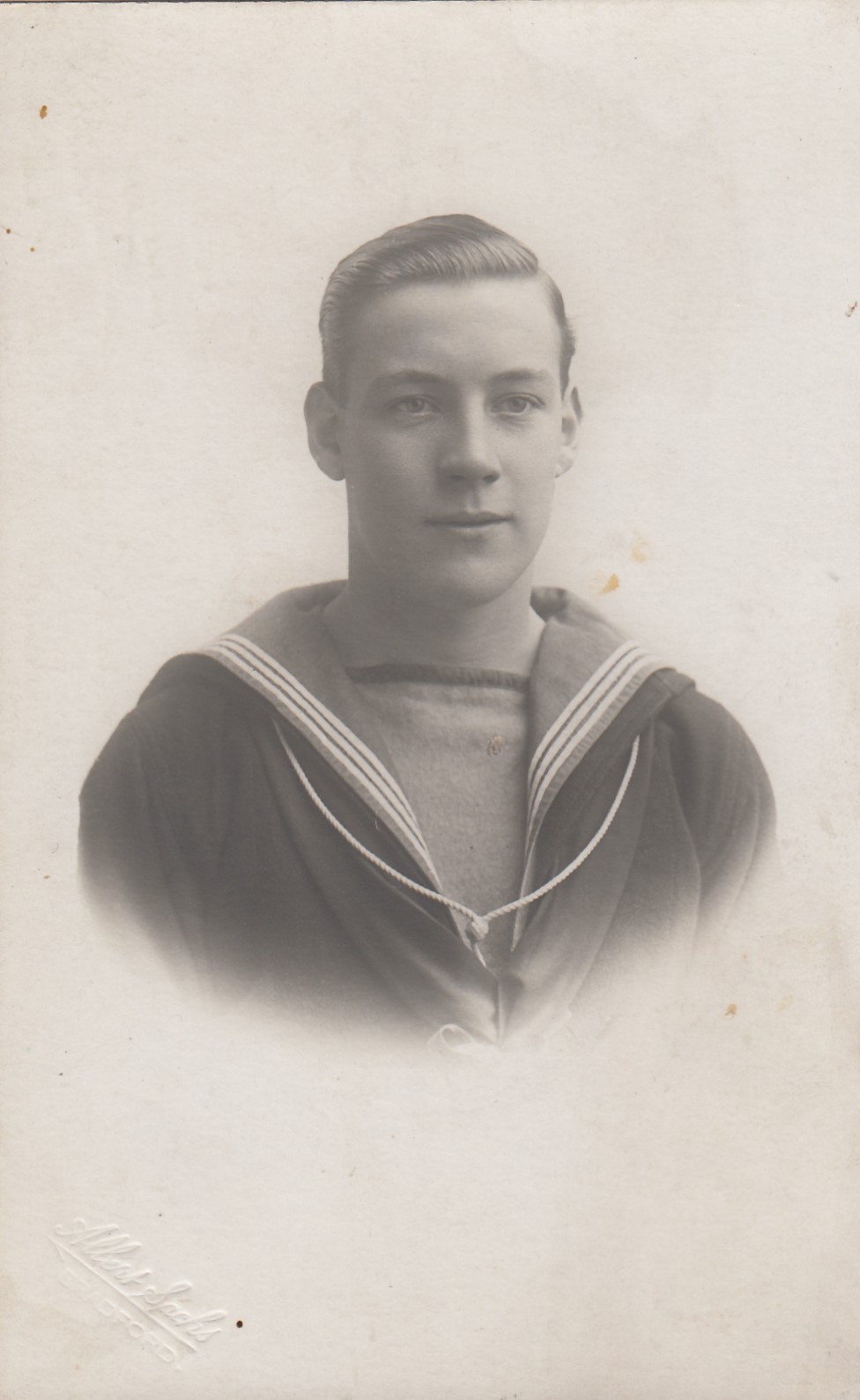
Slowly & steadily, I am working through the box of old photographs that belonged to my great grandmother (Hilda Mary Scott, mother of my Grandma). There are perhaps two hundred or more photos, few are labelled and even those that are can be hard to figure out. Amongst them are several young men in uniform, friends, perhaps, of my great grandmother including these two photos of Harry Clough & Frank White.
Postcard labelled “Harry Clough. Died 1918.” Own collection.
Postcard labelled “Frank White killed March 29/18 in Flanders after 3 years service. Buried at St Amand’s, nr Arras”. Own collection
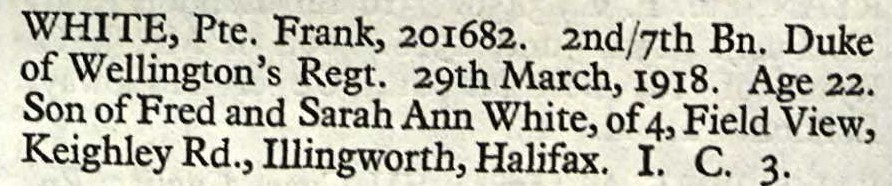
I was curious, it was a rainy Sunday afternoon, so I started to do some research. I took a guess that the men would have been born in Yorkshire c. 1896 or so and hit lucky. I found an index of graves in St Amand on ancestry which gave me the names of Frank’s parents.
Index from St Amand British Cemetery
Then I found a findagrave listing for an Able Seaman Harry Clough who died in 1918. The photo I had was definitely one from the navy. Finally, I spotted an entry which suggested Frank’s mother’s maiden name was Clough and the hunt was on for a connection.
A bit more work and I was able to establish that Harry’s father, William Clough, and Frank’s mother, Sarah Ann Clough, were siblings, children of Edward Clough & Hannah Wilks. Harry & Frank were first cousins.
Wilks sounded familiar so I decided to research a further generation and discovered that James Wilk[e]s was born in Felliscliffe, which is where many of my family are from, encouraging me to carry on. Back again – James was the son of a Francis Wilkes & Hannah Darnbrough. Darnbrough and Darnbrook are essentially different spellings of the same name which was the final link. Hannah turned out to be the daughter of William Darnbrook & Elizabeth Swale (my 5x great grandparents) and sister to Ellen Darnbrook, Hilda Mary Scott’s great grandmother. The family connection was established. These two anonymous young men, who gave their lives for their country in WW1 are anonymous no longer. Frank Harry White was born on the Isle of White in 1895. Harry Clough was born on 3 December 1897 in Baildon, Yorkshire. The parents of these two young men were third cousins to my great grandmother, Hilda Mary, and, it seems, the families were still in touch even to that generation, suggesting a real closeness in the family. Distant cousins, and my great grandmother’s friends. Their memory lives on.
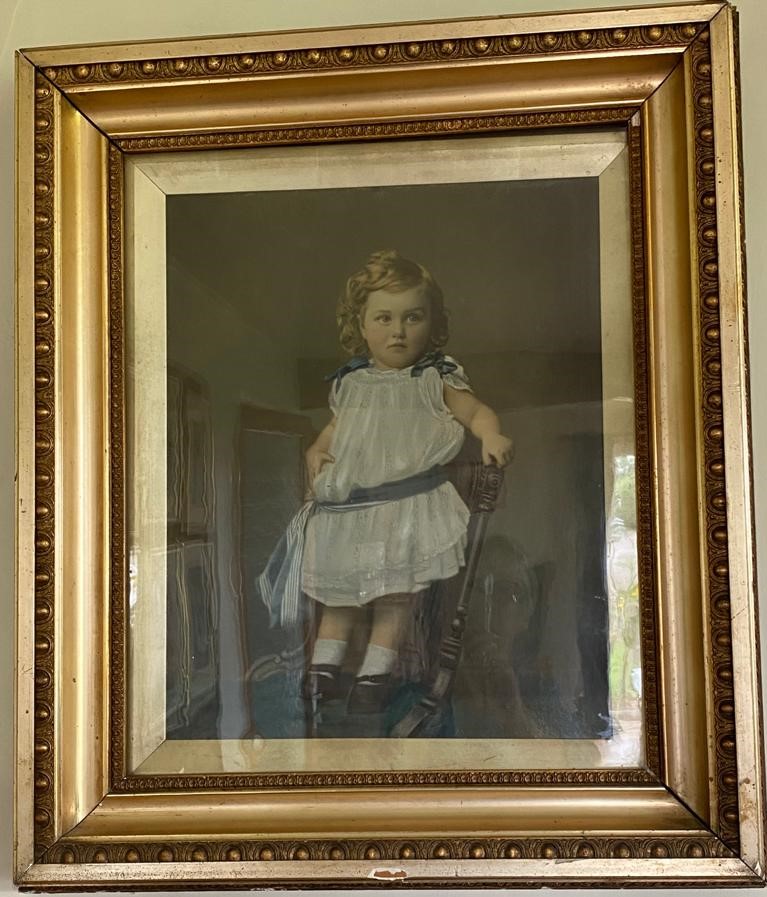
The portrait of Walter Scott, aged four, hanging in my mother’s living room, own photo
“I can shoot you” said the elder friend as he picked up the gun the boys found lying around. And so, he did.
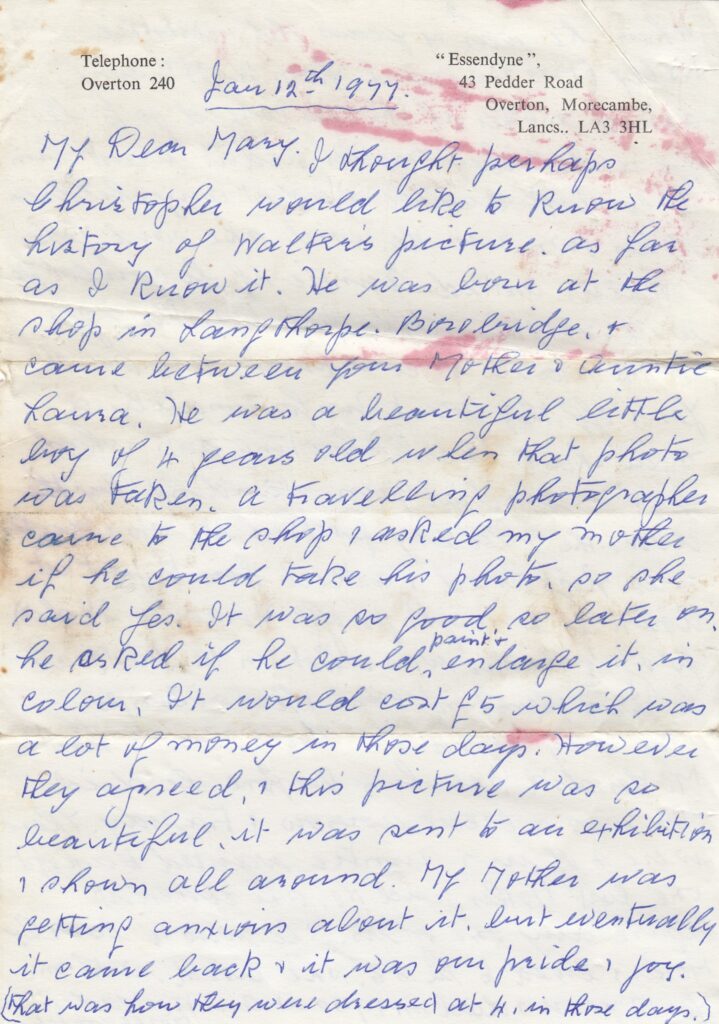
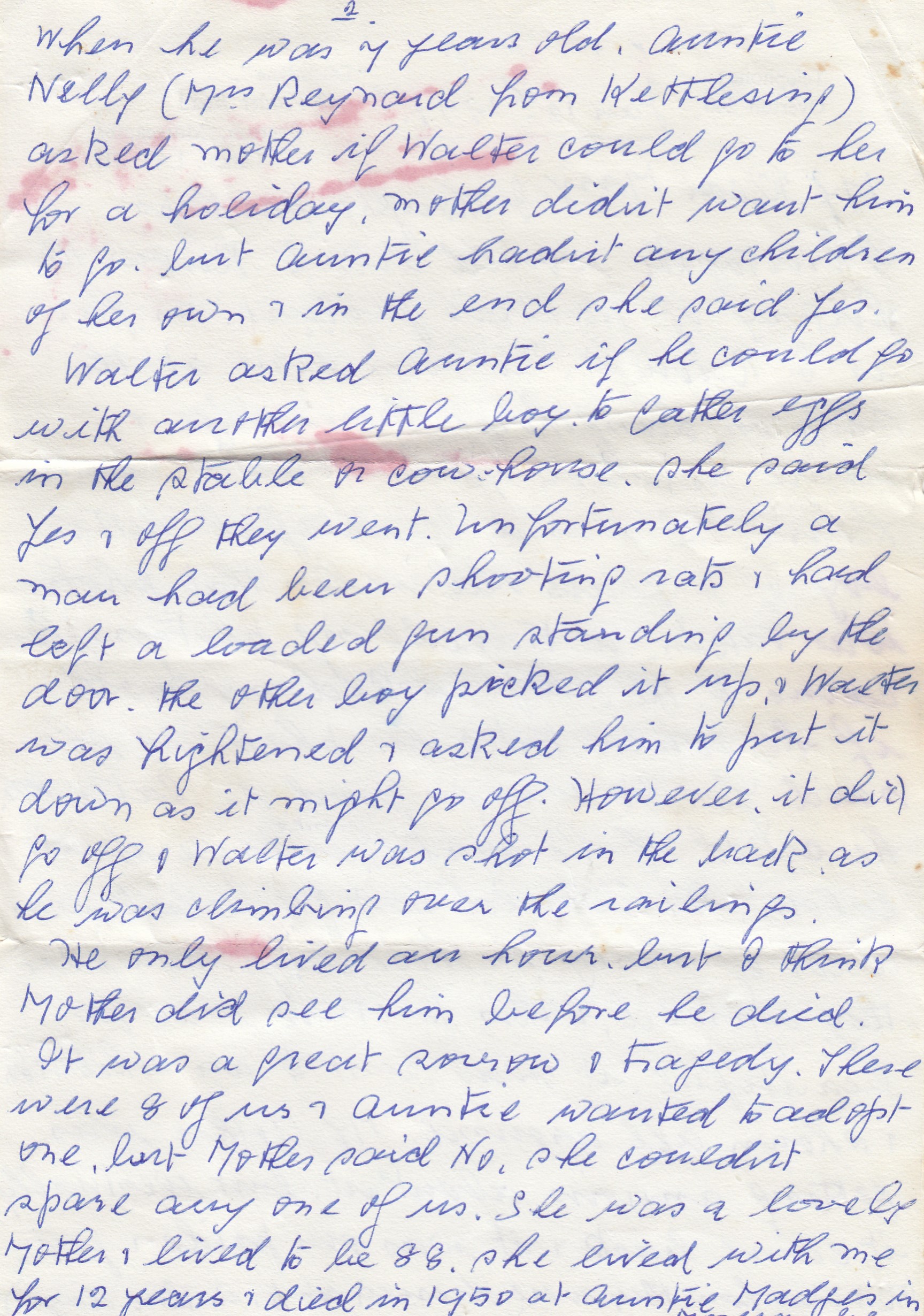
Thus goes the family story of Walter Scott, passed down from Walter’s sister, Hilda Mary Scott, to her daughter Mary, my Grandma, and then to me. My Grandma loved to tell the tales of tragic death but it’s the beautiful, almost life-sized portrait of four-year-old Walter that has made his story so compelling. It is thanks to this portrait too, that I know so much about Walter’s story. My Dad inherited this picture from his Grandfather, Hilda Mary’s husband, Jesse, following Jesse’s death in 1977 and Aunt Clarrie, Walter & Hilda Mary’s younger sister wrote to my Grandma to tell of its history.
Letter from “Aunt Clarrie” (Clarice Scott, sister to Walter Scott), to Mary Houseman (my Grandma) sharing the history of the portrait, written on 12 January 1911, own records
Walter was born on 27 March 1893 above the family grocer’s shop in Langthorpe near Boroughbridge. He was the fourth of the eight children of Maria Reynard & John Scott. The Scott family were relatively prosperous for the time although not without their own sad tales. The first-born son, Charles, had died aged just two from an infection caused by a scratch on a rusty nail in his playpen (another of Grandma’s tales).
It was also a close and happy family. Maria’s sister, Aunt Nellie (Sarah Ellen Reynard who married a distant cousin, William Reynard) was unable to have children and asked if she might adopt one of Maria’s. “Mother said No, she couldn’t spare any one of us” records Aunt Clarrie. Nellie & William were later to adopt a boy, William Watson, at some point after 1901.
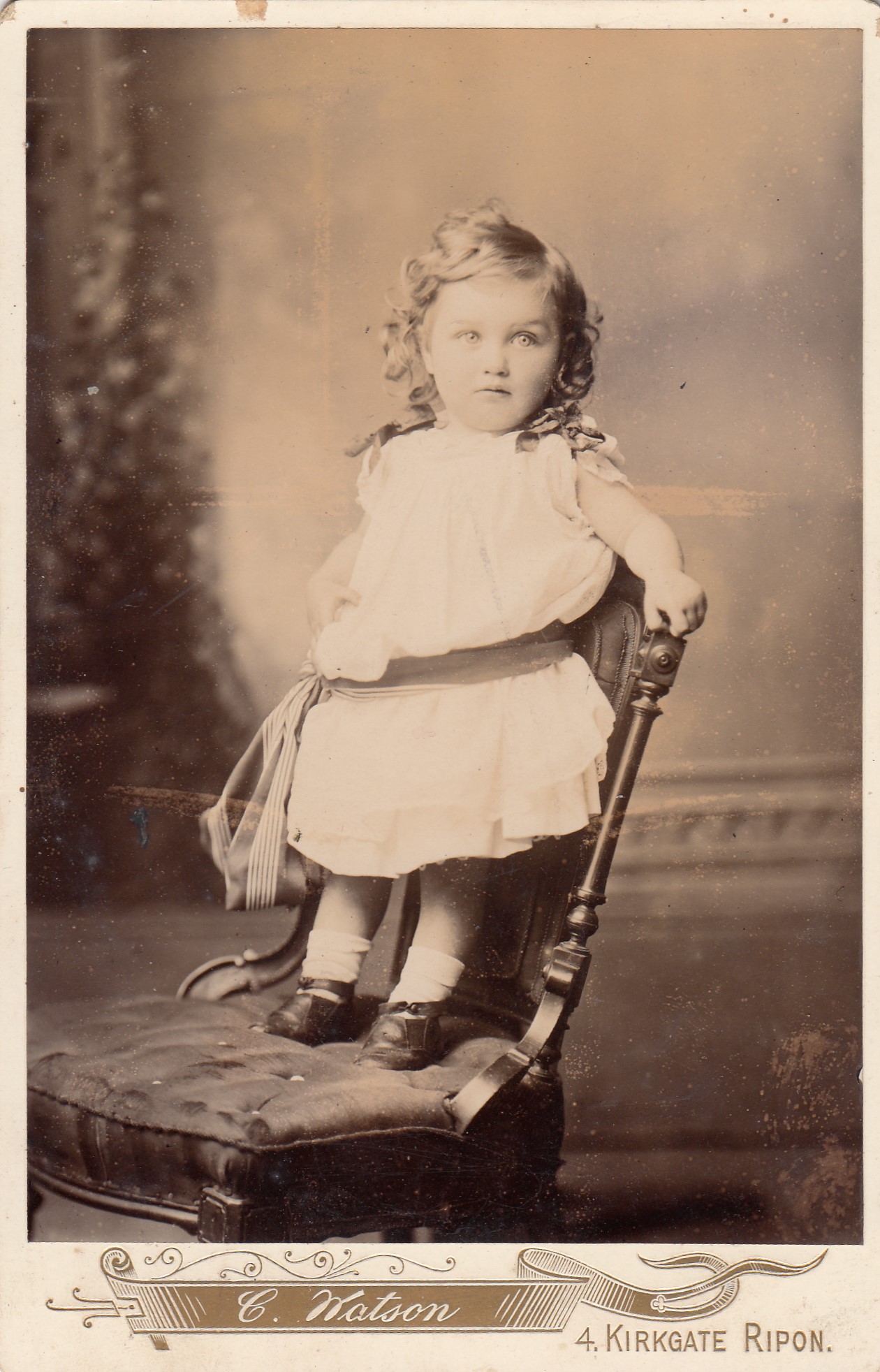
When Walter was four, a travelling photographer, C Watson from Ripon, arrived in the village. Aunt Clarrie picks up the story. He was a beautiful little boy of 4 years old when that photo was taken. A traveling photographer came to the shop & asked my Mother if he could take his photo, so she said yes. It was so good, so later on, he asked if he could paint & enlarge it, in colour. It would cost £5 which was a lot of money in those days. However, they agreed & this picture was so beautiful it was sent to an exhibition & shown all around. My Mother was getting anxious about it, but eventually it came back & it was our pride & joy.
The original photo of Walter Scott, aged four, taken c. 1897 by C Watson of Ripon. Own photo.
In the summer of 1900, Aunt Nellie asked if Walter might come and stay for a holiday and Maria agreed so Walter went to stay with his Aunt & Uncle at Birstwith. On 16 August, Walter asked his aunt if he might go with his friend, Edward Fraser, to collect eggs from the stable and cowshed and his aunt agreed, presumably thinking the thirteen year old Edward would take good care of the seven year old Walter.
Unbeknown to Aunt Nellie, one of the Reynard’s farm labourer’s George Smith, had been having trouble with his gun, a breech-loader, when he had been out shooting rats earlier in the month. The extractor had broken, the cartridges were too tight to remove and so he’d left the loaded gun by the door of one of the outbuildings. Edward, being a curious teenage boy found the gun and picked it up. Walter, being a frightened child, pleaded with him to put it down then turned to scramble over the railings to get out of the way. Too late, the gun went off shooting Walter in the back.
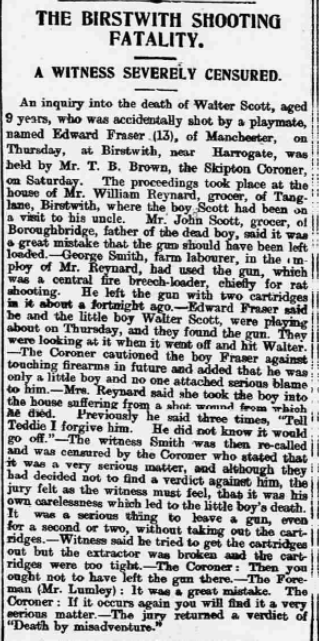
Reports from the Yorkshire Herald on 17 & 20 August 1900 recording first the accident and then the inquest. Note the first report refers to the friend as Gill, aged nine. The inquest report refers to Edward Fraser, aged thirteen. The inquest report has been taken as the correct one
Uncle William ran to the barn after hearing the report, he picked Walter up and ran back to the house. The doctor arrived to examine Walter and found him in a sorry state with both flesh & ribs blown away. Walter’s mother, Maria, was also sent for. Walter, loyal to the end cried “Tell Teddie I forgive him. He did not know it would go off” as he died, we believe, in his mother’s arms.
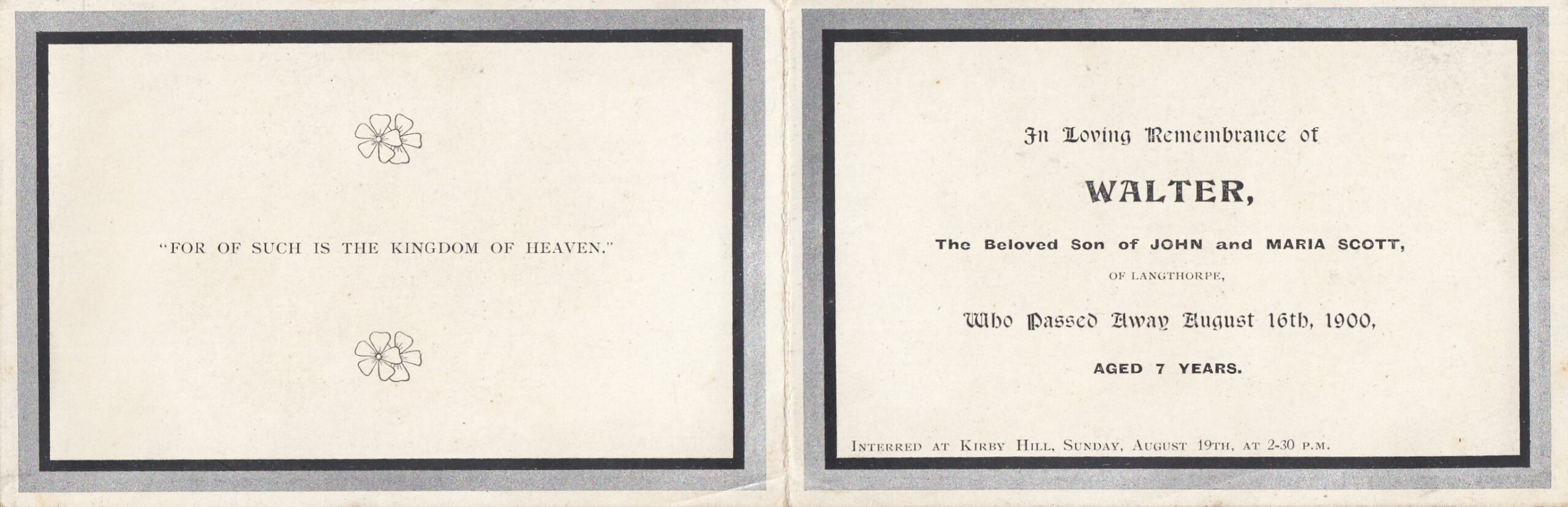
The funeral card to Walter Scott, own records
Walter was buried at Kirkby Hill on 19 August, later joined by his parents, and the inquest the following day returned a verdict of “death by misadventure killed by the discharge of a gun” and the tragic end of a beautiful child.
West Yorkshire County Coroner’s records, 1900
With much gratitude to Walter Scott, my great, great Uncle, who, despite his short life left a story that has lasted a hundred years, Clarice Scott, my great, great Aunt, who told the story of Walter’s portrait, to my Grandma for passing on the tale and to Amy Johnson Crow whose 52 ancestors in 52 weeks challenge encouraged me to publish this series of stories.
This is part of a series of brief biographies of earlier ancestors.
Sarah Stansfield & John Houseman are the parents of Thomas Houseman, father of George Houseman, father of George Houseman, my Grandad, and hence are my paternal great, great, great grandparents.
Sarah was born on 8 December 1804 in Strangford, Idle to Methodist parents. It seems my family were fairly early Methodists and thanks to a dual registration I know Sarah’s birth, baptism, parents, her father’s father and where they lived. Unless of course there were two Sarah Stansfield’s born on the exact same date……
Baptism record of Sarah Stansfield – Upper Chapel, Idle, Yorkshire – 1805Record of birth of Sarah Stansfield – St Wilfred’s church, Idle – 1805
Of John, all we know is that he was baptised in Hampsthwaite on 15 April 1805 so was maybe just a few months older.
Sarah & John married on 13 October 1830 in Hampsthwaite. At the time Sarah could write, John was illiterate. Another legacy of the Methodist tradition? By the time of their marriage Sarah was living in Hampsthwaite, perhaps with some of her mother’s family and I suspect Methodism was how they met – at least the family continued to hold the same faith for several generations.
The couple quickly settled in Tunnel Bank, Darley, close to John’s family, perhaps even taking over a family farm, where they lived for the remainder of their lives. With 64 acres to their name, the couple would have been a respected part of the Darley community.
Four children followed at regular intervals: John (ch. 1832), Thomas (my ancestor) (ch. 1834), William (ch. 1836) and Mary (ch. 1838). All seemed like the perfect, respectable, farming family. Yet, William died aged in 1844 aged just eight, John never married and Mary married a widow twelve years her senior and had just two children of her own. It was left to Thomas to carry on the family name. I was reminded about a comment my Grandma apparently made that “there wasn’t much choice.” Did this respectable family, with strong Methodist links, a focus on literacy and a family that came from 16 miles distant somehow struggle with the Darley community of the time?
Nonetheless the Methodist temperate life likely led to the last facts we know of the couple, that they lived long lives. John died on 13 November 1884 aged 79, Sarah just six months later on 4 May 1885 aged 80. Both are buried in Birstwith. Long lives, that I think, were well lived.
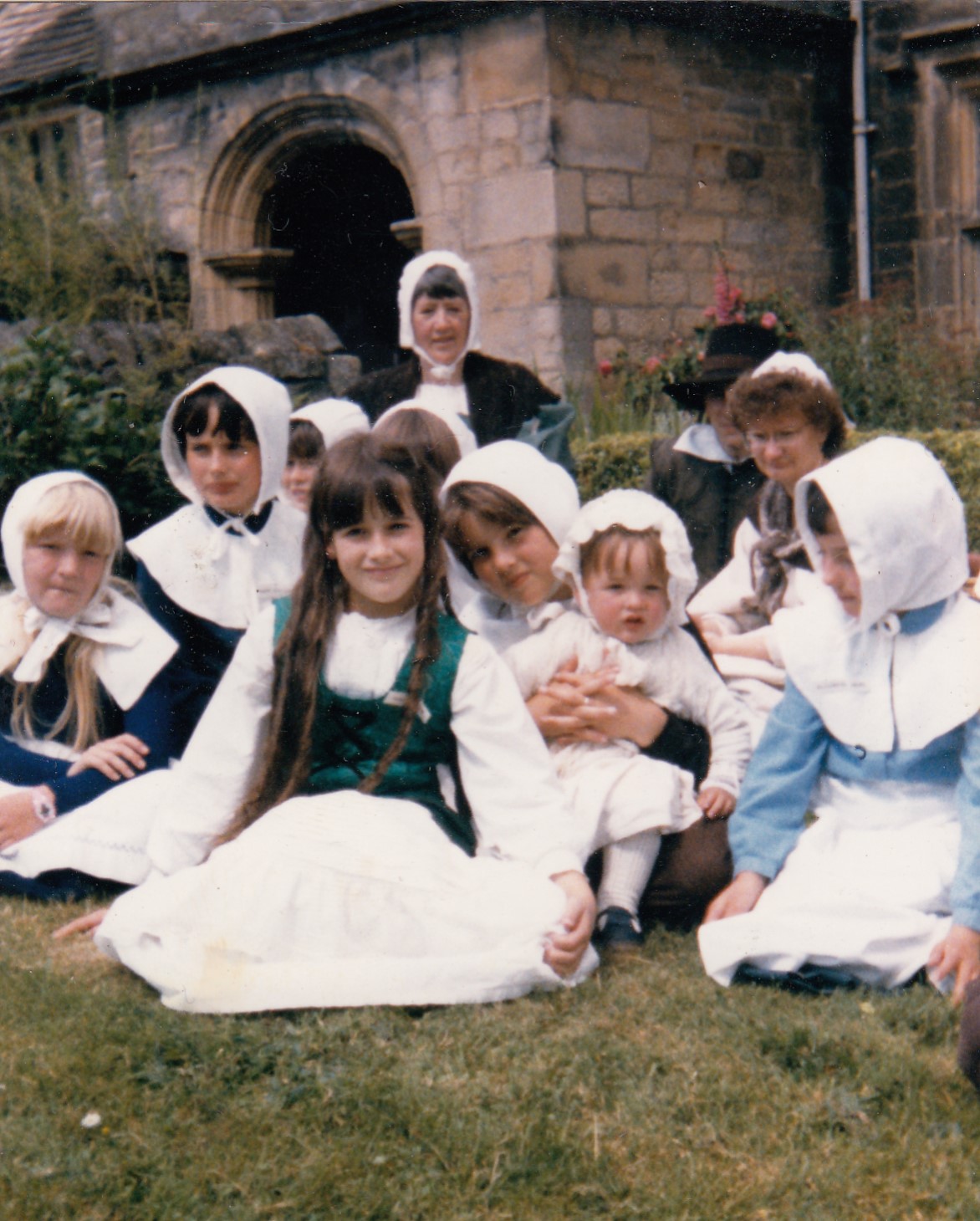
Norwood School’s seventeenth century day at Swinsty Hall. I am in the middle holding my baby brother, David. My sister Helen is to the left having been chosen to represent the wealthy owners, my oldest friend, Andrea, is just behind her to the left. The head teacher, Miss Robinson, is at the back. Own photo, 1985.
On 3 July 2021, as England were preparing for their quarter final match against the Ukraine, I was in Fewston – catching up with my oldest friend, Andrea (featured in the photo above), traipsing through knee high grass in the graveyard with my third cousin, Paul, and reliving childhood memories gazing across the adjoining reservoir towards the gabled rooftop of Swinsty Hall.
Later I was idly wondering whether we were related to any of the five Yorkshire-born players and Google, being Google, gave me an answer. It turns out our family connection to the England team is not with the players, but with the manager, as the gabled rooftop I was reminiscing over is the current home of Gareth Southgate and this being the Washburn Valley there was bound to be a family connection.
Back in 1985 my sisters & I were all attending the tiny village school of Norwood. What do I mean by tiny? I had two fellow pupils in my year group (one being Andrea). My sister Helen had none, she was the sole person in her school year. When I left the following summer there were twenty-seven pupils and when the school closed a few years later there were just sixteen. By contrast, I was walking with a London-born friend last week. As we passed one of the ubiquitous four-story Victorian London primary schools, he commented that he had long thought everyone went to schools of this kind where sixty plus pupils were admitted every year.
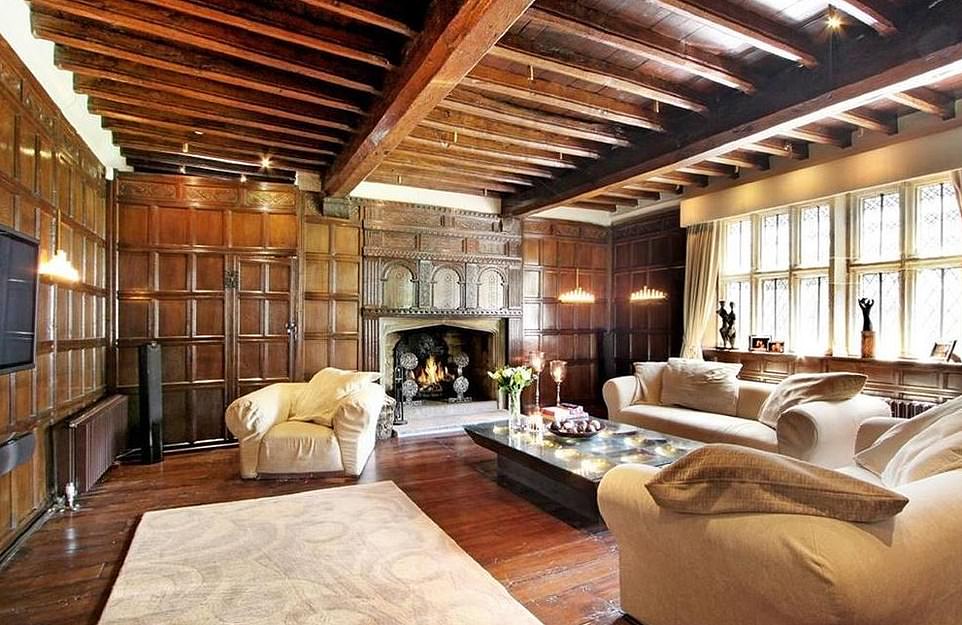
When one or two teachers are trying to effectively educate children ranging in age from four to eleven you have to be creative and engage with the whole community and that’s how we ended up at Swinsty Hall re-enacting the seventeenth century studying clothing, food, dancing & the English civil war. We were joined by parents (well, mothers), younger siblings and even the local vicar all dressed in seventeenth century garb. Lunch was served on the massive oak table in a wood panelled dining room and afterwards there was square dancing on the lawn surrounded by old flower beds.
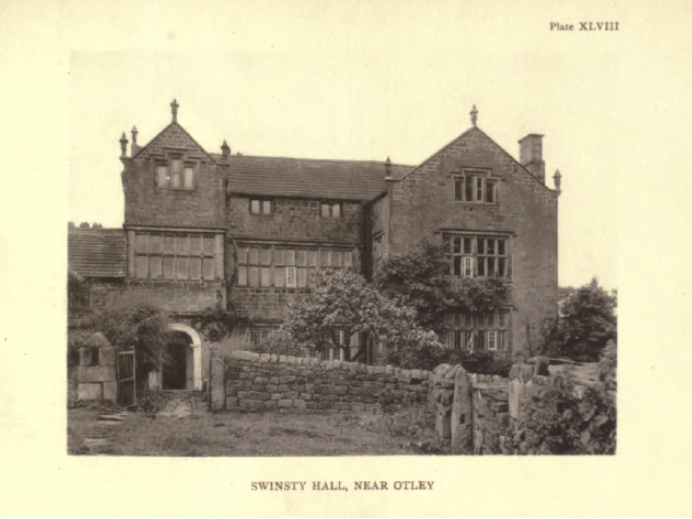
“The front of the hall is simple, yet elegant, consisting of a centre and projecting wings, the latter like square towers, finished with gables and pinnacles at the angles and apex…..On the right is the great hall, a spacious room twenty-one feet square. The beams supporting the upper floors throughout the building are splendid specimens of oak timber, resting on corbels springing from the walls. The floor of this room has been originally laid with lozenge-shaped flagstones, some portions of which yet remain near the walls…… A door leads from this into the drawing-room, or dining-room;…..The doors are all made of oak, without nails; the battens; four in number, being fixed by wooden pins, with the heads projecting a little by way of ornament on the inner side, the two middle ones with three rows, and the top and bottom with only one each. This room is wainscoted with panelled oak, finely carved at the upper border and around the fireplace……The window is of twelve lights, the upper six of which yet retain their antique glazing, being variegated with stained glass; on one piece are the letters H.R.G. and the date 1627, the initials of Henry Robinson, the first owner of Swinsty of that name, and his wife. In this room is preserved a piece of the original furniture — a dining table, 17 feet 6 inches in length, by 3 feet in breadth, and the same in height, made of planks of solid oak, two inches thick, with massive frame and legs of the same material. This table has doubtless played its part in many a hundred feasts, and it is yet as strong, and clean, and bright, as when the wealthy owner of Swinsty, in the day of its highest greatness, sat at its head and dispensed hospitality. The forms, or benches, on which the feasters have been perched also yet remain; they are of such height that those seated on them would have to rest their feet on the lower frame, as they could not reach the ground……In the garden, a few old-fashioned plants remain, such as the Robinsons cultivated when they dwelt here ; roses red and white, aconite, rosemary, balm, lavender, peony, box, and golden rod ; while the wall is partially hidden by the green and golden masses of stone crop, and the walls of the old mansion are coated over with grey and golden lichen”.
Swinsty Hall’s heyday WAS the seventeenth & early eighteenth centuries and what i wasn’t aware of back in 1985 was that I was highly likely to have been feasting & dancing in the footsteps of my ancestors.
For much of the rest of this blog I have to thank my third cousin, Paul for his research. The same third cousin who was wading through knee-high grass in Fewston church. Paul & I first connected through a DNA match site, which is kind of strange as we grew up in the same village (albeit a few years apart) and he knew my uncle from primary school. He even appears on the wallpaper charts I drew up with my Grandma back in the 1980s. We are third cousins through Amelia Bradbury & Michael Houseman (the parents of Jesse Houseman, the father of my Grandma, Mary Houseman). Such is the inter-related nature of small Yorkshire villages I have since discovered several more distant connections. One of these connections is the Hardisty line which leads us back to the Robinsons the owners of Swinsty Hall for nearly two hundred years. Or rather almost……
Swinsty “old” hall was built for the Wood family in the first half of the sixteenth century. The far more substantive “new” hall was added in the 1570s, a wedding gift for Francis Wood & Ellen Sutell from Ellen’s father, Henry. However, Francis seems not to have had the means to maintain such a grand property. By 1590 he was in such debt that he signed over the property to Henry Robinson in exchange for writing off a debt of £2,000. Thus, Henry became the first Robinson to own Swinsty Hall.
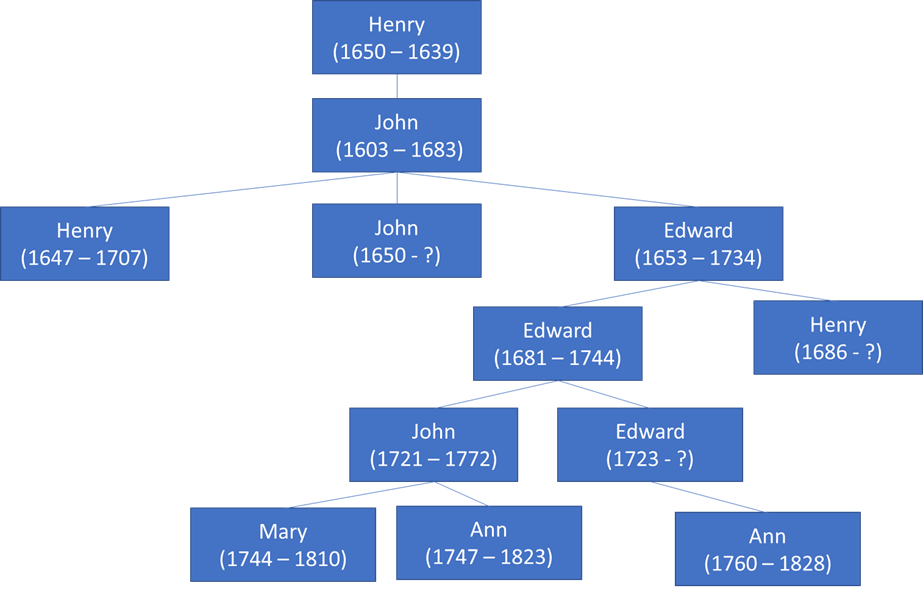
The Robinsons of Swinsty Hall
Henry left Swinsty Hall to his son John. That is relatively straightforward.
John divided his estate up early. He gave Swinsty “old” hall to his son John, who then sold it to his older brother Henry for a nominal sum of just five shillings in 1681. John then deeded the “new” hall to Henry in 1683 thus re-uniting the two parts.
Henry had no heir and so left Swinsty Hall to his nephew, also named Henry. Henry then sold the property to his father, Edward, in 1725 and his father also inherited the remainder of the estate when this Henry, too, died childless.
Edward decided to bypass his children and bequeathed Swinsty Hall direct to his grandson John. And whilst John had one son, he died before John and the Hall was left to his daughters Mary & Ann, finally ending Robinson ownership after 182 years.
Meanwhile, Mary & Ann’s cousin, another Ann Robinson married Samuel Hardisty & they had a child Anne Hardisty in 1782. Anne is Paul’s 4 x great grandmother. Knowing I was related to Paul via the Hardistys I naively thought that meant that I too was related to the Robinsons and thus to the owners of Swinsty Hall. It turned out to be a little more complicated. Anne married another Hardisty, William, whose grandparents, Robert Hardisty & Ellen Kirton were my 7 x great grandparents. Whilst the Hardistys and the Kirtons were both established Fewston families it seems that they may have only been feasters at that grand oak table rather than the ones sitting at the head dispensing hospitality and it is not beyond the realms of imagination that they might have danced in the very same gardens my immediate family did in 1985.
So, whilst my connection to the Euro2020s seems somewhat tenuous, I can perhaps say that both my seventeenth century ancestors and my more immediate family have eaten in the grand panelled dining room of the current England manager’s home.
Images from www.ukhomesearch.org.uk showing the gardens we danced in and the hall in which we ate, Swinsty Hall
With much gratitude to my third cousin, Paul, Norwood County Primary School and my Hardisty ancestors. `