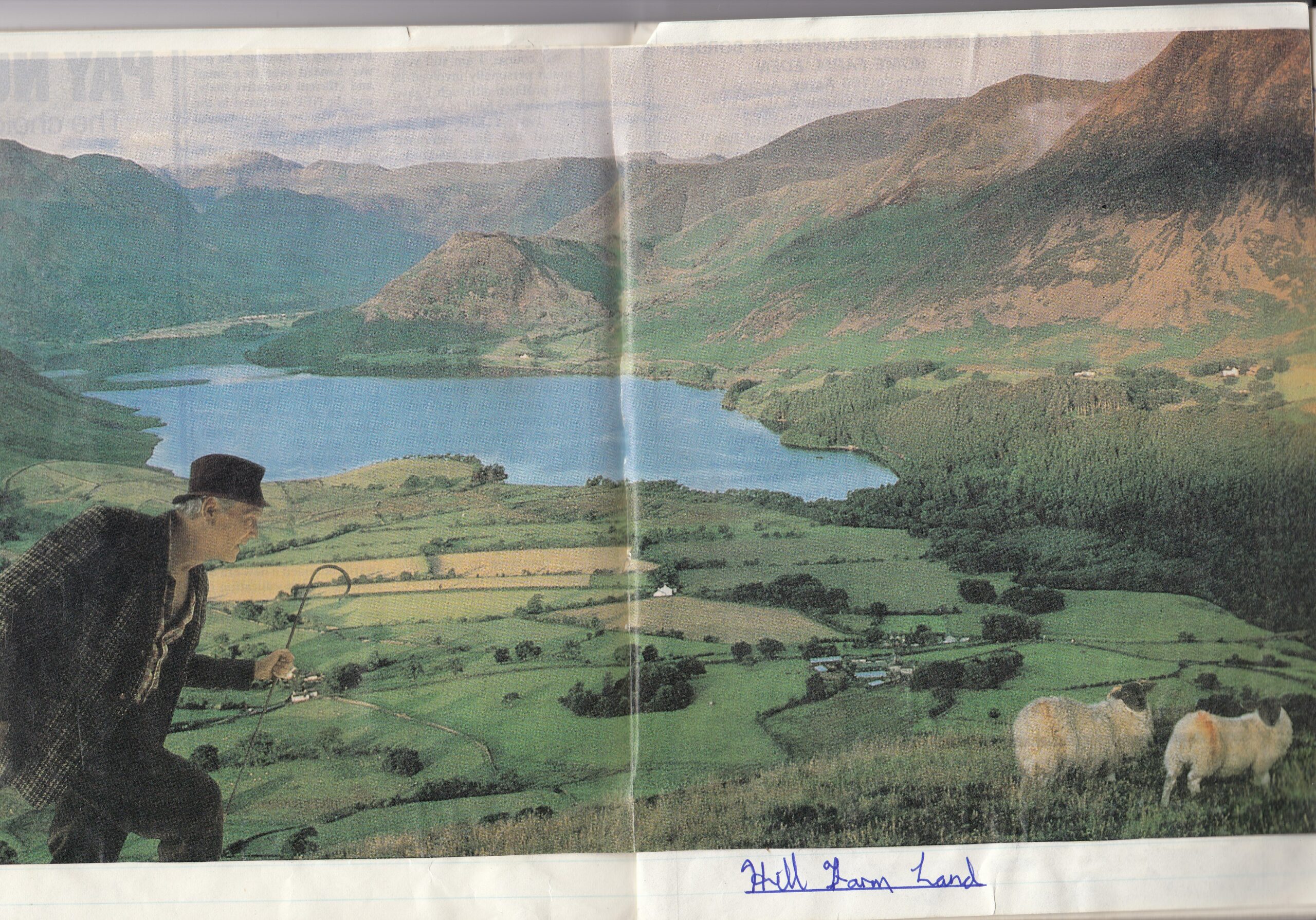
My life as a Yorkshire hill farmer: written by an eleven year old in 1987

All photos are taken from my school geography book. The images were all clipped from magazines and stuck in a school exercise book back in 1987 and as such i don’t know who to credit. If they happen to be yours do let me know.

This week’s #52ancestors hint of “on the farm” had me flummoxed. When your father, both grandfathers, all four great grandfathers and many, many generations before them were all Yorkshire hill farmers, life on the farm is woven into at least half of what I write. How can I either synthesise all of that history into one blog or even pick just one story to tell?

Then I thought of the geography homework I was set in my first year at secondary school when I was eleven years old. We were tasked with writing about a year in the life of a hill farmer in the Pennines. I remember writing this sat in my Grandma’s kitchen at Prospect Farm. The open fire with an old oven was by my side, installed (I believe) when my great grandparents moved in, and now used only to keep orphan lambs warm. My Grandma & Aunt were ready waiting to answer questions and there was a pile nearby of Farmers Weekly and other magazines to cut pictures out of to help illustrate the story. The words flowed and it was no surprise that writing about the life I knew earned me a special commendation.

This story was nothing less than a year in the life of my Dad, my Grandparents and likely my Great Grandparents too. This was life as a Yorkshire hill farmer in the 1980s and as such I have transcribed rather than edited. (Including putting aside the slight geographical liberty in the first line – the Pennines don’t quite continue as far as Harrogate). The added benefit is just a hint of how we spoke which even now (after so many years away from Yorkshire and from farming) causes people to guess where I am from.

There’s also a bonus story. Apparently an eleven year old me had figured out how to solve the financial problems of a hill farmer and it just made me laugh.

My life as a hill farmer, 13 February 1987

Our Farm

My Farm is in the Pennines somewhere near the town of Harrogate. As I have mainly sheep, I only need one farm help, his name is Andrew. The farm buildings are quite ancient as most farm buildings are. My family have lived in it for years on end. During the early summer months there is not much work to do and my son comes over so Andrew is not needed. Late summer he is needed though because of the Haymaking. Other times as well are busy such as Lambing time and winter.
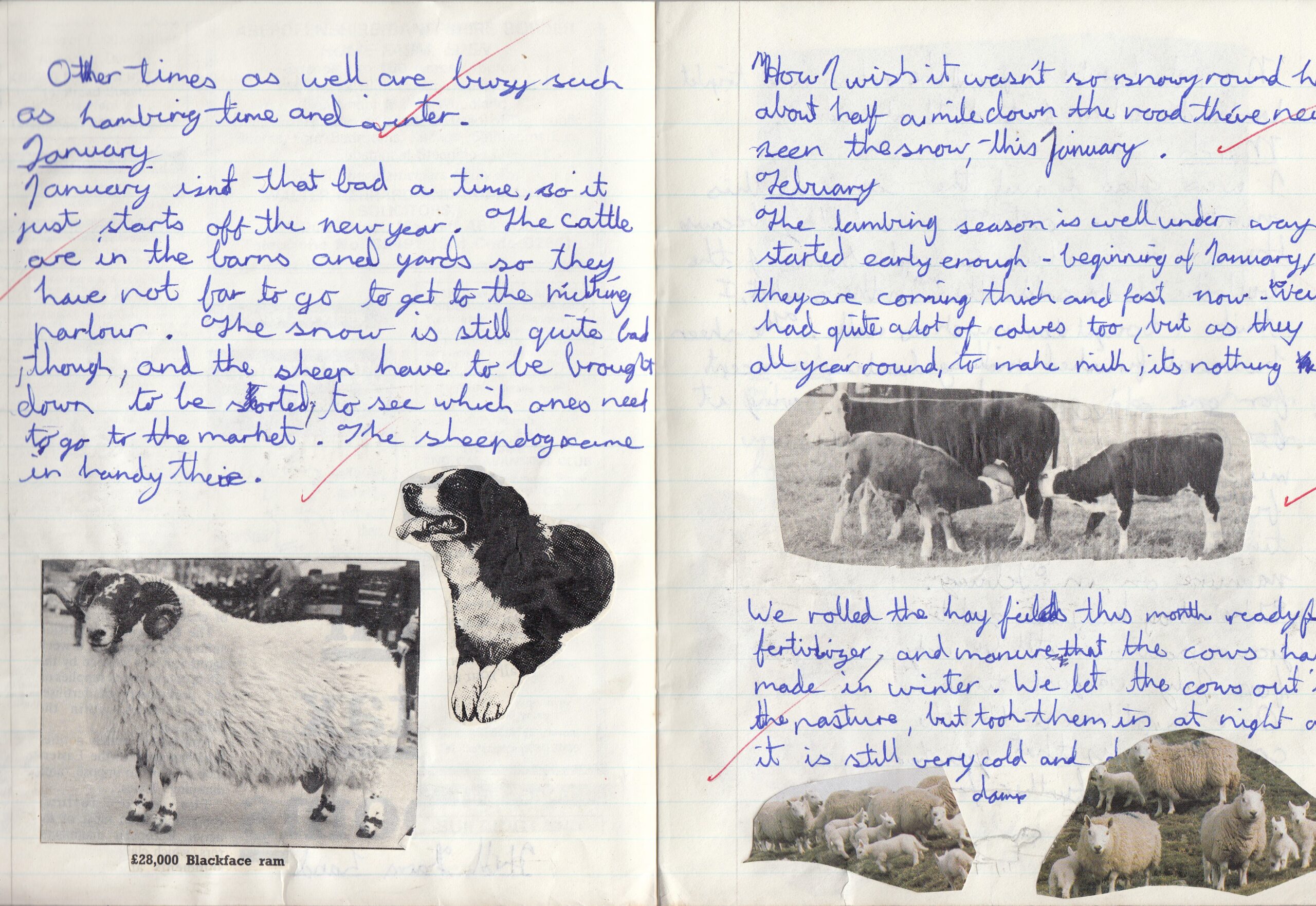
January

January isn’t that bad a time, so it just starts off the new year. The cattle are in the barns and yards so they have not far to go to get to the milking parlour. The snow is still quite bad though, and the shaeep have to be brought down to be sorted, to see which ones need to go to the market. The sheepdog came in handy with these.

How I wish it wasn’t so snowy round here about half a mile down the road they’ve never seen this snow, this January.

February

The lambing season is well under way, we started early enough – beginning of January, but they are coming thick and fast now. We’ve had quite a lot of calves too, but as they come all year round, to make milk, it’s nothing new.

We rolled the hayfields this month ready for fertiliser, and manure that the cows have made in winter. We let the cows out into the pasture, but took them in at night as it is still very cold and damp.

No pet lambs so far all the orphan and triplet lambs have been fostered, thank goodness.
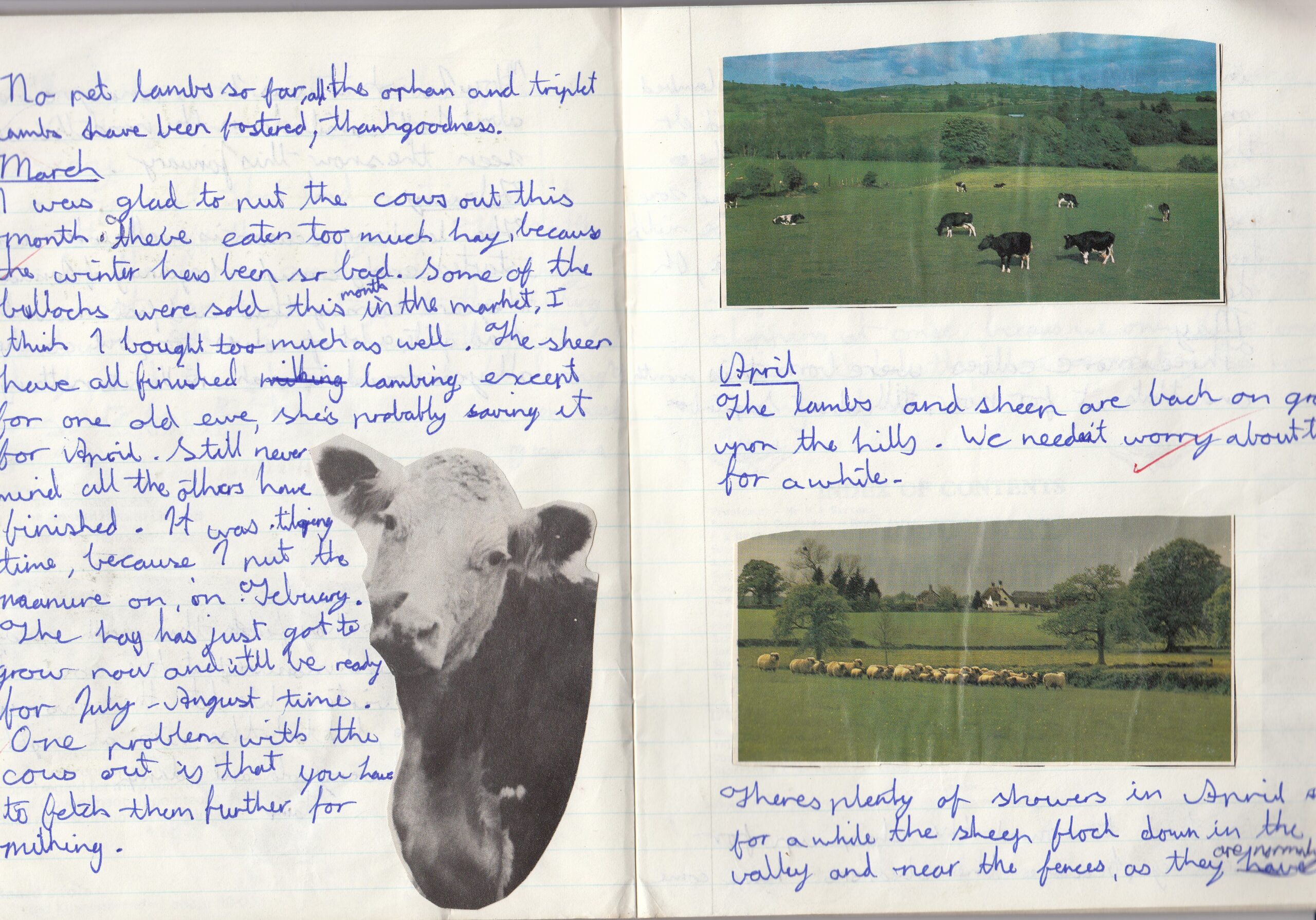
March

I was glad to put the cows out this month. They’ve eaten too much hay, because the winter has been so bad. Some of the bullocks were sold this month in the market, I think I bought too much as well, The sheep have all finished lambing except for one old ewe, she’s probably saving it for April. Still never mind all the others have finished. It was tillaging time, because I put the manure on, in February. The hay has just got to grow now and it’ll be ready for July – August time. One problem with the cows out is that you have to fetch them further for milking.

April

The lambs and sheep are back on grass upomn the hills. We needn’t worry about them for a while.

There’s plenty of showers in April so for a while the sheep flock down in the valley and near the fences, as they are normally indoors for lambing, The old ewe lambed on the 1st second in April. I knew she’d do that, she likes to lamb in April but she couldn’t last any longer. We had some more calves this month and a bit more milk, too much in fact, I was over quota, oh dear!

May

Three more calves were born this month and that’s it for now, til about September.

We had to round the sheep up for shearing, because the shearers have come, the sheep-dogs didn’t let us down today. They didn’t get all the sheep done in one day in took 5 days in all to clip 5000 seep, and only one man was clipping at once, because we only have one clipper, while the others were eating tea or having a drink.

June

Dipping, silaging and checking the hay what a busy month. The dipping was soon done after the clipping and the sheepdogs were definitely needed as they deep don’t like going in the dip. Mind you I wouldn’t either. The hay is nearly ready for haymaking. Maybe in July we’ll harvest it, because this month it’s first cut silage. There was a lot so Andrew had to stay on and help us otherwise we wouldn’t get it all done. The sheep are now going high up in the hills, so high in fact that I have to go up at least once a week to check them, The cattle have been confined to a small space for the moment so there is enough grass for hay and silage. We do keep a few hens and they are really laying now, if we could find the nests.

July

Haytiming has come, and all the preparing hasn’t gone to waste, it is a lovely harvest which should keep the cows through the winter. It was a busy time throughout from 5 o’clock to 10 o’clock at night. Just as the last load came in it started to rain. We were lucky. Unlike our neighbours who had two fields left when it started. Just like we were last year. The sheep have disappeared over the top so we have to go and count them everyday and by it is windy over there. We’ve let the cows in to the hay field so there’s a bit more room now and are making a bit more milk, thank goodness.

August

Haytiming over, and a short second cut silage maybe, but the weather has been so bad. Andrew says down town its nice and dry with maybe two showers at the most, here it’s raining every second.

Maybe I’ll have to sacrifice the second cut silage for the cows. Later on I did just that, sacrificed the second stage for the cows, and next day it cleared up fine. Why did I do that. The cows are lucky though, they get a lot more grass and are producing more richer milk. I just hope I don’t go over quota, I have been three times this year. The sheep are doing alright though. Some of them have come back over the hill which means it must be getting colder.
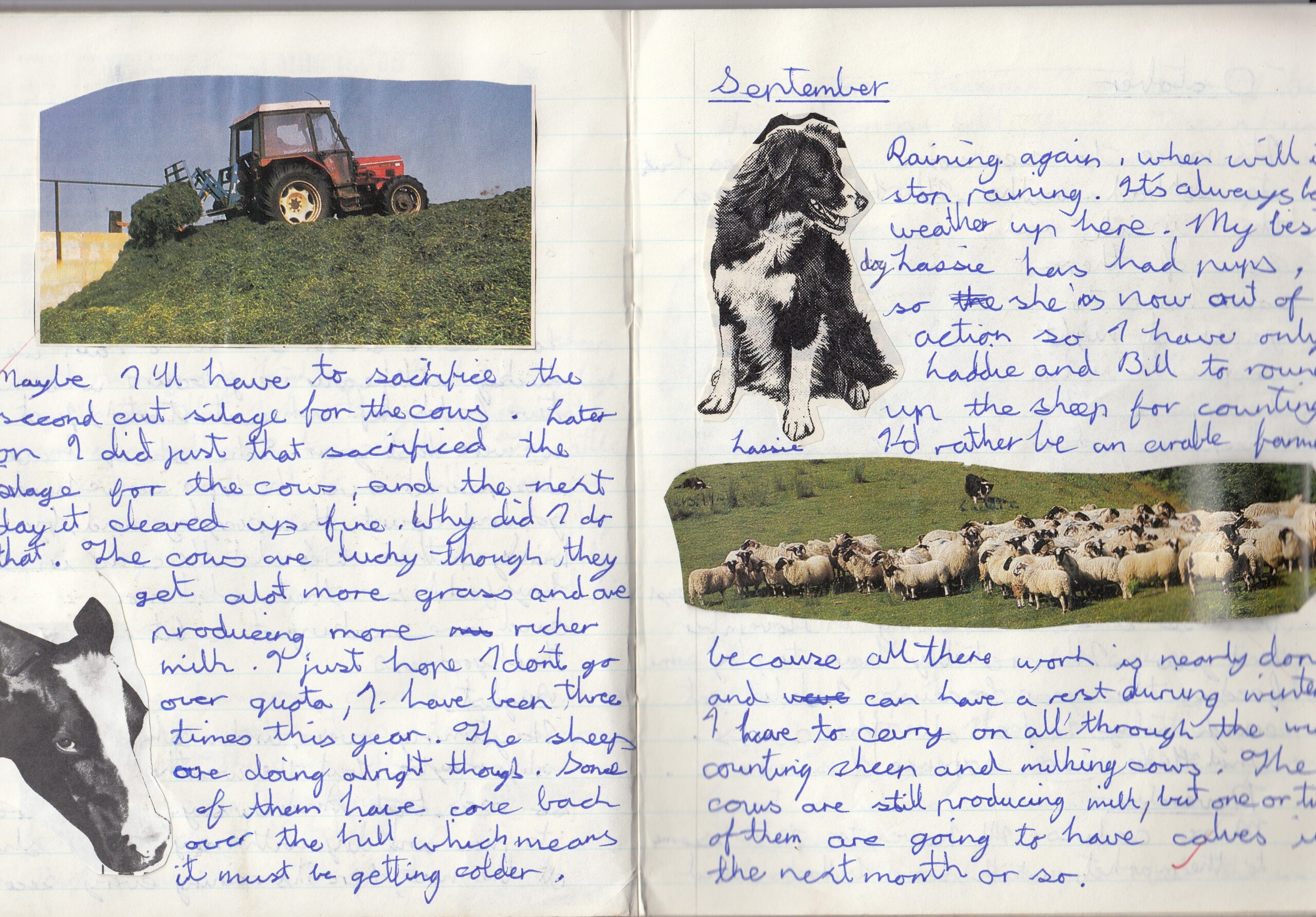
September

Raining again, when will it stop raining, It’s always bad weather up here. My best dog Lassie has had pups so she’s now out of action so I have only Laddie and Bill to round up the sheep for counting. I’d rather be an arable farmer because all their work is nearly done and can have a rest during winter. I have to carry on all through the winter counting sheep and milking cows. The cows are still producing milk, but one or tow of them are going to have calves in the next month or so,

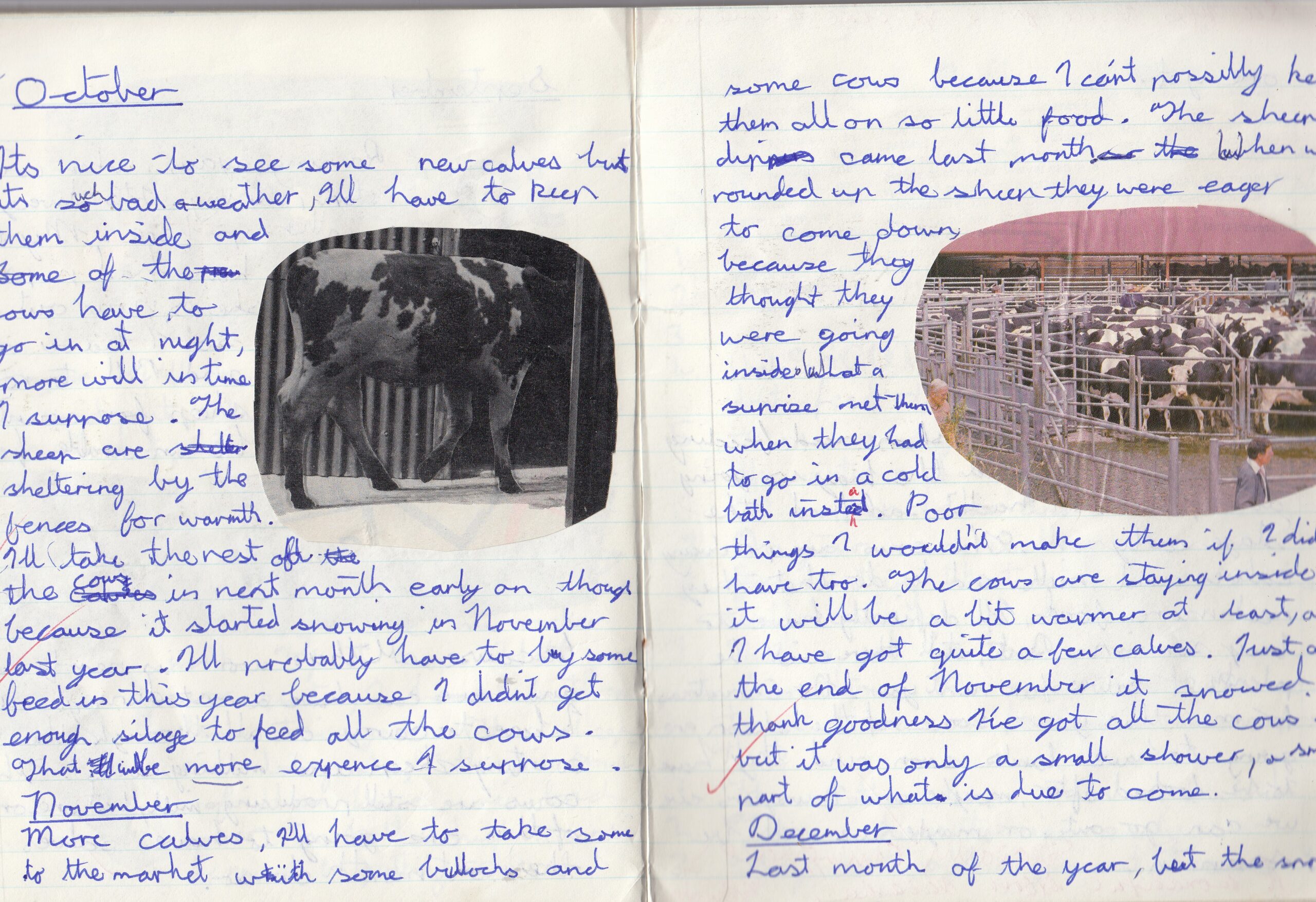
October

It’s nice to see some new calves but it’s such bad weather, I’ll have to keep them inside and some of the cows have to go in at night, more will in time I suppose. The sheep are sheltering by the fences for warmth. I’ll take the rest of the cows in next month early on though because it started snowing in November last year. I’ll probably have to buy some feed in this year because I didn’t get enough silage to feed all the cows. That will be more expense I suppose.
November

More calves, I’ll have to take some to the market with some bullocks and some cows because I can’t possibly keep them all on so little food. The sheep dippers came last month. When we rounded up the sheep they were eager to come down because they thought they were going inside. What a surprise met them when they had to go in a cold bat instead. Poor things I wouldn’t make them if I didn’t have to. The cows are staying inside now it will be a bit warmer at least, and I have got quite a few calves. Just at the end of November it snowed. Thank goodness I’ve got all the cows in, but it was only a small shower, a small part of what is due to come.

December

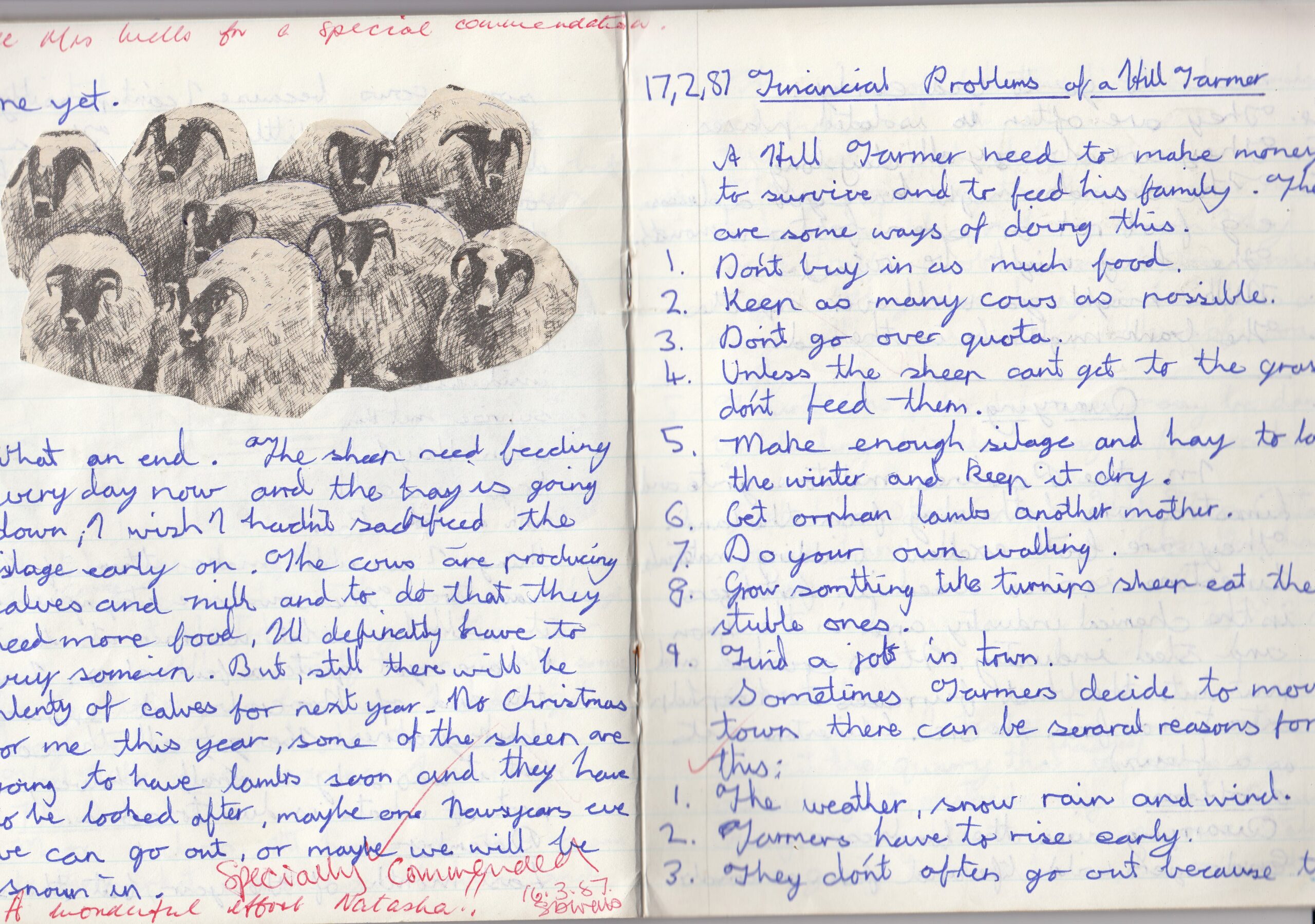
Last month of the year, but the snowiest one yet.

What an end. The sheep need feeding every day now and the hay is going down, I wish I hadn’t sacrificed the silage early on. The cows are producing calves and milk and to do that they need more food. I’ll definitely have to buy some in. But, still there will be plenty of calves for next year. No Christmas for me this year, some of the sheep are going to have lambs soon and they have to be looked after, maybe on New Years even we can go out, or maybe we will be snowed in.
Bonus story: financial problems of a hill farmer

Written on 17 February 1987

A Hill Farmer needs to make money to survive and to feed his family. There are some ways of doing this

  1. Don’t buy in as much food
  2. Keep as many cows as possible
  3. Don’t go over quota
  4. Unless the sheep can’t get to grass don’t feed them
  5. Make enough silage and hay to last the winter and keep it dry
  6. Get orphan lambs another mother
  7. Do your own walling
  8. Grow something like turnips seep eat the stubble ones
  9. Find a job in town

Sometimes Farmers decide to move to town. There can be several reasons for this:

  1. The weather, snow rain and wind
  2. Farmers have to rise early
  3. They don’t often go out because they need to go to bed early
  4. They are often in isolated places
  5. They are busy all day long
  6. The animals might have got a disease eg foot rot or even foot and mouth
  7. The hay might be ruined
  8. Milk might go well over quota
  9. The bank might be in the red.

The earnest advice of an eleven year old!

With much gratitude to all my farming ancestors and particularly to my Grandma & my Aunt who were there by my side when I wrote this story and to my geography teacher of the time, Mrs Swales, who set the assignment.
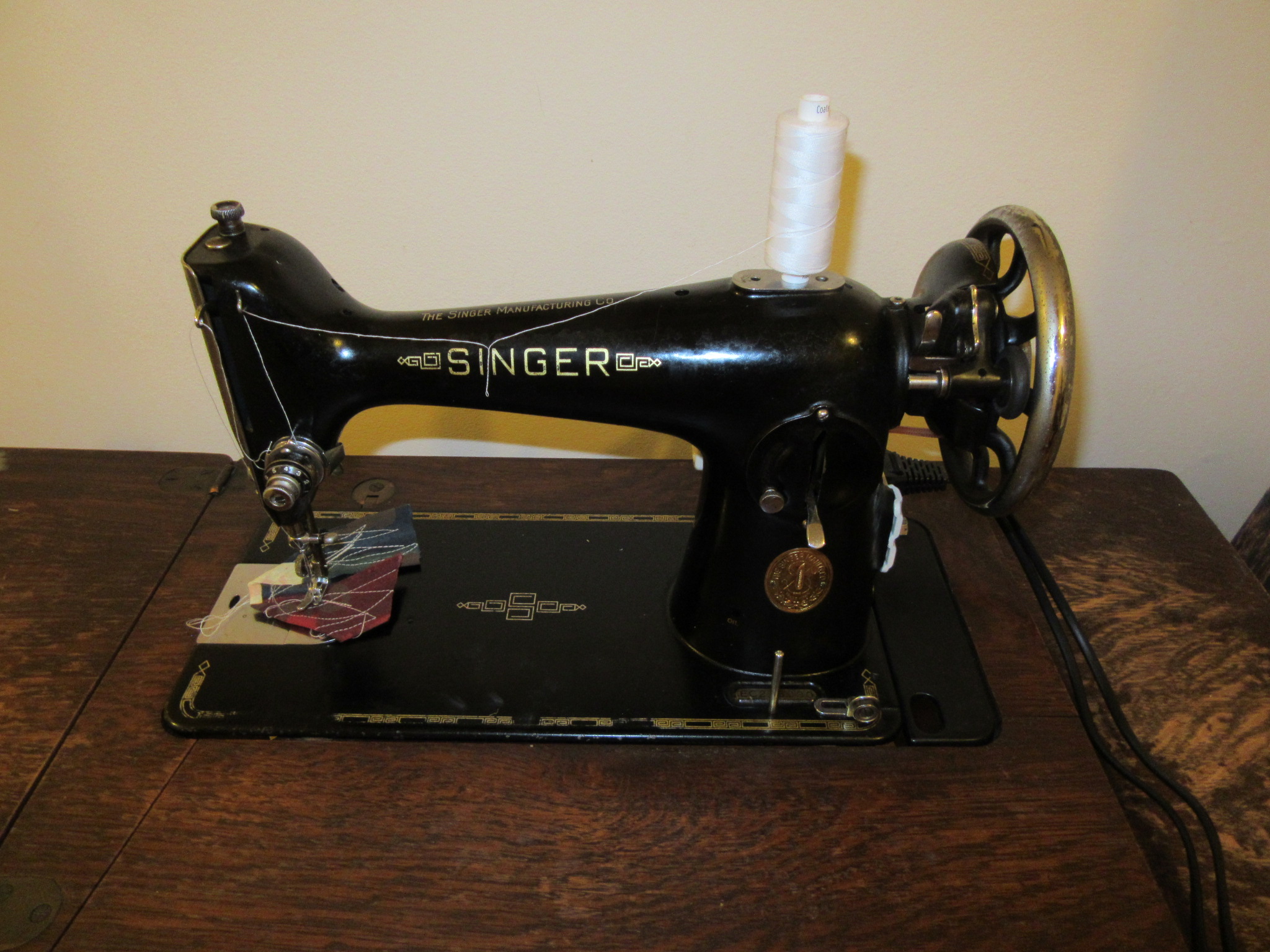
A Singer sewing machine

The Singer sewing machine today, own photo

My beautiful Singer sewing machine arrived home on Wednesday after many months in the repair shop and, with this week’s #52ancestors theme being “working”, there’s really only one story to write. This is the story Mary Booth (aka Nana, my mother’s mother) or more specifically Mary’s working life as a dressmaker.

Mary was just fourteen when she started work as an assistant at a ladies’ outfitters shop at the smart address of The Grove, Ilkley. Each day she would jump on her bike and cycle the four miles each way from her home in Askwith. Each day her sewing skills developed.

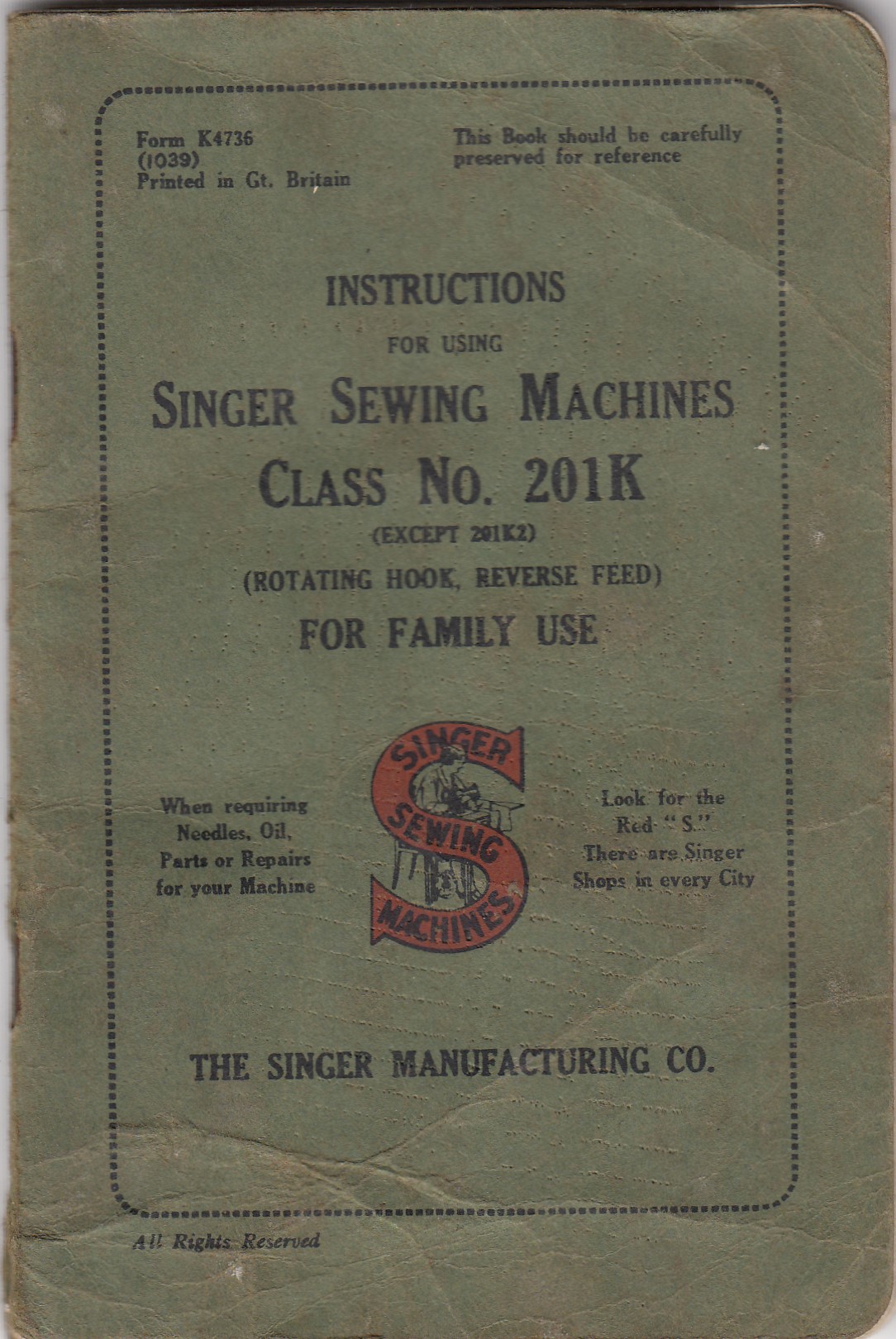
It was her father, Arthur Booth, who had found her this role and it was her father who bought Mary her first sewing machine, a Singer 201K1.

The Singer 201K manual, that tells me I should thread from right to left for this particular machine. Own photo.

This beautiful treadle machine was first produced in 1935. Top of the range, they were expensive to buy. “Favoured by tailors and professional seamstresses because of the large ‘harp’ space, to accommodate bulky fabric, they could easily cost 6 months wages and so were frequently purchased on credit” and I like to think was a the demonstration of a a father’s love for his female child.

Mary’s skills swiftly progressed, and, with her own machine she was able to take on commissions. Demand grew and by her late teens Mary had left the ladies’ outfitters: she was setting up on her own. In the 1940s people still tended to make their own clothes or commission others to do so. This was particularly the case for people of an unusual size or for special occasions. Mary had customers and a viable business.

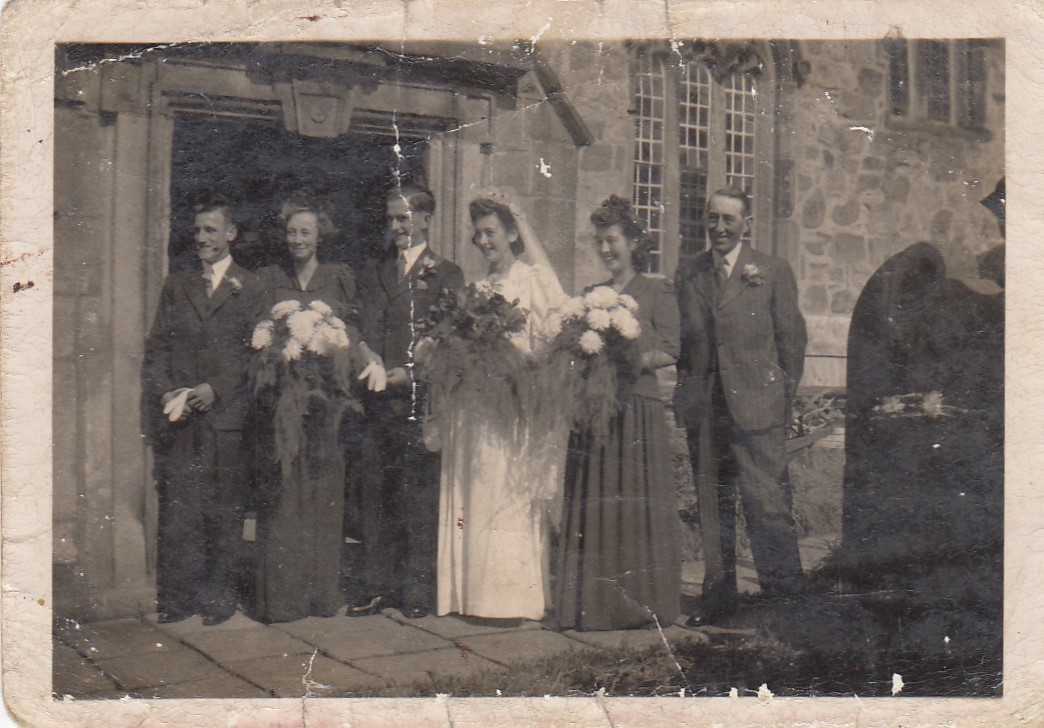
The wedding of Hilda Booth & George “Bud” Nelson on 7 September 1946. All dresses (and accessories) made by Nana. Photo own collection

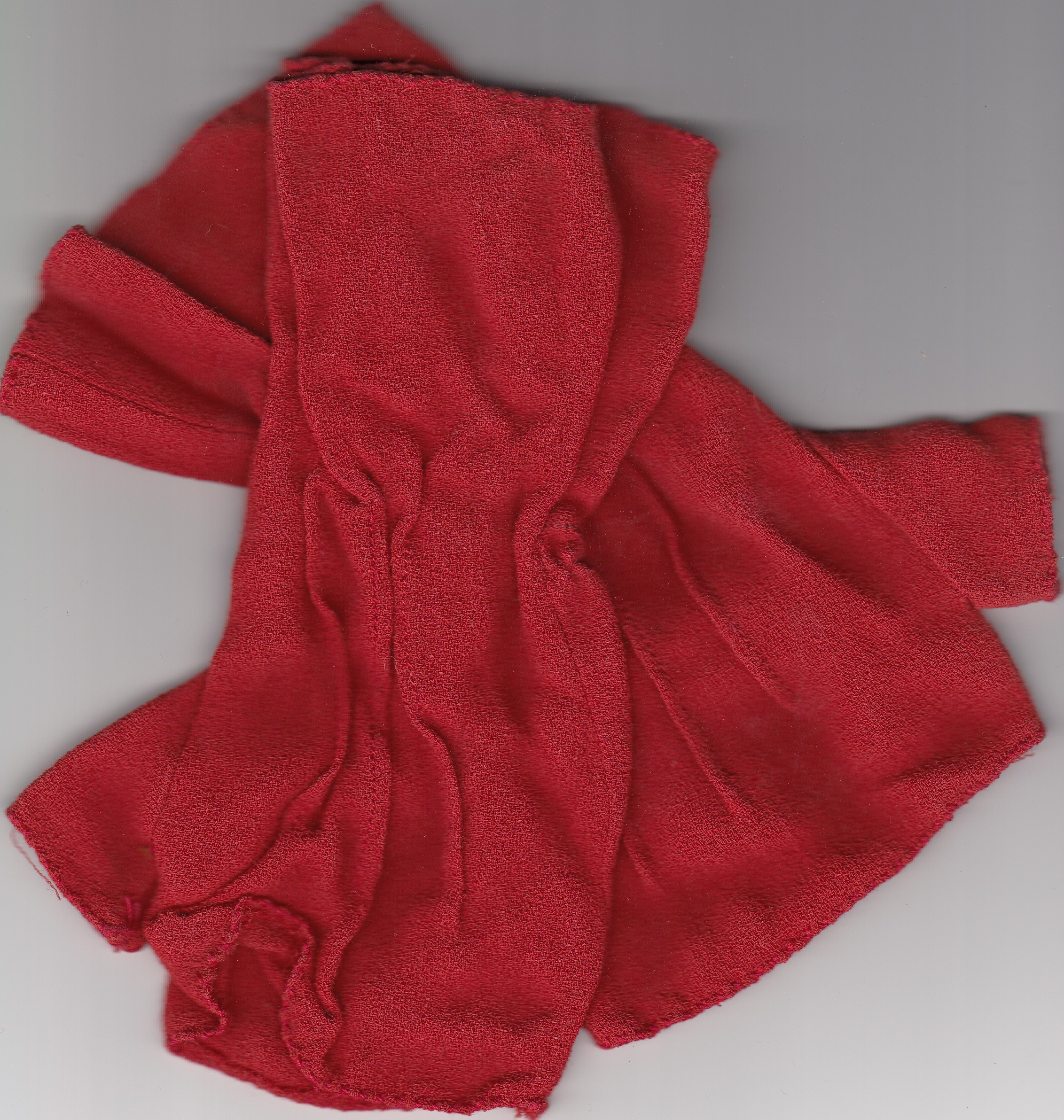
On the 7 September 1946, Mary’s older, and only, sister, Hilda Booth, married George “Bud” Nelson. It was eighteen-year-old Mary who made the outfits for bride & bridesmaids right down to the bright red fingerless gloves. Imagine the pressure! Yet, it also made a wonderful advert for Mary’s skills and wedding dresses became a speciality for many decades. Her own wedding in 1948 & her daughter’s (my Mum) in 1973 illustrating the longevity of her career. Family & friends aside (for Mary was a kind and generous person and known to undercharge) dressmaking provided a steady income for many years until arthritis finally became too severe to continue.

Fingerless gloves made by Mary to wear at her sister’s wedding. Own photo.

Yet what of this wondrous sewing machine? The first Singer 201K was a treadle and these were fast being replaced by those with an electric motor. Recognising the investment, Mary had a motor added and continued to use the same machine until sometime in the late 60s/early 70s when she finally acquired a more modern version with money saved from her dressmaking. The old Singer was relegated to an upstairs bedroom.

It is this newer machine that I remember, sitting in the corner of the main room that served as living & dining space. There was a bin of material scraps by its side, reams of materials underneath and an old chocolate box full of shuttles. It is where I learnt to sew.

A teddy bear I made as a child under my Nana’s tutorship. Own photo – the scanner doesn’t do it justice!

I inherited the old Singer machine, I think when Nana & Grandpy finally moved from the farmhouse to a modern bungalow in the 1990s.

I’m ashamed to admit that, for the last twenty years, this wonderful machine has acted as little more than a table for displaying family photos. Then, about three years ago, I bribed a friend, Rachel (with the promise of an afternoon of sewing with gin & tonic) to help me get over my nervousness. We lifted the cover, flipped down the front ledge and pulled the machine from its dusty lair. Rachel, always diplomatic, suggested that twenty years of being under a table had taken a toll and maybe we should stick to gin & tonic. It took me another year to find a repair shop (Tony’s Sewing Centre) who kindly suggested that the electrics were, quite likely, lethal. Fast forward through Covid and finally, the machine that gave my Nana independence is ready to be used again.

With much gratitude to my Mum, who always helps me with these stories, to my friend Rachel, who made me face what needed to be done to get the machine working, to Tony & his wife at Tony’s Sewing Centre in Tufnell Park who brought the Singer back to life, to Amy Johnson Crow whose #52ancestors challenge encouraged me to publish this story and above all to my Nana who we’ll always miss.

Elizabeth Furniss (1817 – 1911) & George Downs (1809 – 1868)

This is part of a series of brief biographies of earlier ancestors.

I turned to Elizabeth & George as part of a plan to ensure I’d fully captured all relevant documents for each of my great, great, great grandparents. A Darley farming couple, I didn’t expect this to be more than a short biography but when I looked into those documents I found a wonderful story of a woman who really came into her own upon the death of her husband. 

Darley-cum-Menwith is a typical Yorkshire farming village. Today it is a sought after country location close to Harrogate, commutable to Leeds and right on the borders of the Yorkshire Dales. In the mid-nineteenth century it was a thriving village. The 1841 census lists 725 people living in around 150 households who worked in agriculture or as shoemakers, linen weavers and wheelwrights. There was a church, two methodist chapels and a friends meeting house, a school, grocers and public houses. It was a self-contained village – even the arrival of a railway station in the 1860s meant you took a day trip to Harrogate, it didn’t mean you married out of the area.

The Great British Agricultural Depression was yet to hit and Darley was thriving. 

So let’s meet Elizabeth & George at the time of the railways and specifically in the year 1866. Elizabeth was 49, George eight years older. Elizabeth was born in Darley in 1817, the daughter of a local farming couple, Mary Pullan & Joseph Furniss, and she married George Downs, on 2 November 1836 at the age of nineteen. George, aged twenty-seven when they married, was the third son of another local farming family, Mary Beecroft & John Downes. The couple spent their early married life living with George’s parents no doubt whilst they were searching for a suitable tenancy. Such was the life of a third son and those they married. 

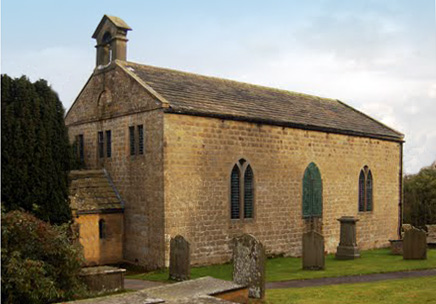
Thornthwaite church (c) Calverleyinfo www.calverley.info

By 1866 they’d made it – 30 acres of land on Craike Lane and six surviving children, Mary (b. 1836), Salina (b. 1839), George (b. 1841), Elizabeth (b. 1847), John (b. 1852) and Ann (b. 1858). There’s a reason for choosing 1866 and it’s not just about the railway. On 22 September of that year, Elizabeth & George’s eldest daughter, Mary, married Thomas Houseman, another local farmer, and that union ultimately led to me. I can imagine that wedding at the beautiful Thornthwaite church with the trees turning their autumn colour. There would have been the traditional seating complications as Elizabeth’s brother, John, had married the groom’s sister, Mary, but at least that likely ensured family presence. The date was no doubt chosen to be post harvest and it wouldn’t surprise me if the ceremony was scheduled to allow for milking time. Elizabeth & George could be proud of the family they had brought up. 

Then, just over a year later, on 7 December 1867, George wrote a will. Maybe he was already ill or maybe he was approaching 60 and conscious of his young family. Whatever the reason, it was timely, he died a few months later, on 21 May 1868.

It was a precarious time. Elizabeth, aged 51, was left to raise a family the majority of whom were female and under age. The eldest son, George, had married, the younger son, John was just sixteen. Farm tenancies didn’t pass automatically to women or underaged boys. The Great Agricultural Depression was just starting and farming was becoming less viable. It would have been very easy for the family to progress to the workhouse.

It is the will that suggests that Elizabeth had this under control. Written months before he died it suggests a confidence in her ability and the likelihood of a couple who had discussed and prepared for George’s death.

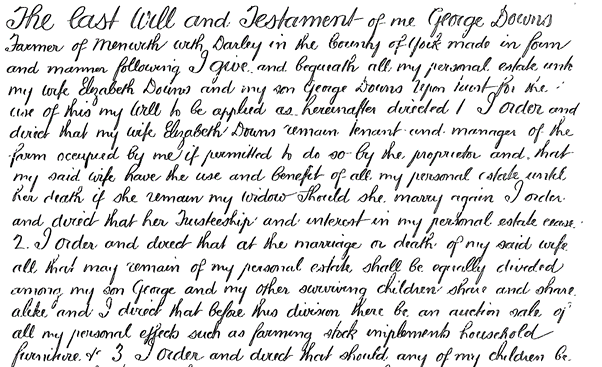
Extract from will of George Downs

George asks that Elizabeth “remain tenant and manager of the farm occupied by me if permitted to do so by the proprietor.” He orders that the “remain of my personal estate shall be equally divided among my son George and my other surviving children share and share alike” and directs that “before this division there be an auction sale of my personal effects such as farming stock implements household furniture etc”

The normal practice is for fathers to leave the bulk of their estate to their eldest son to ensure a viable farm is passed on. The only exception being where an eldest son is already fully set up in business or they have fallen out, and as the son George is named as an executor that doesn’t appear to have been the case. George didn’t do this – he intended for his wife to remain in charge, split his estate equally and specified that everything should be sold before the estate was split. My personal experience is it’s incredibly difficult to properly value everything in a farm business and incredibly expensive to set up from scratch. If you want to ensure equal inheritance this is the way to do it, but it runs the very real risk that none of the sons inherit sufficient to set up on their own.

What all of this (together with other evidence) suggests is that Elizabeth was very much a partner in this farm and that George cared deeply about his wife and all his young family.

Elizabeth took on the tenancy of the farm and by 1881, at the age of 64, had doubled the acreage. Her remaining children went on to marry well and all lived long fulfilling lives. Ten years later, in 1891, aged 74 she was living with her daughter, Ann, but was described as living by independent means. Ditto 1901 and 1911. Finally, at the age of 94, Elizabeth died on 31 July 1911. She lived almost half her life as a widow and had thrived. 

___________

There are missing pieces to this story. I am sure there are documents concerning the passing of the tenancy and I know there’s a lot more I could write about the life of farmers at this time. However, the big gap for me is that I have no photo of Elizabeth. Despite this competent and, quite possibly, formidable woman reaching the grand old age of 94, I’ve found no trace of an obituary, her story or any photos. This blog is the start of a journey to rectify that.

With much gratitude to Nathalie Pithers for running the excellent Curious Descendants Club at which Tina Konstant ran such an inspiring story telling session that I spent the rest of the evening writing this blog and, of course, to Elizabeth Furniss & George Downs, my great, great, great grandparents through my paternal Grandad, for leaving me such a wonderful story to write.