A born & bred Yorkshire lass tells her family stories for a second time!
This time I talk about “farming, names, female ancestors, inheritances, local history and more with tips for making ancestors feel alive and looking for ‘ordinary’ people” plus of course the three critical river valleys of the Washburn, Nidd & Wharfe.
I was excited to take part in this one as I’ve long listened to the Journeys into Genealogy podcast – it’s well worth hearing some of the other episodes too.
Here are some of the links to the stories I talked about.
Hannah Demaine, the woman who married twice, the second time to an older man
With much gratitude to Emma Cox for including me on her podcast (the whole of which is worth a listen to) and to Natalie Pithers who recommended me to her and who’s own podcast #twiceremoved is also brilliant.
The gravestone of Thomas Bradbury showing alll the genealogical data and none of the story. Own photo.
Thomas Bradbury was a very typical and quite unremarkable example of my Victorian farmer ancestors. Born on 21 December 1820, the youngest of eleven children and the third surviving son, Thomas had been fortunate to secure his own tenancy of a twenty-acre farm within walking distance from where he was born. He married a local girl, Jane Teal, on 29 November 1845. Six healthy children arrived at regular intervals and the family continued to farm at Woodmanwray until Thomas died, aged fifty-eight, on 29 March 1879. Thomas’s gravestone in the Providence United Reformed Churchyard at Dacre had given me his date of death. What else was there left for me to learn? Nonetheless, I added his death certificate to my general registry office shopping basket before moving on to other, more interesting ancestors.
A month later my sister called. A pupil at her school had accidentally ripped the birth certificate belonging to a colleague’s son. Might I be able to help her source a replacement? (There are, it seems, practical benefits to having a family history geek as a sister). It was back to the general registry office website. I took the opportunity to add the rest of my shopping basket to the order and Thomas’s death certificate was on its way.
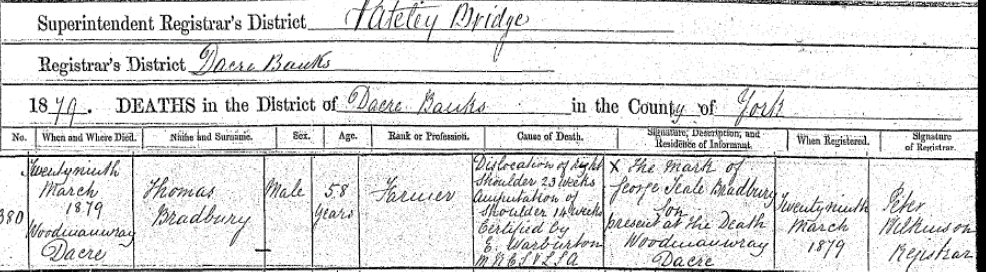
And right there, under cause of death, was Thomas’s story.
Thomas Bradbury’s death certificate. Cause of death: dislocation of right shoulder 23 weeks, amputation of shoulder 14 weeks. Certified by E. Warburton MRCS&LSA.
Agriculture still has the worst rate of worker fatal injury (per 100,000) of all the main industry sectors, with the annual average rate over the last five years [to 2020/2021] around twenty times as high as the all-industry rate. At primary school we watched horrifying educational videos of children crushed by machinery or drowning in slurry. Yet friends were still beset by agricultural injury (including one who lost fingers) and I particularly remember the vividly coloured bruises Grandpy received from a tussle with an unruly sheep. Stepping back a hundred years or agricultural accidents were much, much more common and medical assistance much, much less effective.
It was mid-October 1878 when Thomas dislocated his right shoulder. Perhaps he had a run-in with a cow or fell from a roof he was fixing, maybe he twisted his arm trying to manoeuvre a too-heavy stack of straw or simply got caught under an overturned wagon. A common enough occurrence, the initial accident didn’t leave a written record. Whatever the cause it would have been painful and debilitating, the sole positive being that of his family: adult children to run the farm and a wife to provide nursing care.
The dislocation must have resulted in disruption of the blood flow to his right arm. Gradually over the following couple of months, Thomas would have seen the tissue in his right arm blacken and die. Whilst it is possible that numbness would have overtaken the pain, the foul smell of infected gangrene could not have been ignored and at some point, Thomas would have called on the services of the local doctor and Medical Officer of Health for Pateley Bridge, Edward Warburton MCRS, LSA.
Thomas was fortunate to have such a qualified doctor within calling distance. Edward Warburton’s father, Joseph, had first arrived in Pateley Bridge in 1807 to act as an assistant to Dr Strother. In 1815 the law changed requiring new doctors to be licenced and whilst in earlier years Joseph’s apprenticeship and family connections would have been sufficient, he was now required to qualify. Joseph headed off to London where he studied under the esteemed Mr R. C. Headington (later a president of the Royal College of Physicians) qualifying as a surgeon-apothecary in 1816 before returning to Pateley Bridge. By 1834 he had attracted a young John Snow to act as his assistant, the same Dr John Snow who is considered to be the founding father of both modern epidemiology and the scientific use of anaesthesia. Such was Dr Snow’s reputation that it was he who administered chloroform to Queen Victoria during the delivery of two of her children. Edward himself was apprenticed to his father and qualified through practice at Leeds Royal Infirmary in 1846. Snow remained a long-standing friend of the Warburtons, and Edward would likely have been far more knowledgeable about anaesthesia than many of his rural counterparts. There have been studies too, which demonstrate that the average mortality rate after amputation in cottage hospitals was somewhat lower than that in large city institutions but it still hovered around one in five. Surprisingly in the late 1800s, living this part of rural Yorkshire put Thomas in the best possible hands.
Just before Christmas, Thomas underwent surgery. By 1878, anaesthetics were being used effectively and, more critically, the principles of antiseptic surgery were just starting to be accepted. Thomas may have felt hopeful. He seems to have escaped the initial dangers of shock, haemorrhage, and exhaustion. There was no early onset of septicaemia. The new growth of early spring arrived. Snowdrops were replaced by wild daffodils and garlic. However, amputation also comes with an increased risk of heart attack and deep vein thrombosis, or, more likely, if gangrene had spread beyond his arm, it would have continued to attack vital organs. In the end, nearly six months after the initial accident and three months after his amputation, Thomas died at home in Woodmanwray, his family by his side, his cause of death certified by his surgeon.
Thomas & Jane’s eldest daughter, Amelia, married Michael Houseman. Their son, Jesse was the father of Mary Houseman, my Grandma. Grandma loved to tell a death story, but this was just a generation too far back for it to be part of the tales she told and a reminder of how important it is to track down every document.
Brief biographical details of Jane Teal and Thomas Bradbury
Jane would have been born between 17 January & 2 March 1823 at Holm House (possibly Lower Holme House according to later census records). She was the daughter of Amelia Layfield and George Teal and had five other siblings.
Jane & Layfield were twins. We don’t know whether Jane was born first, but it was Layfield, her twin brother who is listed first in the baptism record on 2 March 1823. It seems she may have been the strongest as Layfield died in November 1826 aged just three years old.
Jane’s mother died in May 1830 when Jane was seven years old.
By the time she was 18, Jane was working as a farm servant at How Gill, Stonebeck Up about 8 miles further up the valley from her family, but in close proximity to her brother William.
Thomas was born a little earlier, on 21 December 1820, the youngest of the ten children of Catherine King & Charles Bradbury. By 1841, the family had moved to Fountains Earth which bordered Stonebeck Up. Thomas’s widowed sister, Catherine, and her son, were living next door. Jane & Thomas likely met around this time.
The pair married on 29 November 1845 in Ripon cathedral. By this time, both were living in Dacre and Thomas was described as a farmer, Jane as a servant. Jane was illiterate, but Thomas could write. I wonder if Thomas had finally found a small farm of his own and Jane had taken work nearby or had even moved to be with him. It seems odd that they got married in Ripon if they had both already moved to Dacre. But equally odd they didn’t get married in Middlesmoor if they hadn’t. Dacre church had been built in 1837.
The couple had six children representing many of the family names. Charles & Catherine (paternal grandparents), Amelia & George (maternal grandparents), Teal & Layfield as middle names (Jane & her mother’s maiden names).
Charles (1848 – 1925), Amelia (1848 – 1931), George Teal (1850 – 1898), John Layfield (1853 – 1922), Catherine (1857 – 1882), William (1860 – 1926). Catherine & her husband died within six months of each other. All the children married and had children of their own.
The couple lived the remainder of their adult lives on a 20 acre farm at Woodmanwray towards the north end of Dacre. Woodmanwray old chapel, where perhaps they worshipped is now available to rent on Airbnb. There’s a lovely description of the farm when it was put up for sale on 30 June 1885. At the time the land was still farmed by Jane & Thomas’s son, George Teal.
“All that compact FARM, with the recently stone-built House, together with the Plantation, Garden, Barn, Stable, Cowhouses, Piggeries and other outbuildings and 9 CLOSES OF LAND, with the allotments or enclosures of grass and unbroken-up lands…..There is a never failing stream of water running through the premises…..The situation is healthy, well sheltered, commands pleasing views of the neighbourhood and is very suitable for residential purposes…”
From the Wharfedale & Airedale Observer, Friday June 19, 1885, a description of the farm at Woodmanwray
Thomas died on 29 March 1879. Jane continued to live at Woodmanwray and expanded the farm to 35 acres with the help of her children. She died, of heart disease and exhaustion on 16 January 1891, aged just 67. They are both buried at Providence Congregational Church at Dacre.
With particular thanks to my twitter #AncestryHour friends who helped me broaden the research, to Spence Galbraith who studied Dr John Snow and made his research on the Warburtons available online and lastly to Thomas Bradbury, my great, great, great Grandfather for enduring the long months of pain whether stoically or not.
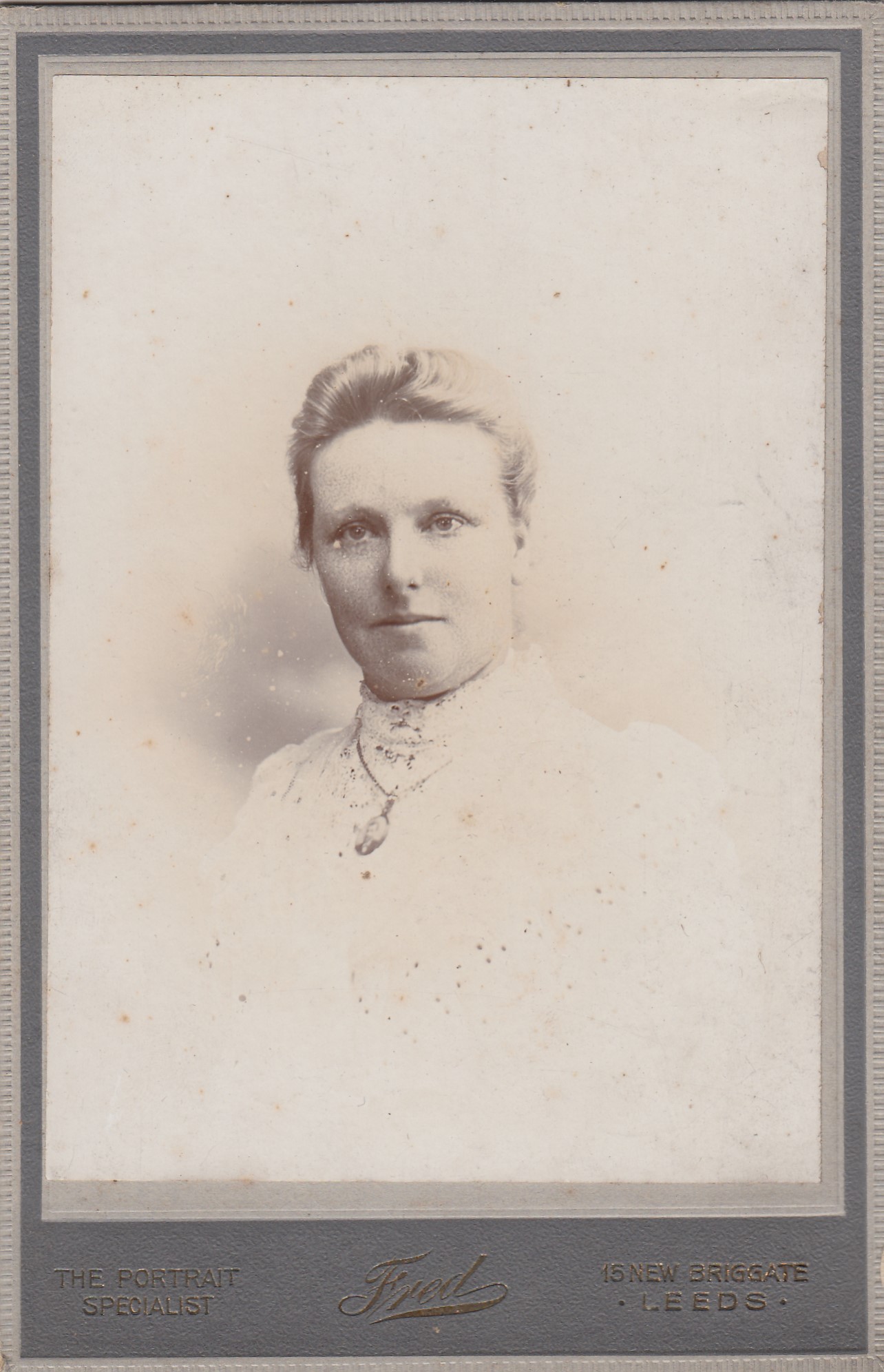
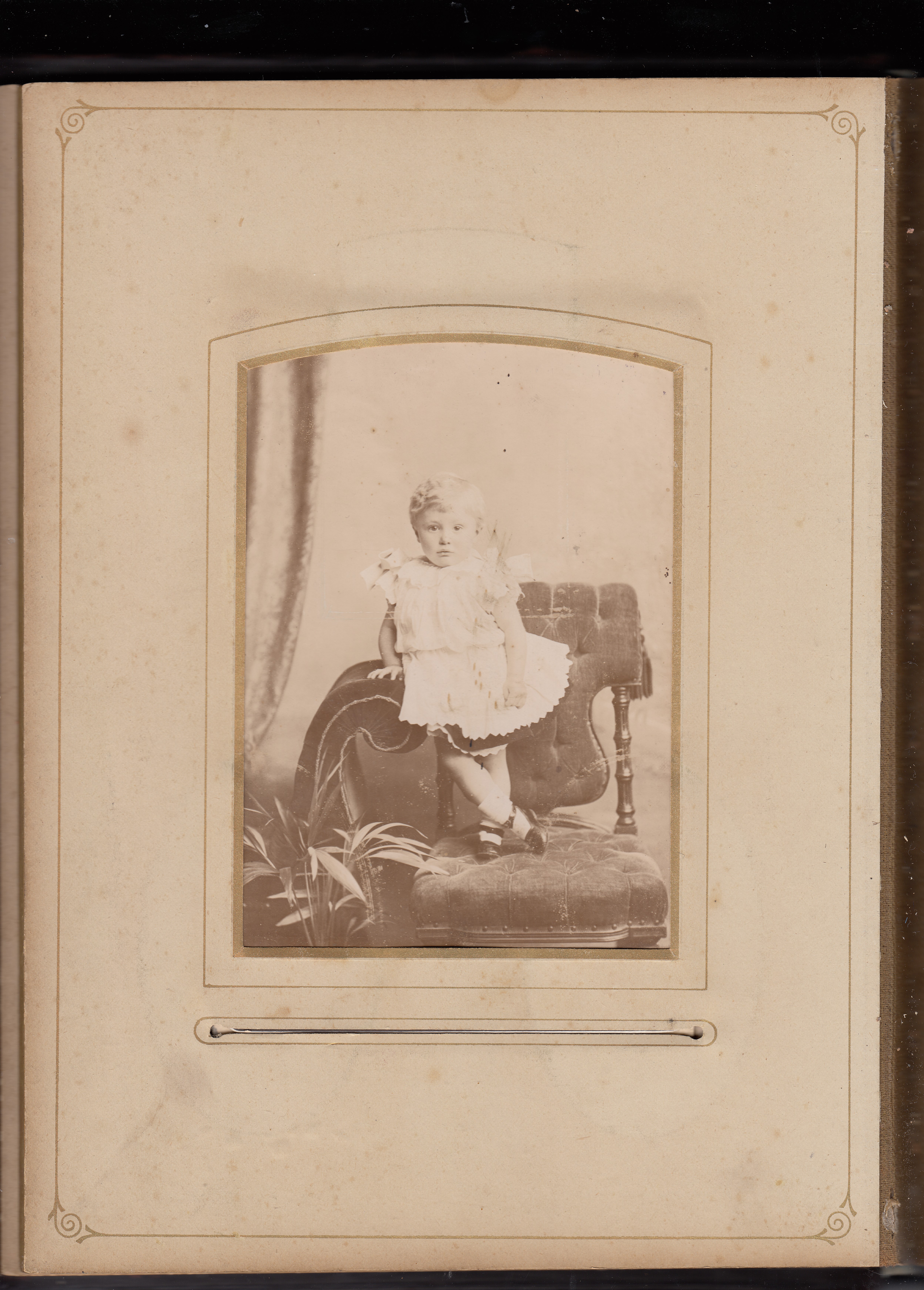
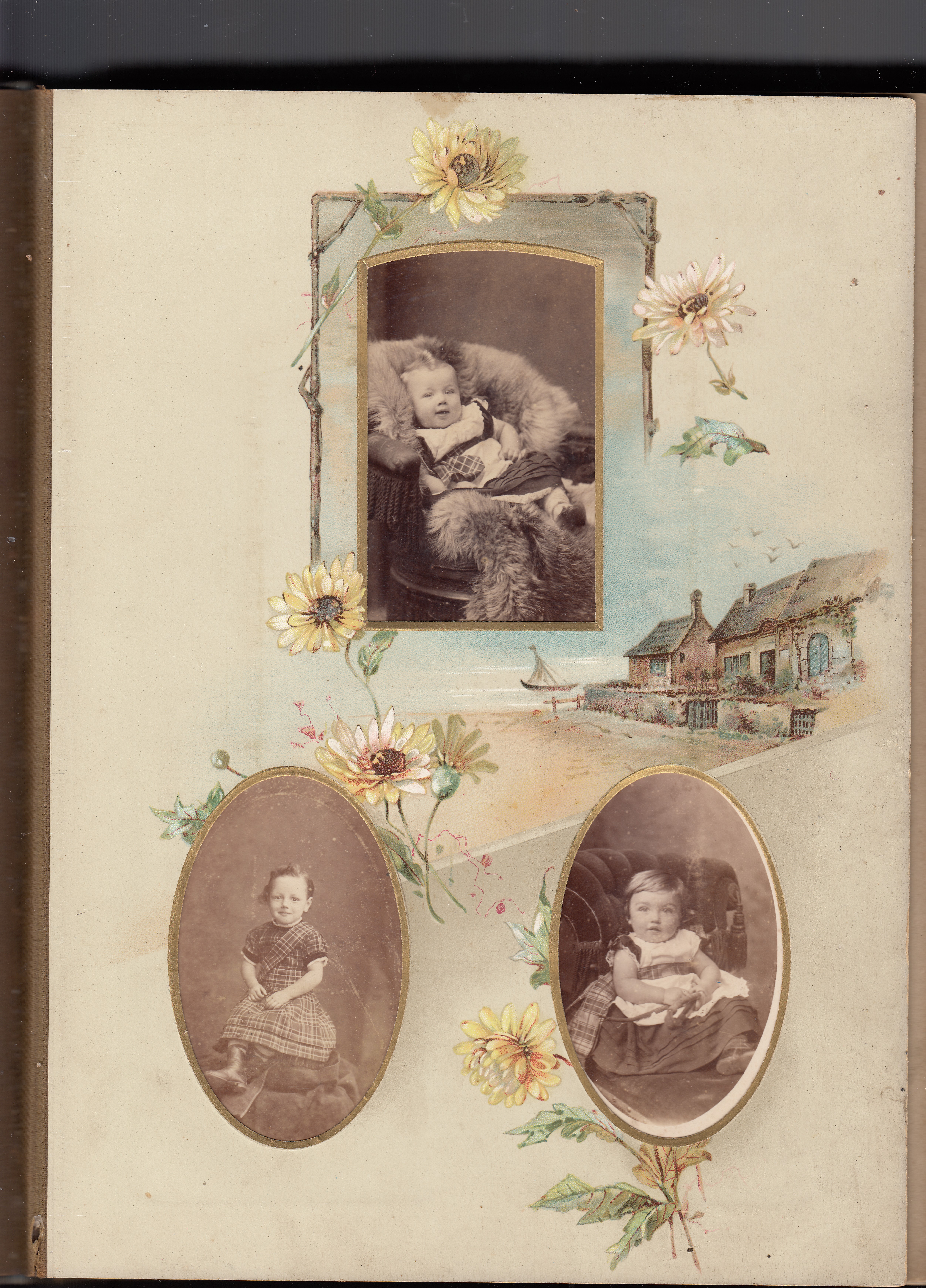
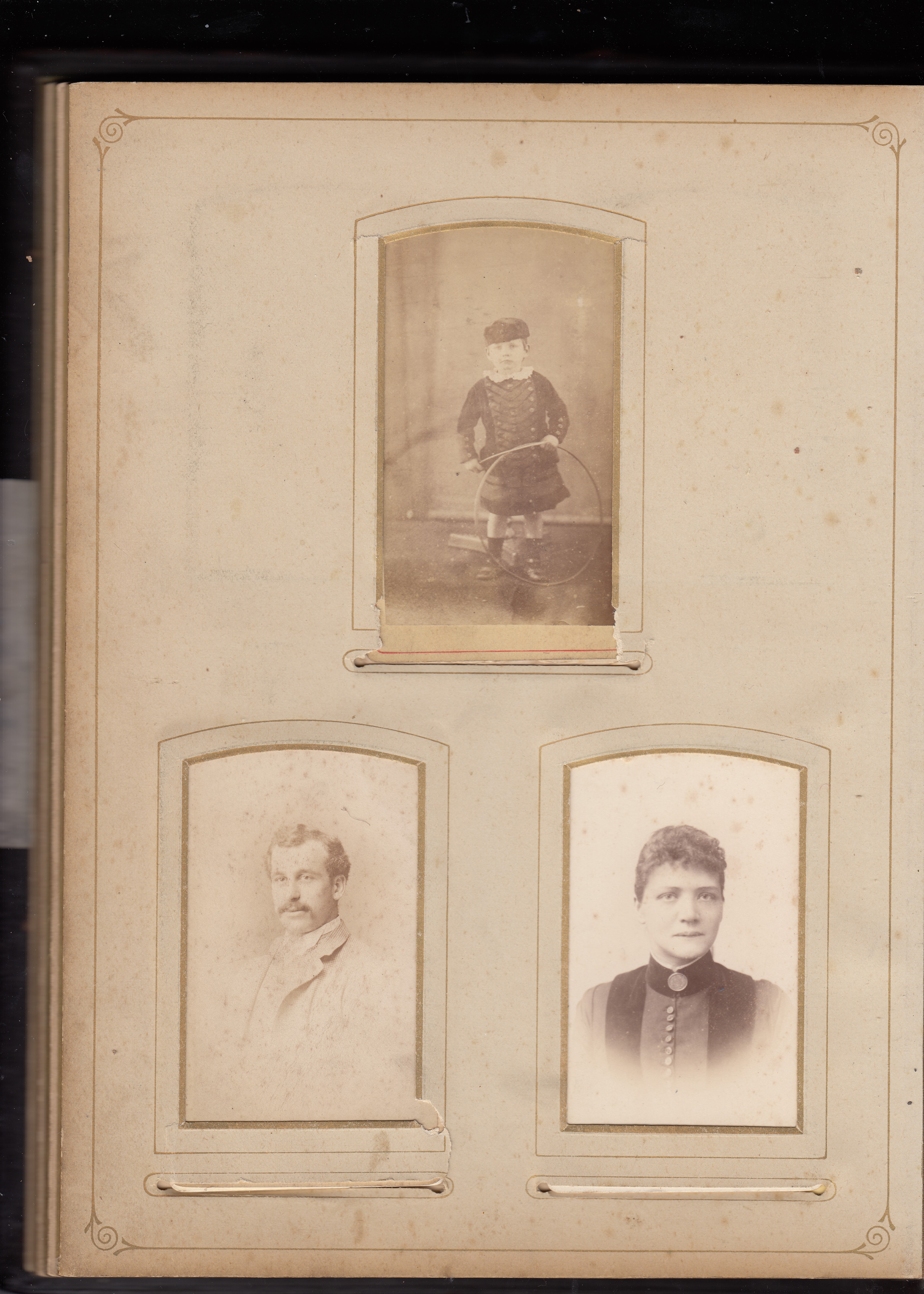
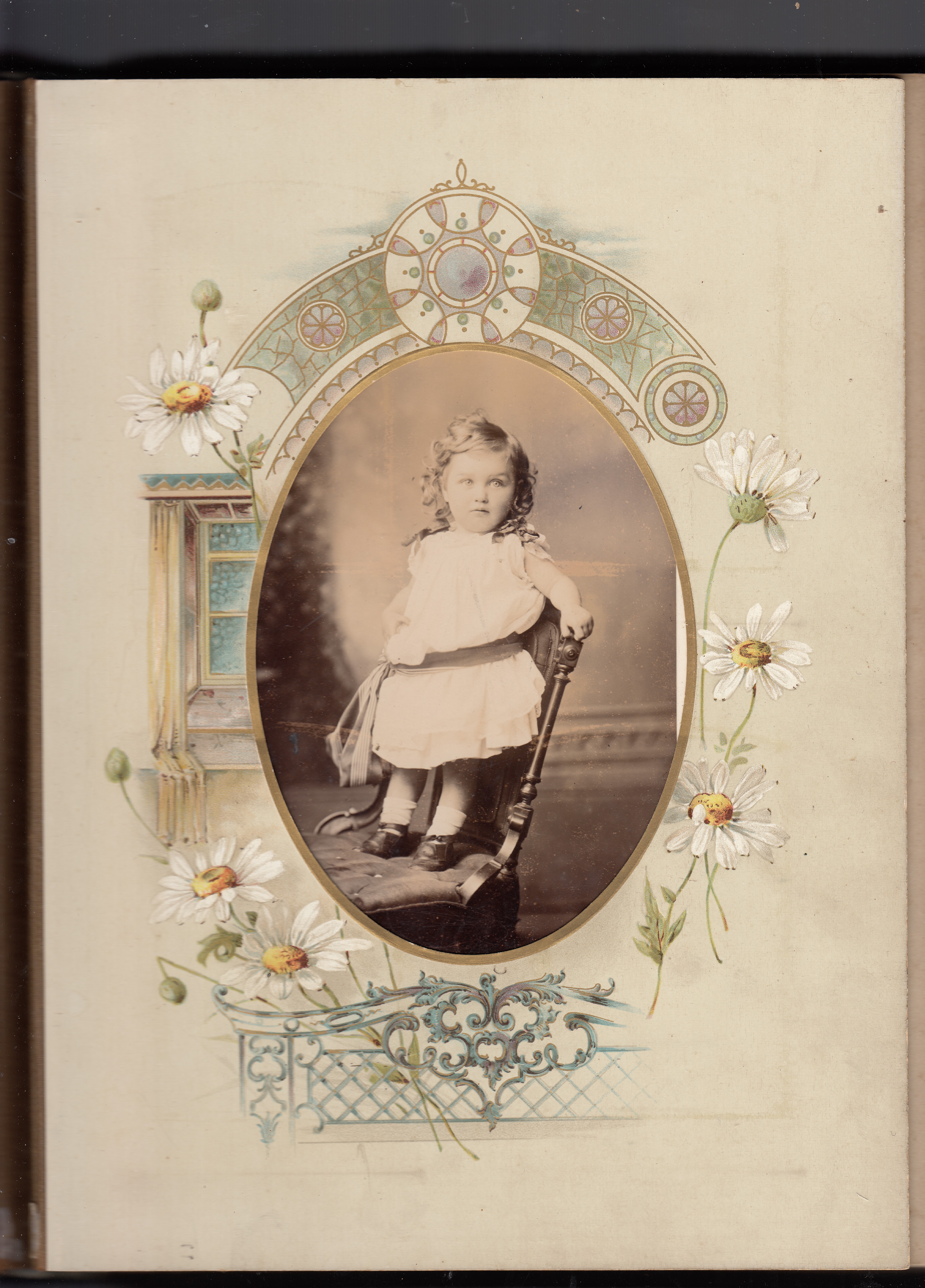
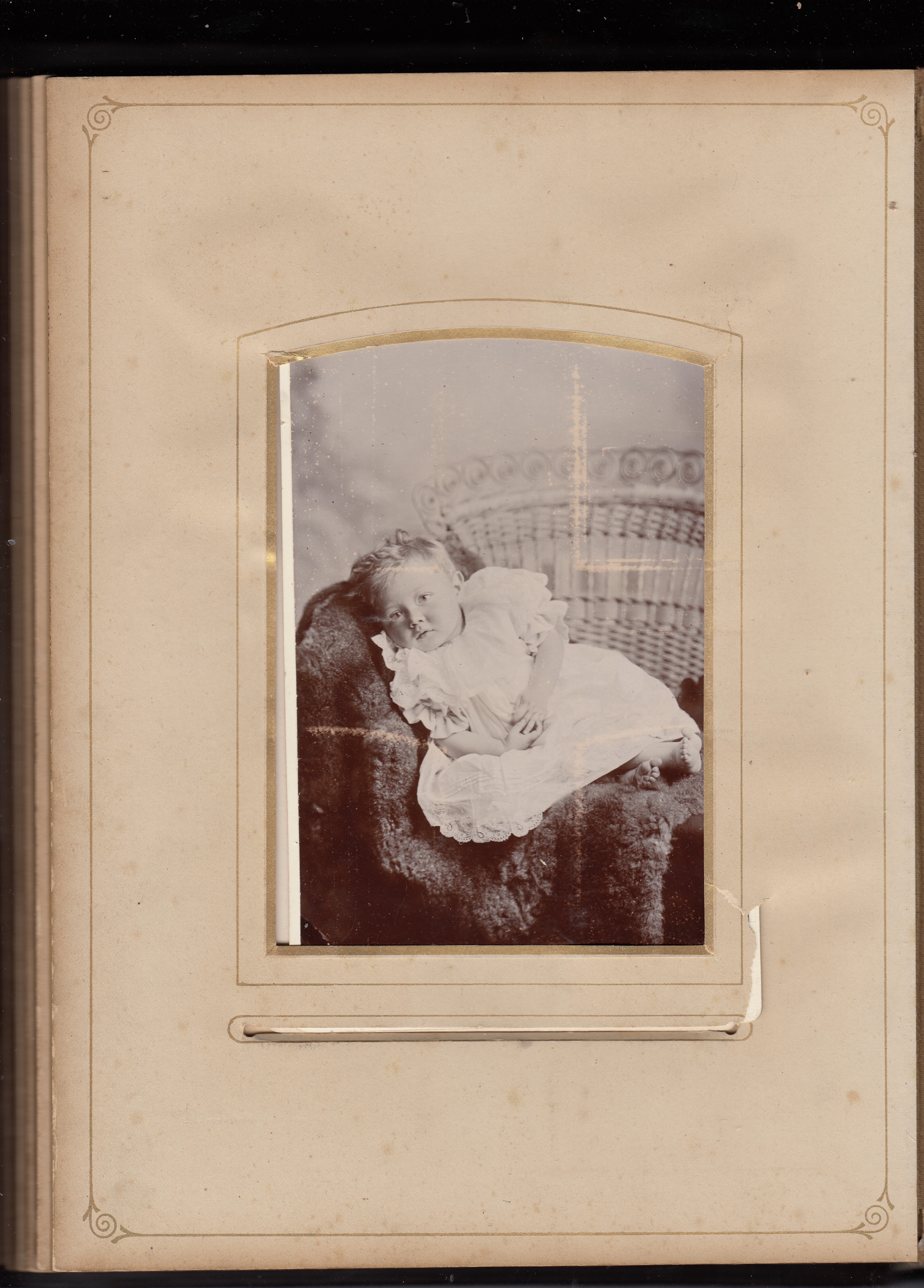
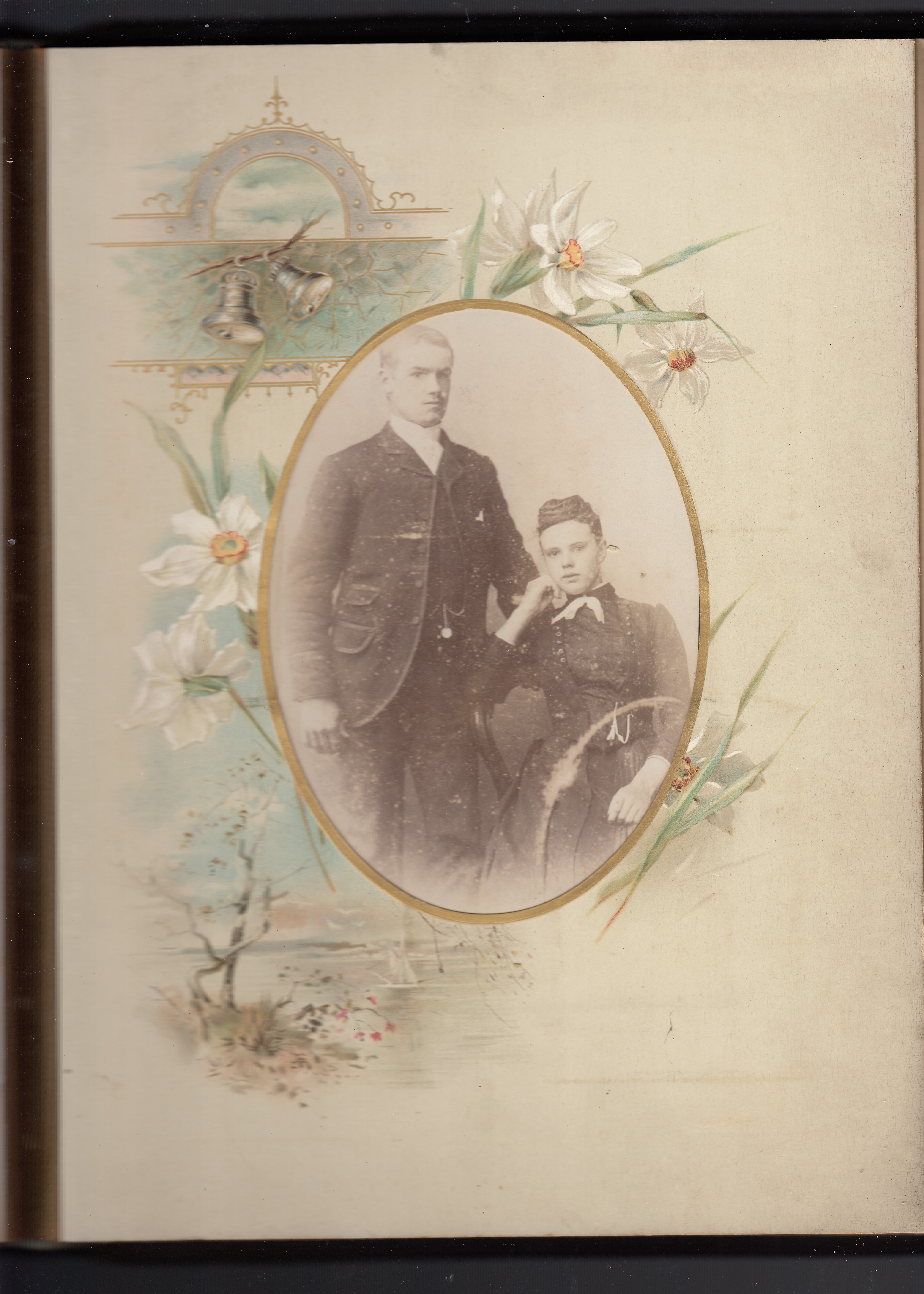
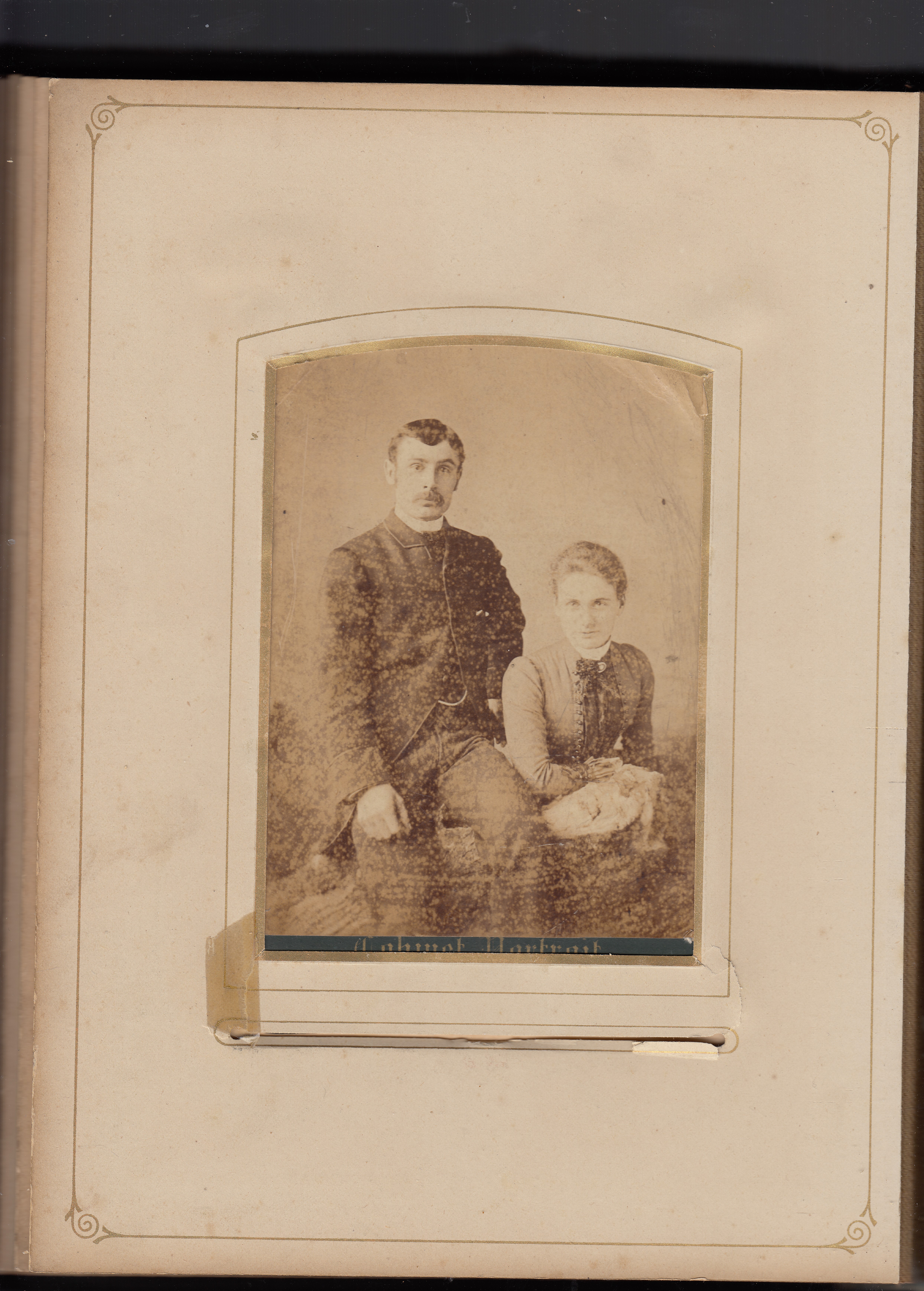
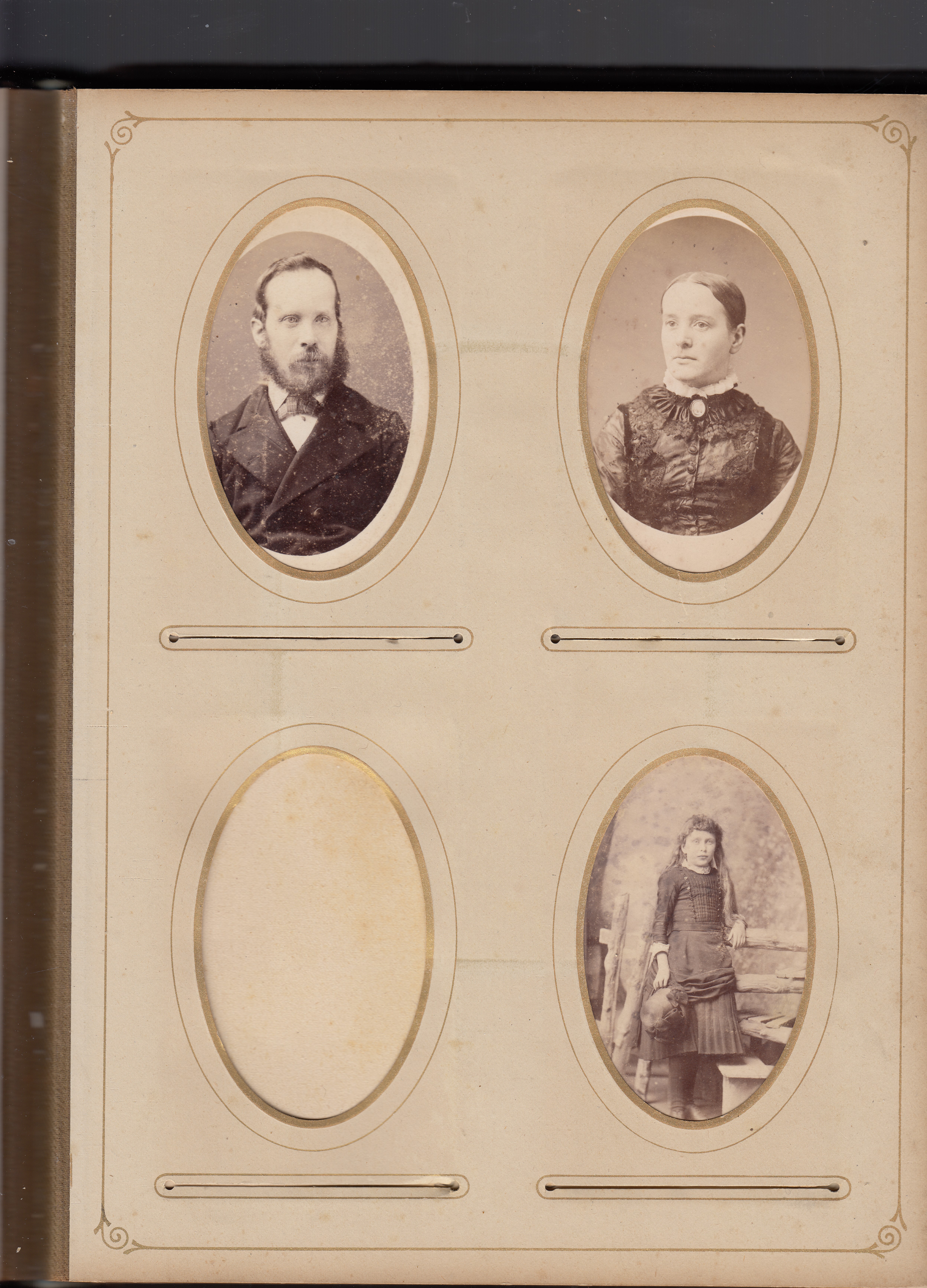
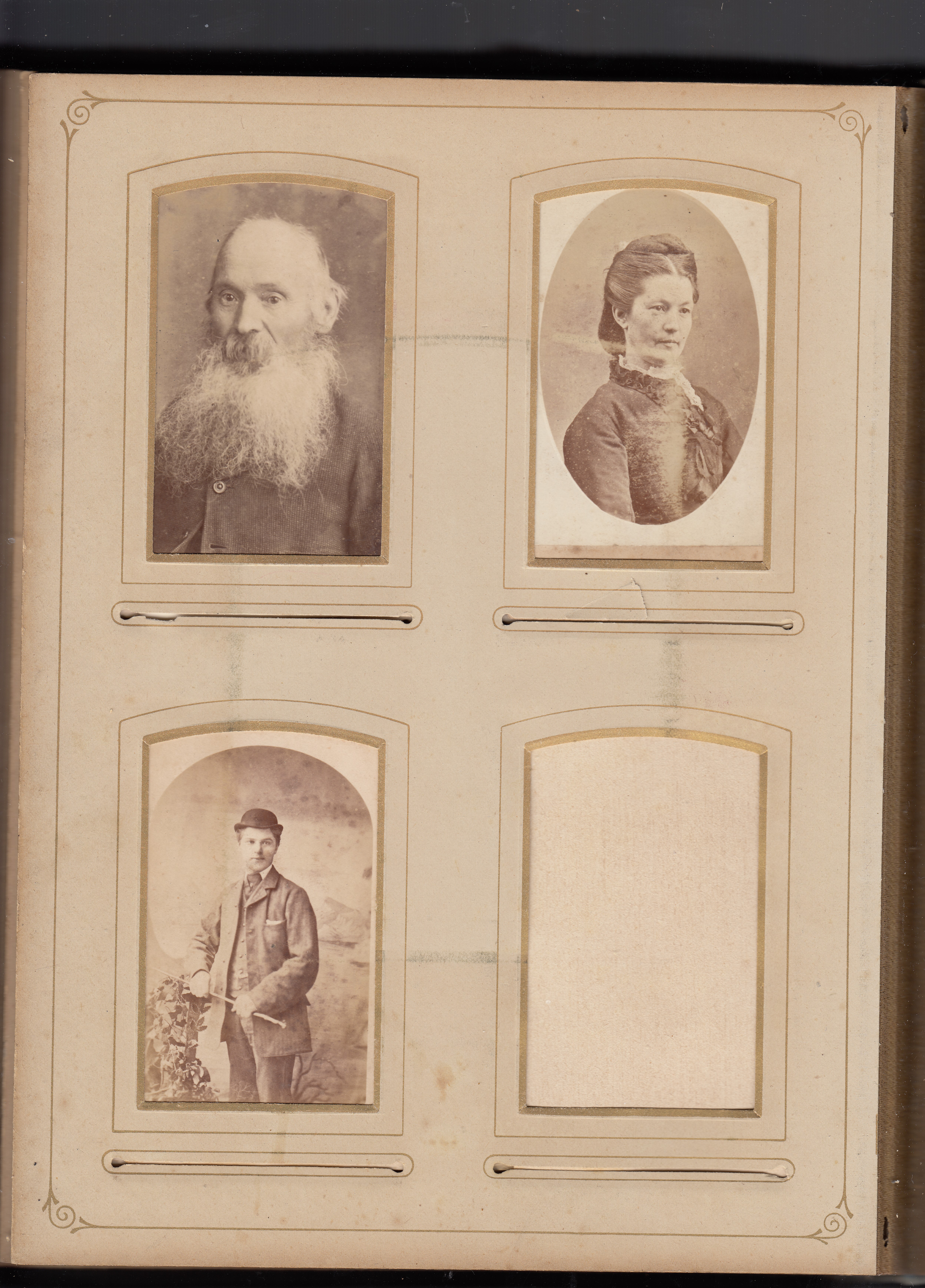
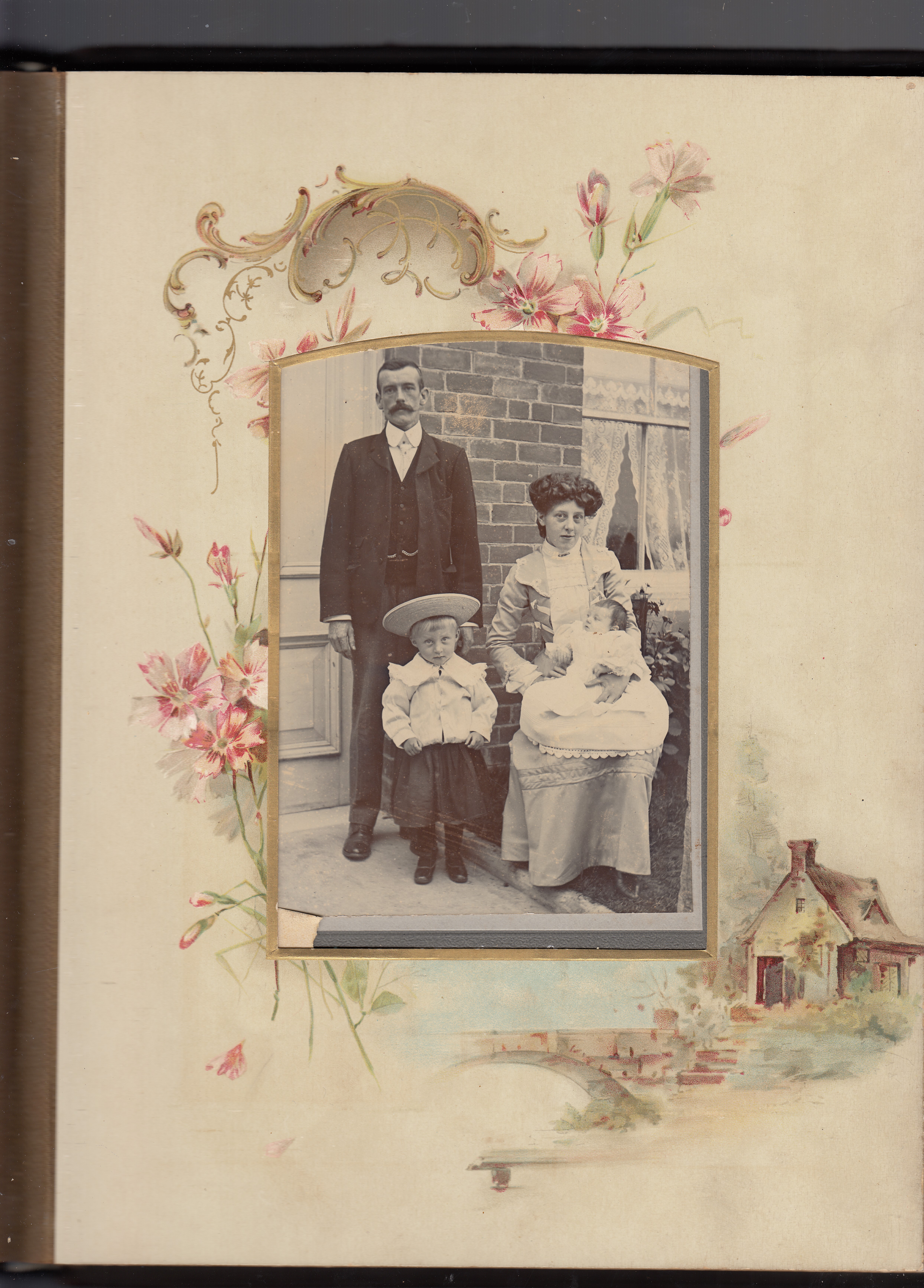
Maria Reynard c. 1902, perhaps on her 40th birthday. From Maria Reynard’s album. Own collection.
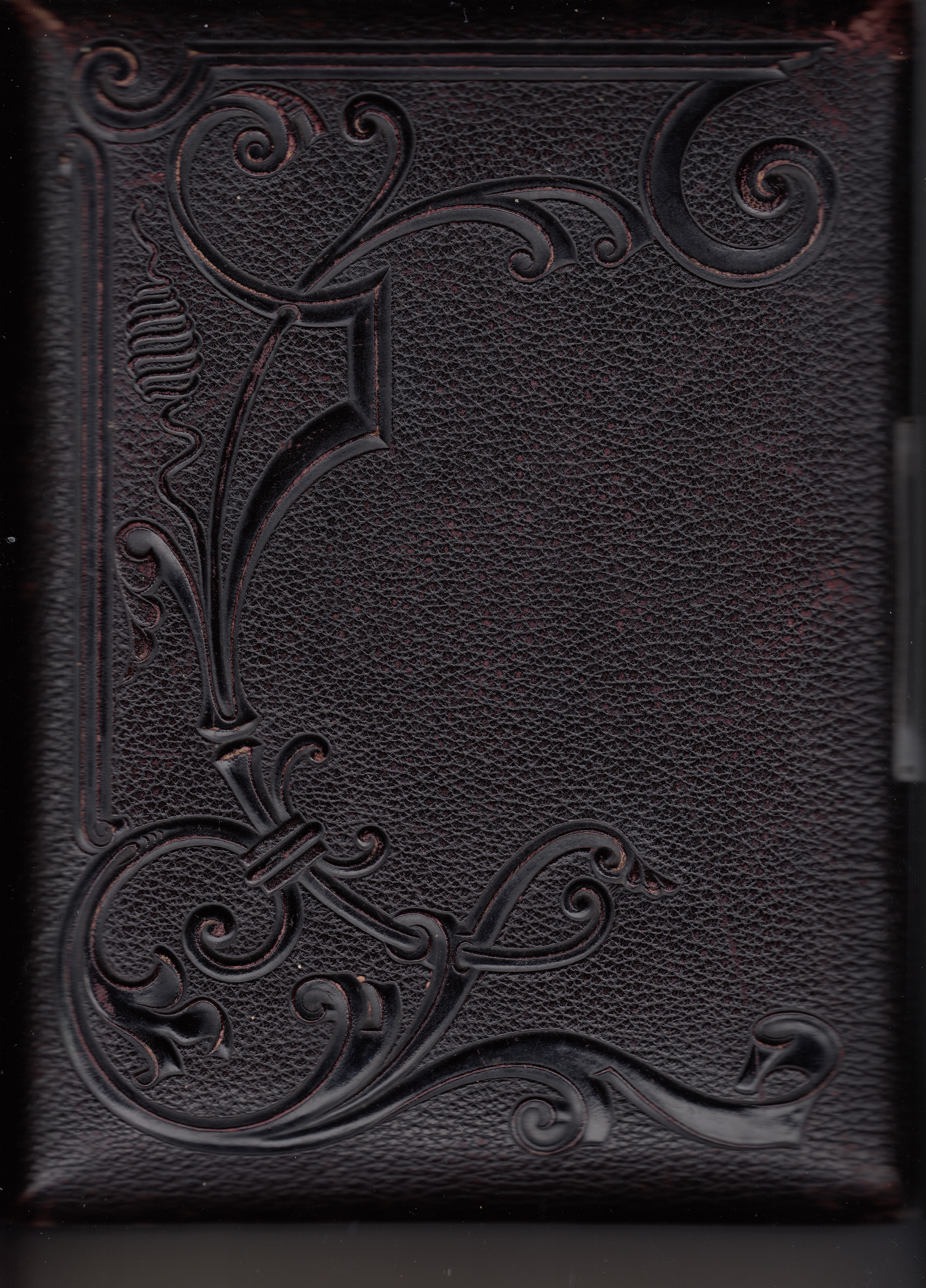
I inherited the beautiful leather-bound album from my Grandma, Mary Houseman. She is turn had inherited it from her mother, Hilda Mary Scott. Beyond that, I knew almost nothing of the pictures within. How old was it? Who had put it together? Who were the photos of? Whilst the clasp itself was broken, the people inside were strangers, their connection to our family locked away, with the key lost forever.
What better thing for someone living alone in lockdown 1.0 than to work away at that lock? I carefully extracted and scanned the photos, scribbled down possible family trees, studied the later pictures of Hilda Mary’s siblings, aunts, uncles & cousins and dived into the world of Victorian photography. Some ideas emerged, I started making educated guesses but was uncertain and didn’t feel I was really doing the album justice.
Then up popped professional dress historian, portrait specialist and photo detective Jayne Shrimpton on Who Do You Think You Are? and I realised it was time to turn to an expert. It took a few more months but finally I was sitting in Jane’s beautiful Lewes garden on a hot, sunny July day slowly unlocking the album’s secrets. Who knew that leg-o-mutton sleeves could date a photo to within three years? Or that a red line around a photo meant it was twenty years older than others on the same page? Several “educated guesses” proved to be out by a decade or two but my earlier research combined perfectly with Jayne’s dress expertise to put many names to faces.
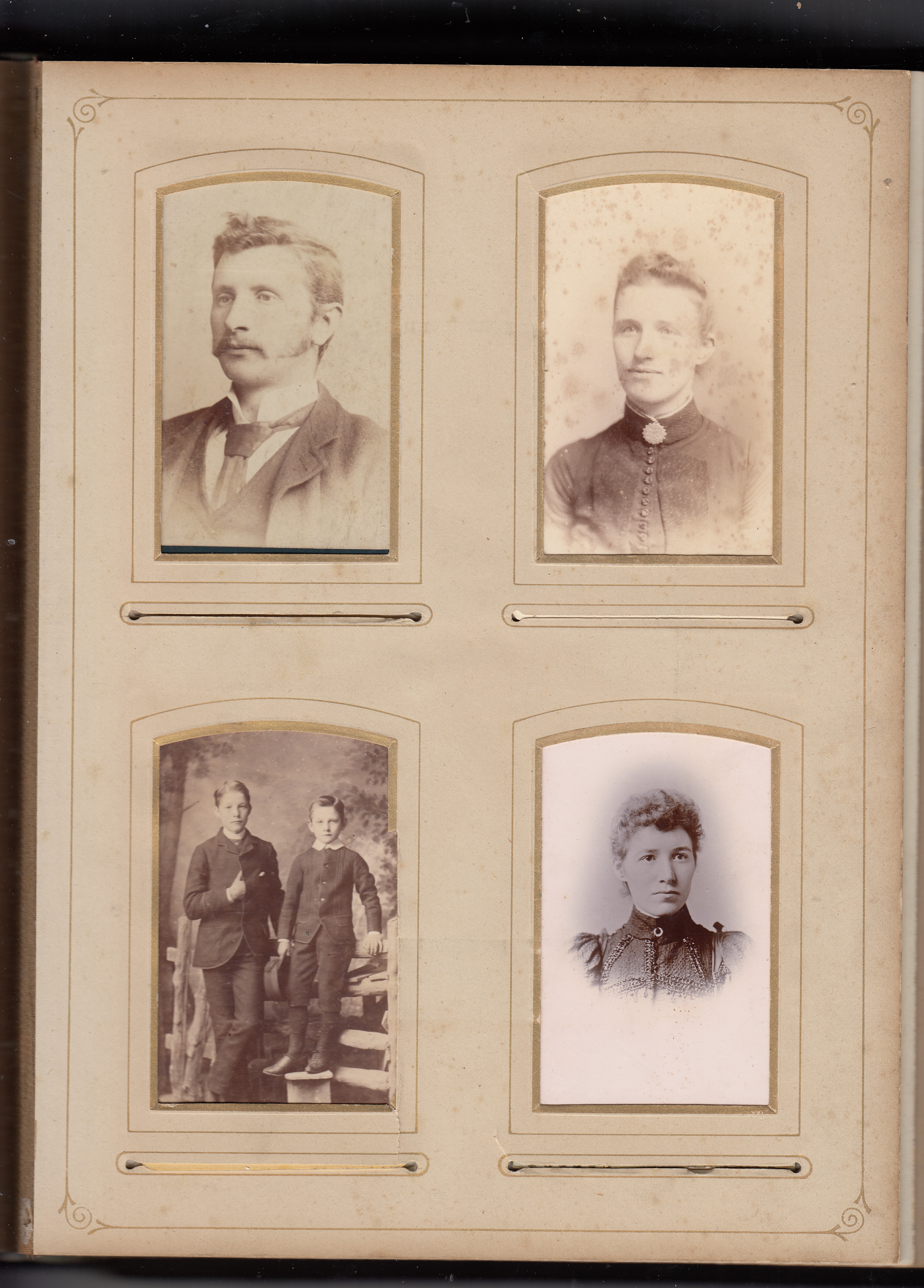
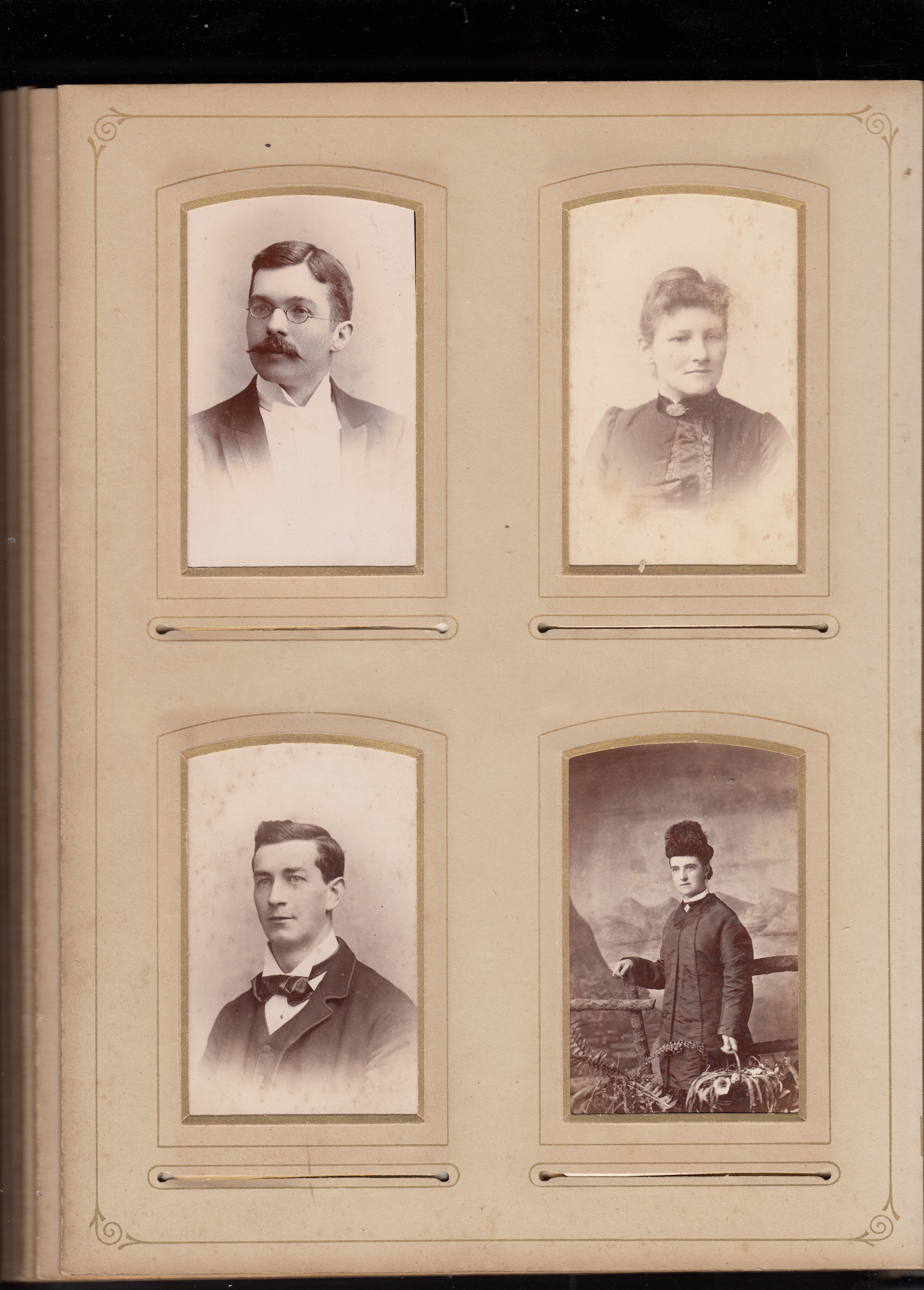
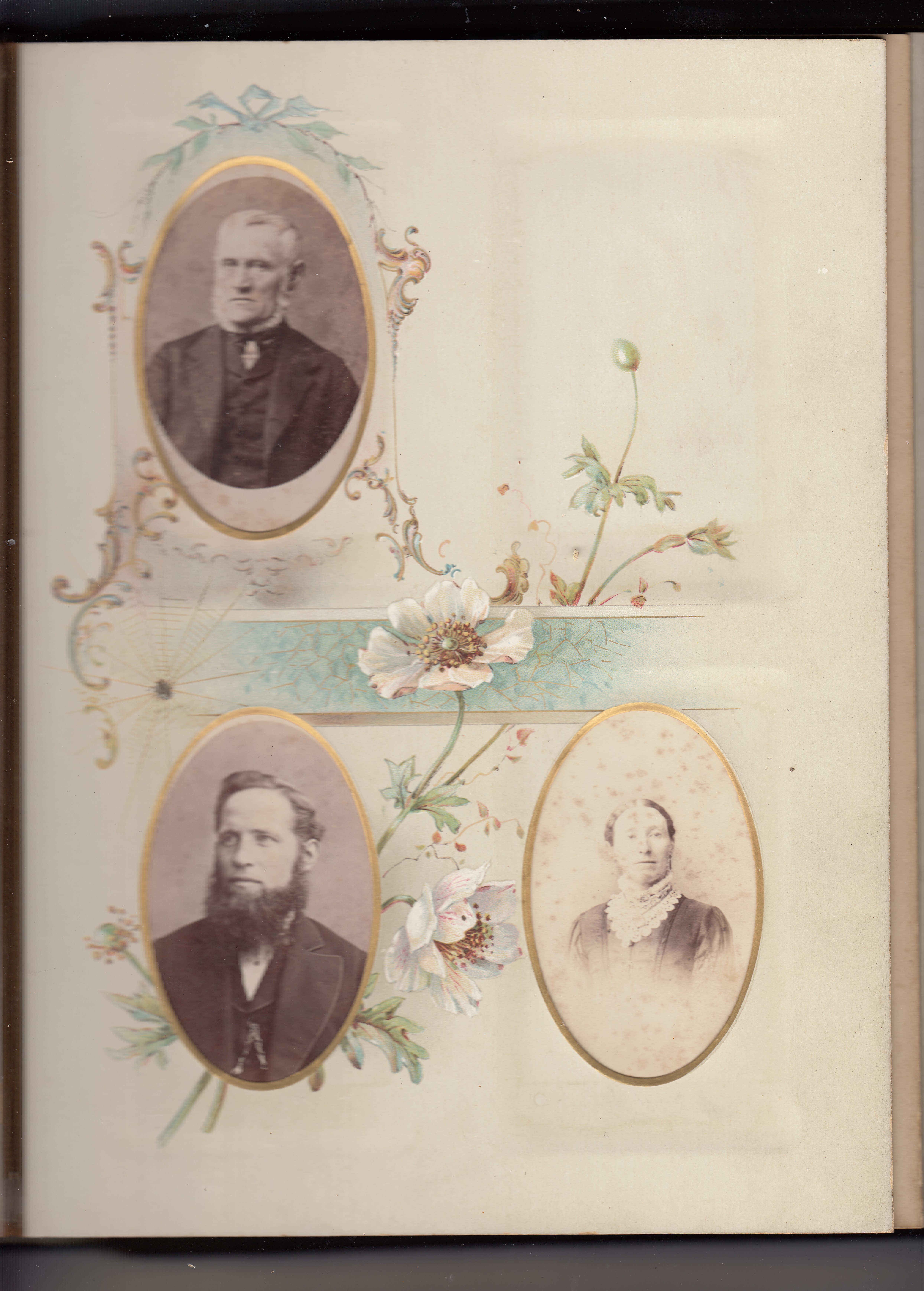
Now, finally, Maria’s album can be unlocked and shared without doubts. The album opens with her husband John Scott likely with his father Charles not long before Charles died. Next are two portraits of Maria aged 21 and 40. Turning the page we see Maria & John’s infant children possibly including the only photo of a son, Charles, who died just three years old, followed by Maria’s siblings and their partners. And so it continues.
There is still a lot more work to do to identify all the people in this album and whilst it’s likely there will always be gaps, I am hopeful that by sharing this story others may spot their ancestors.
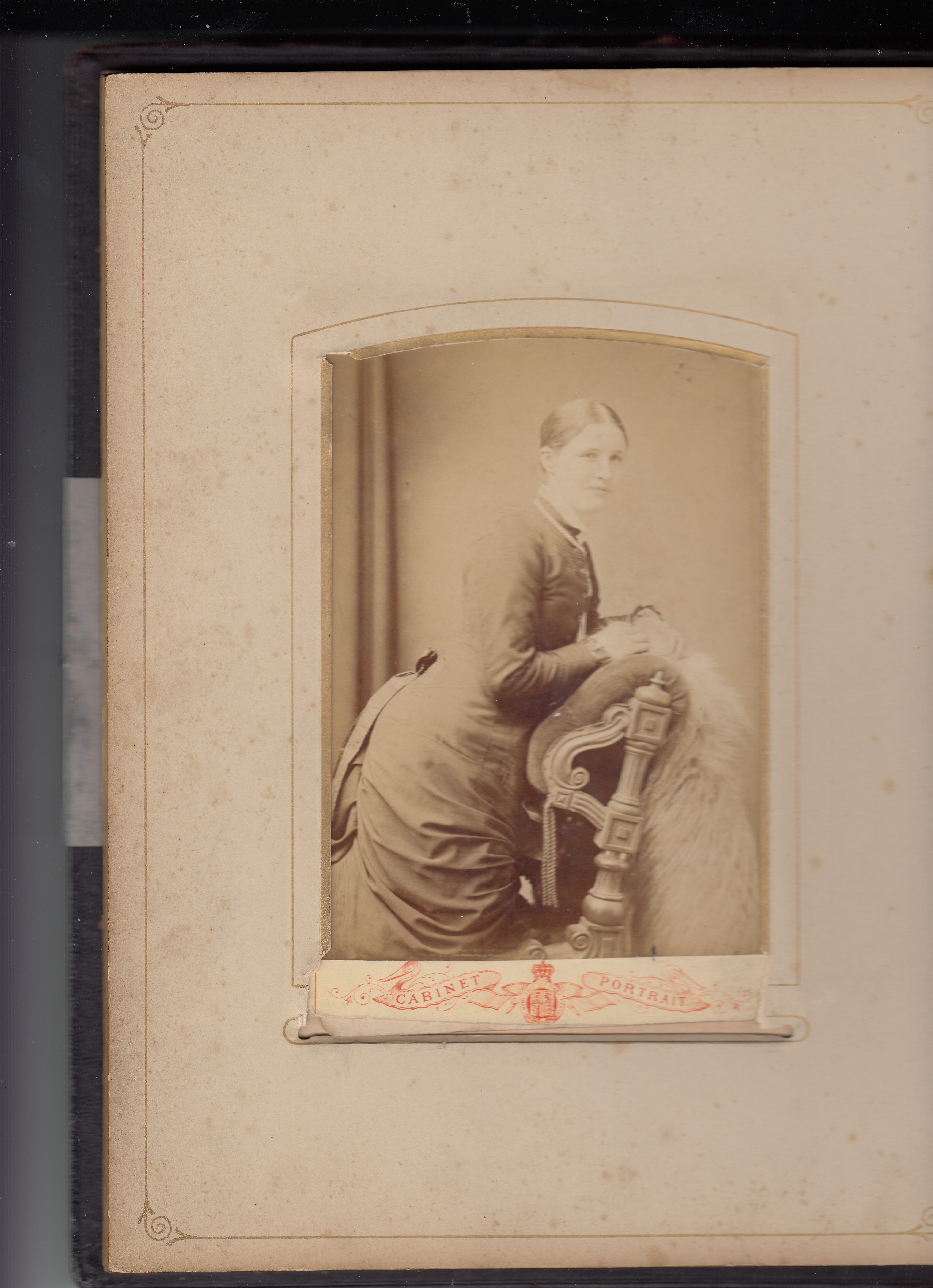
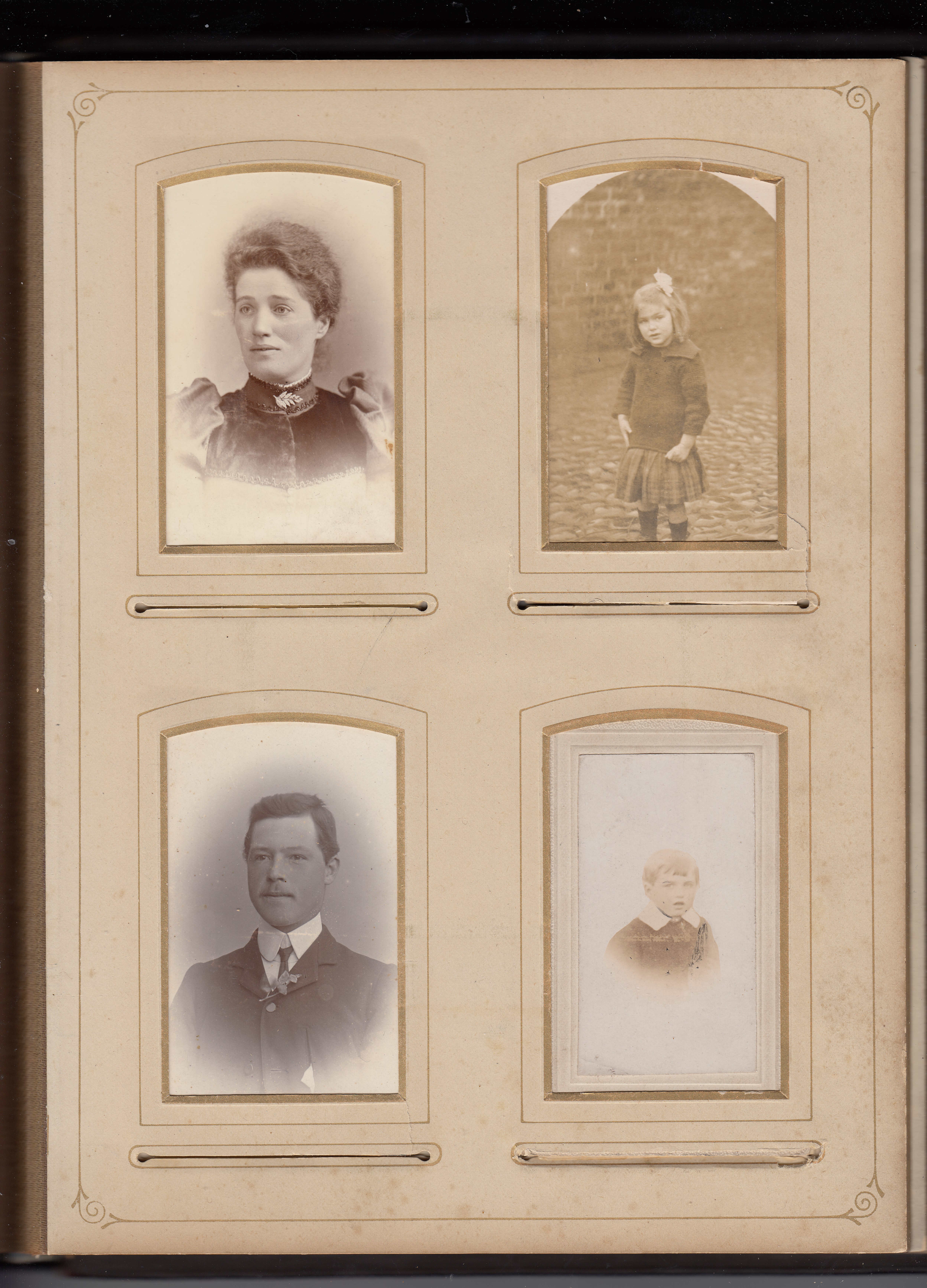
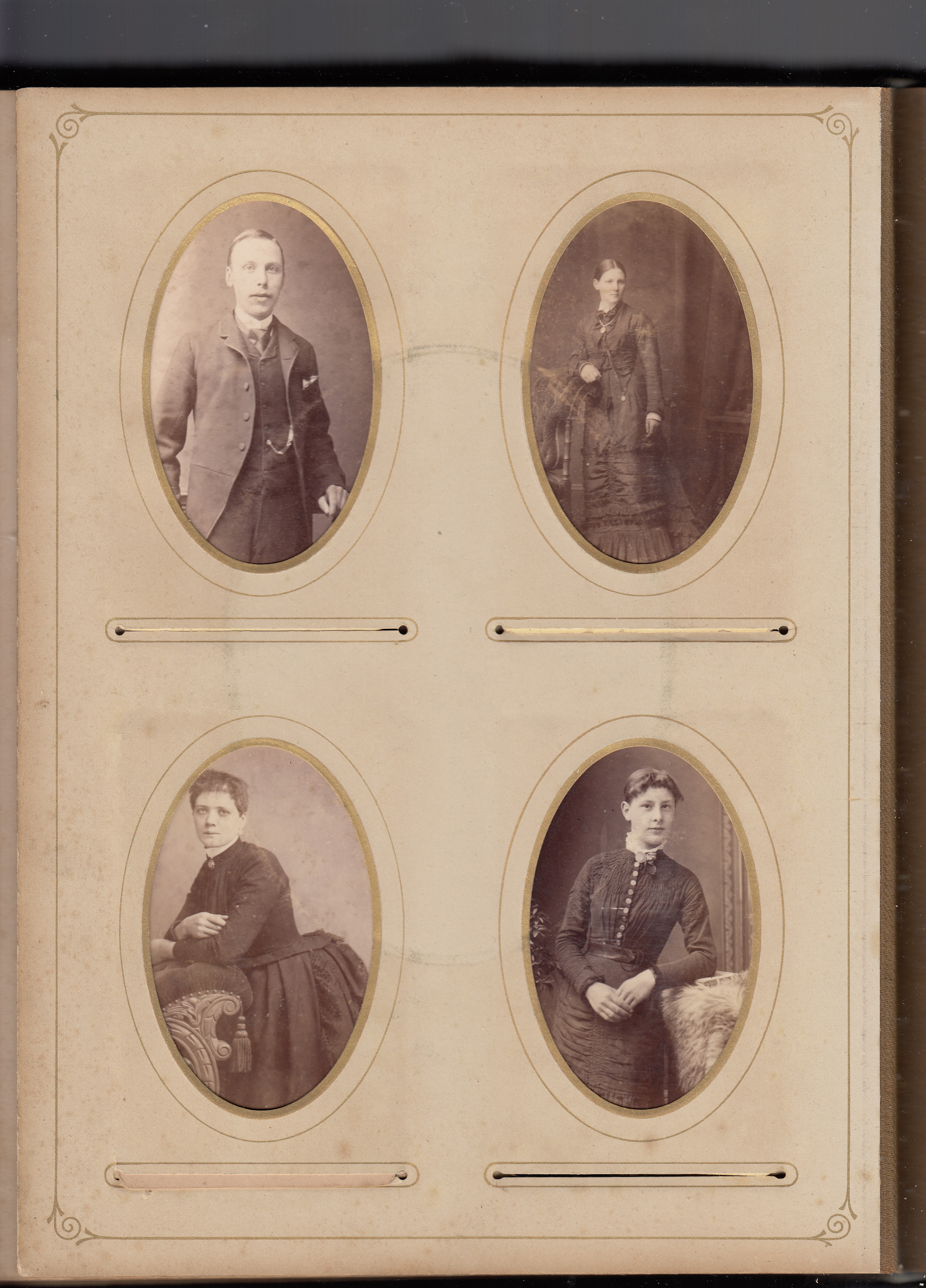
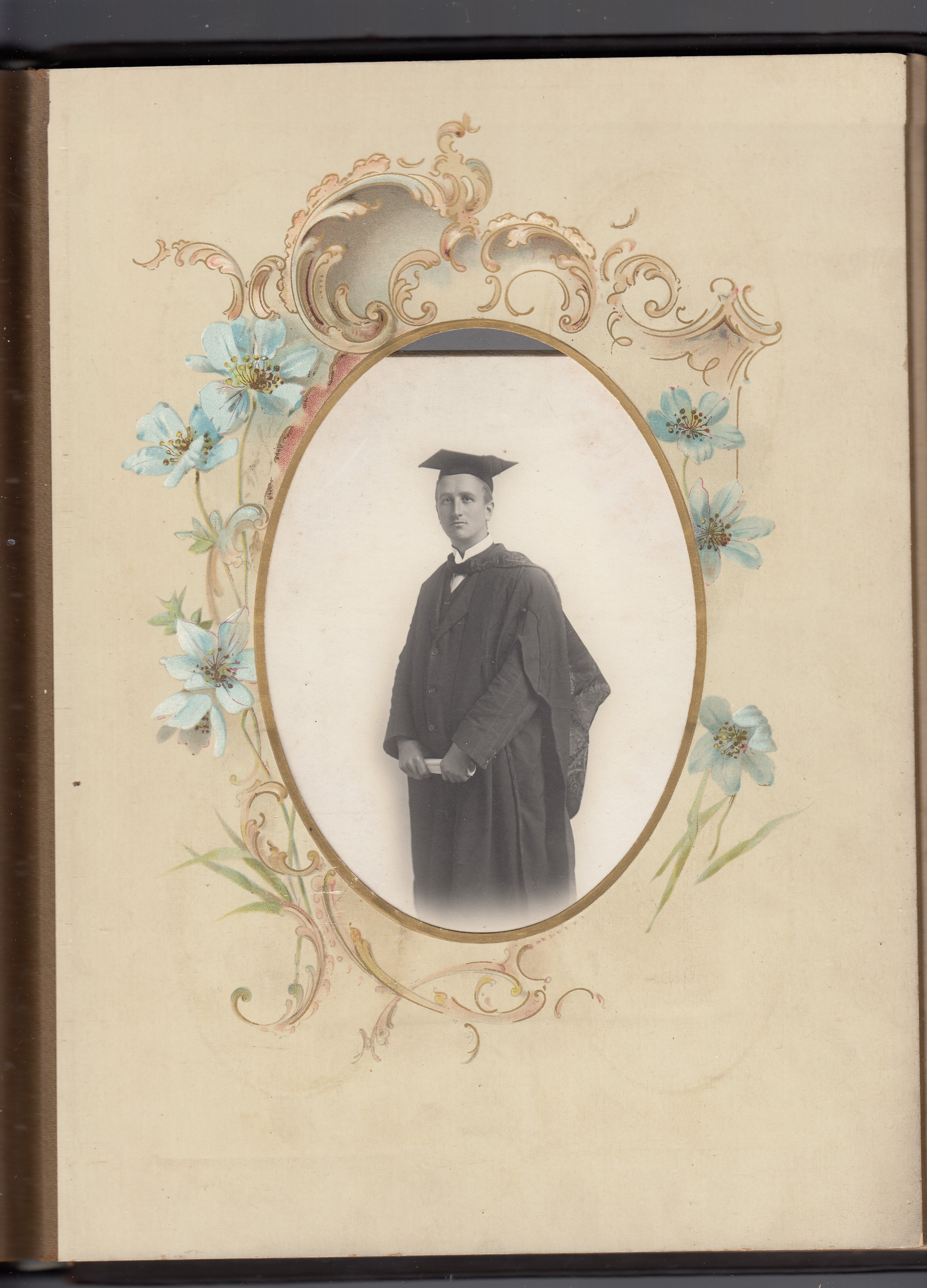
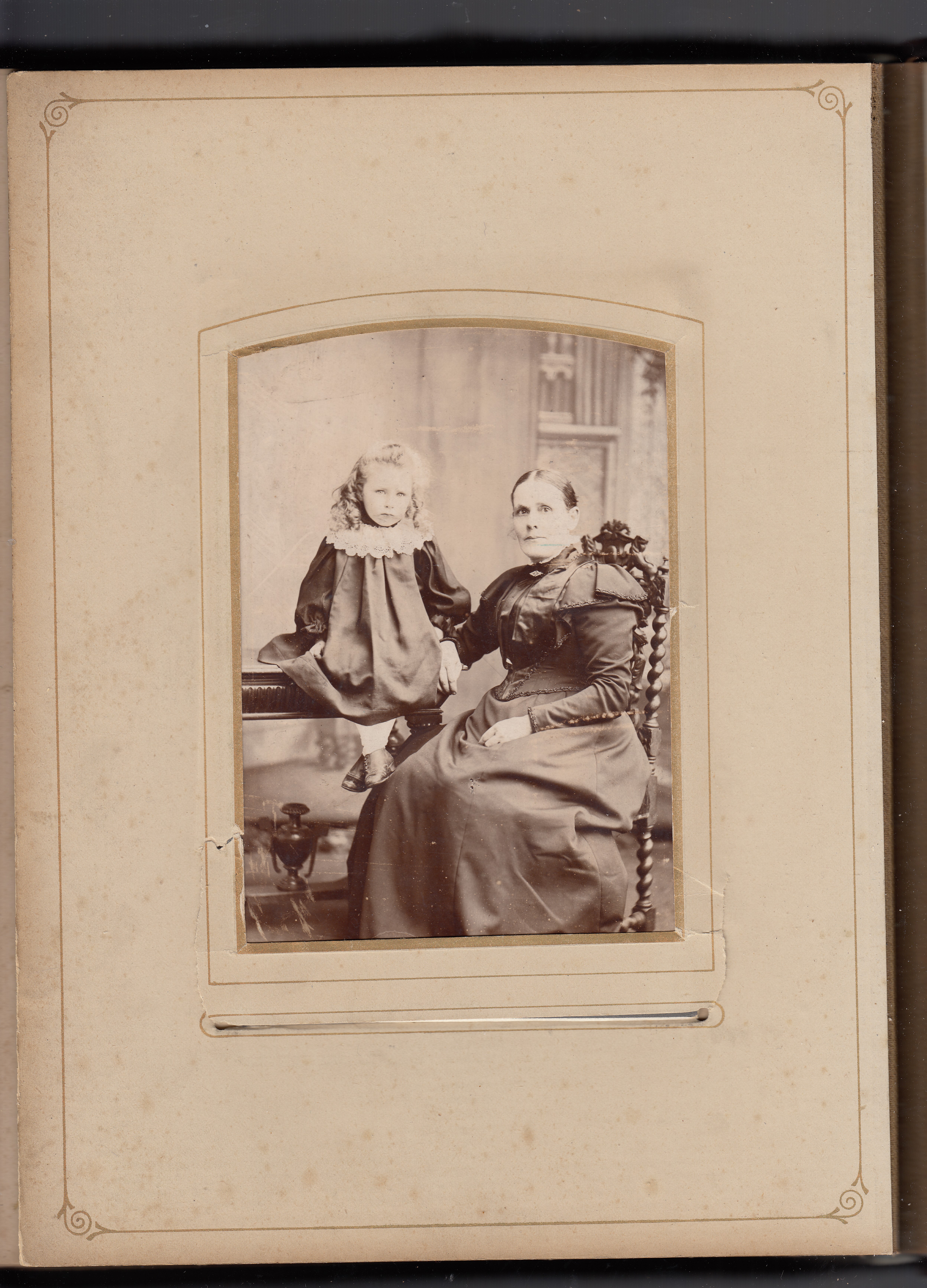
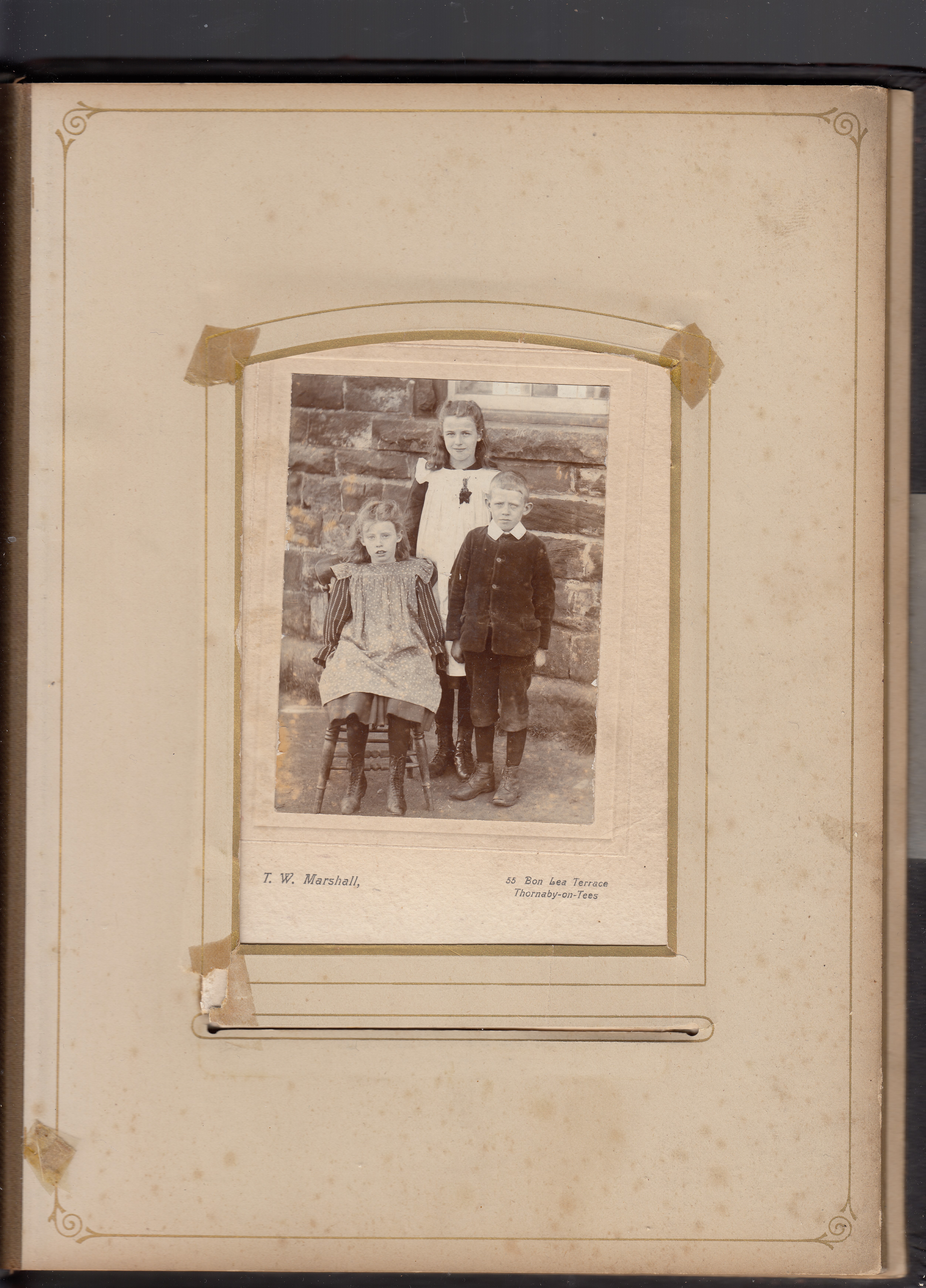
Front coverJohn Scott (1860 – 1920), my great, great grandfather. The elder gentleman could be his father, Charles Scott (1834 – 1897). The winged collar and narrow fit suit date this to the early 1890sMaria Reynard (1861 – 1950). The dress (with a narrow residual bustle) and shaggy rug together would date this to around 1880 or 1881. Photos of this nature were often taken when girls moved into adult dresses (aged 15 – 18) or it could have been Maria’s 21st in 1882Maria Reynard. The high collar & lace would indicate c. 1901, as would the photography studio. This could have been taken for Maria’s 40th in 1902This is either Charles (1886 – 1889) or William Richard (1889 – 1947) Reynard, one of Maria’s children as the chair & studio props would indicate late 1880s/early 1890sThree of Maria’s children. The top photo could potentially be Walter. The photo on the bottom left has note “For Aunt Hannah” on the back and could again be Charles.The top photo is older, likely of John William Reynard, Maria’s brother which would make it c. 1876. The bottom right photo is likely of Mary Reynard, Maria’s sister and was taken in the late 1880s/early 1890s. The photo on the bottom left was taken in Derby and is likely to be either Maria’s husband, Joseph Topham or Richard Reynard, Maria’s brother.The top two photos are likely of Annie Reynard (Maria’s sister) taken 1878 – 1882 and her husband, William Turner, likely 1890s. The bottom photos are of George Gill Reynard (also Marai’s sibling) and his wife, Agnes HallJohn Scott (possibly a 21st birthday portrait in 1881, dated by the morning coat & high collar) & Maria Reynard (taken at the same time as the previous photo). The child is likely Charles. The other woman is likely Hannah, Maria’s sister.Walter Scott (1893 – 1900)Likely either Gertrude or Clarice Scott (Maria’s duaghters). The Wicker furniture & smock dress dates it to late 1890s, early 1900sThe woman on the top right is likely Maria Reynard is mourning for her son Charles in 1889. The boys on the left are John William & George Gill Reynard (Maria’s sons). The woman on the bottom right is likely Annie Reynard on the occaision of her 30th birthday. The photo is dated January 1897 and the leg-o-mutton sleeves date it to between 1894 & 1897The soldier’s uniform may be for the Boer War. The photo of the couple is much older c. 1865 – 1868. This could have been the marriage of Maria’s Uncle, James Gill in 18661888 – 1890. Same woman & photo shoot as next photo.1888 – 1890. Possible wedding photo although couple look very young. Photo by Young & Manders Harrogate.Likely late 1880s. Taken by Young & Manders, HarrogateLikely a family. The photos of the parents were likely taken lat 1870s/early 1880s. The shortcut fringe dates the photo of the girl to the 1880s.Again likely a family. The photo of the woman is earlier (mid to late 70s). The other photos are mid to late 80s.c. 1901 – 1904 given the collar stylec. 1895/1896 possibly a year either side.Possibly a family. The photo of the woman was taken between 1893 & 1897 in Wakefield. The female child is later c. 1910/1920. The photo of the boy child is a copy image, possibly after a child has diedThese are not yet identified and possibly more distant.Possibly 1910s/1920s1898 – 1900 (based on the frills, epaulette’s & lace). Child could be either a boy or girl. Possibly in mourning (with an urn under table). Taken in WakefieldThe corduroy suit and bits of lace would indicate late 1890s/early 1900s. Photo taken in MiddlesboroughUnknown, late 1880s/early 1890sThe back coverMaria Reynard’s family photo album in full. Own collection.
Maria was born in Ellerbeck on 16 December 1861 the second child of Mary Ann Gill & William Reynard. The Reynard family moved to Topcliffe when Maria was about five. Maria married John Scott, the son of Elizabeth Webster & Charles Scott, in 1885. The Gill family were from Norwood, the Reynards from Hampsthwaite, the Websters from Boroughbridge and the Scotts from Minskip. Maria & John had eight children. Two sons died as children leaving just William Richard (b. 1889) to carry on the Scott name. Hilda Mary (b. 1891) (my great grandmother) married Jesse Houseman, Laura (b. 1895) married John Taylor Houseman (Jesse’s nephew), Gertrude (b. 1899) married William Clarke, Clarice (b. 1900) married Malcolm Pennock and Marjorie (b. 1906) married Harold Millington Shutes. If this album was a wedding gift, I am sure it won’t have been the only one.
With much gratitude to my great, great grandmother, Maria Reynard, for creating this album, to Hilda Mary Scott & Mary Houseman for keeping it safe and to Jayne Shrimpton for helping me unlock its contents!