Fizzing with Florence

Florence Wellock (1874 – 1916)
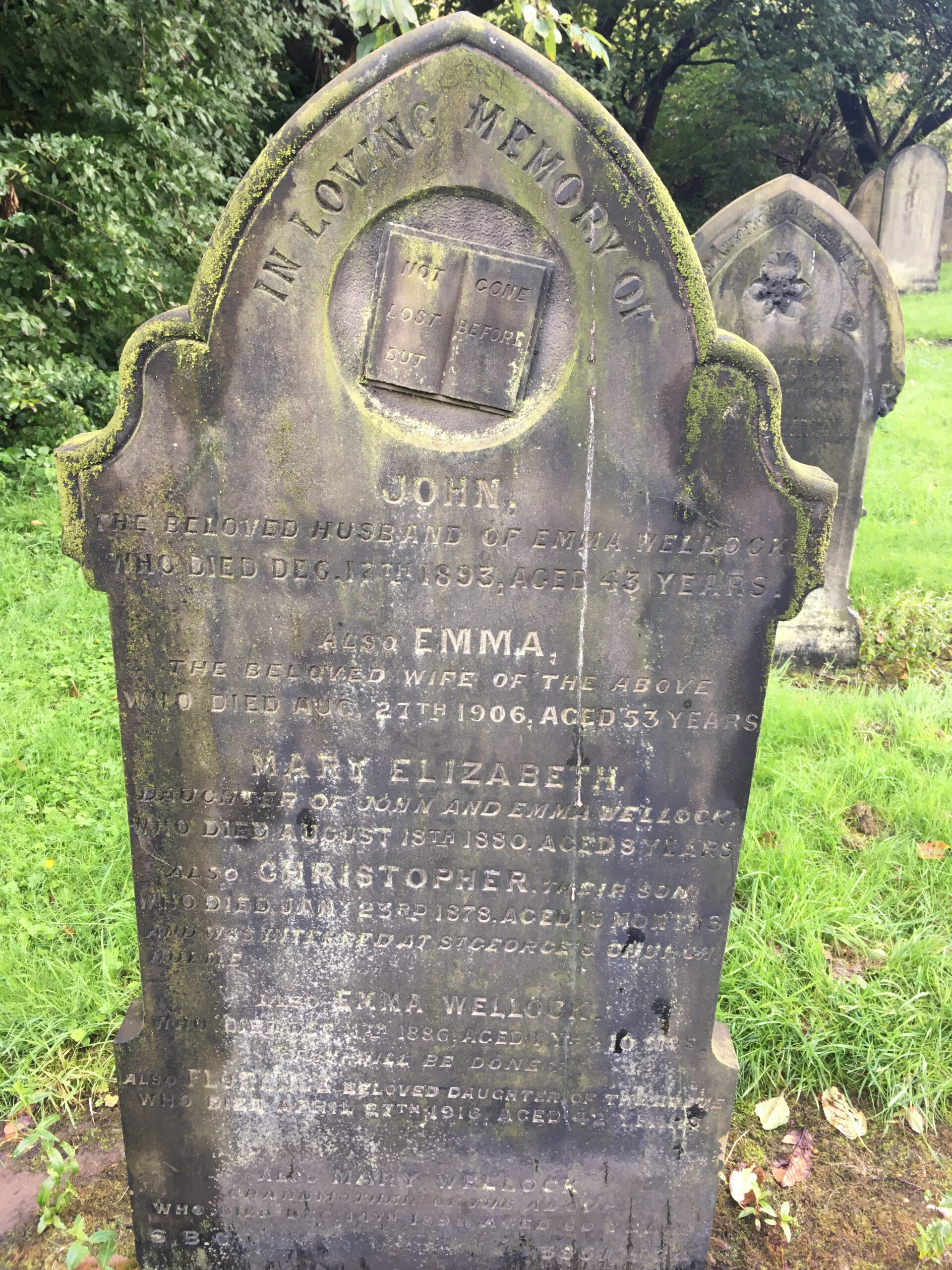
Memorial stone of Florence Wellock and her family. Photo taken by Kyle of findagrave

It all started with a plan to research and connect the Wellocks on findagrave in anticipation of maybe, one day, starting a one named study into the surname Wellock (and yes, I should probably just own that’s exactly what I am doing). The stories just pop out in almost every set of family gravestones. I’ve broken down brick walls, discovered connections between unconnected Wellocks (who are connected through the sisters they married) and even found a tale of bigamy. But it is Florence Wellock’s memorial stone that has completely drawn me in for it’s one of those wonderful family stones – father, mother, four children and a grandmother – which are just brilliant for connecting people.

Jumping straight into the research it was clear that this was THE OTHER BRANCH, the Wellocks who descend from the as yet unconnected Henry who lived in Kirkby Malham in the 1600s. It really was okay to just stop after linking the direct family.

But it didn’t take long to realise that Florence Wellock was the end of the line. Her three siblings, Mary Elizabeth, Christopher & Emma had died as children. The weird eight year gap between the three oldest and Emma could have occurred for all sorts of reasons, but losing two children in quick succession had quite possibly put Florence’s parents, Emma & John, off from trying for another.

So that left Florence. The only one of the four children to make it into a census. There was clearly a close relationship with her maternal cousins. One, Herbert Hough, was captured staying with the Wellocks in 1891, then Florence was recorded with Herbert in 1901, and with another cousin, Thomas Lyth, in 1911. Her will, in 1914, split her estate between the two. For Florence never married. Working as a tailoress (I am assuming dressmaker rather than sweat labourer), she both inherited and earned her own money leaving an estate of £466. Which is why, I imagine, she left instructions for a memorial remembering her parents and her long dead siblings (including reference to the fact that Christopher was buried elsewhere) and, randomly also, her paternal Grandmother, Mary (Hewitt) Wellock.

I thought at first, she’d fallen out with her mother, Emma, who had remarried after her father had died. But then she left her estate to her maternal cousins. Uncharitably I figured her paternal Grandfather, Christopher, may just have been aloof, and maybe that holds some truth. But he died just before Florence’s younger sister, Emma, died, and the likely story is that Grandma Mary came to live with Florence and her parents and helped them all through that last, terrible, death.

Aah, Flo, you truly deserve a remembering. I just suspect you weren’t expecting it to be from the third cousin, twice removed, of the sister-in-law, of the husband, of your third cousin once removed or from someone who feels a connection to a surname, has a niece with a middle name Florence, shares a birthday with the death day of your mother, and has a soft spot for dressmakers as it was her Nana’s profession. My hope is that this story piques the interest of someone closer to you, but if not, your memorial has served it’s likely intention of keeping your family’s story alive.
Killed on a trainline – John Scott (1860 – 1920)

For several minutes Maria watched as the wheelbarrow slowly appeared out of the gloom.

John had been very particular about the view when he built their “forever” home. Prospect House was well-named, offering clear sight as far as the railway at least it would have if the sun had been shining. Maria was still getting used to the quiet after Gertie’s wedding. Just Clarrie & Madge left; the soft giggling from upstairs gave them away as being not quite appropriate for respectable young woman of the time. It was giggling that was soon to be brought to an abrupt halt.

There was just something about the approaching group which left Maria with a sense of disquiet. They were slow in their approach without any apparent sense of animated conversation. Heads were bowed. As the clock continued with its soft ticking the bundle in the barrow gradually gained precision in Maria’s view.

Before they even rung the bell, Maria knew. She knew, just as she had known as she watched her darling Charles slowly dying from septicaemia after a simple scratch from a loose nail in his wooden playpen. She knew, just as she had known when she had flown to her sister Nellie’s home in Kirby Hill to hear her beloved Walter’s last words. At some point, she likely swore, in a way that good upper middle class Victorian women should never do. “What the blazes John, you were just posting a few dratted letters?”

Death certificate of John Scott.

John Scott was 59 years old when he was killed after being knocked down by a goods train just a few short minutes from his home in Pickhill on 12 April 1920. Grandma (John & Maria’s granddaughter through their daughter Hilda Mary) told me of his story when I was just a child, alongside those of his sons, Charles & Walter. The way she told it, he had stopped on the line to rescue a carriage of some kind, possibly, as it turned out, it was nothing grander than the wheelbarrow in which he was brought home. Of course I was fascinated, and these stories are a large part of why I became so obsessed with family history.

Unlike the time I researched the death of his son Walter, I’ve struggled to learn more about what happened. John’s death certificate records the details of “an engine of a goods train” and “on his way home from the post office” but despite my understanding that the Scotts were prominent members of their local society, I’ve been unable to find any newspaper articles or other documents that might provide more detail on what happened.

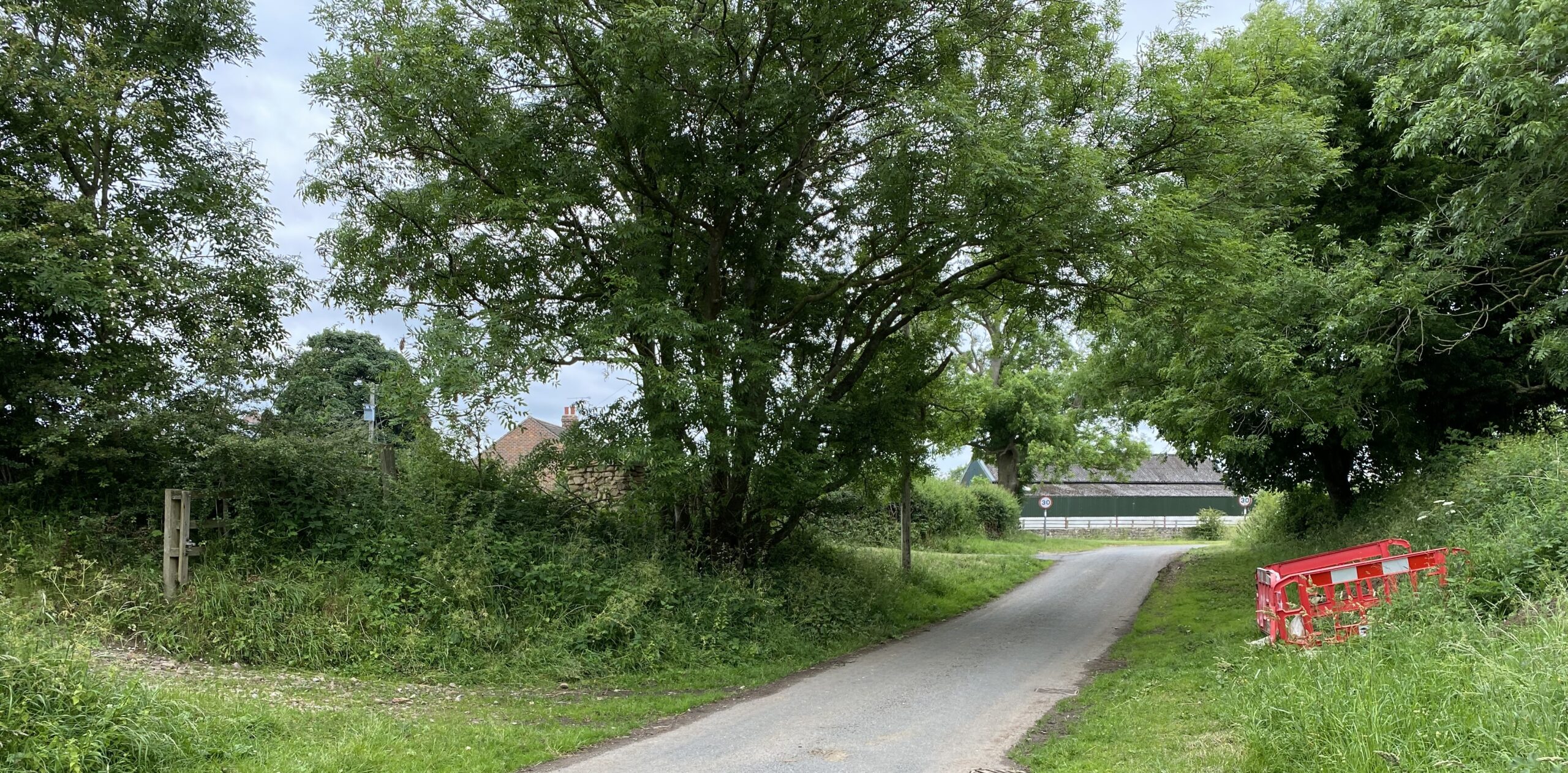
Embankment on road out of Pickhill in the direction of Prospect House which “may” have been where John’s accident happened. Own photo, June 2021

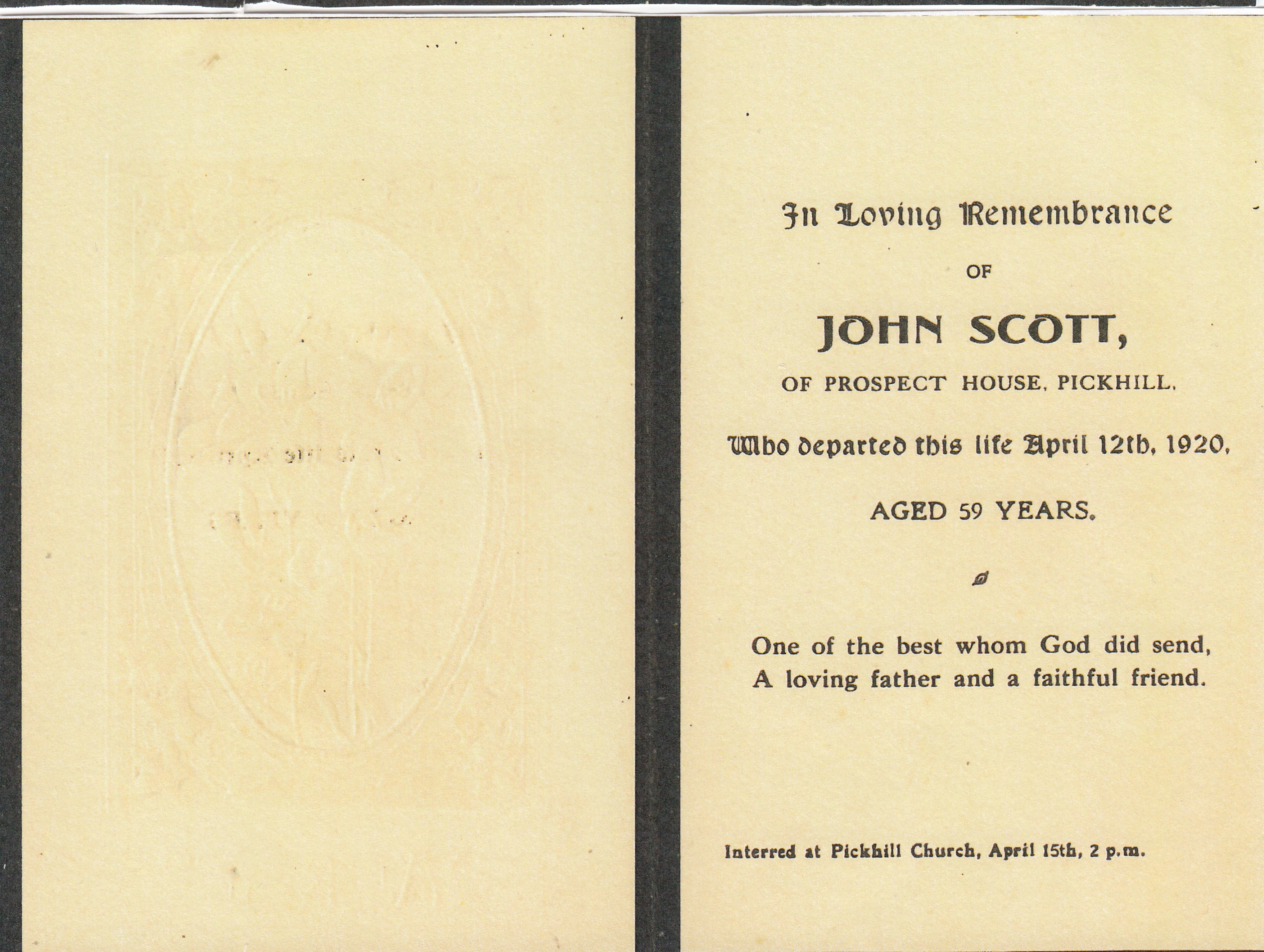
Yet there are always more places to look. A recent speculative letter to a Scott cousin revealed that the story had travelled down her line too. This time with details of foggy weather and of John being brought home in a wheelbarrow. She also had a copy of John Scott’s funeral card showing he was interred at Pickhill Church just after 2pm on 15 April 1920. Studying old maps, I was able to identify Prospect House as now called Highfield Farm. Whilst the train line no longer runs to Pickhill, a visit to the village revealed that it was possible to trace its route across an embankment on either side of the road that leads from the village proper to John & Maria’s home.  

Maria took over the farm after John’s death and lived another lifetime (30 years). Their six surviving children, thrived too, allowing John’s story, together with those of his sons, to reach down through the generations ready to be pieced together by his great, great granddaughter a century later.

With much gratitude to both Grandma for passing on this story, to Susie Pennock for sharing the extra details as well as to Natalie Pithers and the Curious Descendants Club for an inspirational workshop on writing about death. My thanks also go to Mike at the “Railway Work, Life & Death Project” for his encouragement on twitter and with hope that John Scott’s accident might pop as part of their project in the future!