Four generations

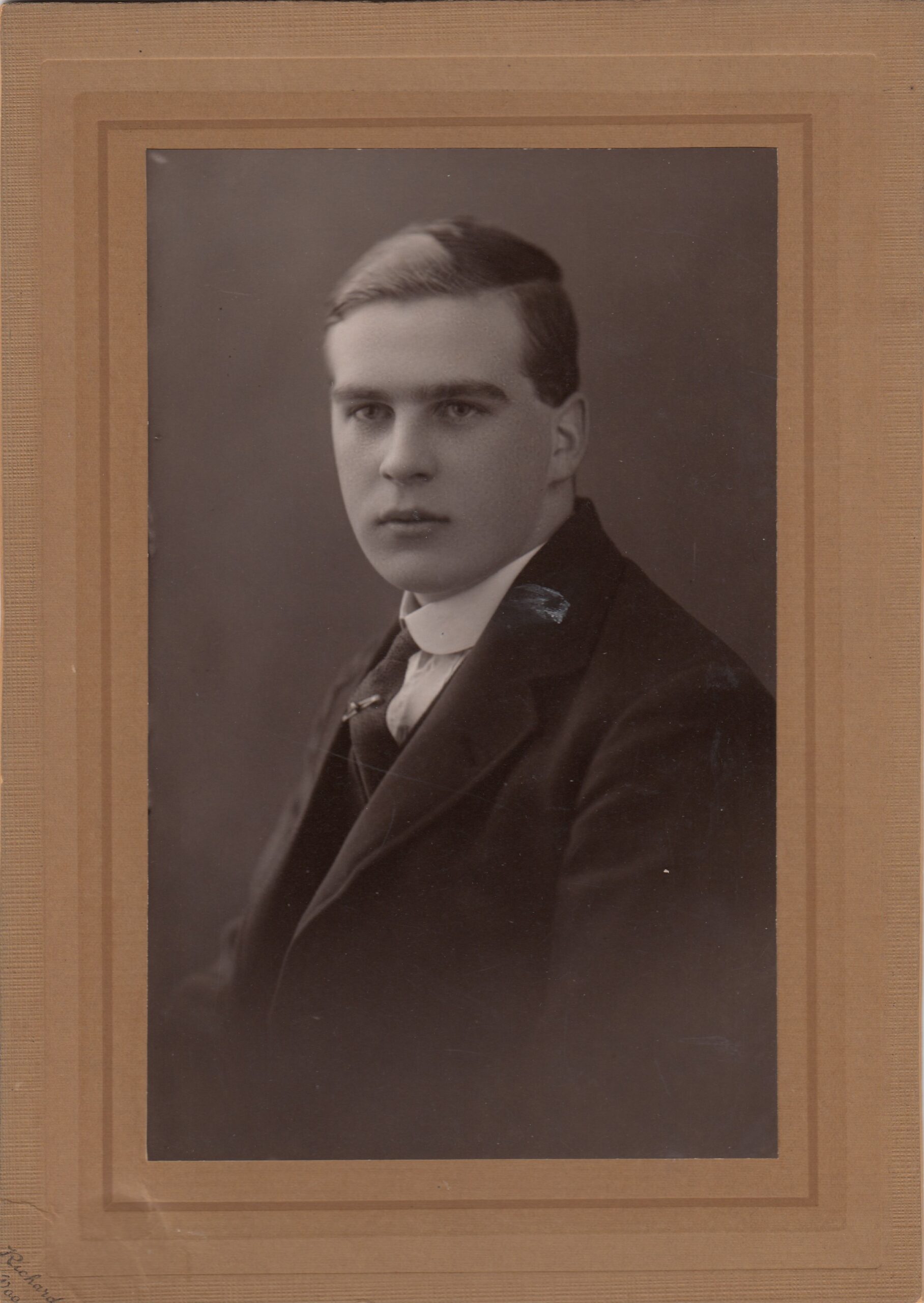
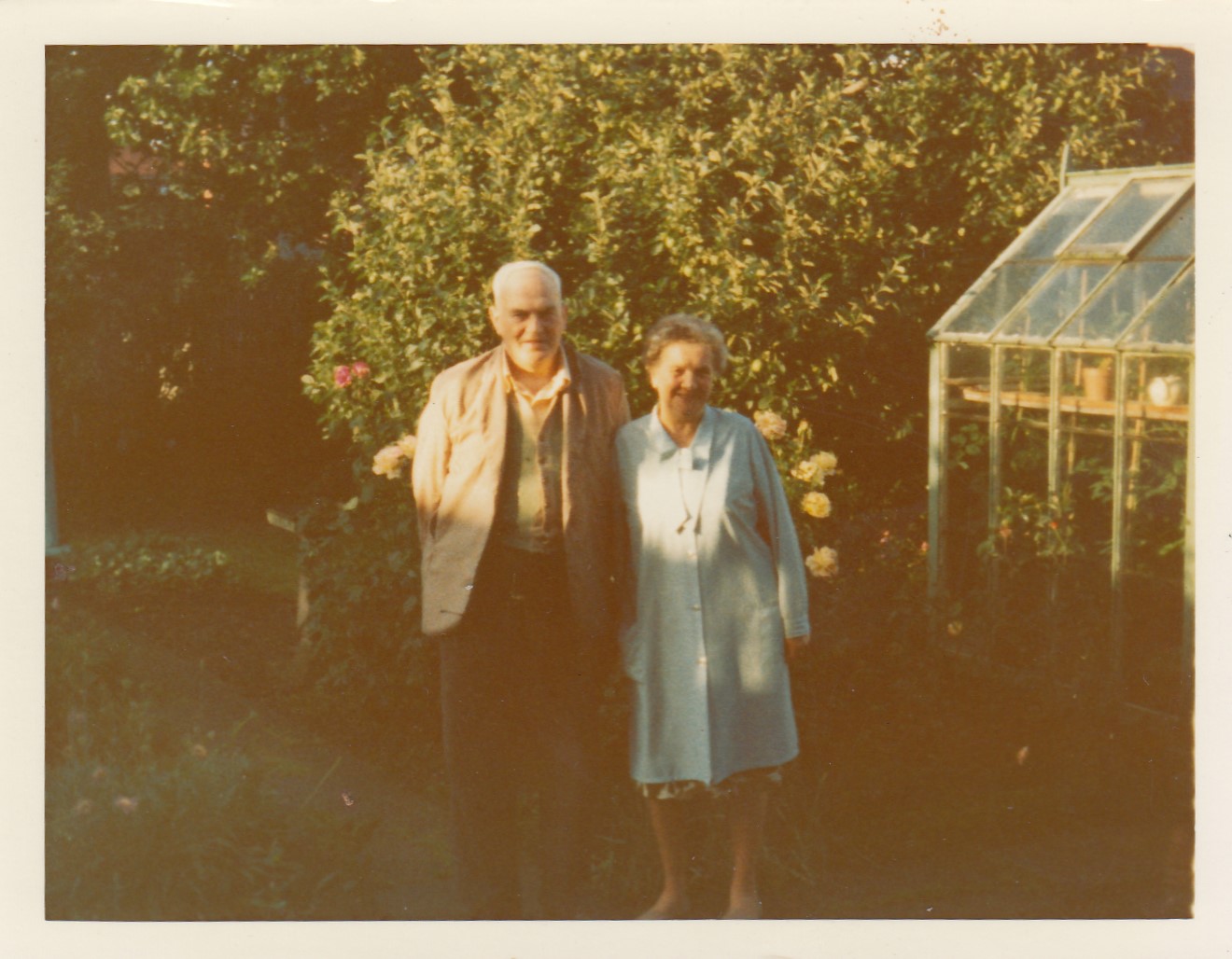
Christine Mary Houseman, Mary Houseman, Hilda Mary Scott & Maria Reynard
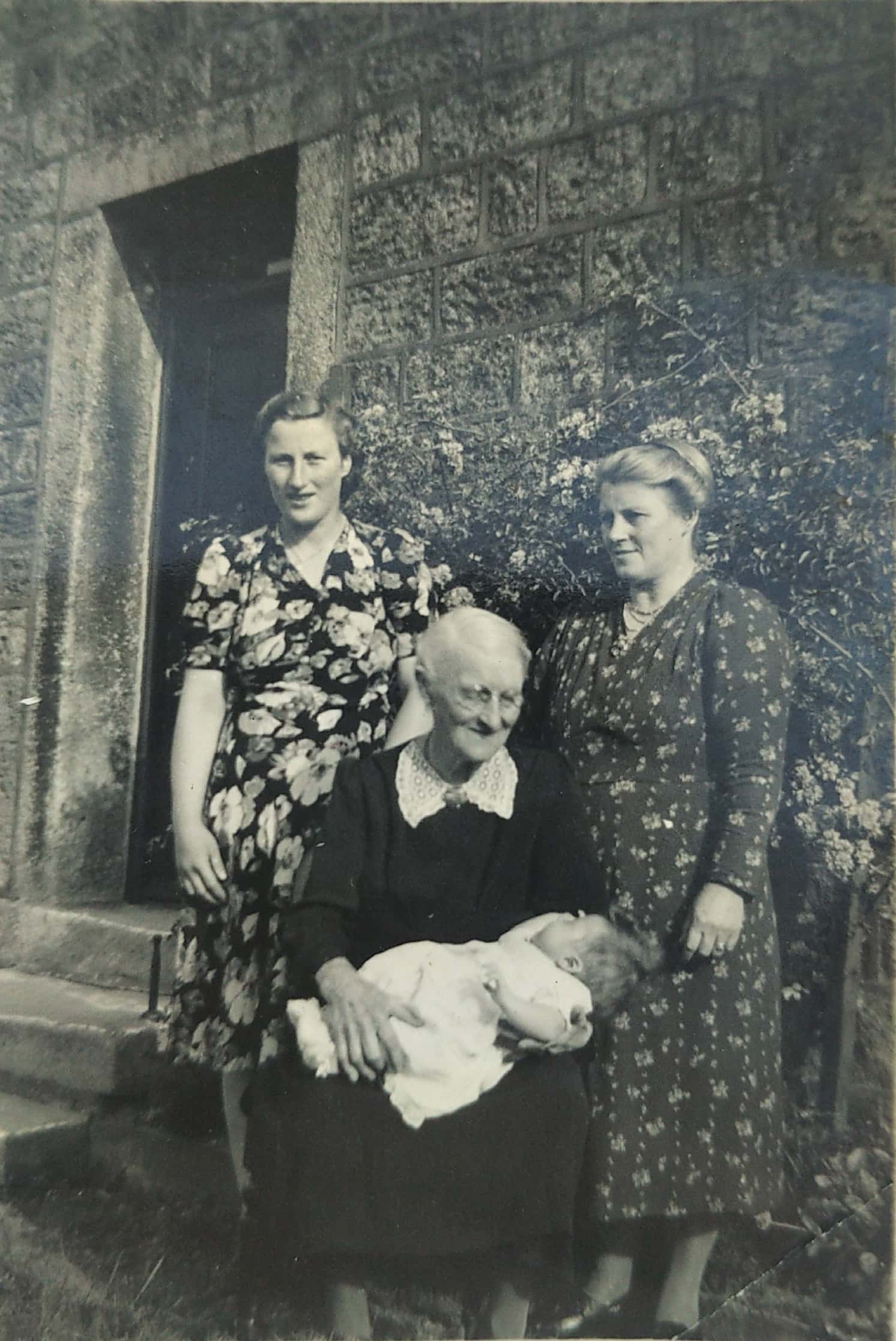
From young to old: Christine Mary Houseman, Mary Houseman, Hilda Mary Scott & Maria Reynard. Own collection

It was Christmas 2002. Grandma (my Dad’s Mum) was known for mostly standard presents, with an occasional inspirational one dropped, unexpectedly, into the mix. This year, it looked like a box of chocolates. I was gracious in my thanks and then I realised it wasn’t in a cellophane wrapper. I opened it up and inside was a photo album working backwards through my life and beyond, from that very summer to the 1940s. Right at the back was photo you see here.

I don’t know exactly why Grandma decided to do this. My best guess is that I was her eldest grandchild and was two years married. I think, perhaps, she was looking to inspire a new generation.

I have loved this photo since I have first seen it. It is August 1947 outside Prospect Farm, Lindley. My Aunt Christine is the baby, her mother, my Grandma, her mother, Hilda Mary nee Scott, Grandma’s mother, my great grandmother and finally Maria nee Reynard, Hilda’s mother and my great, great grandmother. A fellow family story blogger shared their three Grandma photo and story last week and made me want to share this story. It’s a super brief summary of four “mothers” that I plan to share much longer stories about.

Christine Mary Houseman, the baby in the photo, is a very special person in my life. She was born on 13 June 1947. Her older brother, George Christopher, lived just two and a half days, so she was de-facto oldest child. I always got the sense she was encouraged to stay at home, the daughter who would look after her parents. Whether this is true or not, Christine never married. She was a farmer, a caterer, a WI produce judge and a Sunday School teacher at Norwood Bottom Methodist Chapel. Her twin loves that I witnessed were Young Farmers and us, her nieces & nephews. When my Dad, her brother, died in 1984, she was a constant support. The best epitaph for me, though, came many years later when talking to some ex-Young Farmer friends, who said “We still ask ourselves what Christine would have said” – she was as important in their lives as she was in ours. Sadly, Aunty Christine lost her battle with cancer on 1 April 1999.

Mary Houseman, the new mother, my Grandma, was born in 1921. This being the 100 year anniversary of her birth I plan to write a more fulsome story. She married my Grandad, George Houseman, in 1945. This photo, though, tells something of her life. It’s taken on the front doorsteps of Prospect Farm, Lindley. Grandma moved here when she was a young child. She left, briefly, when she married and had returned by the time of this photo. As she writes it

One Monday when Thomas [Grandad’s brother] and George [my Grandad] went to Otley auction they had been talking to my Dad and he told them that George Baxter had got other work as an apprentice joiner in Otley. That just left Dad, Mother and George Barker to start hay time. Would we consider coming back home and taking over the farm? They would find somewhere else to live as soon as they heard of something near and suitable (what a decision for us to make). It was coming back home for me BUT I was now married and felt that I could not please both my husband and Dad. It was harder for George to leave home where he was born and Thomas at the face of hay time. What had we to do? Mother told me that Dad had been so sad and lost without me at home. He was not the only one. Meg my little dog from being a pup just whined and wouldn’t do anything for anybody else. Thomas and George had been to look at other farms previous over the past but never found anything that they liked. So we decided it was an opportunity not to be missed. We came back home to live here at the beginning of July.”

We have photos of Grandma and her own great grandchildren on her 90th birthday just a few steps away from this photo. Grandma didn’t leave Prospect Farm until she was too ill to live without full time specialist nursing care. She died on 31 March 2020 aged 98.

Hilda Mary Scott is stood to the right of the photo. Hilda was born on 31 August 1891 and grew up in Pickhill near Thirsk. She was a beautiful young woman who knew her own worth. She married Jesse Houseman on 28 September 1915 and moved, originally to Haverah Park and then to Prospect Farm. Everything I have read suggests this was a love match, like the postcard from Jesse to Hilda that reads simply “Dear Hilda, hope you are keeping alright, it seems very queer without you. Love from Jesse.” Hilda & Jesse had three daughters, Muriel born in 1916, Jessie in 1918 and my Grandma, Mary, in 1921. She was a champion butter-maker, competing and winning in a number of local shows. Her death on 9 August 1954, of cancer, left her family heartbroken.

Maria Reynard sits at the front of the photo. Maria was born on 16 December 1861, daughter of Mary Ann Gill & William Reynard. She married John Scott in 1885 and together they had eight children, Hilda Mary being the third child and first daughter. The family prospered moving into a detached property, Prospect House in Pickhill, that John had built. By the time this photo was taken, Maria, 85, was already a great grandmother several times over and yet she still looks delighted to be holding baby Christine in her arms. You can read more about Maria’s family photo album and her son, Walter Scott.

Four generations captured together in love and motherhood.

With much gratitude to my Aunt Christine, my Grandma, Mary, my great grandmother, Hilda and my Great Great Grandmother, Maria, in who’s arms the generations have been nurtured, to Joan Weise who’s three Grandma’s blog inspired this one and to Amy Johnson Crow whose 52 ancestors in 52 weeks challenge encouraged me to publish this series of stories.
Annie Bentley & Edith Moody – my mother’s line

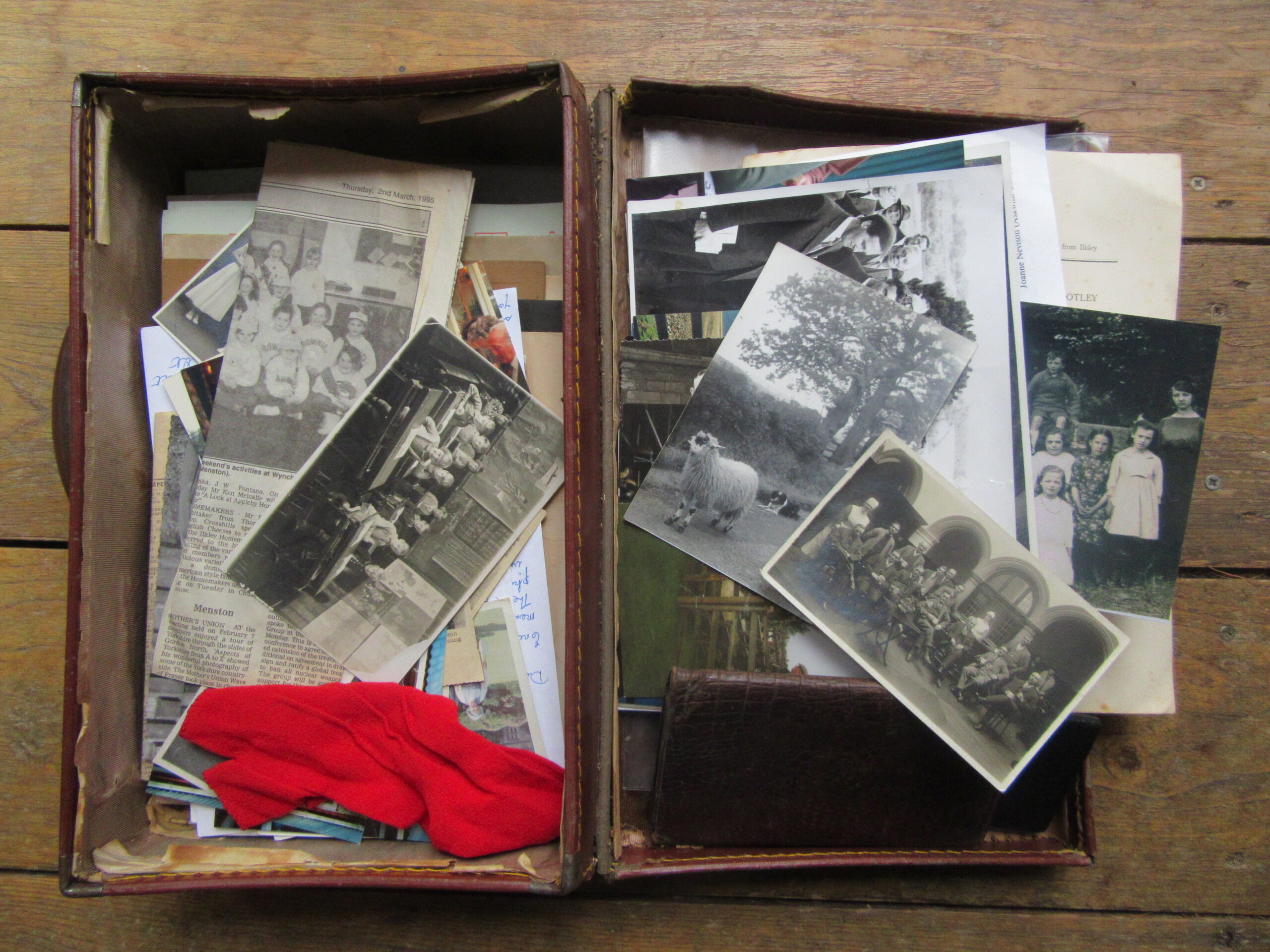
The old leather suitcase full of genealogical goodies. Own photo.

Back in March I snuck up to Yorkshire to see my Mum. It was her birthday, I hadn’t seen her for eight months, she’d had her first jab and she was on her own for a few days. Technically we could be a household bubble as I live on my own, but we were both cautious not wanting to advertise a 200 mile trip at a point when we were still advised to stay close to home. I brought my scanner. Mum dug out a little leather suitcase full of old family photos and documents. We spent three wonderful days identifying photos, family artifacts and sharing family stories.

My Dad’s family history is well documented – my Dad’s Mum, my Grandma, was, essentially, a genealogist. I can also (benefiting from the hard work of others) trace Grandpy’s line (my Mum’s Dad) back to the 1500s.

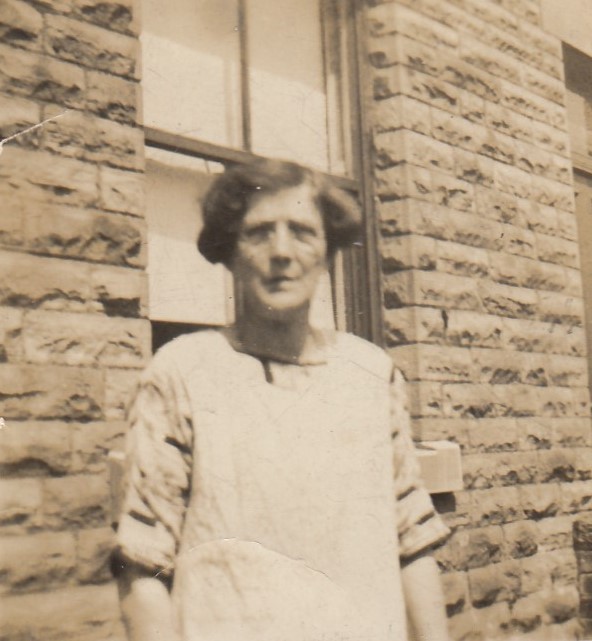
That leaves me with my Mum’s Mum, my Nana, Mary Booth. Her parents, Marion Moody and Arthur Booth grew up in different parts of Yorkshire – Marion’s family were coal miners living close to Wakefield, Arthur’s family were farmers living around the Otley/Bingley area. Those who know Yorkshire will understand why I still have a question as to how they actually met. Both families were relatively poor (two feature in my paupers blog) and moved a lot for work. Of my first 126 direct ancestors (ie up to great great great great Grandparents) I have just one illegitimate ancestor and it’s in this branch [Postscript, November 2022, Annie’s father, also turned out to be illegitimate].  Even the DNA evidence is scattered – just enough distant cousins for me not to question the track, not enough to help me go back. That’s why the most exciting discovery in that little leather suitcase was a photo of my Mother’s Mother’s Mother’s Mother, Annie Bentley – the first one I had ever seen. This being just after Mother’s Day in many parts of the world is a good reason to tell the story of Annie and her family, particularly of her daughters Edith & Elsie, who, for different reasons, never got to be mothers, which makes it important to tell their tale too.

The sole photo of Annie Bentley, own collection

Childhood & marriage

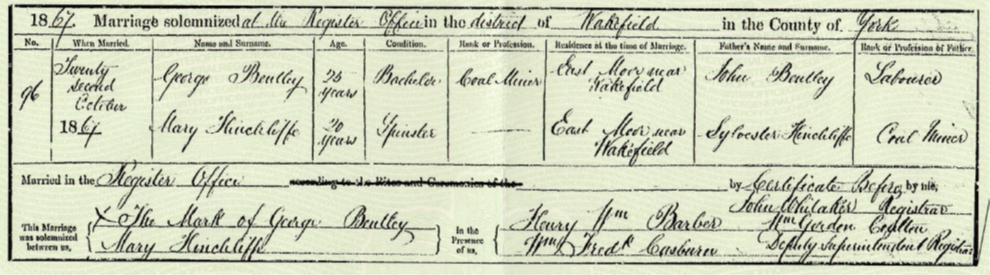
Annie Bentley was born on 7 July 1876 in the village of Netherton, near Wakefield, the fifth of twelve children. Annie’s parents, Mary Hinchcliffe & George Bentley were both from mining families. The Hinchcliffes came from Barugh near Barnsley and the Bentleys from the Netherton area near Wakefield. Whilst Barugh and Netherton are within an easy half hour drive these days it was a very different proposition in the 1860s and 1870s. It seems likely both Mary & George moved for work associated with Parkhill Colliery as their marriage at Wakefield registry office in 1867, has them both living in Eastmoor without family as witnesses.

The marriage certificate of Mary Hinchcliffe & George Bentley, Annie Bentley’s parents, in 1867

By 1882, the Bentleys had settled in Netherton in a row of mining villages called Little London. This little strip of housing was apparently built by Emma Lister-Kaye. Emma was the daughter of Sir John Lister-Kaye who owned Caphouse colliery. Emma, being female, did not inherit the baronetcy, but she did inherit the colliery. She was heavily supportive of the local area and on her death her manager described her as “an aristocrat to her fingertips, and an excellent business brain, which could not be said for her father.” Annie grew up in a miner’s cottage, but likely a better than average one.

The Bentley girls seemed to have developed an obsession with the Greenwood boys. Three of Annie’s sisters married two brothers and their nephew (see my sister is also my aunt). One of these, Florence, moved to Otley, which might just be the explanation for how my great grandparents (Marion & Arthur) met. Annie, however, had different ideas and chose nearby boy, Ernest William Moody. Ernest was just a couple of months older and living in close by Horbury Bridge. In 1891 they were both working in a mill, Annie as an assistant feeder and Ernest as a millhand and whilst I haven’t, yet, been able to prove they were the same one it seems a likely explanation. They married on 26 December 1899 at St Johns, Horbury Bridge. A Christmas wedding sounds romantic but was more likely chosen to coincide with a factory closure.

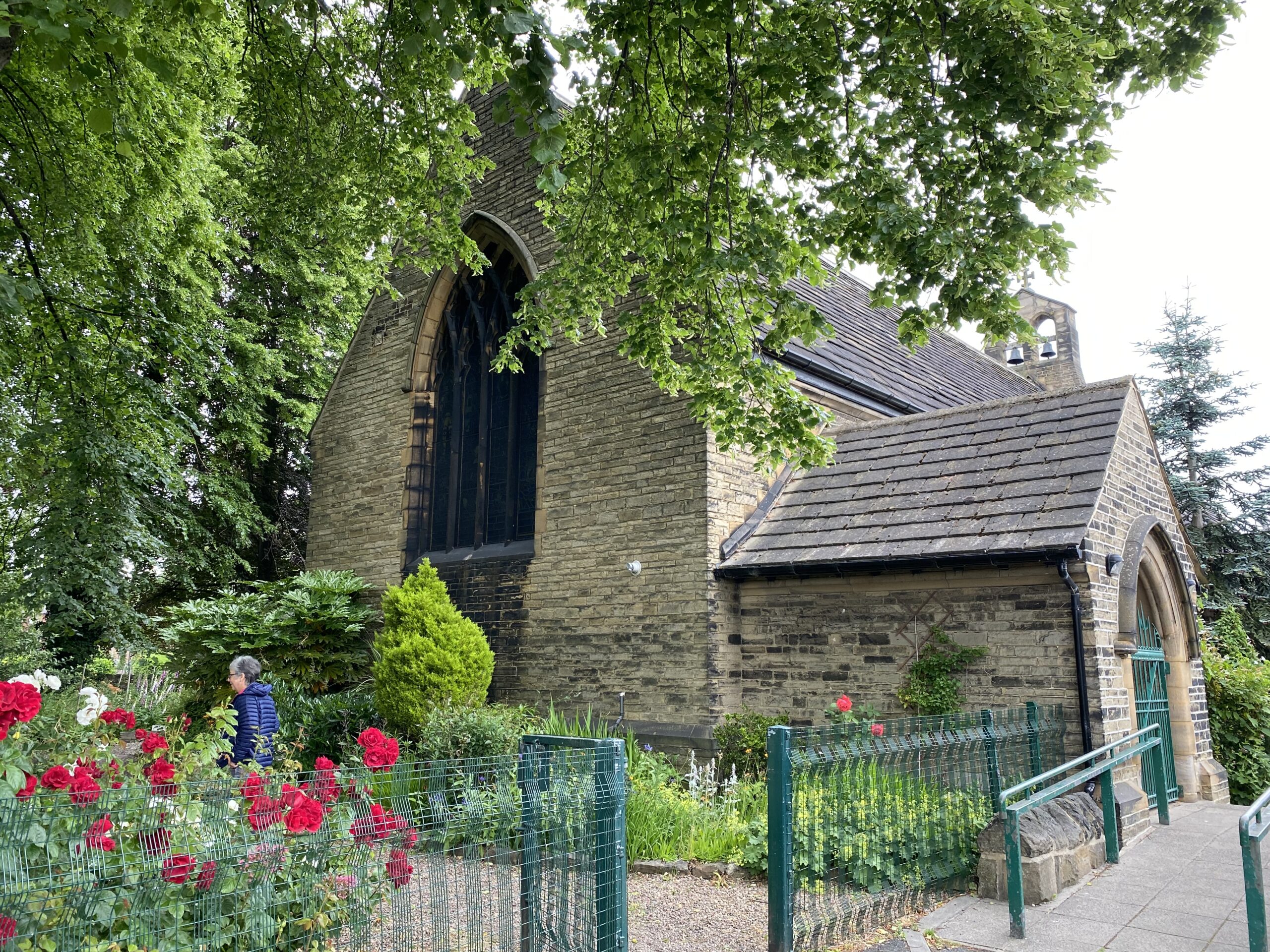
St John’s church, Horbury Bridge complete with Mum. 2021. Own photo.

The Moody family

By 1901, Annie & Ernest were settled in a small terrace house on King Street, Horbury Bridge.

Children followed, Marion (my great grandmother) was born on 5 April 1902, Edith on 15 September 1904, Elsie on 8 February 1907 and then a bit of a gap before a son, George, arrived, on 10 September 1913.

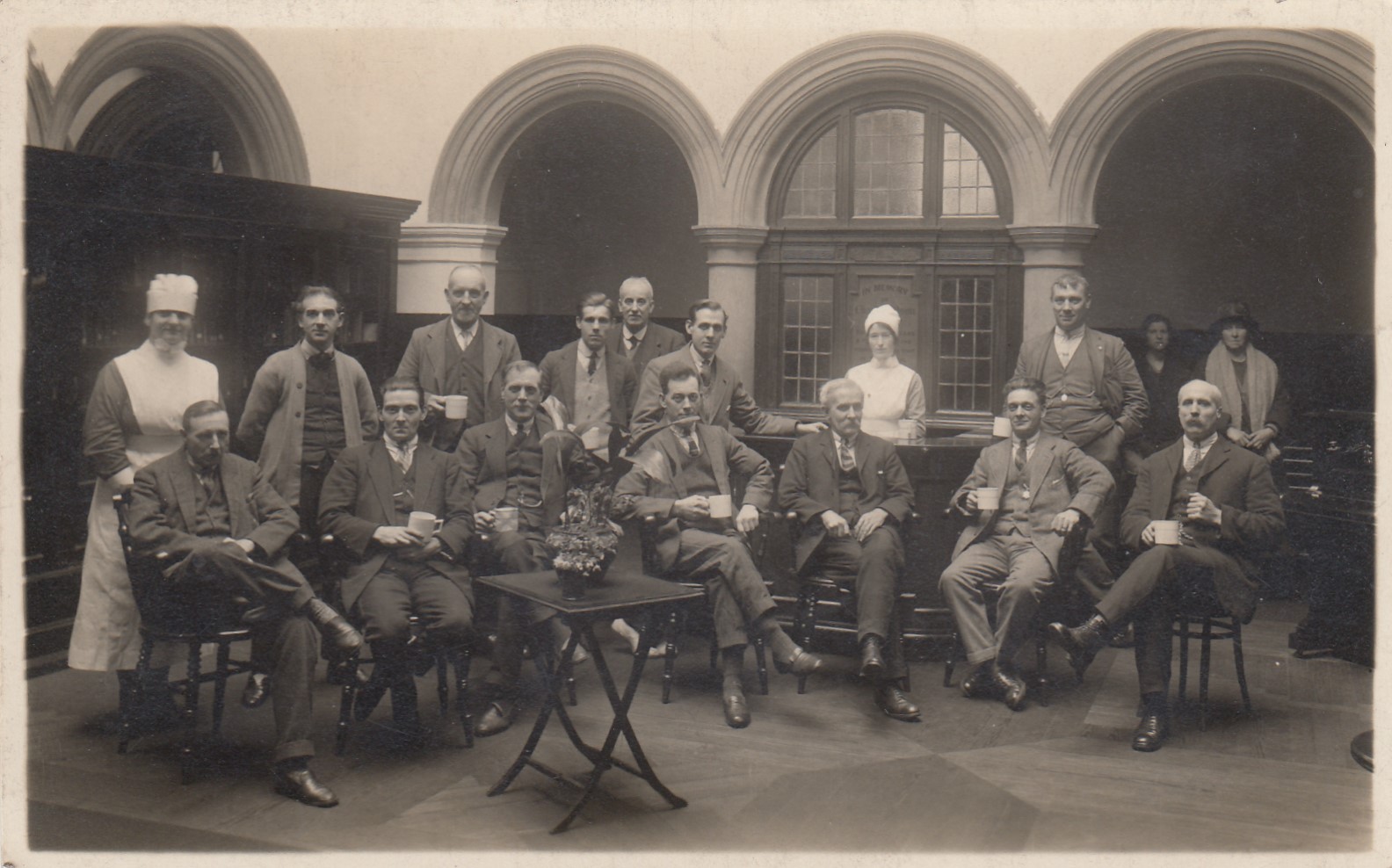
The new century was a time of social movement. The labour party was formed in 1900. In Horbury canals had given way to railroads but left plentiful water for factories and of course there was the coal which drove the economy at that time. There are hints about how the family were involved in this social movement. George (their son) was heavily involved in the labour movement in adult life, Ernest gave some very detailed evidence at the inquest of a fellow worker in 1936 suggesting he was prepared to be public about workplace accidents and then there is an intriguing photo of Ernest at the Harrogate baths that feels like an organising conference of some sort. It’s a direction for future research.

Photo taken at Harrogate Baths. Ernest Moody is sitting on the front row, third from the left. Own collection.

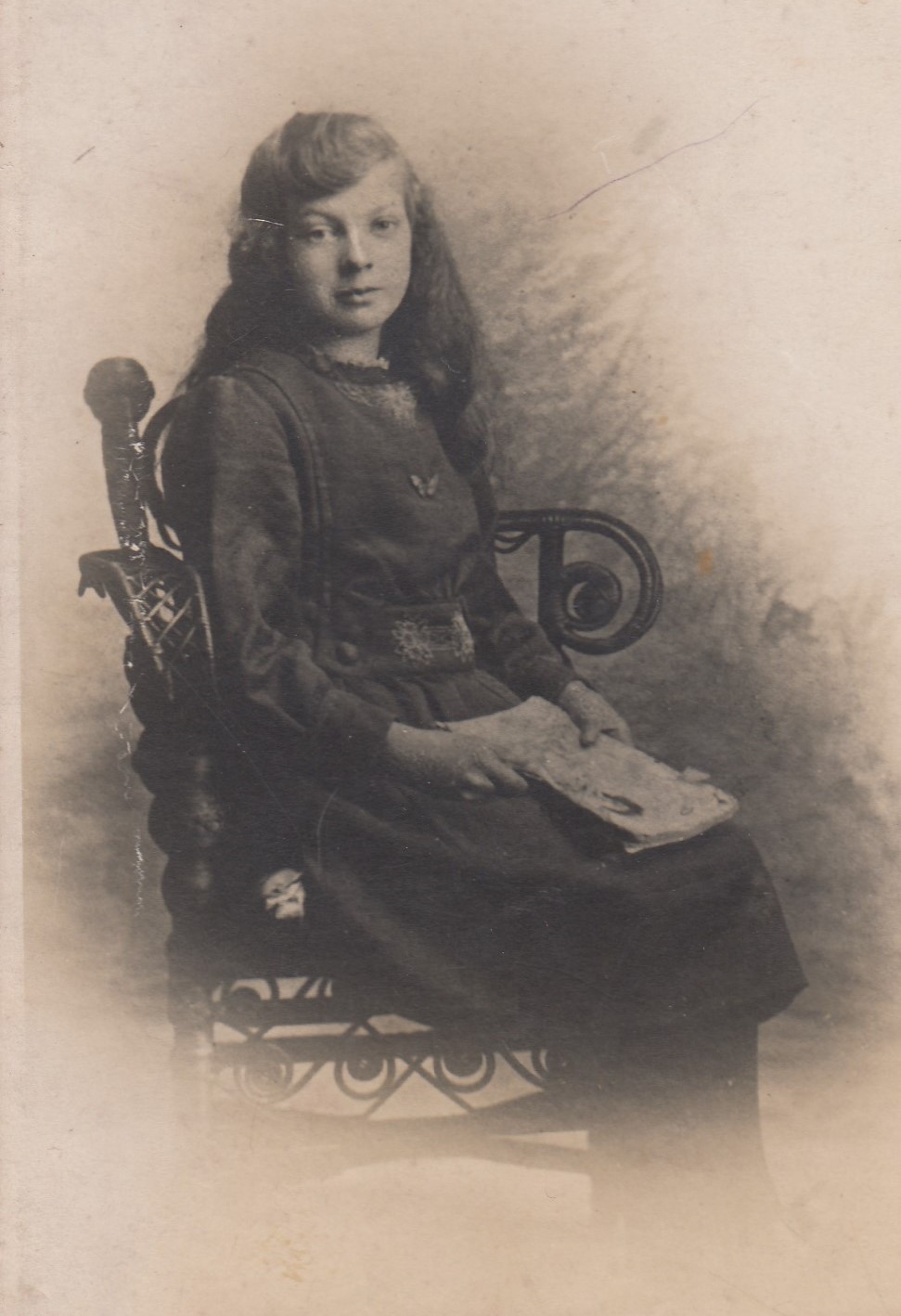
What this meant to Annie is impossible to establish. There is a family rumour that George was the son of the lodger. There was such a lodger, Tom Atkinson, registered on the 1911 & 1921 censuses, but I suspect the rumour is more likely to be a reflection on a couple who had different lives than of an actual affair. More likely still is that this was a family dealing with an ill child. Elsie, Annie’s youngest daughter, died on 29 June 1924, at home with her family in Lodge Terrace, Netherton (now South Lane) in Netherton. She was just seventeen. In the one photo we have she is sat in a chair with a newspaper or magazine and I believe she would have been ill for some time.

Elsie Moody. Own collection.

Annie’s eldest daughter, Marion, my great grandmother, married the following year and moved away. Edith, however, stayed close.

Edith (aka Auntie Edie)

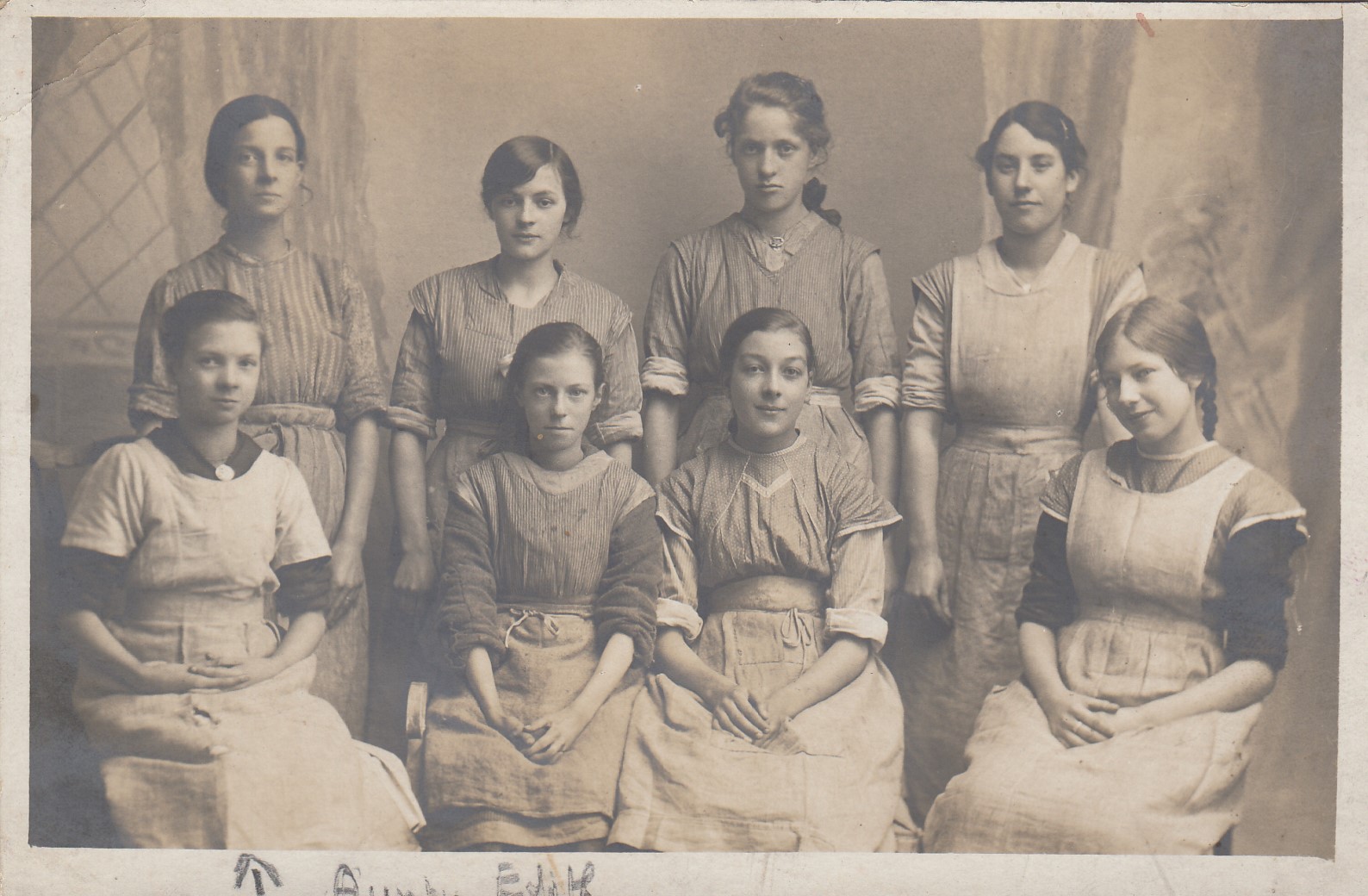
Edith Moody, possibly between 1914 & 1918, possibly in a work place – possibly either a factory or in a hospital. Own collection.

Whilst Elsie’s story is contained within Annie’s, Edith’s continued long beyond Annie’s and deserves its own telling. Whilst my great Grandmother, Marion, died when my Mum was just nine. Auntie Edie was someone I had the pleasure of having personally known. The two things that shine through for me are her love for family and her love for Uncle Charlie.

Annie died in 1932 aged just 56 and Edith married Charles (“Charlie”) William Hardy in 1934. Charlie was cute, came from a good family (his father was a police constable) and he had a solid job in a local factory. Did she wait until after her mother died and no longer needed her at home? Maybe. It was often the case that at least one daughter was “encouraged” to stay at home and look after her parents. There is further evidence of filial responsibility in the 1939 register. By then Edie & Charlie were living at Sunny-Dene, 17 Elmwood Grove, Horbury, the home where the two were to live out their whole lives and her father, Ernest and her younger brother, George, were living with them continuing to be supported by Edie.

Edith Moody. Own collection
Charles Hardy. Own collection

The photos I have continue to tell the tale of family love. They fall into two groups. One group has Edie by the side of her sister Marion either with or without Marion’s two children my Nana, Mary & her elder sister Hilda. The other group is generally taken in the garden at Sunny-Dene, Edie & Charlie with their arms around each other and, generally, a brother, a niece or a nephew.

Edith with her sister Marion (my great Grandmother) and her two nieces Hilda & Mary Booth (my Nana). Own collection
Auntie Edie & Uncle Charlie in the garden at Sunny-Dene. Own collection.

My strongest personal memory of Auntie Edie is of a trip to Horbury, to the garden of Sunny-Dene. I think it was around the time of my birthday and we had were visiting for tea. Auntie Edie’s neighbour gave me a black handbag and this became the holder of my marbles as we competed in the playground of Norwood School. I have no idea who that neighbour was, but this generous gift is a suggestion of someone who made deep friendships with their neighbours.

Sadly, Uncle Charlie died on 13 December 1978 and, yet, even here we have evidence of the closeness of the coupler. Charlie’s probate wasn’t finally settled until Auntie Edie, too, died on 20 February 1984 when the estate, such as it was, was split equally between Edie’s two nieces and one nephew. A few months later my Dad died. My Mum always says that she was grateful Auntie Edie had never had to learn of her great niece’s loss, a reflection of the great affection Auntie Edie had for my Nana & my Mum, who were almost as close as a daughter and granddaughter in her heart. With much gratitude to Annie Bentley and Edith & Elsie Moody who are just three of the people who make up my motherhood. Also, to Amy Johnson Crow whose 52 ancestors in 52 weeks challenge encouraged me to publish this series of stories.
Postscript: Edith also appears in Nana’s box of joy.

St Oswald’s church, Leathley – a place of family joy and sadness

St Oswald’s, Leathley

Religious centres witness our beginning and our end, moments of intense joy and of deepest sadness almost always in the presence of our dearest family and friends. Even for those of us without strong faith they have so much more meaning than just the stone or brick from which they are built. St Oswalds church, Leathley has become that special place for me.

The picturesque village of Leathley is bounded by the river Washburn, a river which features heavily in my family history. It is an old settlement, established in the Anglo Saxon period, more sheltered than many of the surrounding villages. St Oswald’s Church occupies a piece of rising ground in the centre of the village, across the road from the village green, parish rooms and the almshouses. The tower dates from the Norman period and was enlarged in 1472. It is a simple, serene church surrounded by a peaceful graveyard.

Looking south from the village green next to St Oswalds. This is the road I walked to my wedding. Photo © Mark Anderson (cc-by-sa/2.0)

St Oswald’s played an important role in our family for several decades prior to us moving to the village of Leathley in 1988 – this blog brings together some of those stories.

The story starts with my great grandparents, Mary & George Thomas Barrett. When Mary & George Thomas retired in 1948 (passing the tenancy of the family farm in nearby Stainburn onto their son, my Grandpy) they moved to Little London Cottage in Leathley. Sadly their retirement was not to last long. George Thomas died in 1951 and Mary followed in 1954. They were buried, together, at St Oswald’s.

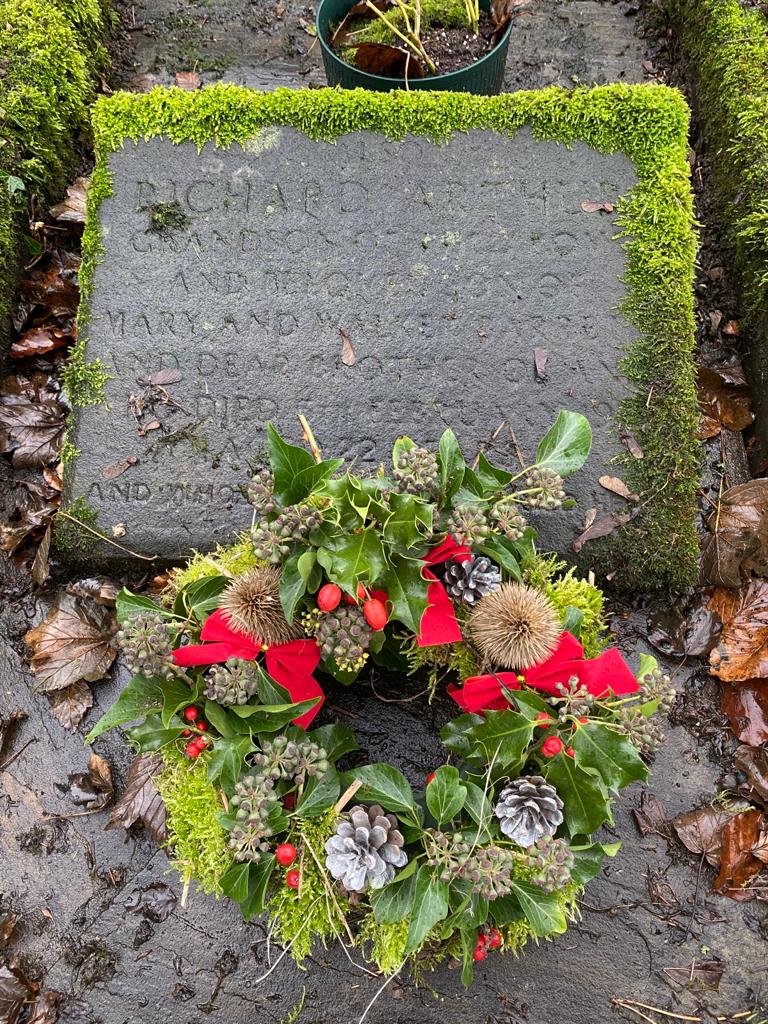
Fast forward nearly twenty years. My Nana & Grandpy, Mary & Walker Barrett watched their two children, Richard & Ann, grow to adulthood. Nana was an active member of Leathley WI and would often have been in and around the church. Then tragedy struck, Richard was killed aged just 22. His funeral was held at St Oswald’s and Richard’s remains buried with his grandparents, no doubt in the hope they would be together. 

Headstone for Richard Arthur Barrett, my uncle

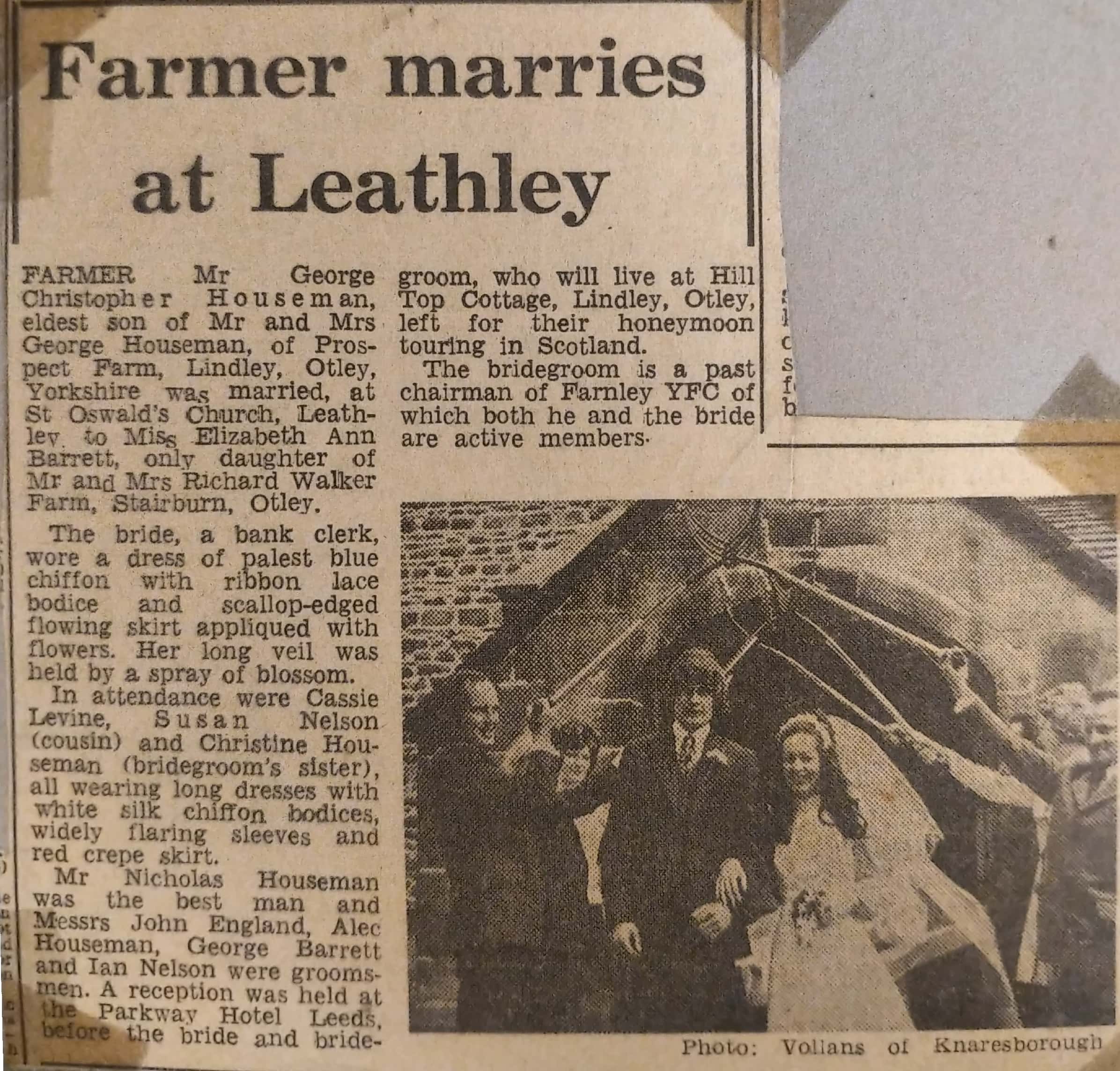
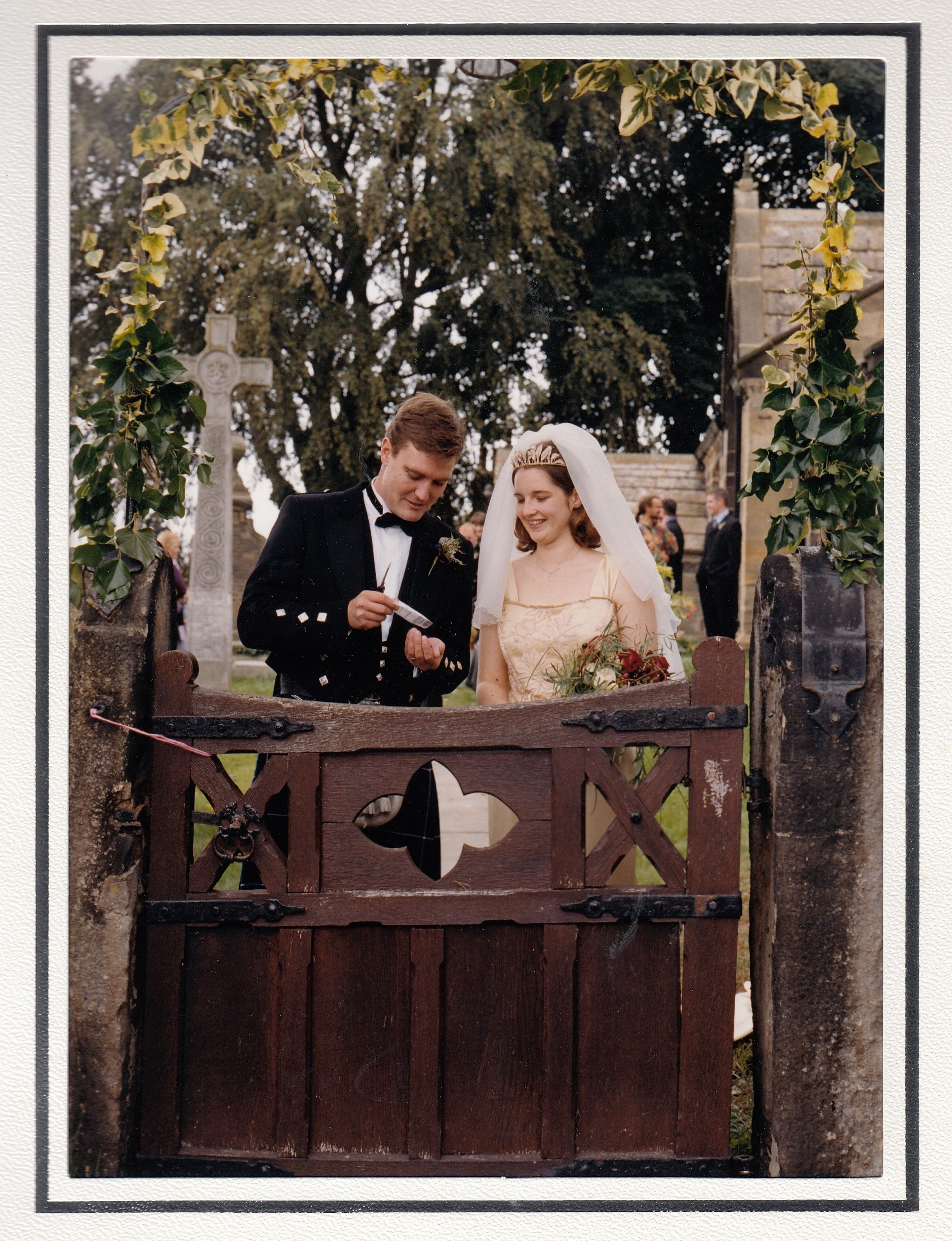
It is then that our connection takes a more joyful turn – the wedding of Ann (my Mum) & George Christopher Houseman, otherwise known as Bob, (my Dad) on 9 June 1973. Although Stainburn has its own beautiful church, weddings were no longer being held there. Instead the wedding should have taken place at North Rigton. It was St Oswald’s though, that held a special place for the family and so Ann moved in with family friends (Dot & Dennis Beecroft) to be technically within Leathley parish for the three weeks whilst the banns were read. One must assume that this was with the blessing of the vicar!

It was a glorious, joyful, special occasion, a time to put aside the family sadness and celebrate the coming together of two very special people. Mum wore “a dress of palest blue chiffon with ribbon lace bodice and scallop-edged flowing skirt appliqued by flowers” made by Nana. The Young Farmers provided a guard of honour with forks and the tradition of lifting the bride over the lychgate was upheld.

Mum & Dad’s wedding

Then it was time for christenings, my own in 1975, and those of my three sisters in following years. It’s a beautiful old font topped by a carved wooden triangular canopy but, no matter how beautiful, the shock of the cold water was still making some of us cry!

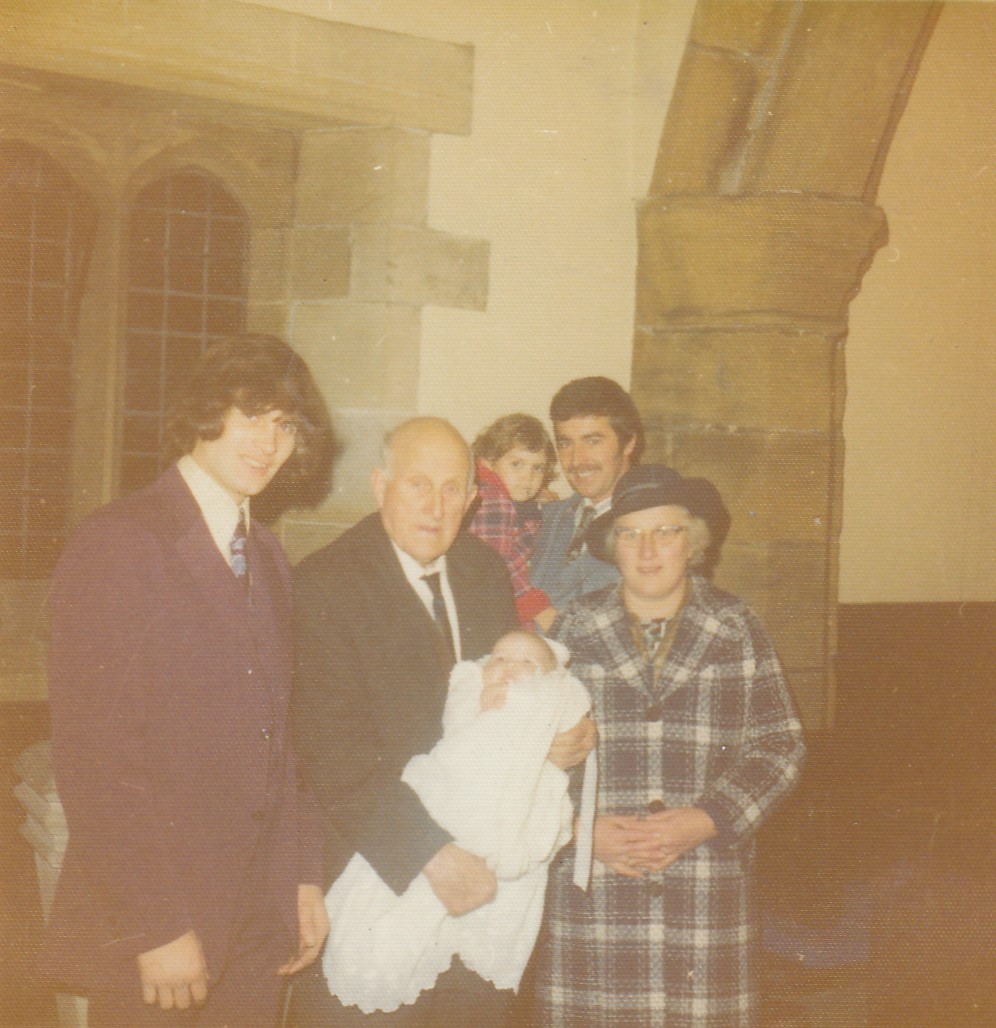
My christening at St Oswalds. Left to right: George Christopher Houseman (my Dad), Jesse Houseman (my greatgrandad), me, Mary Houseman (my Grandma) and behind Joseph Ross (Godfather) & Tracey Ross.

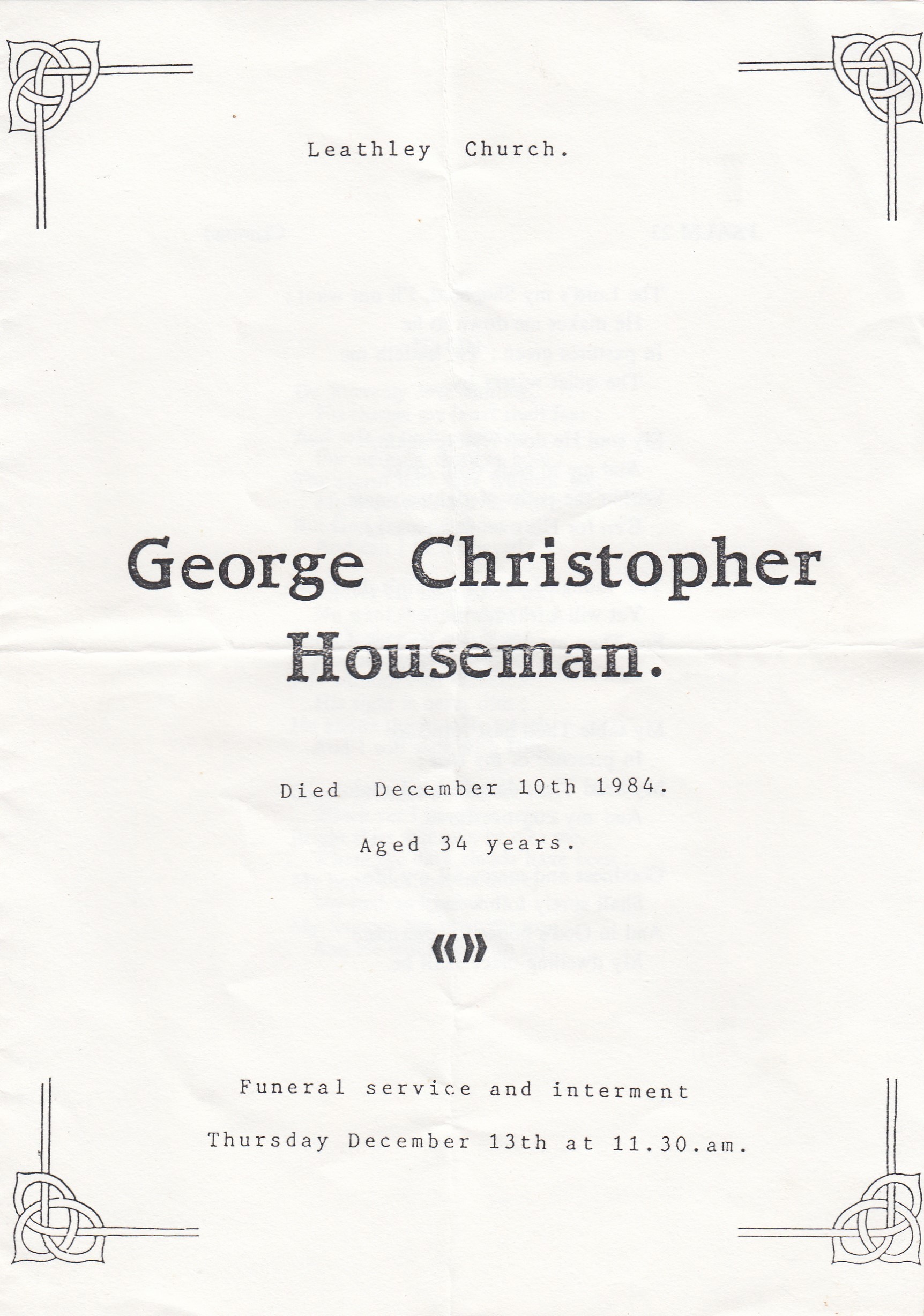
Then in December 1984, my Dad was tragically killed in another road traffic accident. Someday I’ll feel able to write fuller stories of my Dad. But it was to St Oswald’s we turned for the solace provided by a final resting place. My brother’s christening, held early the following year at St Oswald’s, was bittersweet.

Although Nana & Grandpy had retired to Otley, it was to St Oswald’s we turned when Nana died in 1999 and she was buried close to her son. The church was overflowing, those planning perhaps not quite understanding how much she meant to so many people. It became Grandpy’s final resting place too, many years later.

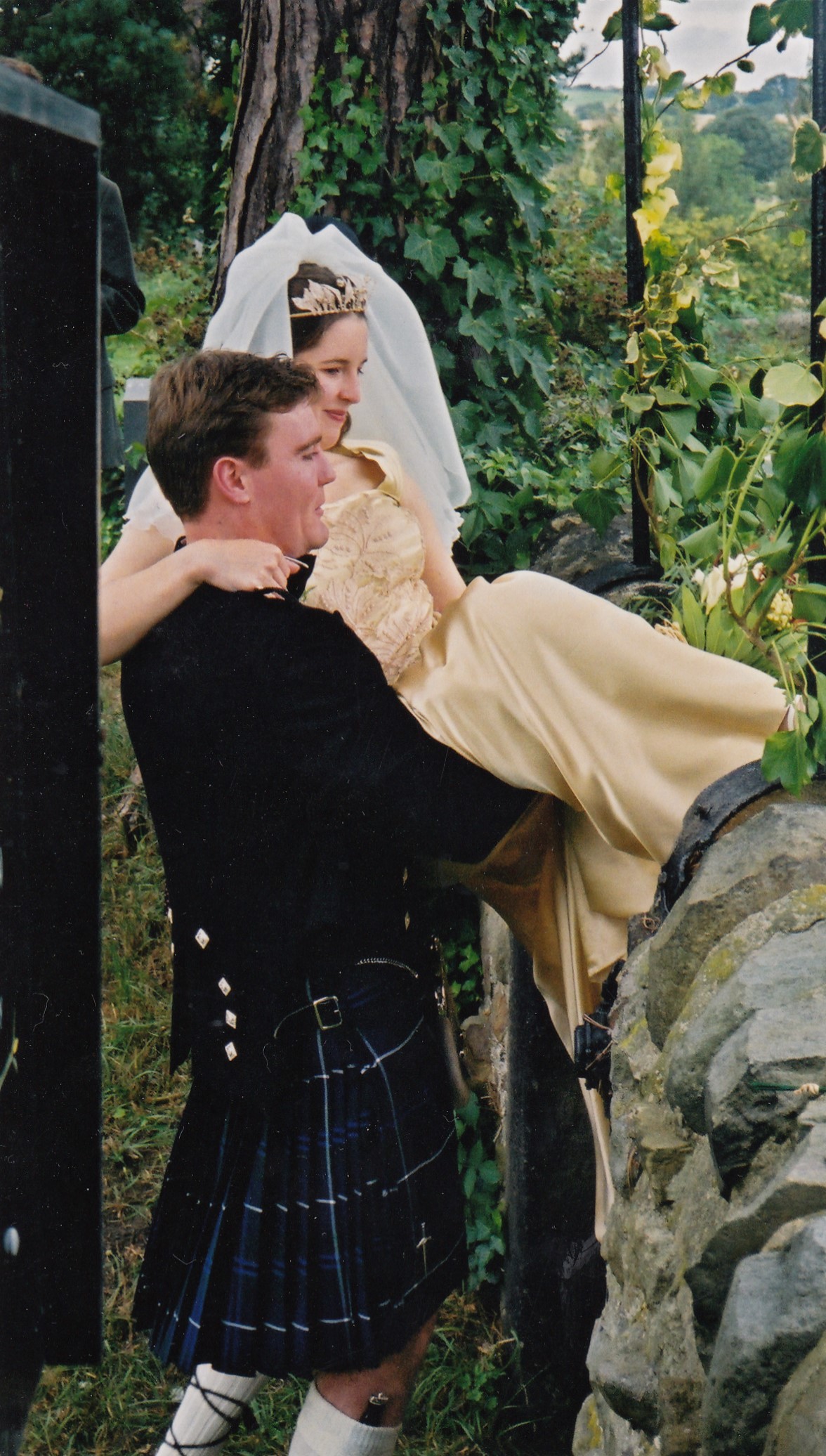
Again the cycle turned. When I got engaged to Paul there were all the usual decisions to be made – location for the reception, wedding outfits, photographer, band, but there was only one place I wanted the ceremony to be held – St Oswald’s. I chose to walk to the church through the village providing a strange spectacle no doubt for the cars speeding past. Our wedding was witnessed by friends & family, there was a guard of honour from the Young Farmers (this time with shepherds’ crooks) and, although a little red-faced, Paul continued the tradition of lifting the bride over the lychgate. In amongst all the celebration there was time to visit my Dad’s grave and it helped to know that he was there in the churchyard with us.

My wedding, 9 September 2000, inside St Oswald’s
The lychgate at St Oswalds

Mum, too, chose St Oswald’s when she married six months later – in the church records there is only one other wedding between mine & Mum’s. One of my sister’s, too, chose St Oswald’s for her wedding.

My Mum signing the register at Leathley for her second marriage to Joe Ross.

I moved to Leeds and Mum moved to live with her new husband near York. We still visited Leathley regularly but were no longer living in the parish. Then our third family tragedy. On 3 May 2004 my husband Paul was killed, aged just thirty, in yet another road traffic accident. The vicar had changed since we were married and initially questioned why Paul’s funeral should be held at Leathley when we no longer lived in the village. It didn’t take long for someone to share the importance of St Oswald’s to our family. Paul has a small square stone close the second entrance. He’s safe there with my Dad, my Nana & Grandpy, my Uncle and his Grandparents. My family take wreaths at Christmas and bluebells in the spring.

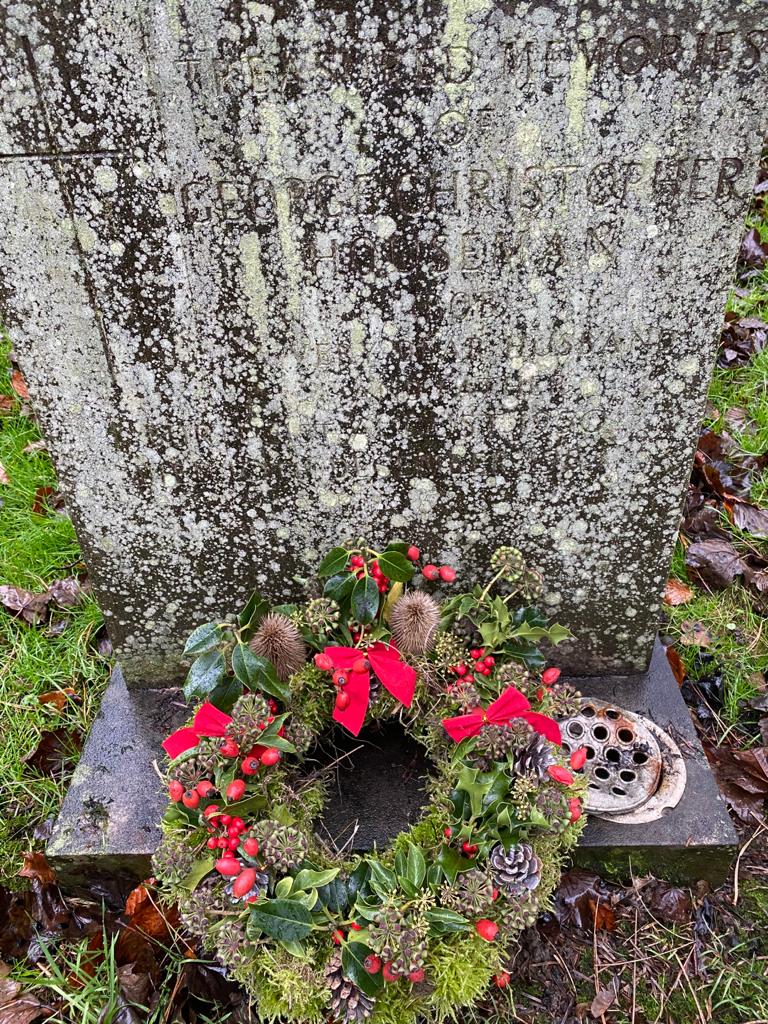
Gravestone of George Christopher “Bob” Houseman with a wreath at Christmas.

It is the joy and the sadness that makes St Oswald’s hold a very special place in my heart.

You can read more about Grandpy’s life and the early part of Mary Wellock’s life at Toft Gate.  

With much gratitude to St Oswald’s of Leathley, to the many clergy who supported us through these times and to Amy Johnson Crow whose 52 ancestors in 52 weeks challenge encouraged me to publish this series of stories.