Grandma’s locket

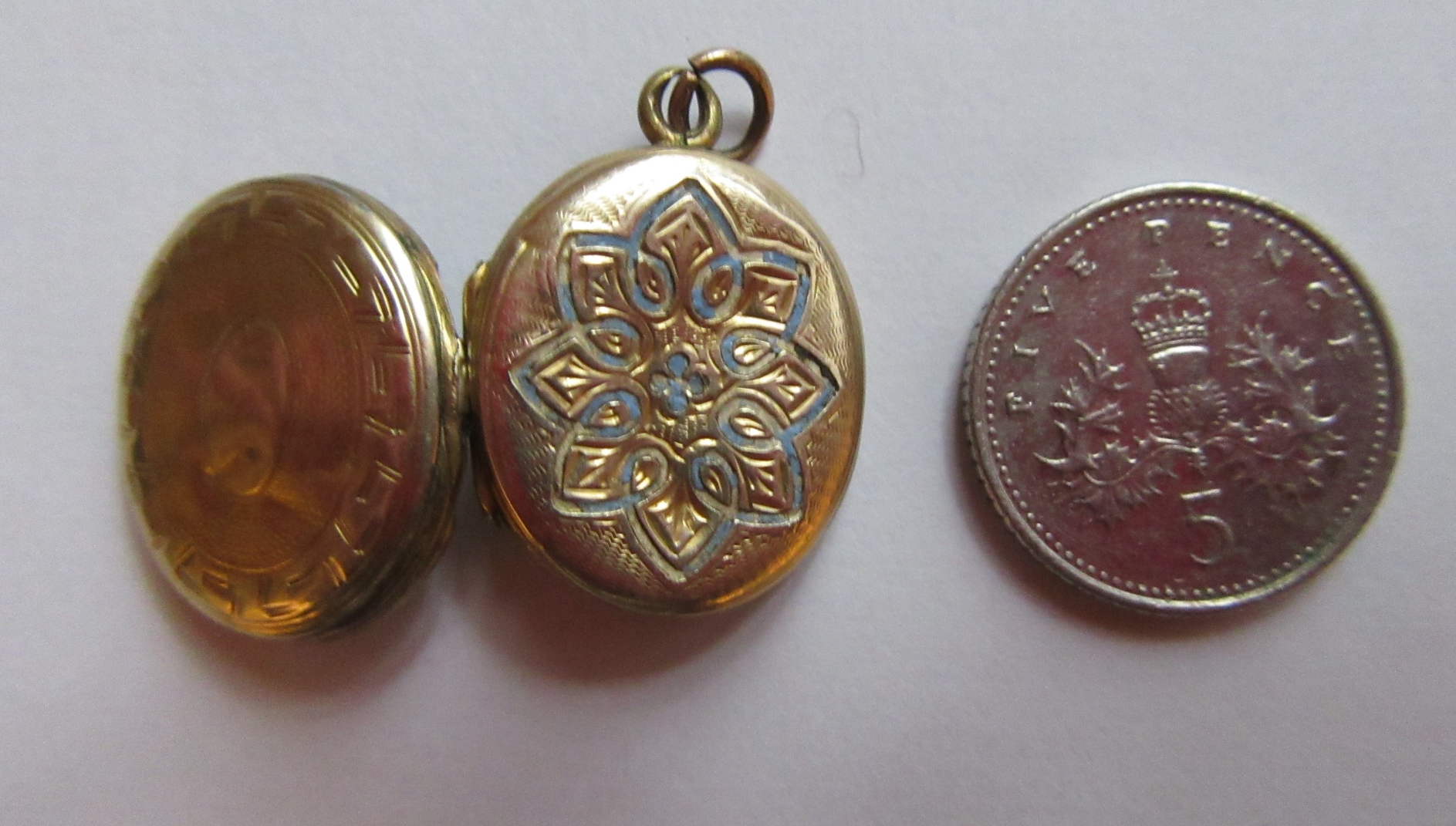
Grandma’s locket. Own photo.

Smaller than a modern five pence piece made of nothing more valuable than gilt and paste, Grandma’s locket could hardly be considered an heirloom. Until, that is, you unpack the stories.

Grandma’s locket. Own photo.

The locket tells of two wonderful times in my Grandma’s life.

Grandad’s picture matches the wedding photos leading me to think this was a wedding gift. As my uncle recently said, “she worshipped me father.” There’s Thomas in the background, brother Thomas, twelve years older, who acted as the father figure when my Grandad’s dad died but perhaps didn’t always act in my Grandad’s best interest when it conflicted with his own.

Grandma’s picture appears to be taken from the one below. She’s with Mary & Jim Marshall (George’s sister & brother-in-law) and likely one of George’s sisters. Neither Aunty Mary nor Aunty Hilda ever had children of their own and remained close to Grandma all her life.
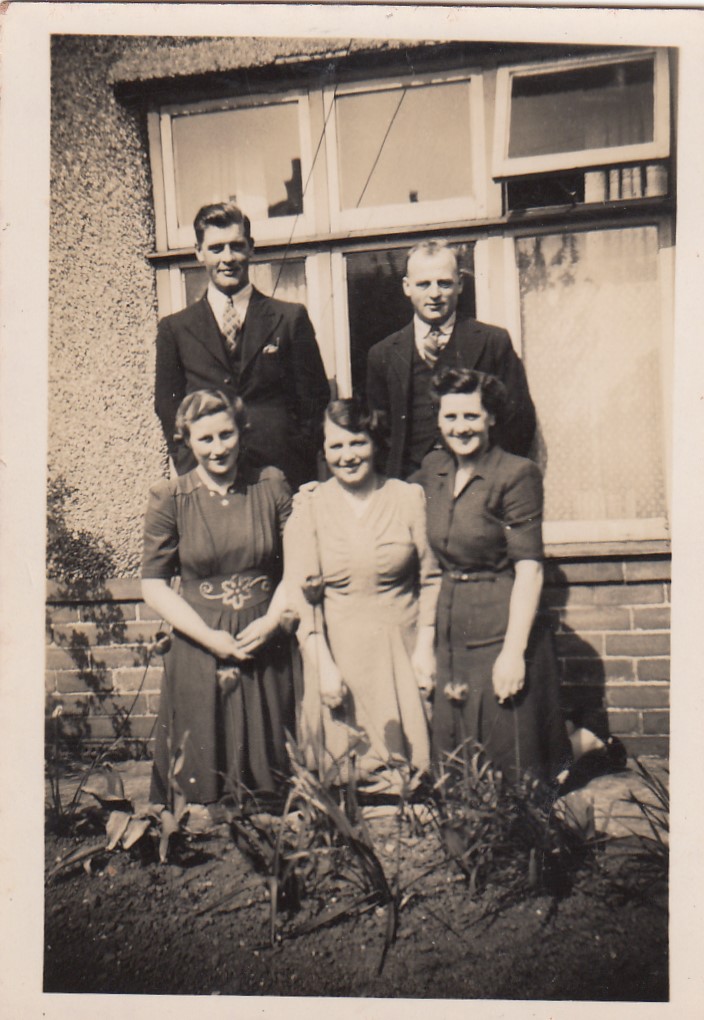
Grandma & Grandad are on the right, Mary (Grandad’s sister) & Jim Marshall on the left & I believe it’s either Hilda or Annie (Grandad’s sisters) in the middle. Own collection.

Yet the patina of this locket holds far more of our family history than just two photos of special times.

Twelve times in my life (so far) people have broken into my home and stolen money, TVs, computers, rings and whatever else was worth selling at the time. In one particular house it became fairly standard to come home on a Friday night and find that the house had been broken into. I’ve learnt how to hide or wear the few pieces of jewellery that is either valuable or sentimentally important. I’ve learnt not to take it personally.

Twice though the burglars have taken an entire jewellery box.

The second time was (I hope) my last burglary. I lost the necklace my dead husband had bought me and the ring I’d bought myself after sneaking away with my sister from him & his friends to visit the diamond museum in Amsterdam. I lost the silver bracelet which held charms purchased to reflect twenty years of my life. I lost the paste necklace that was my go-to for posh black-tie events. I lost the little silver stamp holders that made me smile every time I posted a birthday card. I lost the poppy brooch my Mum had bought me because it was the flower for my month of birth. I lost the cheap plastic orange ring that was festival perfect. I even lost the box that my sister had carefully chosen to store all these “treasures.” It hurt.

The first time this happened it was my Mum who suffered. Six months after my dad died Mum arrived home to find our house had been broken into. They’d watched the house; they knew she took my sister to playschool on a Friday morning. They’d gone straight to her bedroom and ransacked one jewellery box, before someone disturbed them, and they ran taking the whole of the second box. So many memories embedded in inexpensive jewellrey that would likely just get thrown were gone. Unlike when it happened to me, Mum had never been burgled before. Whether you’ve experienced this type of crime or not, take a moment to think how it felt to lose so many memories so soon after losing the person to whom they related.

Grandma did the best she could. She took out her own jewellery box and encouraged my mum to take what she wanted. The tiny locket was amongst the things Mum chose. And in doing so this tiny locket became a family heirloom.

An addendum

One of the wonderful things about writing up & sharing these stories is they often lead to more family memories. Amongst the contents of Grandma’s jewellery box was a broken signet ring. Mum had it mended and inscribed with A for Ann. When my sister tried it on she declared it was A for Anna and it has remained on her hand for the last 30 years!

Is it A for Ann or A for Anna?

I am planning a series of stories about objects imbued with family heritage. I’ve been thinking about this for a while and was finally inspired to write by a workshop on the history of an item by Gudrun Laurent part of the wonderful Curious Descendants Club run by Natalie Pithers.
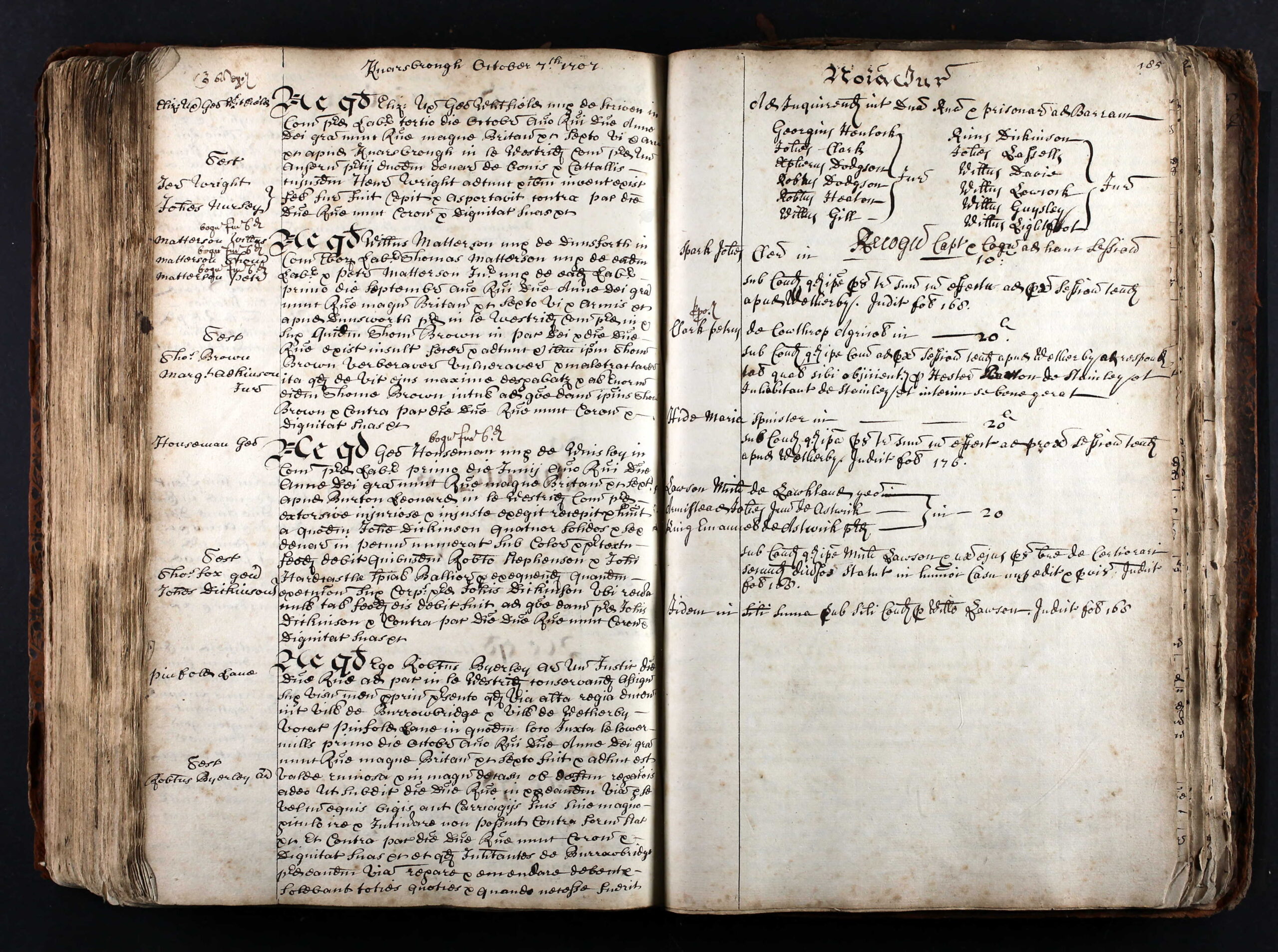
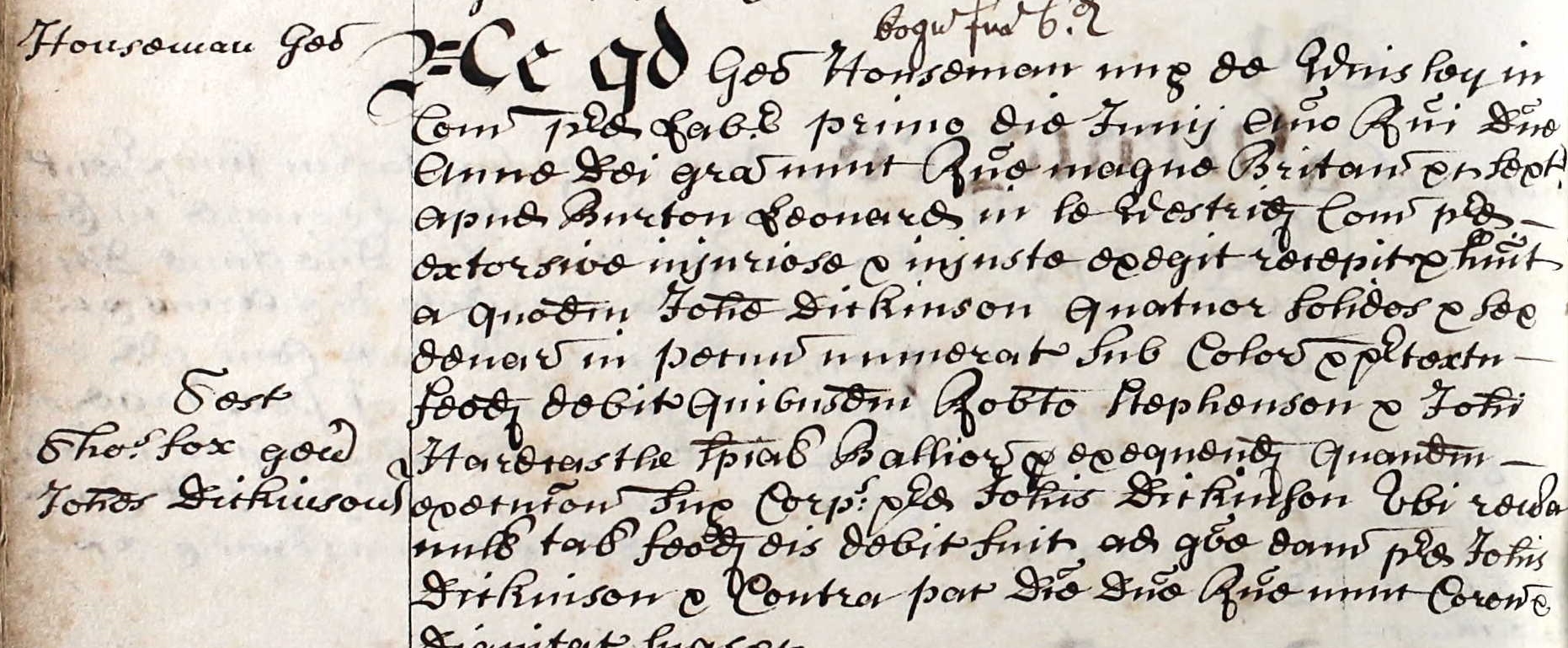
This document told of a crime but was it “our” George Houseman?

The full record from Ancestry, Yorkshire, England, Quarter Session Records, 1637-1914

The year was 1707. Queen Anne was on the throne: Queen in her own right, her husband merely a consort. Britain was now just about a “thing” as the negotiations over The Scottish Union were to conclude the following year. We had survived the Glorious Revolution, the Nine Years War and were now fighting the War of Spanish Succession “to preserve the balance of power in Europe”. Despite the heavy land taxes (four shillings a pound) government borrowing increased leading to the formation of the Bank of England in 1694. England was polarising and, in the countryside, successful (tenant) farmers were beginning to dominate the rural economy leaving the less successful to drift downwards into the life of the landless labourer. Closer to home the medicinal powers of the Harrogate springs were starting to draw increasingly large numbers of people to test the purported curative powers.

1707 was also the year that Jeremiah Wilkinson “of Wooten” [likely Weeton] was recorded as being buried at Harewood on 8 December. Jeremiah could be our 9x great grandparent through his son, John, a product of his first marriage to a woman called Ellen rather than Grace Moore who our Jeremiah may have married at Harewood on 4 July 1671. Jeremiah is a rather typical example of the nearly 100 ancestors I can name who were alive in the year 1707. I know nothing more than can be gleaned from church records. This brief paragraph is the sum total of everything I know.

Imagine my excitement then when ancestry offered the hint of a record from the Yorkshire Quarter Sessions of a George Houseman of Winsley indicted on 7 October 1707 with a copy of the original document.

Houseman is not like Smith or Cooper. www.freebmd.org.uk currently shows records for just 2,639 births in England & Wales between 1837 and 1997(*) of which just under half were born in Yorkshire. The Housemans of Nidderdale database records 674 that are proven to directly connect to us and Hartwith cum Winsley was a township right in the centre of it all.

I opened it and realised eighteenth century handwriting was the least of my worries as the record was in Latin…….More tantalising still when I searched the database there was a second indictment for Georgius Houseman, also of Winsley, in 1717. Was it worth investing in translation? What did I know of my Houseman ancestors at that time? Who could have been of an age to commit crimes in 1707 and 1717? Was it, in fact, my 6x great grandfather George Houseman, the father of the George Houseman who married Margaret Grange and was the founder of our local dynasty?

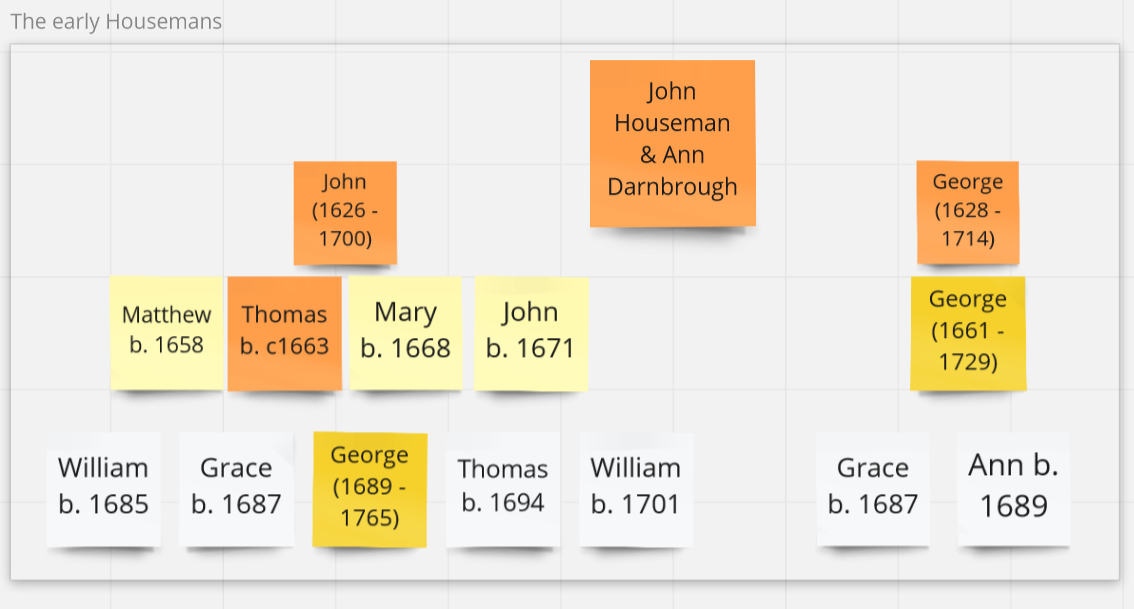
Which George Housemans were in contention? Own miro board.

I spent the evening on two trusted (but secondary) genealogical websites. It seems there are two potential contenders. A father’s cousin or a cousin’s nephew, in modern parlance a first cousin once removed

A. My ancestor, baptised on 14 May 1689 at Kirkby Malzeard, son of Thomas Houseman and Elin Carrick. This George married twice, first to Mary Jackson on 11 June 1710 at Kirkby Malzeard who was buried on 1 February 1722 at Ripley and second to Margaret Wilks in 1723 at Pateley Bridge. George’s only recorded children come from his second marriage. Three of his children were recorded as being on Winsley in 1685, 1687 and 1701 in their baptisms.

B. My ancestor’s father’s cousin baptised on 27 April 1661 at Hampsthwaite, married Anna Leuty on 21 January 1686 at Kirkby Malzeard. Two known children: Grace (baptised 1 May 1697 at Ripley) and Ann (baptised 29 November 1689 also at Ripley). One of his daughters, Grace, was recorded as being from Winsley when she was baptised in 1687 and this George was also recorded as being from Winsley when he was buried in Ripley in 1729.

(And as an aside for future the original John Houseman was apparently “slain in Mr. Wythes barn of Eastkeswick with thunder” – how hard was that not to drop into a rabbit hole).

I had no choice, I had to get the Latin translated and here we are:

The full record from Ancestry, Yorkshire, England, Quarter Session Records, 1637-1914

Knaresborough October 7th 1707

George Houseman: And that George Houseman, late of Winsley in the aforesaid county, labourer, on the first day of June in the 6th year of the reign of lady Anne, by the grace of God now queen of Great Britain, etc, at Burton Leonard in the West Riding of the aforesaid county, extortionately, injuriously and unjustly exacted, received and had from a certain John Dickinson four shillings and six pence in ready cash, under colour and pretext of a fee due to a certain Robert Stephenson and John Hardcastle, special bailiffs for executing a certain execution upon the body of the aforesaid Dickinson, where in truth no such fee was due to them, to the serious damage of the aforesaid John Dickinson and against the peace of the said now lady queen, her crown and dignity, etc.

Witnesses: Thomas Fox, gentleman, John Dickinson.

Acknowledged: fine 6d.

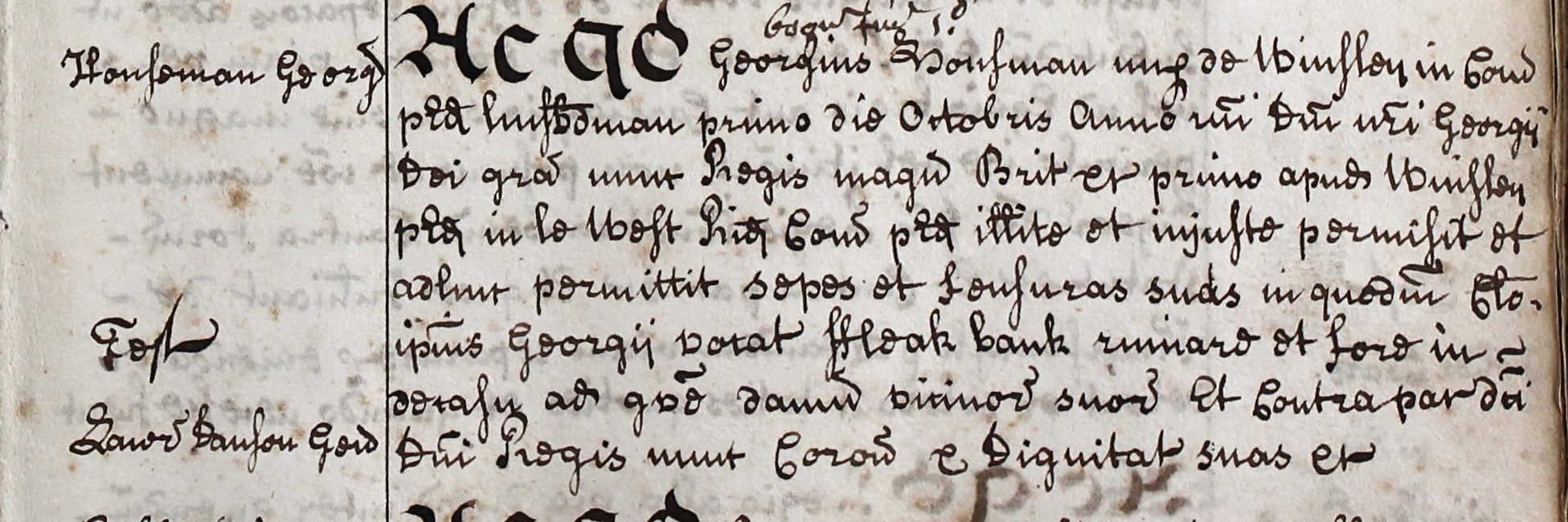
The full record from Ancestry, Yorkshire, England, Quarter Session Records, 1637-1914

­­­­­­­­­­­­­­­­­­­­­­­­Knaresborough 5th October 1714

George Houseman: And that George Housman, late of Winsley in the aforesaid county, husbandman, on the first day of October in the first year of our lord George, by the grace of God now king of Great Britain, etc, at Winsley, aforesaid, in the West Riding of the aforesaid county, unlawfully and unjustly permitted and still permits his hedges and fences in a certain close of the same George called Fleak Bank to be in ruin and decay, to the serious damage of his neighbours, and against the peace of the said now lord king, his crown and dignity, etc.

Witness: Lawr[ence] Danson, gentleman.

Acknowledged: fine 1s.

So we have a labourer in 1707 who extorted money and a husbandman in 1714 who didn’t keep his hedges cut….

George A (my ancestor, the younger) was married for much of this period. George B (the older) had two daughters. Both have links to Winsley. Was it youthful exuberance (George A would have been aged 18 & 25 when the crimes happened) or an older man not knowing how to stay solvent in a changing world with only daughters to see him through (George B would have been 46 & 53)? My gut feel knowing George A left a legacy is that it was the other but who knows? And either way they are both part of my history and understanding of the world in 1707.

*On 28 April 2022, the Houseman count on www.freebmd.org.uk stands at 2,639, the Wellock count at just 1,239 – if I ever do a one name study, I will do two. These two family surnames are heavily concentrated around specific locations in Yorkshire. If you are a descendant of anyone bearing either of these surnames, there is a high chance we are related and a good chance I can prove how – please do get in touch!

The naming of our grandparents

My siblings & I have never quite agreed how to spell Grandpy (my mum’s dad). Is it Grandpy, Grampy or Granpy?

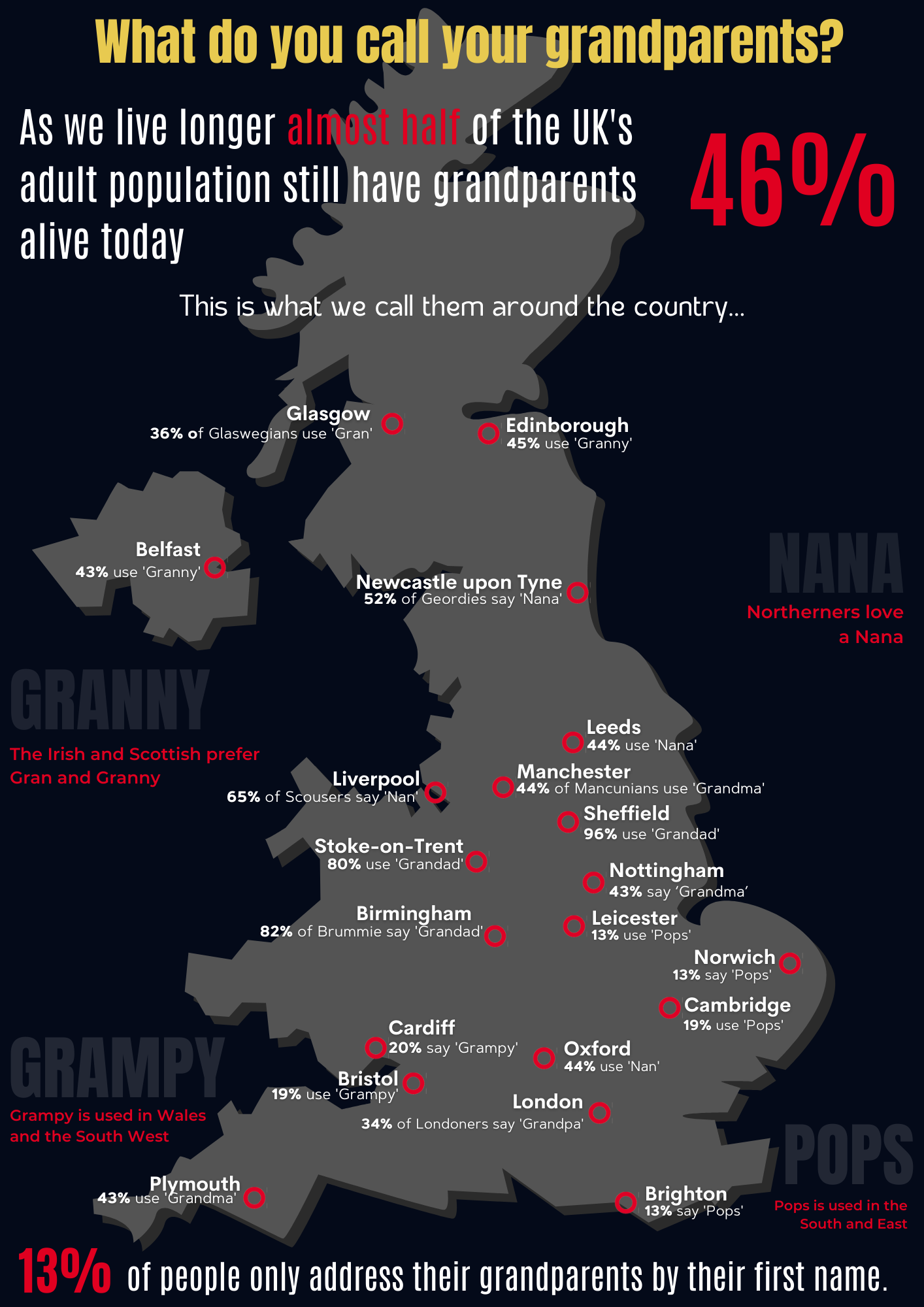
It seems, from recent consumer research into the names we Brits call our grandparents, that Grampy is now the more popular. Whilst I may have to concede Grampy is, in fact, a legitimate spelling, he’ll always remain Grandpy to me! Reading the research further I discovered that Grampy is particularly popular in Wales and the South West and my curiosity was piqued for Grandpy’s own great grandparents, Elizabeth Prout and Thomas Barrett, were born in Pembrokeshire and Gloucestershire, respectively. Could the name have echoes of distant ancestors? And what other grandparent names have we used in our family?

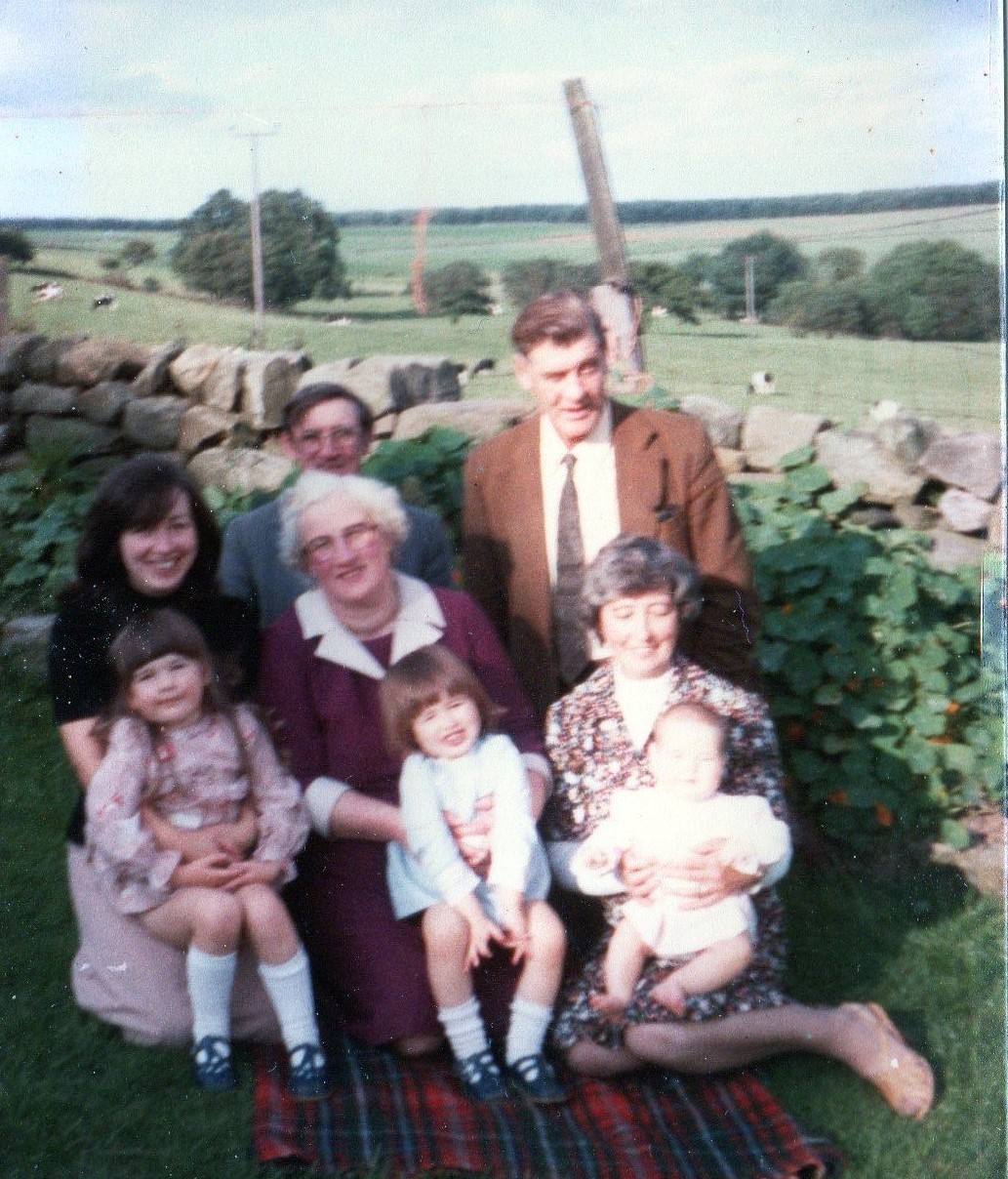
My sister Anna’s christening in 1979 taken in the garden at Hill Top Cottage, Lindley. From right to left, back row: Grandpy & Grandad, middle row: Mum, Grandma & Nana, front row: me, Helen & Anna. Own collection.

I was the first grandchild on both sides, so Mum was able to decide what our grandparents would be called. She had a Nan & a Grandma herself so decided on Nana instead for her mum. Grandpy was not, sadly, a historic echo but rather chosen simply as a name which was different and more fun. (As an aside Nana’s sister, Hilda, became Gam, which I also love). Mum’s relationship with her in-laws was undoubtably more formal and she avoided calling her in-laws by any name until I was born when she could refer to them as Grandma and Grandad. My nieces and nephews know Mum as Gran (as Nana will always be Nana, and Nan felt far too old), Dad as Grandad Bob and Mum’s husband as Papa Joe (of Charlie and the Chocolate factory fame).

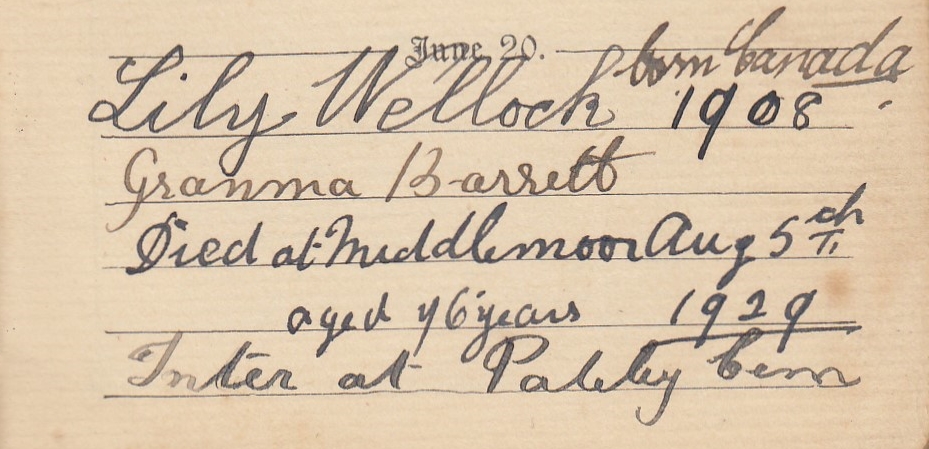
An extract from Mary Wellock’s date book showing use of “Granma Barrett” to describe Jane Brooks. Own collection.

Mum’s grandparents were Nan & Grandad Booth (Marion Moody & Arthur Booth) and Grandma & Grandad Barrett (Mary Wellock & George Thomas Barrett). Grandpy, in turn, called his own Barrett grandparents Granma & Grandad Barrett (Jane Brooks and Henry Barrett), demonstrating conclusively that the name Grandpy did not pass from our Welsh forebears.  

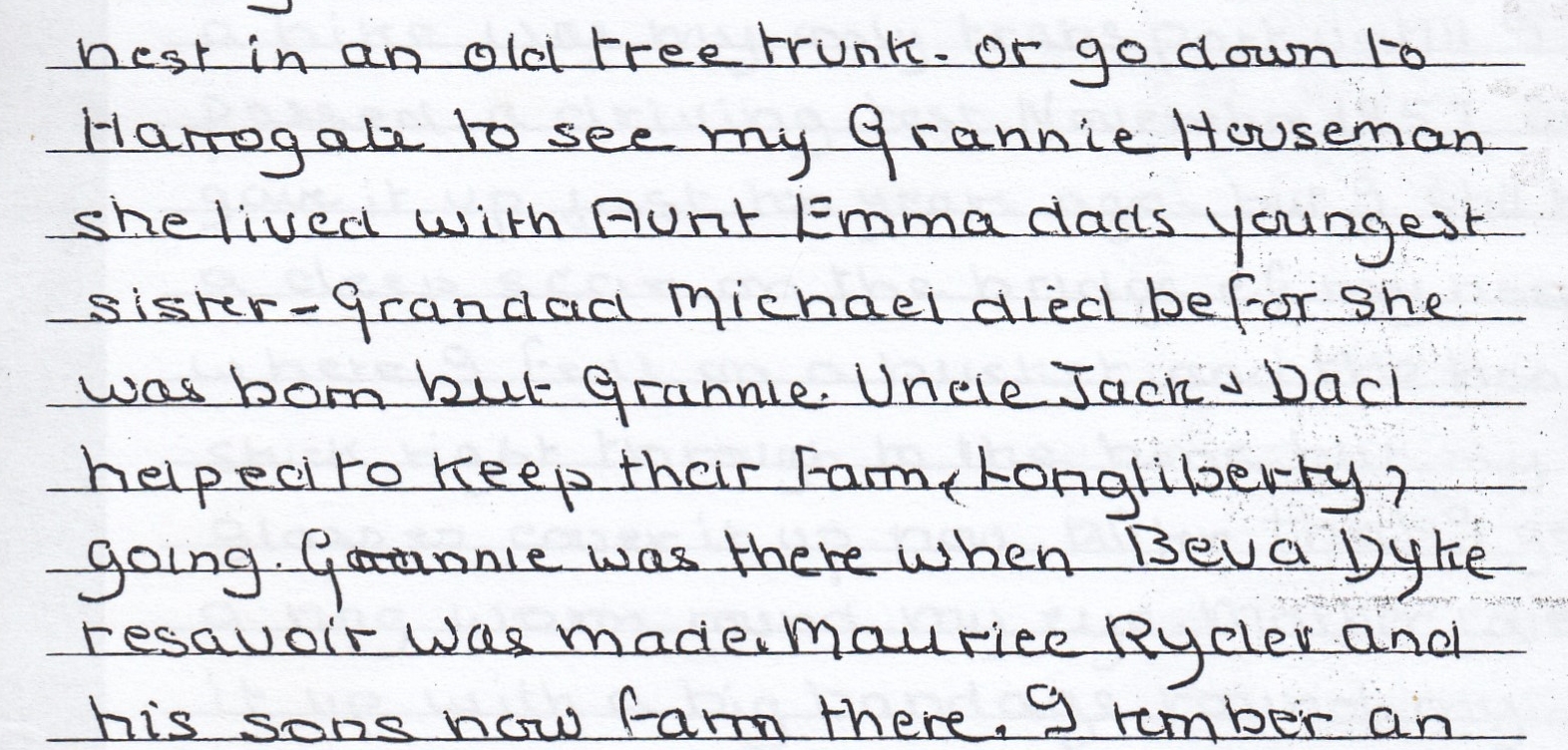
An extract from Grandma’s memoires “The Changing Years” referencing Grannie Houseman and Grandad Michael. Own collection.

Dad only really knew two of his grandparents. According to my uncle, my grandad’s mum (Mary Abigail Clapham) was Grandma and my grandma’s dad (Jesse Houseman) was Grandad. As there were only two grandparents, there was fortunately no need to add a surname. Fortunate as confusingly both would have been Houseman! Grandma always called her own parents Mother & Dad, perhaps reflecting their respective family status which is also seen in how she referred to her own grandparents. Her father’s parents were Grannie Houseman & Grandad Michael (Amelia Bradbury & Michael Houseman) and her maternal grandmother was simply Grandma (Maria Reynard) “a refined lady.” Strangely there is no note in Grandma’s memoires of her maternal grandfather, John Scott. He had died just before Grandma was born so she never knew him, yet her other grandfather, Michael, had died almost thirty years earlier and he was still warrented a mention.

With seven Grandads, a Grandpy and a Papa, four Grandmas, a Gran, a Granma, a Grannie, a Nan and a Nana in our family we seem to mirror the modern research. Whilst 68% of men are known as Grandad the women show more diversity with Nan coming in at 33%, Grandma 32% and Nana 24%. Once again, I am grateful to Mum for choosing a more unusual option as a name!

With much gratitude to my grandparents for all their love and to Amy Johnson Crow whose 52 ancestors in 52 weeks challenge encouraged me to publish this series of stories.

Infographic presenting the main research findings on what we call our grandparents, from the original press release.