Reflections on a month of writing

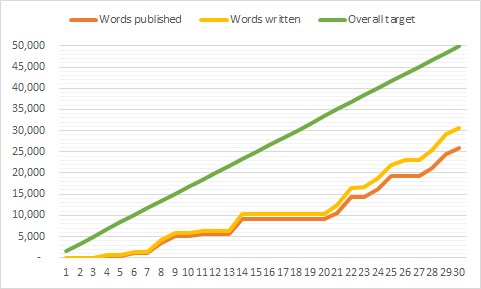
Tracking my writing progress over the course of November 2022.

And so my first attempt at #NaNoWriMo draws to a close.

For those who are not familiar with concept, hundreds of thousands of people from across the globe commit all their free time and then some to sitting in front of their computers, typing, attempting to write 50,000 words of a new novel. Natalie Pithers of Curious Descendants had the bright idea of turning this into a family history writing challenge, encouraging us all to write more by sending daily prompts.

That’s a great idea I thought, it’ll encourage me to get more of my research off the tree and into a readable format. Here’s what I’ll do. I’ll count the words in any blog I publish this month plus any decent paragraphs I write in response to the daily prompts which might form a blog in future. 50,000 words doesn’t sound that hard.

The first few days went smoothly enough. Two shorter blogs were quickly rattled off and I’d also made progress on a few more. Then on the 8 November I joined a co-working session with fellow Curious Descendants. Two hours later, I’d written just 800 words. Admittedly there’s always a good catch up at the beginning and end of the session, but that meant I’d need to commit three hours a day, every day, just to write 50,000 words. Then there was the editing, sourcing of photos, additional research and finally uploading it all to my blog all of which could easily double or more the time taken. Natalie kindly suggested I develop a more realistic goal. But no, I was convinced that once I reduced my target once I’d be all too willing to reduce it again. I was only 9,000 words behind.

Initially I shared each blog I wrote with all my family & friends on facebook but I soon realised there was a limit to the number of words even my mother might be willing to read. Sharing would better be done over time.

Then came a week where I had no time for writing. I started to revise my goal. If I could reach 25,000 words published with another 5,000 words well written ready to integrate into other stories, I would be happy.

All thoughts of applying for new jobs went out the window, as did the garden which desperately needs some attention. I wore the same dress for days in a row. I started checking my phone for Natalie’s daily prompt as soon as I woke up so as to start mulling on what I would write as I showered. I drafted sentences in my head as I cooked and ate and reviewed what I knew of an ancestor just before I went to sleep in the desperate hope that I would dream up some inspiration.

The total slowly rose but ultimately 50,000 words is a lot for someone who nearly failed her economics A-level because she couldn’t write essays. The C-grade was almost entirely down to the multiple-choice section. I even thought about just publishing my Grandma’s memoirs as they stood. 34,000 words in one go. But that would have done my Grandma a disservice. I intend to annotate and illustrate before publishing, maybe that can be next November’s goal.

The word count dropped and motivation too, meaning the word count fell further behind until I reached out to my fellow curious descendants, one of whom advised me to “mind you don’t end up not worrying about the quality but feeling the width.” It was time for the final sprint. If I wasn’t going to reach 50,000 words, what was it that would make me proud of this month?

A couple of days later, Vu, the author of my favourite non-profit blog, shared his weekly missive entitled “18 tips to help you become a badass writer!” including two perfect pieces of advice for the last sprint: “Writing is a lot like cooking or water puppetry: the more you practice at it, the better you get” and “You can publish first and edit later.”

I set out to write up our family history to ensure it was both accessible and better preserved, but I also wanted to improve the quality and speed of my writing more generally. I had also set myself a goal about eighteen months ago to complete short biographies of each of our sixteen great great great Grandparent couples. There were seven left at the start of the month and just three left at this stage all involving a woman called Elizabeth, two of whom were married to a man called Thomas. They were also, invariably, ones where I had doubts or questions about the research. I realised I needed to stop prevaricating and find a way to write what I knew.

Now, as the clock counts down to midnight, it’s time to take stock.

First, advice to my future self, should I choose to do this again.

  • Have a goal beyond the words. When all else failed those great great great Grandparents biographies just had to be finished.
  • An extensive stock of research is a prerequisite. The quickest stories to write were those where I had already collated all available evidence, the slowest those where I to wait for various certificates to arrive.  Which basically means spending the month before writing looking for gaps.
  • As are ideas for stories with relevant links to content. I thought I had this, but most of the ideas needed a lot more research than I had time to devote to them. On the flip side, I was able to finish a number of stories which I had already explored in detail.
  • Consistency is key. On the days I wrote, I averaged over 2,000 words.
  • Find a cohort to provide ideas and motivation when both are slowing. Thank you, Curious Descendants!
  • And finally, wine is a mixed blessing, the words flow at night, the editing is harder the next day

Ultimately, I didn’t write fifty thousand words. In the month of November, I wrote 30,500 words including 25,792 which are now live online in twenty different blogs. 61% of the total, higher than I’ve been all month – that last sprint made such a difference. More importantly I’ve completed my goal of writing up the stories of all sixteen of my great great great grandparent couple biographies with half of them written this month. Two further blogs stand out. The first is the story behind an 1899 divorce of two Wellock cousins, an astonishing story of domestic cruelty and the courage Ellen needed to free herself from it. The second “the death of a farmer” is much more personal as although it is the tale of death of my great grandmother’s uncle, the circumstances so exactly mirror those of my father one hundred and one years later, it has taken me a while to get it right. And I’m not out of ideas yet. As well as my Grandma’s memoirs, I’m also mulling on a series of annotated maps linking the stories geographically.

So yes, it really was worth it and I am proud but with Christmas rapidly approaching, I may just down my pen for a while!
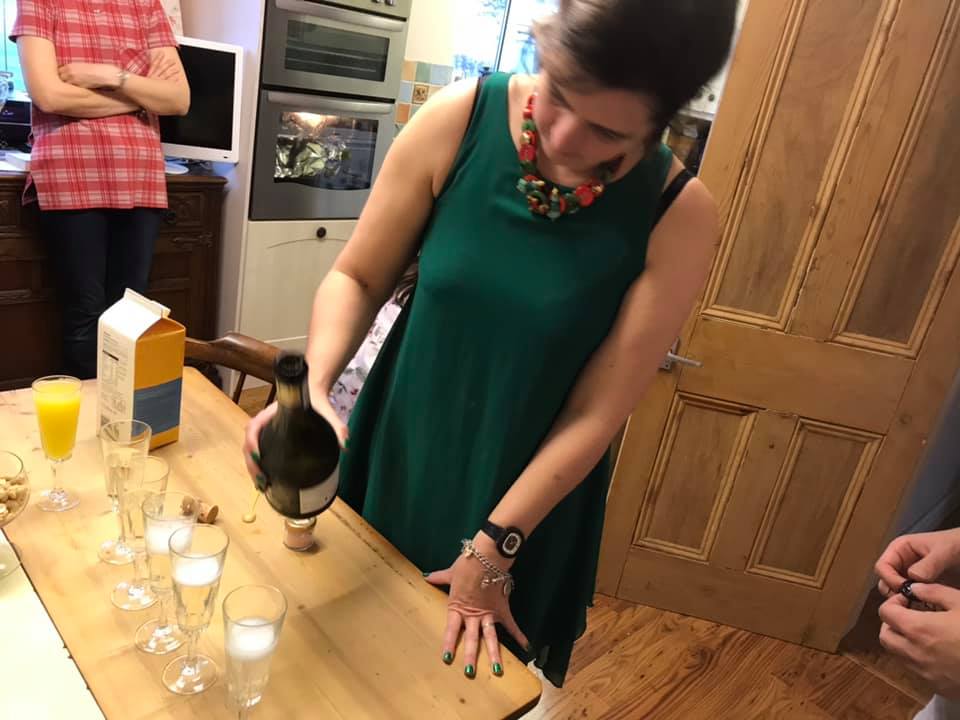
Cracking open the bubbly. Photo from 2018. As neither 2020 (lockdown) nor 2021 (poorly) family Christmasses happened I am looking forward to this one! Sharon’s photo.
Our gamekeeping heritage

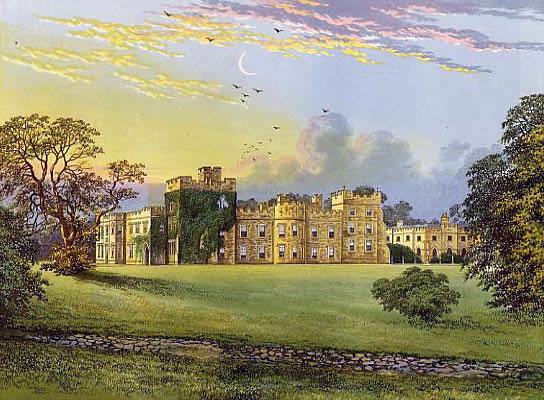
Hornby Castle in its 19th century glory. From Morris’s “Country Seats” (1880).

Finally, we reach the last in this series of 3xg grandparents biographies, that of Elizabeth Prout (1822 – 1875) & Thomas Barrett (1820 – 1890), Grandpy’s great grandparents through his father’s father, Henry. Born outside of Yorkshire, to parents with no previous connection to the county they are the couple I think of as being responsible for the almost in “An almost Yorkshire family”. Not that I hold that against them, but is has left me with an almost unanswerable question – why did a woman from Wales and a man from Gloucestershire choose to build their life together in Yorkshire?

It doesn’t help that I am unable to find half the birth certificates for this apparently well-researched family. Nor a reliable marriage certificate. Yet the censuses and other documents all consistently record the same detailed information, down to which property the children were born at. In the end I have decided to focus this blog on what I do know and explore their earlier lives in the future.

Thomas was born c. 1820 in Tetbury, Gloucestershire and Elizabeth c. 1822 in Amroth, Llanelli, Pembrokeshire. By the time Thomas died, in 1890, he had just completed fifty years of service as a gamekeeper for the Dukes of Leeds (the 7th duke succeeded in 1838, the 9th in 1872) and at some date before 1845 must have moved to Hornby Castle, near Bedale, Yorkshire, where the couple were to spend the remainder of their lives. The connection with the estate has to be the best guess as to how the couple met. 

Intriguingly, Elizabeth wasn’t the only Prout sister to end up in Yorkshire as Mary, too, married a man from Bedale. I do wonder if Elizabeth had spotted an opportunity for her to work in the big house. Another reason for me to try and find those estate records. 

In the nineteenth century, Hornby Castle was simply stunning worthy of being made the main seat of residence for the Dukes of Leeds. It contained all the usual trappings of a major stately home including a detached Banqueting House, no less than three icehouses, an eagle aviary and landscaped parkland as good as any designed by Capability Brown.

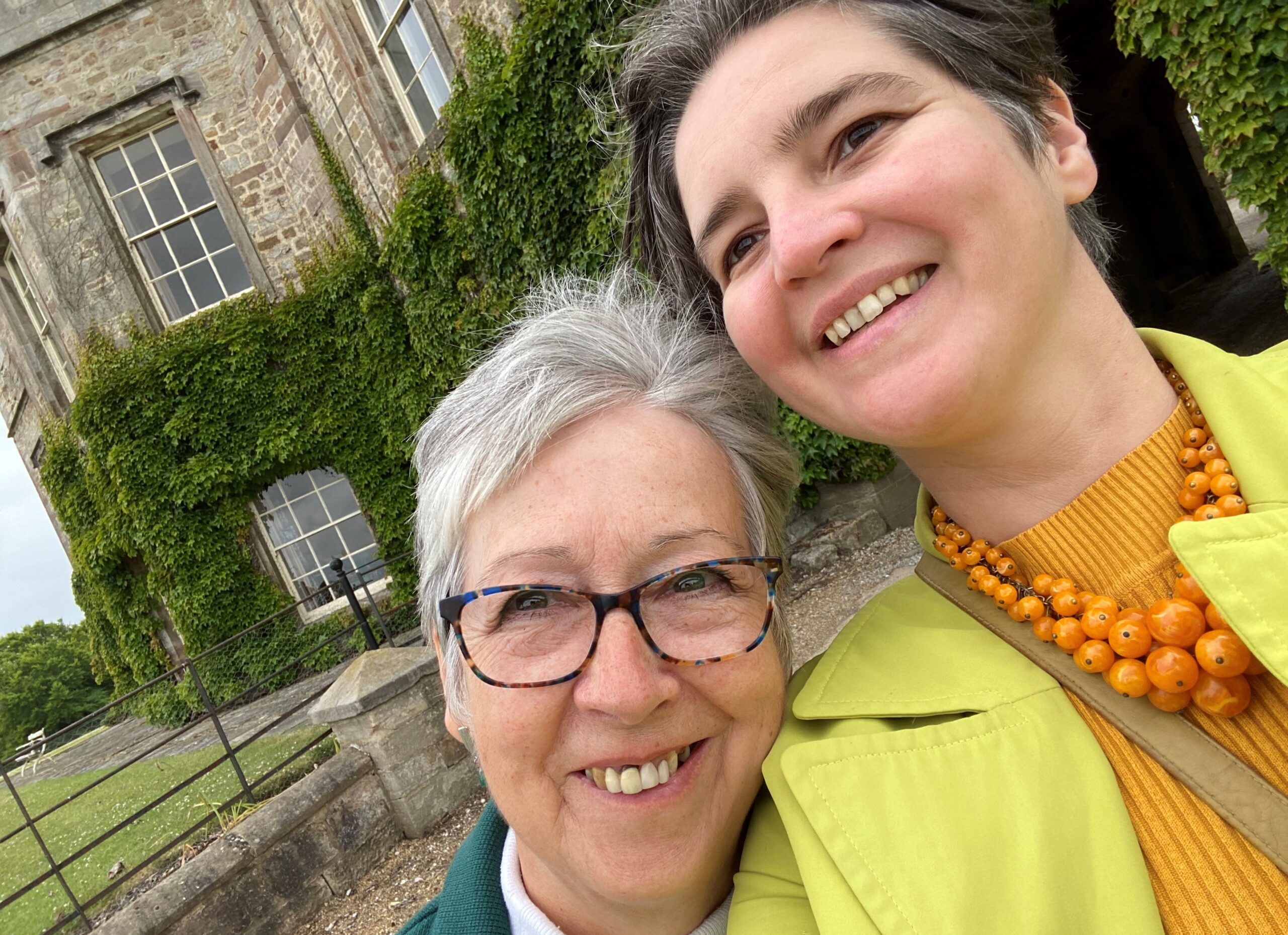
Mum & I in front of Hornby Castle. Summer 2021. We did knock at a couple of the doors to see if we could take a peek inside, but sadly non-one was at home. Own photo

It’s now a shadow of its former self. In 1930, the 11th duke was forced to sell the property after a “no-holds barred baccarat game” in Monte Carlo, more fool him. The house was due to be demolished with the rubble to be used to build roads. Fortunately, one of those tasked with stripping the property thought better, and a proportion was saved. The tower, inner courtyard and a few other remaining parts are now split into several smaller properties.

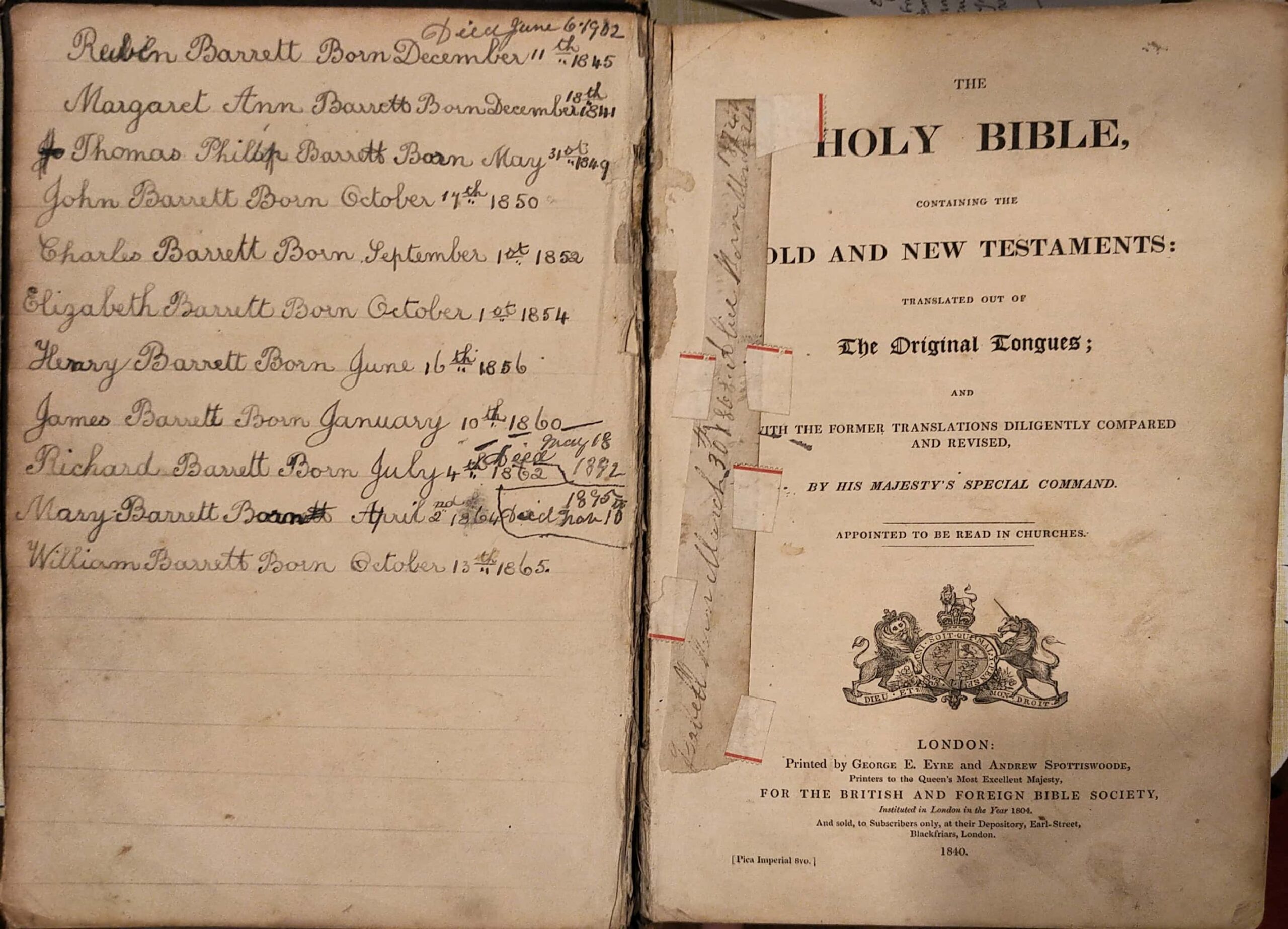
Holy Bible with dates of birth of the Barrett children. Mum’s collection. Strangely one son, James, born 1858, seems to be missing.

The 1845 date, with which I can start this couples’ story, comes from the birth of their first child, Reuben, who was born at Barn House in nearby Ainderby Miers. Eleven more children followed: Margaret Ann (b. 1847), Thomas Philip (b. 1849), John (b. 1850), Charles (b. 1852), Elizabeth (b. 1854), Henry (b. 1856) (our ancestor), James (b. 1858), James (b. 1860), Richard (b. 1864), Mary (b. 1864) & William (b. 1865).

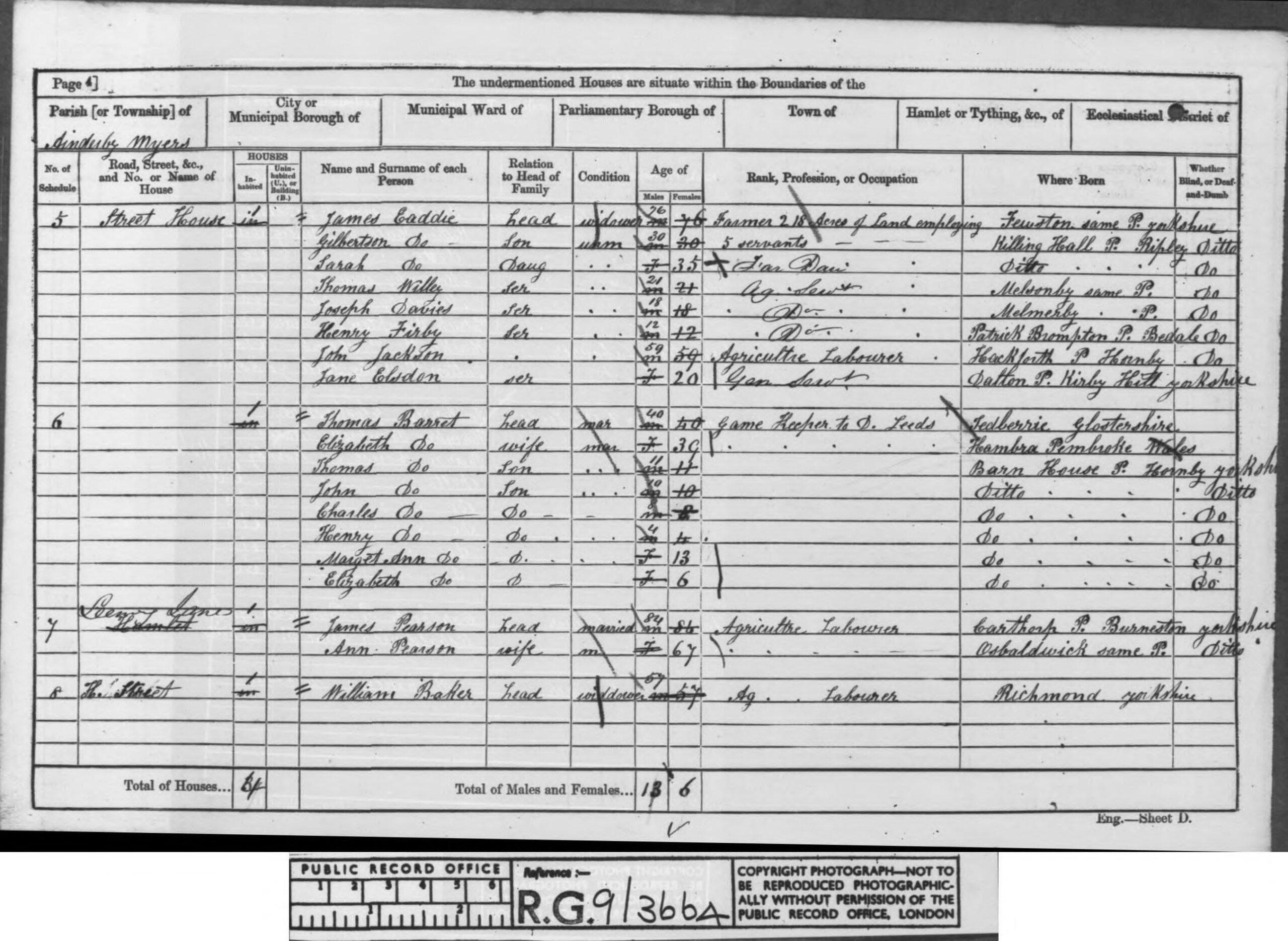
1861 census listing children’s birthplace as Barn House, parish of Hornby. I am very thankful that the enumerator, Mr Francis Jameson, took his job so seriously. Reuben, the couple’s first child, appears on the previous page, a live-in servant at the big house. His birthplace is listed the same.

Through the wonderfully detailed censuses we can tell that the family moved to West Appleton at some point between Richard & Mary’s births (4 July 1862 and 2 April 1864).

The 1871 enumerator, Mr Edward Fisher, wasn’t quite as particular in his facts though as his predecessor. For in this census another “daughter” Isabel has appeared on the census. Isabel turned out to be a granddaughter, the illegitimate child of Margaret Ann. Margaret went on to marry and have two more legitimate children, taking her Isabel with her. Alice was not so fortunate. You might have thought the family would have learnt from this necessary deceit, but no, for four years later, Elizabeth, the second Barrett daughter, also had a child, Alice (b. 1872), out of wedlock. Something about being a female servant on a large estate perhaps. Sadly, Elizabeth died in childbirth and Alice too, died young at the relatively young age of twenty-one.

Elizabeth (the daughter) & Alice (the granddaughter) were not alone in dying young for this was not a long-lived clan: The Richmond & Ripon Chronicle was awash with notices for the Barrett children. The two James’s both died in infancy, which would be fairly typical, but then, in what must have been an annus horriblis in 1871/1872, John, Charles and Elizabeth all died as teenagers. Richard & Mary too died relatively young. They outlived both parents only because they were amongst the last to be born for both were barely thirty when they died.

Elizabeth herself was just 53 when she died on 24 September 1875.

Thomas remarried, another Elizabeth, a widow, on 20 December 1876. This second Elizabeth was born in Moffatt, Dumfriesshire neatly bringing Great Britain’s three nations together in one family.

There may well have been a good reason for Thomas to choose another outsider as his second wife for gamekeepers occupied a somewhat controversial position in the Victorian countryside. On the one hand they were one of the more respected senior servants on the estate and developed a deep knowledge of the local countryside. On the other they were the upholders of fiercely contested laws preventing public access to land and to game, regularly required to catch and prosecute poachers who were often their neighbours. Many gamekeepers felt a swift hiding was more effective than bringing the offenders to court, but Thomas seems to be quite a regular at the local petty sessions.

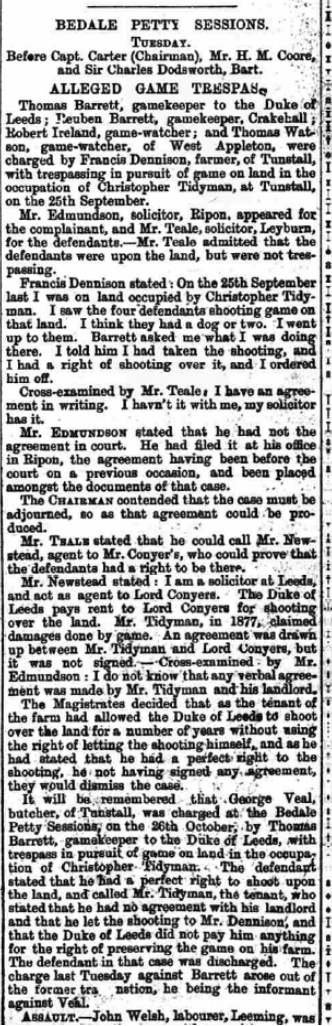
Nor was Thomas always on the right side of the law. The following, lengthy, report details a game trespass claim made against Thomas and his son Reuben. Ultimately the magistrates decided that “as the tenant of the farm had allowed the Duke of Leeds to shoot over the land for a number of years without using the right of letting the shooting himself, and as he had stated that he had a perfect right to the shooting, he not having signed any agreement, they would dismiss the case.” Phew.

The Knaresborough Post article, Saturday, 27 November 1880.

The above article also illustrates the strong tradition of gamekeeping being handed down from father to son. Reuben, the eldest, was ultimately to take over his father’s position at Hornby Castle. Henry, our ancestor, moved to work for the Yorke family on their Bewerley Estate at Middlesmoor. Like any profession, the younger training starts, the more skilled an individual could become and in, what was a twenty-four-hour, seven-days-a-week occupation, children with a gamekeeper for a father had a tremendous head start.

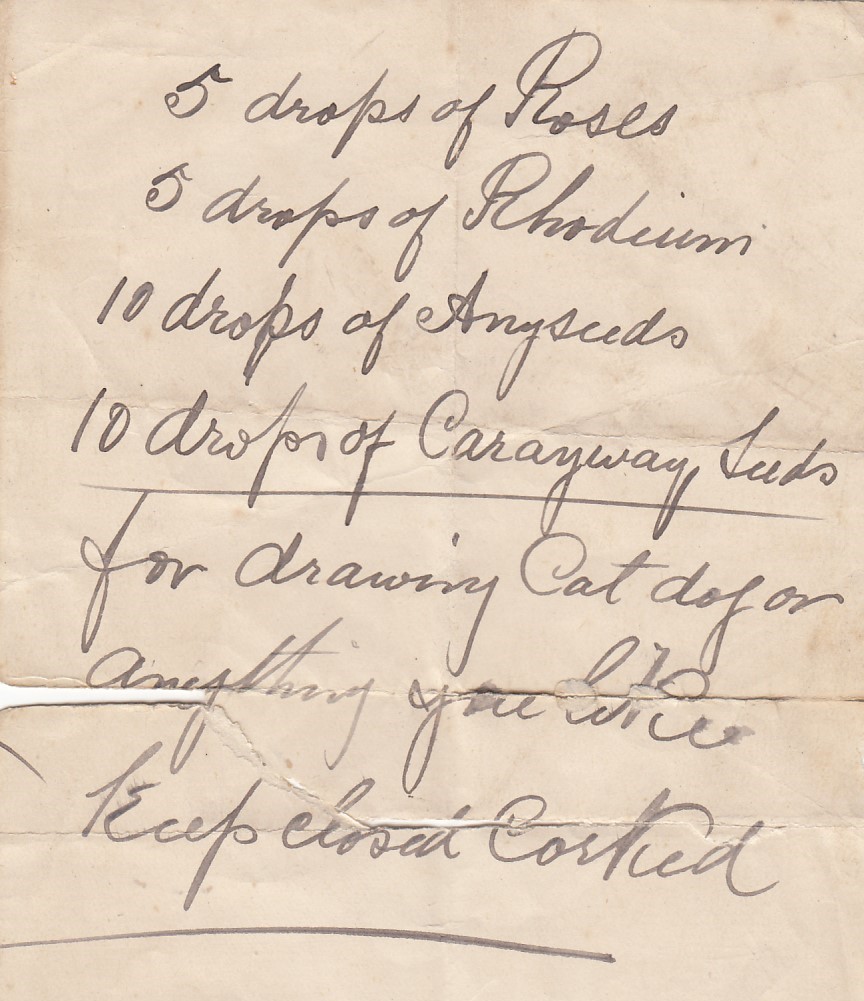
And it was a skilled profession. Gamekeepers had to master a variety of countryside skills to raise the game and keep it safe from poachers and vermin. Each gamekeeper developed his own means of doing so and these tips and recipes would be passed on from father to son. I think that’s what this receipt is. It was found in my great uncle Henry Barrett’s papers, but it clearly written in his father, my great grandfather, George Thomas Barrett’s, handwriting. I’d love to think that he, in turn, had inherited from his grandfather, Thomas.

A receipt to draw vermin, believed to be in George Thomas Barrett’s handwriting. Own collection.

5 drops of Roses, 5 drops of Rhodium, 10 drops of Anyseeds [Aniseed], 10 drops of Carayway [Caraway] Seeds

For drawing Cat dog or anything you like. Keep closed corked.

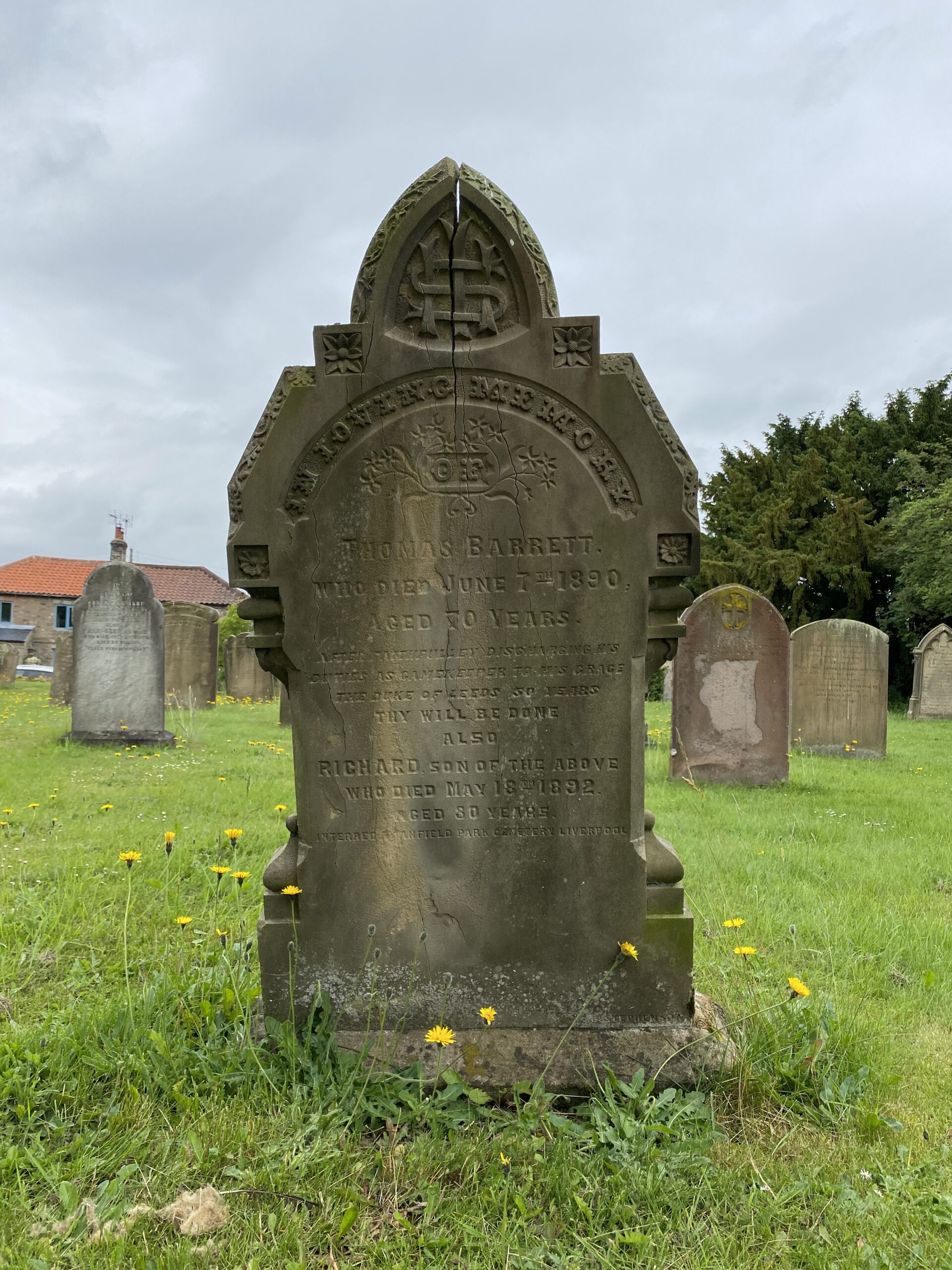
Gamekeepers, the least violent ones at least, also had to be skilled at handling a wide range of people, from local labourers caught poaching to the highest toffs in the land during major shoots. Thomas, I feel, had this cracked. For after he died, on 7 June 1890, after fifty years of service, his well-attended funeral, was considered of sufficient worth as to have been reported on in detail in none other than the York Herald.

“Funeral of Mr Thomas Barrett, of Hornby Castle – On Tuesday afternoon the remains of Mr T Barrett were interred in the Hornby Churchyard amidst every token of respect. Mr Barrett had just completed a service of 50 years, having been head gamekeeper to the Duke of Leeds the largest portion of that time. Several beautiful wreaths were sent by Mr S T Jones, steward on the Dukes Estate, Mr Nichol, head gardener, Mrs Waters, the housekeeper, and Mr Hutchinson and Mr Hallam of Leeds and others. A very large number of tenants and workspeople on the estate as well as tradespeople and relatives and friends paid their last tribute of respect. The service at the grave and in the church was most impressively read by the Rev D Moore, vicar of Hornby””. (York Herald on 14 June 1890)

The gravestone of Thomas Barrett in Hornby Church. Note the lack of any mention of his wives. Own photo. Thus, this series of biographies of our great, great, great grandparents come to an end. Although this not the end of the tales!
Thus, this series of biographies of our great, great, great grandparents come to an end. Although this not the end of the tales as each one has left me with something new to research.

With much gratitude to all my great, great, great grandparents who have provided me with such a rich range of material through which to get to know them just a little bit better.

What surnames can add to the knowledge of our beginnings

We begin our family history journey at the end. There are many logical reasons for this, for after all, what would be the beginning? The generationally oldest ancestors? I believe I know something about eighteen 12x great grandparents who lived in the 1500s but far from enough to make their life interesting and what about the other 8,174 of them (endogamy aside)? DNA? Mine simply supports what I already know – my ancestors are mostly from Yorkshire. However, there is one other angle, that of surnames which can provide an insight into ancestors much further back than we will ever be able to prove.

In this article, the numbers born refer to the period from the start of civil registration, currently transcribed on freebmd (1837 – 1992 approx). The counts for the first seven surnames were taken on 3 August 2022, for more distant ancestors on 29 November 2022.

HOUSEMAN

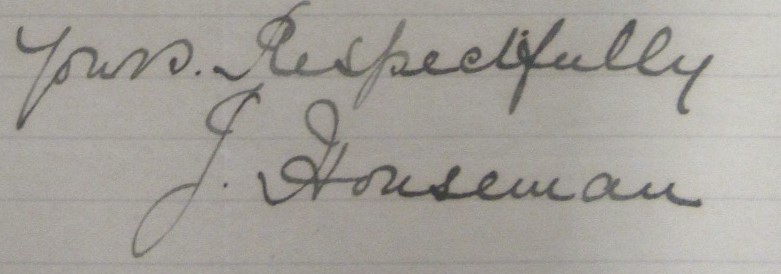
Jesse Houseman (Grandma’s Dad)’s signature at the end of a letter to his landlord. 1920. Own collection.

Born a Houseman, like my Grandma, I plan to die as one. Although I’m resorting to changing my name back by deed poll whilst my Grandma just married a Houseman. As the subtitle to my website notes “it’s who I am.” It is, though, only my second favourite surname. Largely, I think, because it’s already been well-researched and I am forever grateful to Gary Houseman who proved the link between my two paternal grandparents.

Whilst this surname is believed to originate from an occupation, from someone working at or associated with the local “great” house, it is relatively uncommon and highly geographically concentrated. 43% of the 2,651 Housemans born in England & Wales between 1837 and 1992 (as counted on 3 August 2022) were born in Yorkshire counties and of these there is only one branch who are not directly related. I was delighted to find that the one family in Yorkshire who are not related by blood can still be connected into my tree as William Shaw Houseman (b. 1848) who’s father, Robert, was born in London, married Hannah Smith, who’s mother was a Houseman!

Barrett

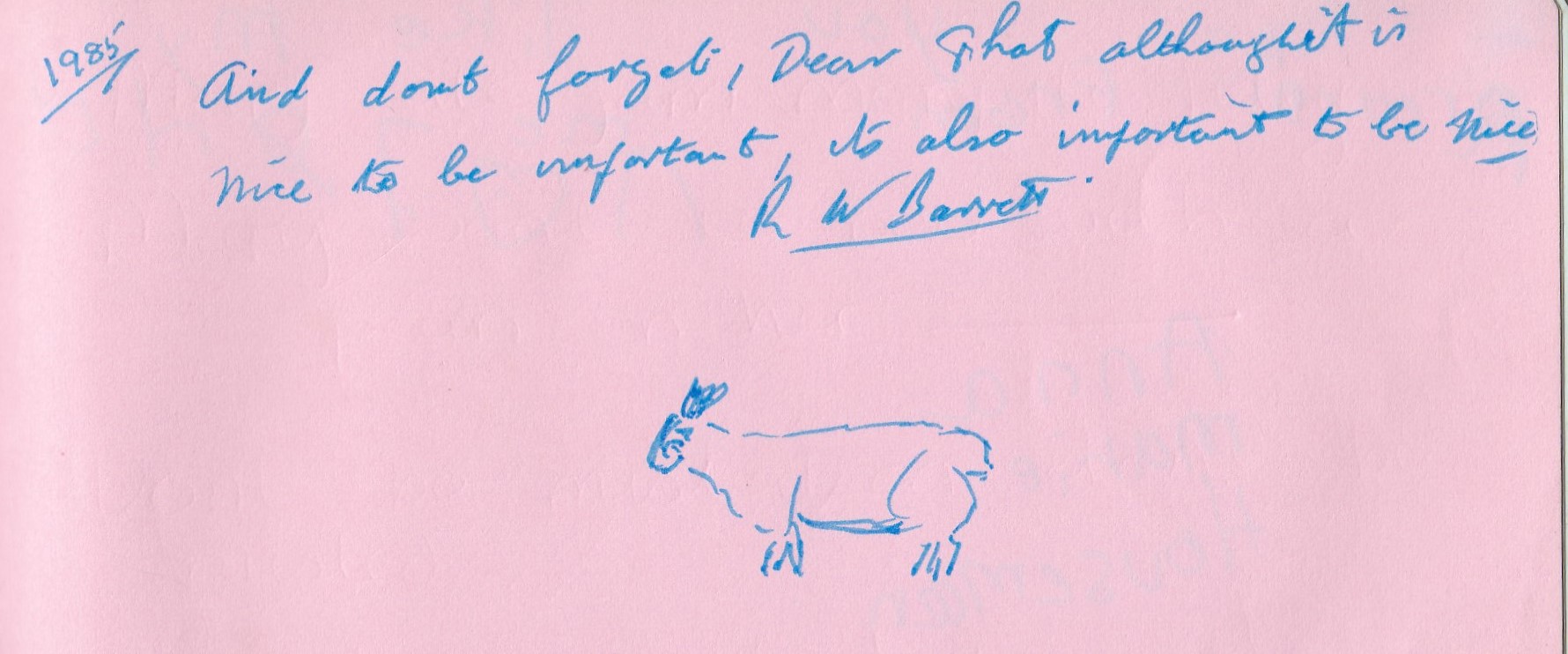
Grandpy’s entry in my autograph book. 1985. Own collection.

By contrast, I’ve never felt the same connection to my mother’s maiden name. It crops up too often for me to be sure I’ve found the right family. There’s even a shoe store which carries the name. Our Barretts had the audacity to originate from Gloucestershire and it’s Norman in origin. Sorry Grandpy, I love you, but it’s not a surname that holds my attention.

Booth

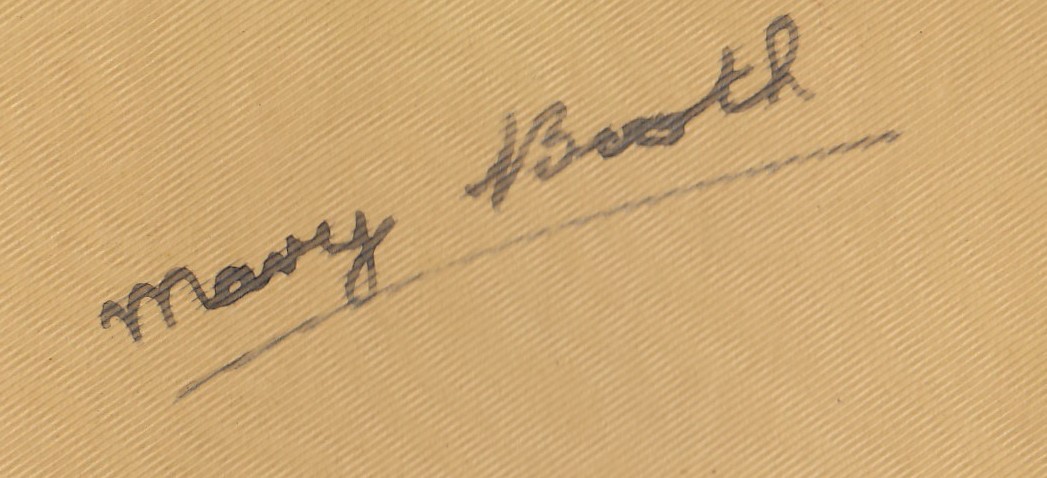
Nana’s Booth signature at the front of her own autograph book. c. 1939. Own collection.

Nana’s birth name.

Many years ago I spotted a beautiful seventeenth century wooden tray painted with the names of a Booth family. £400 was an awful lot of money but I was severely tempted, convinced the family would be related somehow. Whilst I still hold a slight sense of regret the chances that the tray family were in anyway related is slim to non-existent for there were nearly 50x as many Booths born as Housemans.

Booth is considered to be a northern name (over a quarter of those registered births were in Yorkshire) originating from the old Danish word “bōth” meaning a temporary shelter such as a cattle-herdsman’s hut. We were cattle keepers, probably the most appropriate of our surnames throughout my paper history. It also accounts for the 2% of Swedish & Danish ancestry in my Mum’s DNA profile.

Booth is also one of the two surnames I planned to use if I was ever to write under a pen name, which leads me onto….

Moody

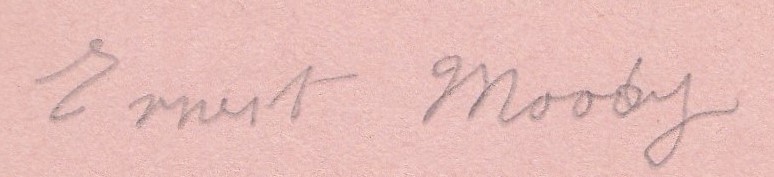
Ernest Moody (Nana’s grandfather)’s autograph from Nana’s book. 1939. Own collection.

Nana’s mother’s birth name and the other pen name I would choose.

From the Middle English mody meaning ‘proud, haughty, angry, fierce, bold, brave, or rash’ not grumpy as it is now.

I broke freebmd trying to work out what percentage of people had been born in Yorkshire, but in the 2021 census, Yorkshire was home to about 9% of the population of England & Wales so essentially anything over 10% represents a northern bias and Moody, at 14% is no exception.

But as for Moodys being proud & haughty? This was the most unassuming branch of our family tree. We’d obviously not inherited those genes.

WELLOCK

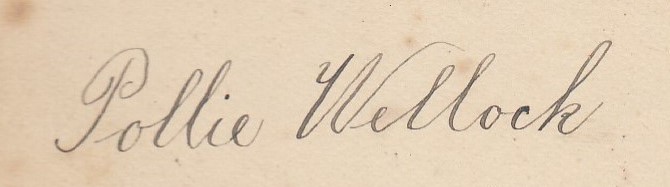
Mary (Pollie) Wellock, Grandpy’s mother. From her date book. 1907. Own collection.

Grandpy’s mother’s birth name.

I love the Wellock surname. Most recently it’s enabled a wonderful Canadian adventure. Every Wellock alive today can be traced back to just two men. They are either descendants of Henry (born in the late 1500s in Kirby Malham) or of Robert (b. c. 1546 in Linton in Craven). The two are undoubtably related but I am always disappointed when a Wellock is descended from Henry.

Common thinking is that Wellock is a derivation of de Wheelock suggesting Norman ancestry, but given that the Wellock (or Walock) name is only held by those from Craven, Yorkshire, my interest stops there.

Scott

John Scott (Grandma’s grandfather) from his will dated 1920. Own collection.

Grandma’s mother’s birth name.

Ultimately it’s a man from Scotland. Which could mean anything. Weirdly, my Mum’s DNA contains a lot of unexplained Scottish DNA whilst my paternal Uncle’s contains none. It’s also the most common surname amongst my great grandparents. Combine it with John and you’ve got a genealogical nightmare. So I just feel grateful that I’ve been able to trace this line as far back as my 6x great grandfather, John Scott, born in the early to mid 1700s in Branton Green, North Yorkshire.

Clapham

Martha (Handley) Clapham (Grandad’s grandmother)’s signature from the 1911 census. Own collection.

Grandad’s mother’s birth name.

The last of my great grandparents surnames is slowly gaining my attention. Growing up there were a lot of Claphams and I thought it must be a common name. But there were under 10,000 of them born between 1837 and 1992 and of those, over 40% were born in Yorkshire. Which explains why there were a lot of them about when I was growing up.

More interestingly (for me), I have Claphams on my maternal side too – my 5x great grandmother, Elizabeth Clapham was born in Lawkland about three miles from the village of Clapham.

Given that Clapham is believed to originate from the name of a village that could suggest a connection for whilst there are Clapham villages and (different) family branches originating as far away as Bedfordshire, Surrey, Sussex and even Devon, my Grandad’s mother’s family had been slowly tracking south and east away from the original Clapham village. 

Could this be the elusive connection between my Mum & my Dad’s family trees?

Earlier generations

Going back to my 3xG grandparents adds a further twenty-four surnames. It seems I’m unlikely to ever find a familial connection to my friends Sarah Walker & Helen Cooper (being the two most popular surnames in my tree with over 300,000 of each of them born). There were fullers and coopers in almost every village from which these surnames derive.

There are some though which will be worthy of further exploration.

  • Stansfield, Furniss and Hinchcliffe are all relatively rare. They are locational surnames recognising people from Stansfield (near Todmorden), Furness (Cumberland) and Hinchliff (near Holmfirth) so it is not surprising that around 50% of these births were in Yorkshire. Each one might give me a hint as to where the families originated from. Each also has a number of different variants and the exact spelling could be useful in tracing my line.
  • I grew up surrounded by Beecrofts and they pop up on both sides of my tree so was surprised to learn how uncommon the name was both generally and in Yorkshire. It’s a locational name based on an apparently “lost” village named “beo-croft” meaning bee farm. Tracing potential locations in the region could help me bring together the two sides of my family.
  • Down to those names with fewer than 5,000 children born. Teal has my favourite origin story, as it is thought to be a nickname, meaning like a water-bird. One of my distant ancestors must have been graceful in their deportment. The Teal variant of the name is also strongly associated with Yorkshire with over half those born being from Yorkshire.
  • There were fewer Reynards born than Housemans. Reynard does not in fact mean fox-like, but rather a popular medieval story book fox character was given this name and it stuck. It’s a surname with a number of variants, but 64% of the people born carrying the surname in this form were from Yorkshire meaning I stand a good chance of bringing them together in one tree.  
  • And finally, my favourite 3xG Grandmother, Hannah Demaine, keeps on giving. Surprisingly, given it means someone from the ancient French province of Maine, it’s a surname even more rare than Wellock and just as heavily concentrated in Yorkshire. The variant Demain, which I have also seen, only adds a few hundred births. This family of agricultural labourers are about as far from a Norman knight as it is possible to be and has whetted my appetite to research further.

There are a few more ancient names I should mention as being gateway surnames that have enabled me to reach back much further than I would otherwise have done: Wigglesworth, Hebden and Swale are all locational from Yorkshire. Pettyt leads me to a cousin, William, appointed Keeper of the Records in the Tower of London in 1689, who invented a wonderful family history claiming descent from King Arthur and might provide a connection to my oldest friend, Andrea (nee Petty). Finally, there’s Inglesant is a rare example of a surname derived from a woman demonstrating the strength of my female ancestry right back into the medieval ages.   

And so it is that my beginnings reflect the end. It’s an (almost) Yorkshire story.

With much gratitude to Natalie Pithers for her two prompts, beginnings & surnames, which led to this blog and to all my ancient ancestors for picking such wonderful surnames.

Oh I do like to be beside the seaside!

Living almost halfway between the east and west coasts we had our pick of the best seaside resorts. To the west there was Blackpool with its illuminations and tacky souvenirs, Morecambe where the tide went out for miles and Lytham-St-Annes which I remember most for having a far smarter class of charity shops. To the east we had amusements in Scarborough, cliffs at Flamborough Head, eight miles of spotless sandy beach at Filey, the old school charm of Robin Hood’s Bay and of course Whitby where the best fish and chips in the world are to be had, together with a sprinkling of Dracula on the side. Each year we’d board the coach for the annual Sunday School seaside trip optimistically clad in shorts and t-shirts which would alternate visits between east & west.  

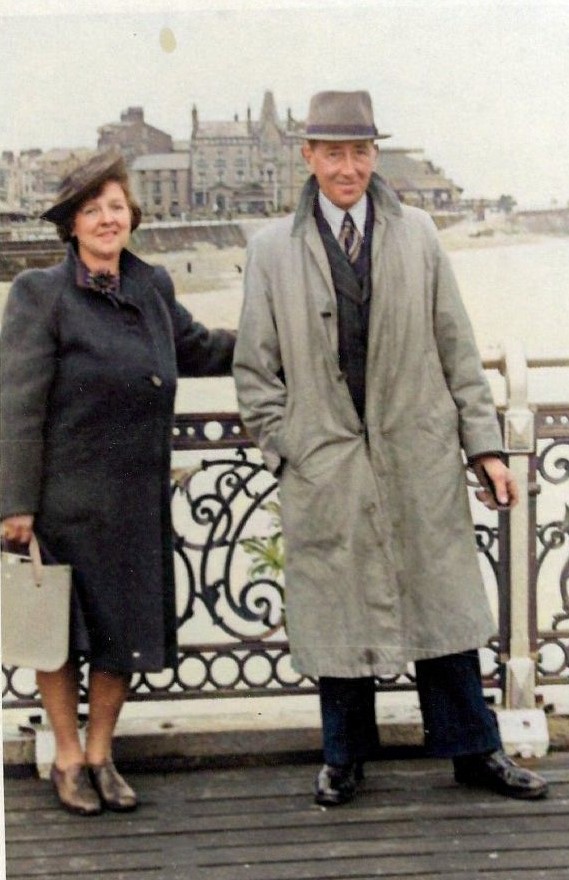
Certainly, my great grandparents, Marion (Moody) and Arthur Booth did and for them it was almost invariably the west coast.

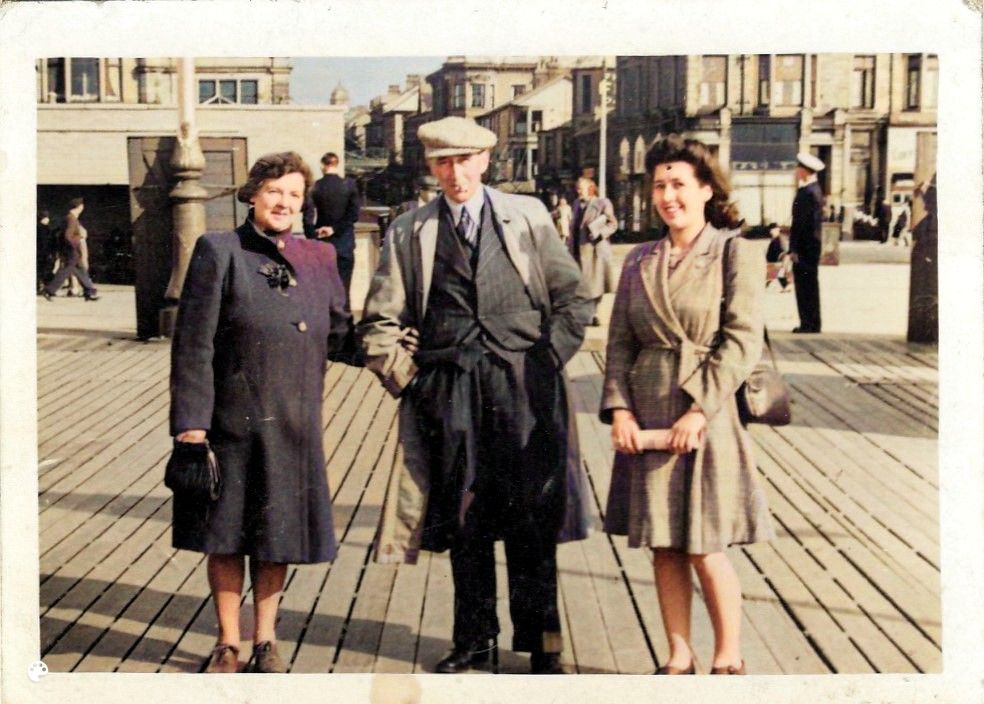
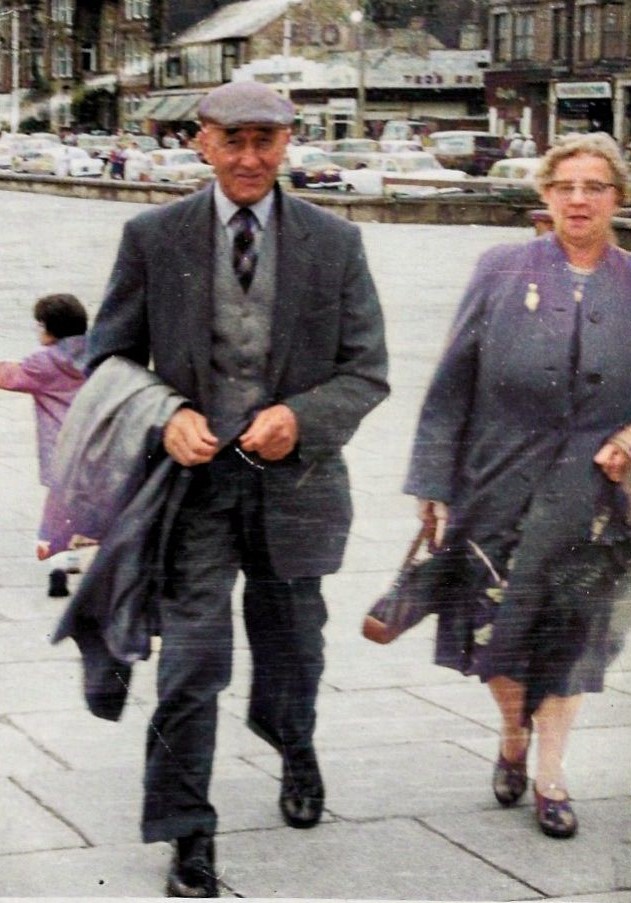
At first glance I thought these two photos had been taken on the same seaside excursion. Arthur is wearing his greige raincoat, pinstriped suit and carefully knotted tie. Marion has a dark blue coat with a jaunty collar, on which she has pinned a cloth flower, and paired the smart coat with sensible brown shoes. But look more closely and you start to notice the differences. Arthur has switched his rather swish fedora for the ubiquitous flat cap, Marion has moved her flower and changed the colour of her handbag. Broadly, too, the couple have aged. Judging by Nana (their daughter), I would say the photo on the left was taken in the mid-1940s, which would make the one on the right could be as much as a decade earlier.

Whilst the outfits may have changed and I can’t quite envisage Marion astride a donkey, I am not so sure our great grandparents’ experience was that different. Candyfloss, icecream and fish & chips with a slice of white bread and butter and a mug of tea still taste very much the same. Amusement arcades, risqué postcards and holiday snaps still keep us entertained.

A trip to the seaside was a pleasure eagerly anticipated.

By the time we reach the end of the 1950s, Arthur & Marion are back travelling without their girls. The pinstripe suit has been replaced, but not the flat cap. Marion has a new coat, but she’s kept with the sensible brown shoes.

Arthur Booth & Marion Moody. Photo coloured with myheritage. Own collection.

This was such an annual tradition that even after Marion died, Arthur took a final trip to Morecambe on his own sending separate postcards to his daughter and grandson which I found in Nana’s box of joy.

Nana’s parents, my great grandparents were modest hard-working people. They had both died before Mum reached her teens and I have far fewer documents and photos through which to reconstruct their lives. These three seaside photos represent such a small snippet and yet create a thread directly between their lives and mine.  

Life on the canals – a biography of Elizabeth Schofield (1832 – 1911) & Thomas Moody (1833 – 1901)

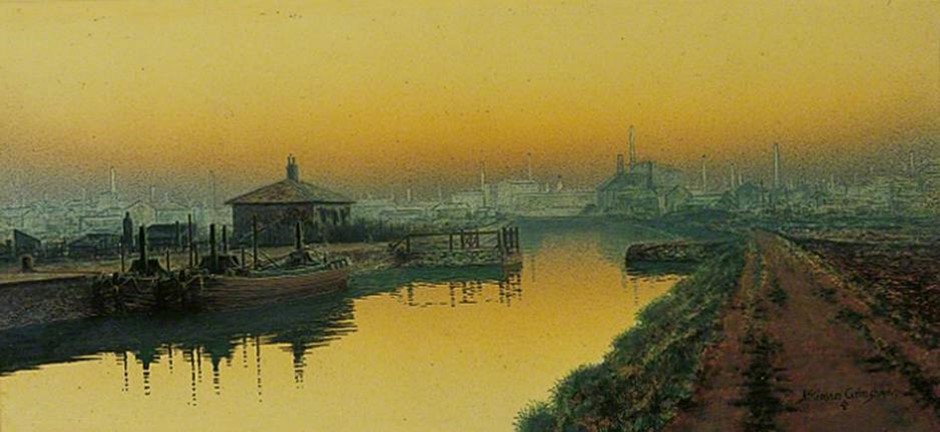
Sunday Night, Knostop cut, Leeds by James Atkinson Grimshaw. 1893 (c) Bridgeman images via www.artuk.org. Painting owned by Leeds City Art Gallery.

Many years ago I bought a print of this painting. It’s Leeds, not Mirfield and painted a little late (1893) for our story but so evocative of industrial Yorkshire.

Unusually amongst our ancestors, Elizabeth Schofield & Thomas Moody’s lives did not focus on a single farm, house or even a village for their family was not built on land, but rather around water, specifically the Calder & Hebble Navigation. The journey along the canal from Mirfield to Horbury Bridge via Thornhill Lees is under seven miles. It takes a couple of hours to travel it by narrowboat and yet this short stretch of waterway spans Elizabeth & Thomas’s lives.

The canal also helped to obscure their beginnings, particularly those of Elizabeth. Watermen had a tendency not to complete census forms whilst on the move, which was often if they were to make a living. Elizabeth remains unaccounted for in the 1841 census (and I am uncertain about that of 1851) and Thomas in those for 1851 & 1871. Several of their children’s baptisms and burials remain missing and Elizabeth’s father, William, is currently without both parents and a date of death. Nonetheless I now feel sufficiently confident in the evidence to be able to tell the story of Elizabeth & Thomas, my 3xG grandparents through their son, Ernest William, father of Marion, Nana’s mother.

Elizabeth was born first, baptised on 9 December 1832, the likely first child of Margaret Robshaw & William Scho[le]field. The family were living at Ledgard Bridge at the time, quite possibly on the barge itself. At some point between the birth of Elizabeth’s siblings William (1834) & Sarah (1839), the family appear to have relocated to Thornhill Lees although the whole family was on the move and unrecorded on the night of the 1841 census.

Elizabeth is difficult to pin down in the 1851 census, but after eliminating all the other Elizabeth Scho[le]fields born in Mirfield the only one left is a visitor of a widow called Susan Wooler or Woller in Cleckheaton. If this is indeed our Elizabeth, there’s a potential familial & religious connection for further research and it also tells us she was working in a woollen mill a trade her sisters were also to follow.

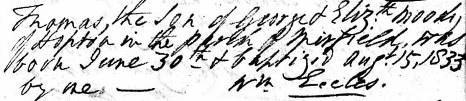
Baptism record of Thomas Moody, 15 August 1833, Hopton Independent [Congregational] Chapel, Mirfield.

Thomas was also an eldest child, born on 30 June 1833 in the village of Horton. His parents, Elizabeth Lee & George Moody, went on to have six more children, all of whom survived into adulthood.  The Moody family were staunch Presbyterians and maintained an ongoing link with Hopton Independent Chapel where Thomas was baptised.

George Moody, Thomas’s father, was a woodsman and built up a successful timber business. His youngest son, William Henry, or Harry ran a joinery and undertaking business in Upper Hopton building on his father’s trade. His next youngest son, John, also, in a way, entered his father’s trade, apparently of stealing three loads of timber in 1899 and sentenced to 21 days imprisonment in HMP Wakefield (although I should note that there were other John Moodys in the area at the time).

Why, then, did Thomas take to the canals? It is rare, in my experience, for eldest sons not to follow their father’s trade. The charitable explanation is that George had set his son up in logistics as a useful compliment to the timber trade, but I just don’t buy that. In my view Thomas’s career choice was either the cause of a father/son falling out or a result of one as there is no evidence that Thomas had anything to do with Moodys of Hopton in later life, no marriage witnesses nor visitors on census returns, no presbyterian religion and certainly no evidence of financial support.

Thomas is nowhere to been found in 1851, so on a barge I would guess.

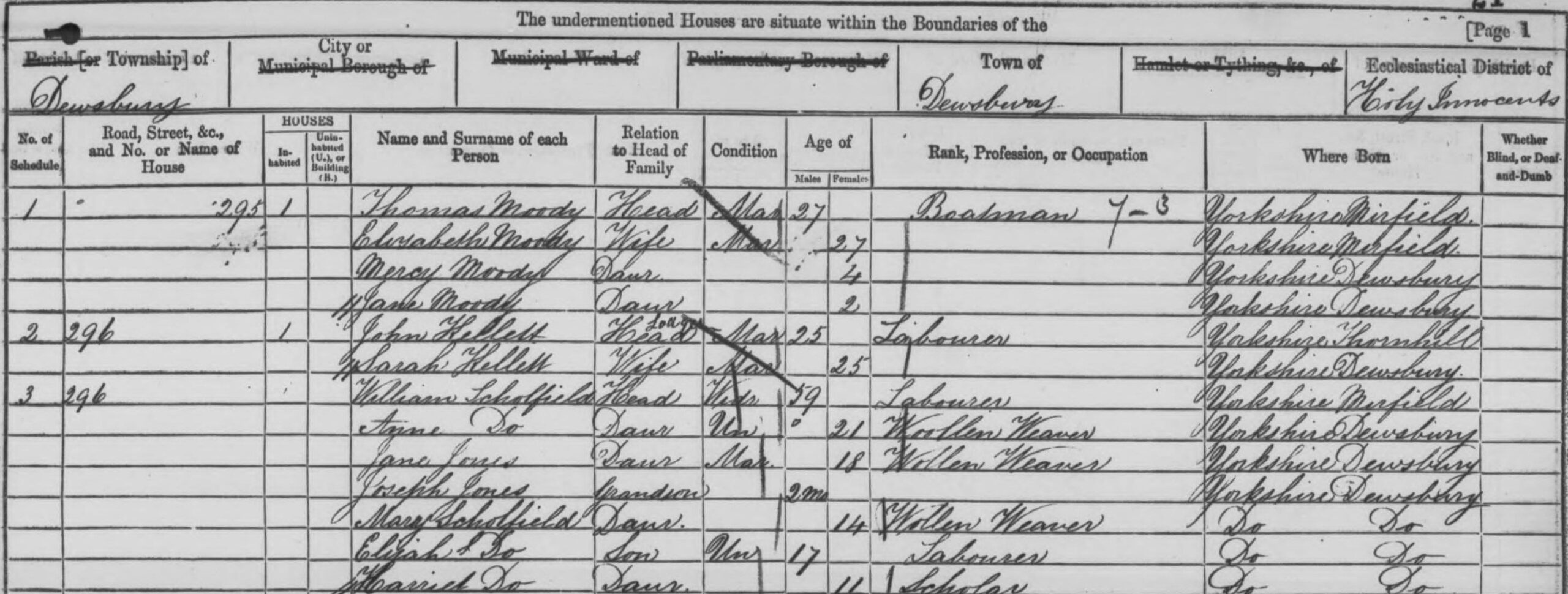
Elizabeth & Thomas were married at St Michael’s & All Angels at Thornhill on 7 September 1856. At the time both were living on Lees Moor which aligns with the 1861 census above. Children quickly followed, Mercy just a couple of months after they married, Jane in 1858, Emma in 1861, George in 1863 and Lee in 1866. Lots of little helpers.

1861 census for Thomas & Elizabeth Moody along with their two daughters, Mercy & Jane. Elizabeth’s father, William Schofield, is living two doors away.
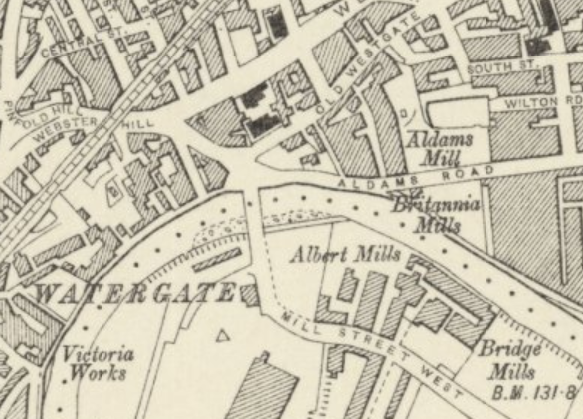
Map from 1881 – 1913, www.archiuk.org showing the approximate location of where the boats were moored in 1861 based on the enumerator route described as starting at “Aldams Head on the south of Webster Hill.” There are several mills within easy walking distance where Elizabeth & her sisters may have worked.

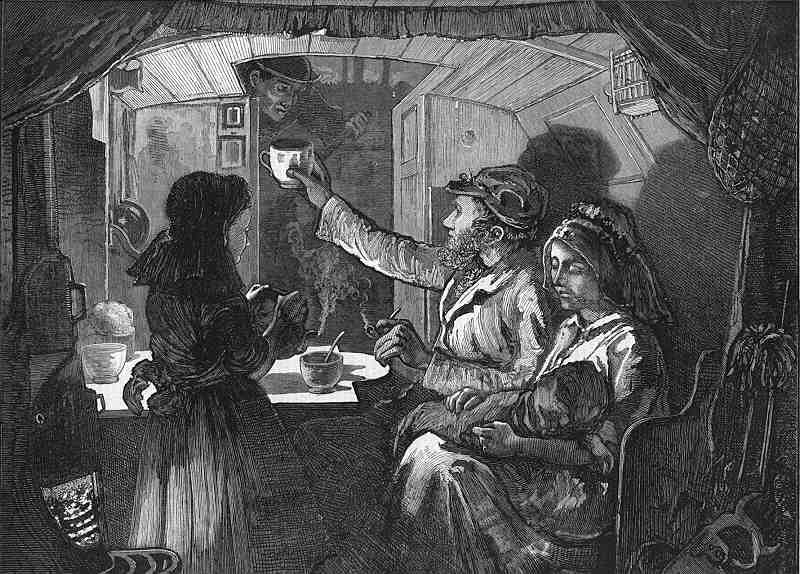
In the mid-1800s a canal boat would absorb the whole family. Men, women and children worked them and those same men, women & children lived in them. When transporting a load, the seventeen-hour days would have required all those able to lead the horse, steer the tiller and unload the cargo. Those who were too young to manage the heavy work would be keeping a close watch over their younger, toddler, siblings to make sure they didn’t get in the way of the work or even fall overboard. Living accommodation was cramped and squalid with limited facilities to wash or even to cook. Educational opportunities were non-existent and although Thomas was literate, none of the older Moody children were. Canal boat people were often misrepresented by outsiders, a community in need of civilisation.

Family inside a canal boat cabin. Unknown source.

Disease was rife on the canals: it was even suspected that cholera flowed down the channels from cities out to smaller towns. When ten-year-old Mercy & six-year-old Emma died within four weeks of each other in the summer of 1867, it was time for the Moodies to make a change to their way of life. The family moved to Horbury Bridge and into an onshore home. Four more children followed: Mercy in 1869, Tom in 1872, William in 1874 and then finally, twenty years after her first child, Elizabeth gave birth to her last, Ernest William, in 1876 whose middle name gave away her next to last child, William, had not survived infancy.

George and Lee both followed their father onto the waterways and Jane, too, married a waterman but the younger boys, Tom & Ernest went into millwork. By the time they were of age the golden era of the canals was being supplanted by rail for valuable goods at least. Designed as they were, the canals still retained a critical role for transporting coal and other heavy goods direct from mine to factory gate. Perhaps though, their choice of career was influenced by what happened to their elder brother Lee. I’ve not been able to find out any details but by 1901 Lee, aged 34, was blind.

Working in a mill seems also to have helped the boys’ marriage prospects as both Tom & Ernest married whereas George & Lee did not. Mercy too, was to remain a spinster, seemingly destined to stay at home to look after her aging parents and blind brother.

Thomas died in March 1901 aged 67 and Elizabeth in December 1911, aged 79. With their burial in Thornhill churchyard our direct connection to the water came to an end although not our connection to Horbury for Ernest had stayed in Horbury when he married, as did his daughter, my Aunty Edie, whom we used to visit when I was a child. It was not until she died in 1984 that we lost our final connection to the Calder & Hebble Navigation.

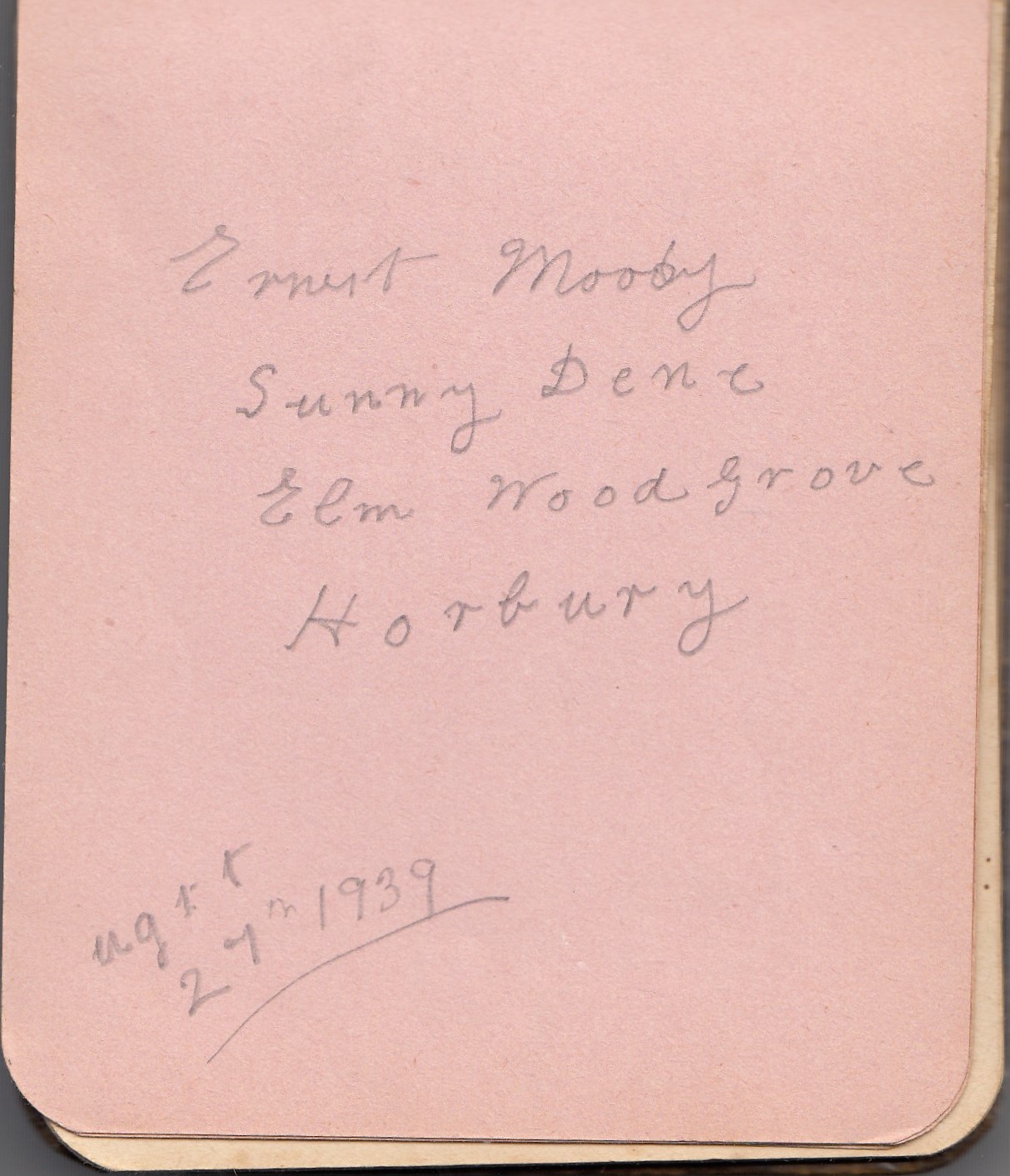
Ernest Moody’s entry in Mary Booth’s autograph book from Sunny Dene in Horbury, August 27th 1939. Own collection.

With much gratitude to all those who worked on our canals transporting goods to enable industry and who were often misunderstood. Thanks too, to Elizabeth Schofield & Thomas Moody for providing me with an excuse to gain a deeper understanding of these lives.

How accurate is Ancestry’s DNA ethnicity percentages for English ancestry?

I want to start by this blog by stating that whilst I am proud of my deep Yorkshire heritage I in no way associate with English nationalism. England has much to be positive about, but we have also, as a nation and as individual humans, wreaked havoc on peoples across the world and it cannot be right that to continue in the same xenophobic vein. I have not, as yet, discovered any ancestors who were directly involved with any historic atrocities, but I, and they, have still benefited from the privilege such acts have accorded us. We all need to recognise our own and our ancestors’ role in the system as was and more importantly strive to change it.

That being said, I’m now about to write about how Ancestry’s newest tool, the DNA sidebar, doesn’t work well for people with deep, known, English ancestry. I think this matters more broadly. One thing the English have been good at is record keeping. For over four hundred years parish churches have recorded births, deaths and marriages, plus parish poor law guardians took particular care to identify the fathers of any illegitimate children. Ancestry can’t be short of people to include within their sample groups, which should mean they can be more accurate than telling me I originate from “England and North Western Europe”. I only hope that Ancestry have instead focused their resources in adding to sample groups which can help those with more complex ancestry. Those with enslaved ancestors for example for whom so few records exist.

Each year I like to count the ancestors I have “identified”. It’s far from a perfect barometer of progress, making no reference to the depth of research. Sometimes all I know is a first name, generally Mary or Elizabeth. Nonetheless last time I counted (January 2022) I could identify 567 ancestors and I am also aware of other’s (quality) research that could help me extend this further.

Broadly the paper evidence leads me to believe I am 90% Yorkshire, 75% from 3 river valleys originating in the Dales – the Wharfe, the Nidd & the Washburn. Another 6.25% covers Wales and the Gloucestershire or the Welsh/English border. The remaining 3 – 4% is unknown but given where the babies were conceived there’s a high probability their fathers were from Yorkshire or surrounding counties.

In working this out I generally start with my 4xG Grandparents. This generation was born in the late 1700s/early 1800s when ordinary folks moved around less, and I’ve not found any evidence of earlier ancestors moving far. Indeed, they rarely even move beyond a neighbouring parish. One is unknown due to illegitimacy, one is questionable for the same reasons (both on my Mum’s side), four were from Gloucestershire & Pembrokeshire (equally split, again my Mum’s side). One, on my Dad’s side, carried the surname Scott, so some small part of him was possibly Scottish. That leaves me with fifty-seven (90%) from Yorkshire.

My DNA matches support the paper trail. I have found no unexpected parental events. I am a descendant of the left-behinds, of those who didn’t stray from home either geographically and sexually speaking. It makes me a somewhat inbred and my family history a little dull.

With background, let’s move to what Ancestry’s ethnicity data shows.

My DNA analysis

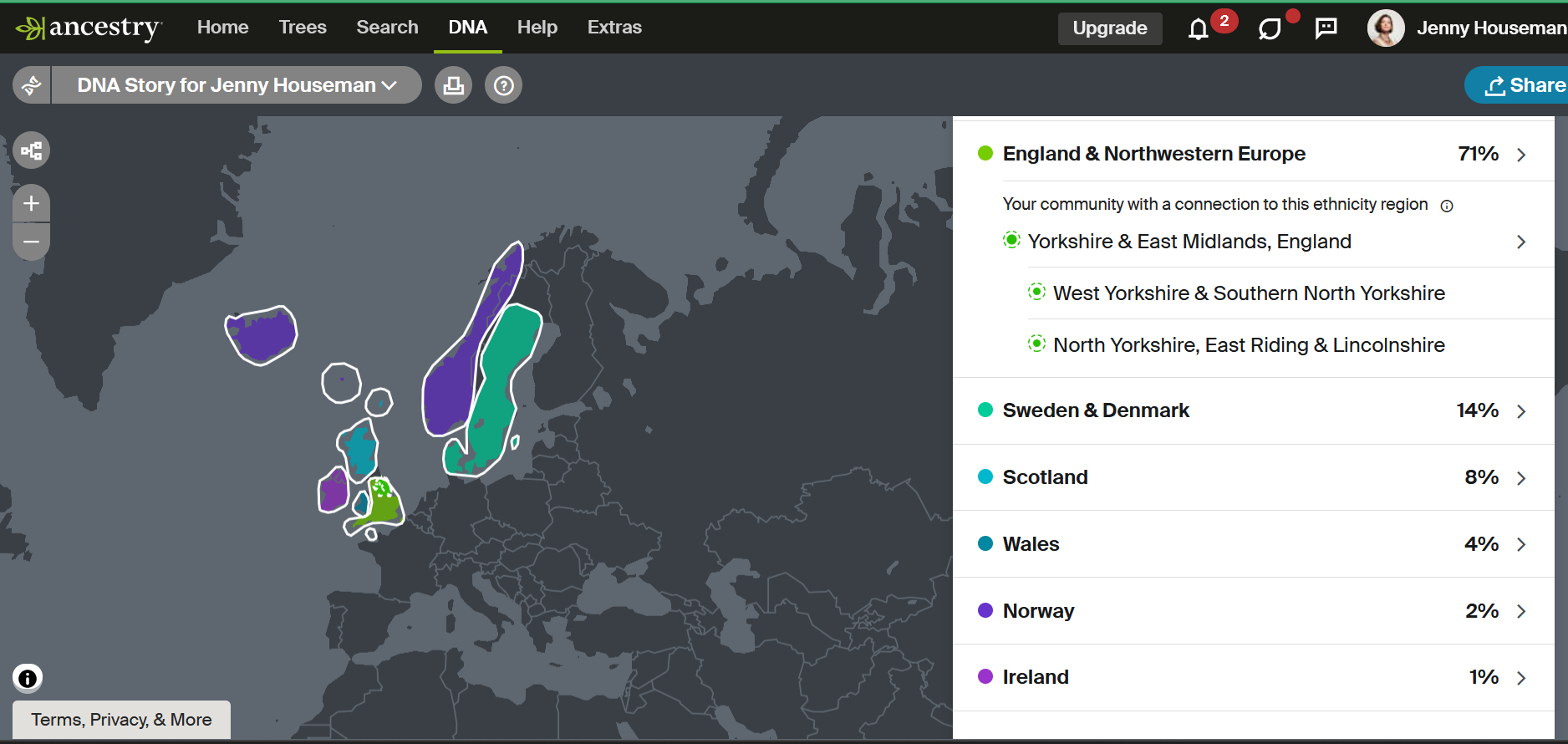
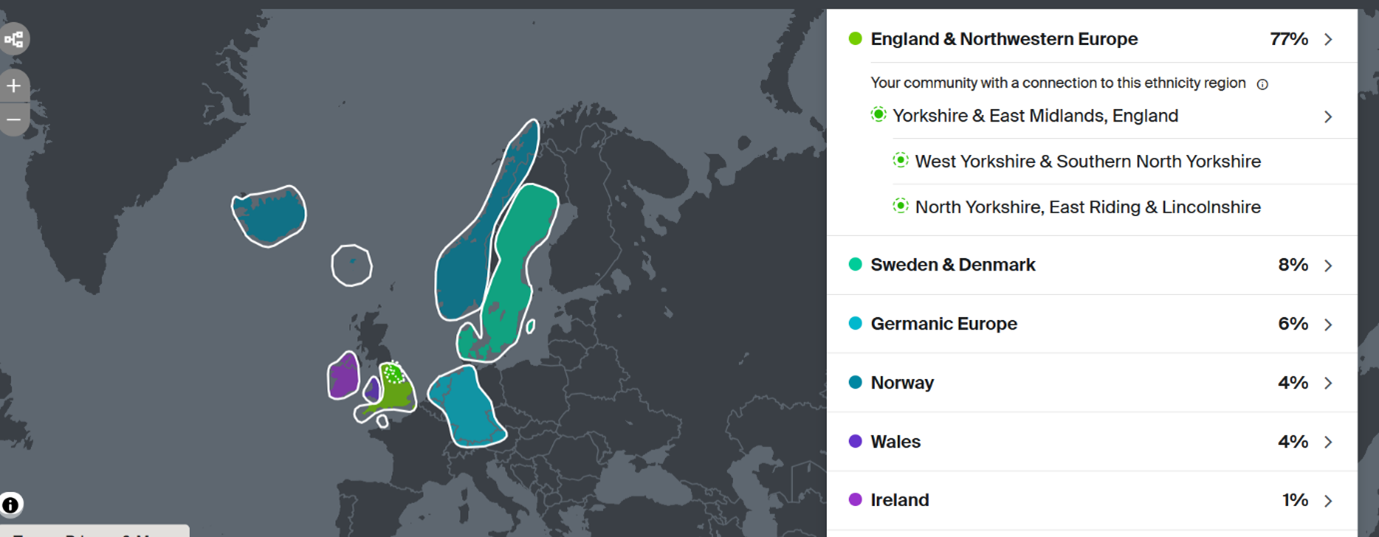
Ancestry DNA ethnicity estimate – October 2022

On the face of it my England & Northwestern Europe heritage has increased from 67% to 71% and indeed the range suggests that it could be as much as 99%. The regional identification is sound, but why not provide an estimate for this? Looking at it in more detail:

  1. England & Northwestern Europe? That is a huge area and quite honestly belittles cross fertilisation within the Isles. Why are Scotland & Wales considered separate units and England not?
  2. The range now runs from 63 – 99%. I could be just 2/3rds from Yorkshire, or equally, totally inbred. Ancestry’s best guess (71%) is considerably lower than it should be.
  3. Sweden, Denmark, Norway – on first glance it could be as much as a sixth of my ancestry. The range runs from nought to a quarter. Yorkshire was, of course, Viking controlled, but that was over a thousand years ago when they controlled or invaded much of Northwestern Europe. This is where my doubts about the usefulness of this tool really started to creep in.

I turned to the parental splits being fortunate to have access to both my Mum’s and my paternal Uncle’s DNA which takes me back a further generation.

My Mum’s DNA

Mum’s DNA – ancestry October 2022

The Welsh ancestry made it easy for me to identify which of Mum’s two parents was Grandpy and hence which was Nana.

Diving into Mum’s ethnicity split it seems that Mum could be somewhere between 2/3rds and 99% England & Northwestern Europe with Ancestry’s best guess being 72%, fractionally higher than my own. Odd, as it is from Mum that I inherit both my known Welsh ancestry and that part of my DNA which could come from anywhere.

But then it tells me that Mum is also, apparently, 19% Scottish. Split 11% maternal and 8% paternal,

That would make my Nana nearly a quarter Scottish. Possible as she has two illegitimate great grandparents, but there is evidence to suggest who one of the fathers was and he has Yorkshire ancestry. Which would make the other a full-blooded Scot. The North Yorkshire/Lancashire border is not that far from Scotland. It is certainly possible. But I’ve also got to factor in my apparent Irish heritage of course making up about 4% of Nana’s DNA.

Grandpy on the other hand? The only reason he is not highest in my ancestor count is because I got a bit bored of adding others (quality) research to my tree. 10% Welsh, absolutely, if you count the Barretts from Gloucestershire, everything else is pure Yorkshire. I have no idea how he’s turned out to be 16% Scottish. Hence why I think the English/Scottish split is unhelpful. I am sure Northumbrians & Cumbrians would agree.

My paternal Uncle’s DNA

Paternal uncle DNA – ancestry 2022

My paternal Uncle’s DNA is the best substitute I have for my Dad’s. I based his parental split on shared matches but given how odd his own DNA ethnicity breakdown seems to be I don’t think the split adds any value. What’s interesting is that there’s no Scottish ancestry. Clearly the surname Scott doesn’t necessarily mean Scottish heritage. My Uncle is a Viking at heart so perhaps he’ll be pleased with Swedish, Danish & Norwegian genes.

I, on the other hand, am not, for both my paternal grandparents’ trees are fully documented for over 200 years. All 32 of my paternal 4xg grandparents were born in Yorkshire as were all of their ancestors whom I have so far identified (275 at the last count). It helps that they are (twice) descended from the same ancestors and rarely married outside of the parish.

Clicking in, the detail becomes increasingly lazy as whilst the ranges allow for my Uncle being 99% England & Northwestern Europe they also allow for him being 21% Swedish and Danish and up to an astonishing 29% Germanic European. Imagine if you were starting without a decent paper trail. These ranges would leave you criss-crossing the whole of western Europe.

In conclusion

It would be unfair for me to end this blog without referring to all that is positive about DNA testing. Through DNA testing I have been able to confirm the paper trail and have also corresponded with and even met some wonderful DNA cousins. It’s also helped an adopted friend who was delighted just to know that he was as biologically Irish as his adopted family helped him feel (although even in this example, it’s the specific matches which have helped us prove this). It’s just that, at best, the ethnicity splits, promise an accuracy which they don’t deliver. At worst, without a paper trail to fall back on, you could end up believing something which isn’t true.  

Elizabeth Webster (1832 – 1903) & Charles Scott (1834 – 1897)

The Reynard-Scotts were the smartest of our Victorian great great grandparents. The Reynards were one of the first couples I wrote about intrigued by stories of a spice loaf and a wig so it seems apt for the Scotts to be one of the last, bookending tales of mining, farms and grinding poverty with two stories of the Victorian middle-class.

Elizabeth Webster & Charles Scott are my 3xgreat grandparents, Grandma’s mother’s father’s parents and for this tale we are moving into what is now North Yorkshire, to the village of Minksip just south of Boroughbridge.

Last year, for my birthday, Mum took me to the Wild Swan pub for dinner. It’s one of her favourite “local” pubs, local being defined as anything within a twenty-mile radius so long as it’s not in a town. The food and the company were wonderful and the trip had the added benefit of being able to wander down the village high street trying to work out exactly which home had belonged to Elizabeth & Charles.

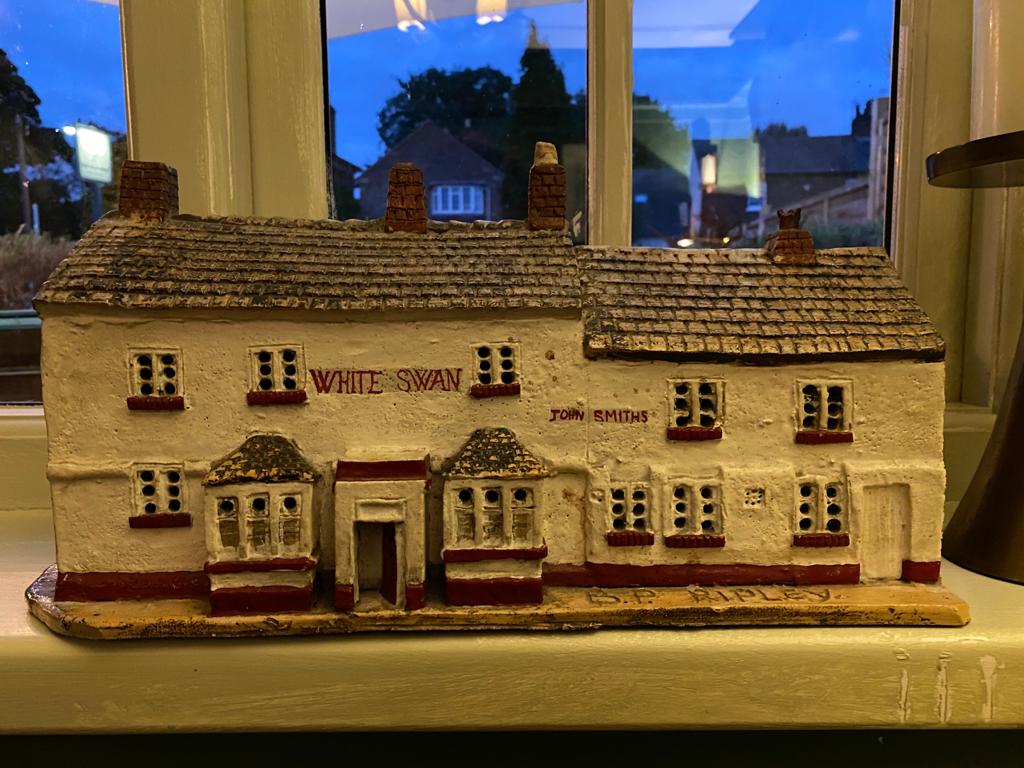
A model of the White Swan pub, Minskip, now known as the Wild Swan. Own photo.

Minskip is one of those immaculate North Yorkshire villages with solid brick-built houses and well-tended gardens strung along a main road. The location is key to that well-heeled vibe. Harrogate, York and even Leeds are all within reasonable commuting distance for those with a car. Without a car, you are much more limited. I did discover the existence of a once daily bus which would take me from Mum’s direct to Minskip but none which would bring me back!

Minskip’s location was just as important to its economic prosperity in the early to mid-1800s for the Great North Road ran close by and stagecoaches were in their heyday. The White Swan coaching inn opened for business in 1832 bringing an increased number of travellers (and their coins) to the village. This wasn’t to last as within three decades trains had decimated the stagecoach trade, but by then the Scott family were already established.

Elizabeth Webster was born the same year as the pub was opened in the village of Kirby Hill, about three miles north of Minskip, just the other side of Boroughbridge. She was the daughter of Ann (Williamson) & John Webster, a cordwainer. Elizabeth’s exact birth date was unknown, but she was baptised at All Saints church, in Kirby Hill on 6 May 1832 and a birth date in mid-April would fit with most documentation.

Charles Scott was born in Boroughbridge a couple of years later, the second child of Jane (Drury) and Thomas Scott. Jane is another of those wives hidden by lack of records and propensity for the widowers in my family to choose a second wife with the same name as the first. For a long time, I thought Charles’s mother had died in 1872 until another person’s research alerted me to the death of a Jane Scott on 18 June 1838. As is also the way with the widowers in my family, Thomas didn’t hang around, remarrying the following year, to a woman named Jane Kendrew……

Like John Webster, Thomas Scott was also cordwainer. I imagine a mini guild of cordwainers in Boroughbridge, a rural remnant of The Company of Cordwainers of the City of York which had been disbanded in 1808. In addition to the Websters & Scotts there was also the Barker family of Dishforth. Dishforth is another small village in the vicinity of Boroughbridge, now mainly associated with the airfield. It also happened to be where Thomas Scott had been born and where he sent his son Charles to be apprenticed to one Francis Barker. The heads of all three households were small business owners and likely met regularly over a pint of ale to critique the latest shoe fashions, complain about the price of leather, and even share business opportunities during peak periods. Like any good fraternity, I expect they also drawn to each other at larger social gatherings such as the Barnaby horse fair bringing their families with them, meaning Elizabeth & Charles would likely have known each other as children.

So it was, on 3 May 1856 that the Webster and Scott families were united in marriage. By this time Charles had completed his apprenticeship and Elizabeth was earning her own money as a dressmaker giving them the means to set up home together. More pertinently, Elizabeth was in the early stages of pregnancy….

Thomas Scott had left the area by this point and was living with a nephew, John (son of his brother William), close to Bradford. This explains the birthplace of Mary, Elizabeth & Charles’s first child, although it is not clear whether this was a short family visit, the place where the couple first set up home together, or a deliberate attempt to disguise a child conceived out of wedlock by moving out of the local area. Scott is simply too common a surname for me to be able to follow this up.

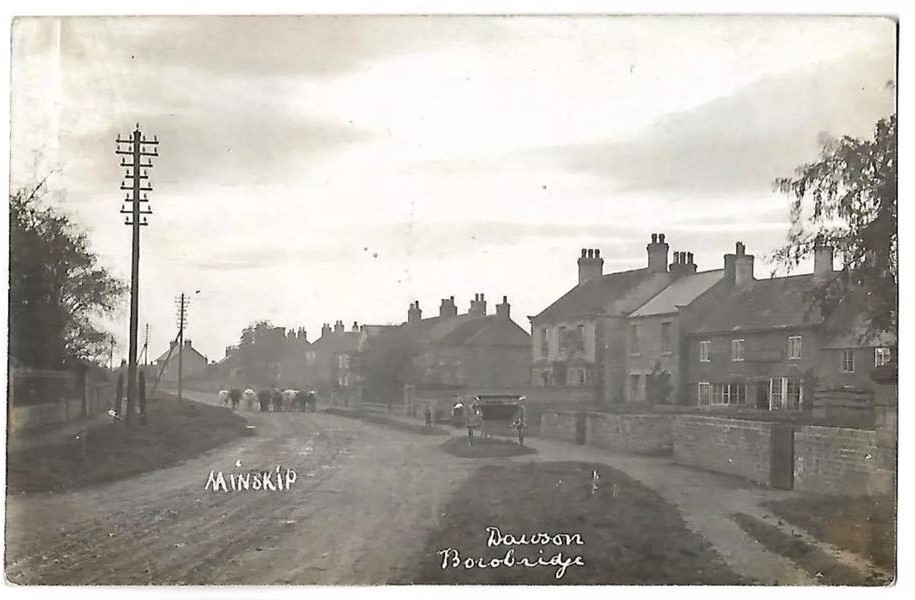
A postcard of Minskip c.1900 from the facebook page Boroughbridge then & now.

By the end of 1860 (before the birth of their second child, Arthur), Elizabeth & Charles had moved to Minskip where they were to spend the remainder of their lives. Charles’s occupation was given as a cordwainer in both the 1861 & 1871 censuses. More unusually, Elizabeth continued to have her occupation listed too, as a dressmaker in 1861 and a milliner in 1871. These complimentary trades could have helped the Scotts attract a more fashionable elite. Certainly, their third child, John (my great, great grandfather) cut a fashionable air in his youth.

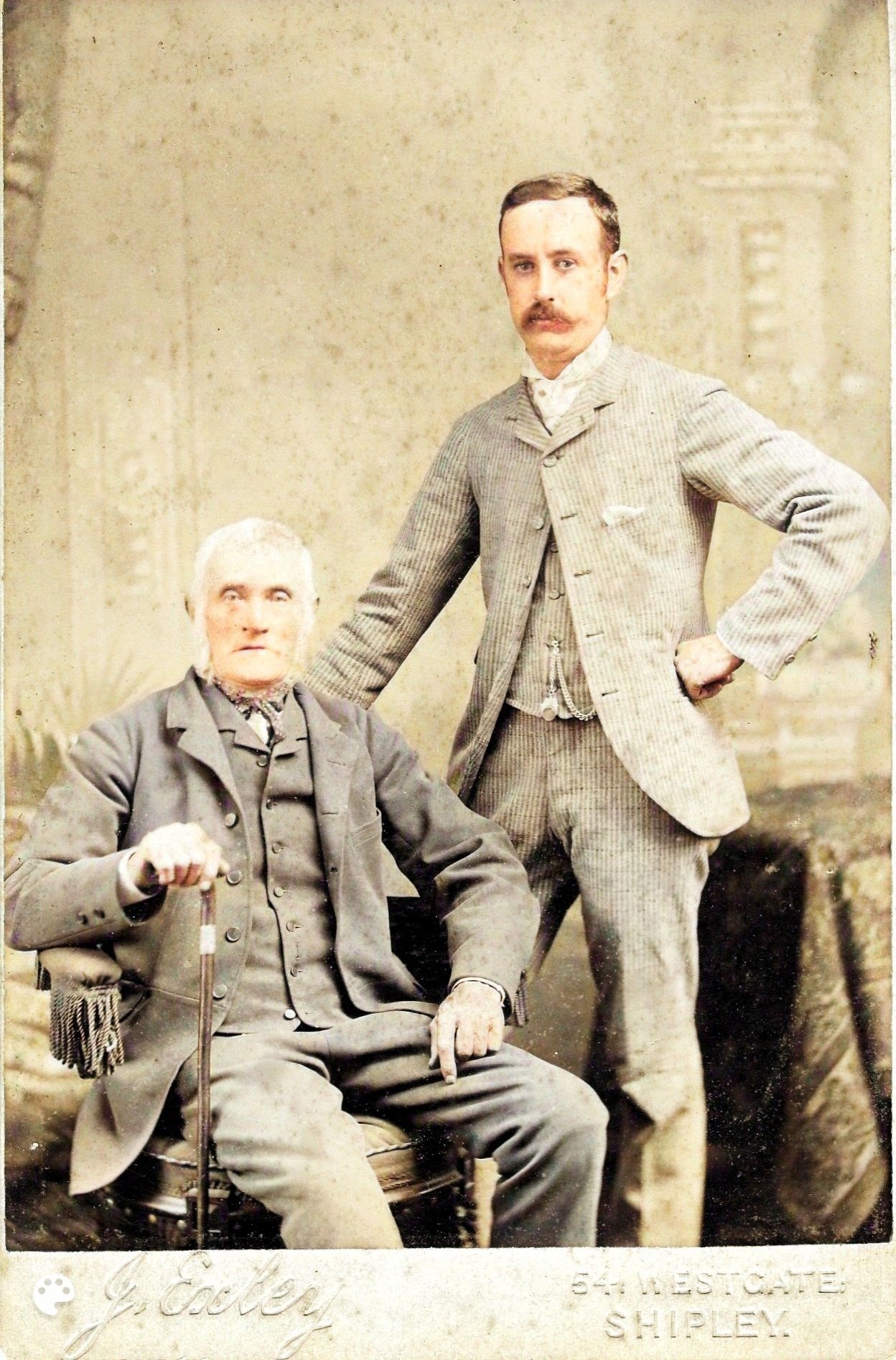
John Scott (right, standing) taken c.1890. The seated man could be his father, Thomas. Although Thomas would only have been in his late fifties by this point, many of Grandma’s relations sported white hair from an early age. From the Maria Reynard family album. Own collection.

Elizabeth & Charles had two more children, Alfred Herbert & Annie. Mary married a farm labourer, Joseph Dobson and moved to Easingwold. Arthur trained as a joiner, before eventually becoming a farmer and milk dealer in Menston. John, trained as a bricklayer, and then worked as a grocer before moving into farming in Topcliffe, eventually putting those bricklaying skills to good use by building his own home there. Alfred, trained as a joiner and ended up in Harrogate. Annie did not marry, but became a butter factor in her own right, leaving an estate worth £188 when she died in 1903, a decent sum for a single woman.

What the children’s occupations tell me is that this is a family who understood the value of being skilled in a trade and were also astute at business, knowing when to switch to alternative ways of making money. In this they were following their father’s example. By 1881, Charles had switched career to become a fruiterer. Later that decade he also became a landlord. At a major property sale in 1889 he “secured two cottages, with outbuildings and gardens, occupied by Mrs Taylor, for £160,” a major outlay for the time.

But not everything was as rosy as business, for at some point in the mid-1880s, Elizabeth became a “hemiplegic.” Whilst most commonly caused by a stroke, it can also be the result of some other brain trauma, an accident or a tumour. This would have been devastating for an intelligent, active woman such as Elizabeth. For the next seventeen years, until she died from heart failure on 28 June 1903, Elizabeth would have been reliant on others. I’m guessing this was when Charles invested in a horse & some sort of carriage, adding carrier to his portfolio career.  Her granddaughters (Mary’s children) took on the domestic work.

Still, paralysed as she was, Elizabeth outlasted her husband by six years. For, like his son and two grandsons after him, Charles fell afoul of a random tragic accident.

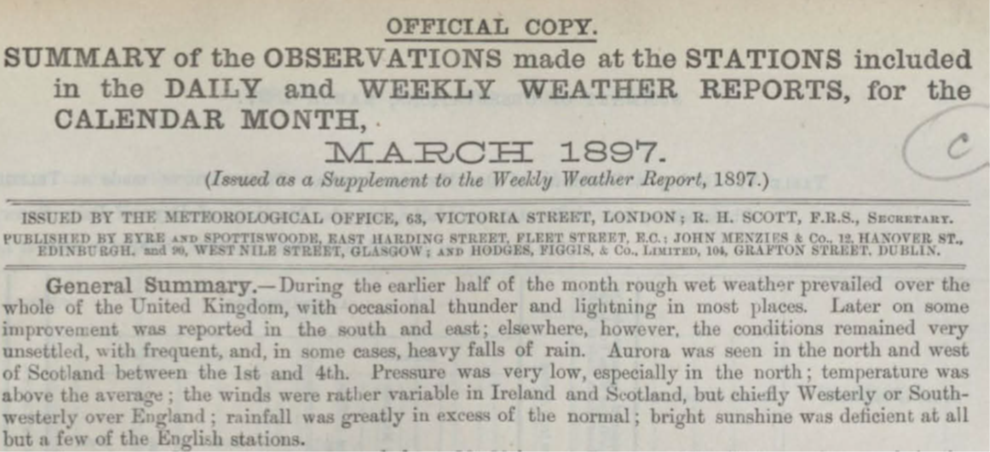
The met office monthly weather report for March 1897. From the met office archive.

On the 24 March 1897, yet another spring storm hit northern England. The met office report for the month focused rather more on the south of England and on Scotland, but did note that “elsewhere, however, the conditions remained very unsettled, with frequent, and in some cases heavy falls of rain.” Local newspapers help to provide a better picture of the day’s weather. Whilst the Knaresborough Post chose to focus on a local football match writing that “This match took place at Ashville in very stormy weather. Trinity, who won the toss, elected in the teeth of a perfect gale,” the Hull Daily News took a wider view reporting on the overturning of a tramcar in Bradford (no serious injuries), and the loss of at least one member of a dredger crew off the west coast. This was serious weather.

Charles and his daughter Annie braved the storm. Wednesday was and still is market day in Knaresborough. There were goods to transport and butter to be sold. Charles Mackintosh had long since patented his waterproof raincoat providing protection from the rain if not the cold on the six-mile journey into town. However, the market was uncovered and by the end of the morning the pair would have been chilled to the bone. I really hope they had chosen to partake of a cooked dinner before they set off home in the early afternoon.

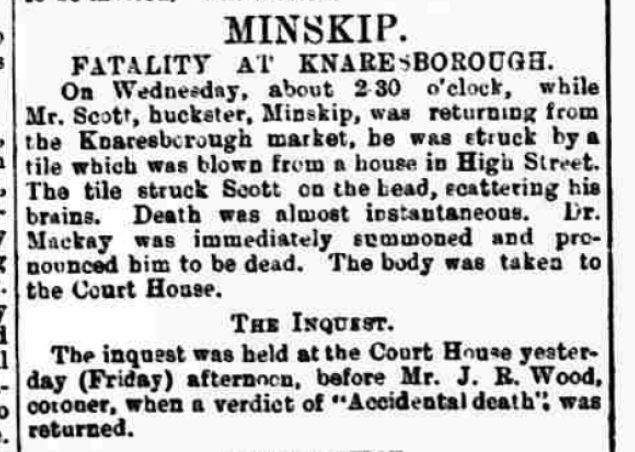
There again, it would have been better if they hadn’t, for just as they were passing Mrs Collins’ house on the high street, a tile flew from the roof and struck Charles on the head, “scattering his brains” (to quote The Knaresborough Post, in its rather graphic description of events). Charles was killed immediately, a death subsequently found to be accidental, but I can imagine Mrs Collins was careful to keep her roof properly maintained from then on. I cannot begin to imagine the impact on Annie.

A report of Charles Scott’s death in the Knaresborough Post, 27 March 1897 downloaded from www.britishnewspaperarchive.co.uk

It’s rather a sad and abrupt end to this tale, so let us finish back in the White or Wild Swan with a toast the couple who rode the Victorian wave of prosperity and, of all my 3xg grandparents most effectively set their five children up to continue that journey. RIP Elizabeth & Charles.

Mary Holmes (1826 – 1876) & George Brooks (1829 – 1901)

The children of Mary Holmes & George Brooks. Unknown origin. Shared by William Brooks’ descendent, Adrian Rhodes.

More than once I have misjudged our ancestors. “Rogue” Robert Walker is perhaps the most blatant, but when I re-read my early attempts to capture George Brooks’ story, I realised I was in danger of misjudging him too. It reminded me that George’s declining career and the hoicking of his family from the fresh air of rural Bewerley into the slums of Bingley was due to poverty and circumstances beyond his control, not laziness and certainly not from choice.

I do not know who to credit with sharing the above document, but I am grateful that they did. It shows George’s son, William, entering what I believe to be the Manchester Unity of Oddfellows in 1881. William was seeking to join a fraternal order set up to protect and care for its members. This must surely be a hardworking family, taking proactive steps to care for themselves and others. William is not George of course, but in 1881 he was still living with his father. Joining the Oddfellows must have been done with his consent and perhaps blessing.

This then is the rewritten story of Mary Holmes and George Brooks, our 3xgreat grandparents, through Grandpy’s father’s mother, Jane Brooks.

George was born on 8 March 1829 in Bewerley. His father, William Brooks, was already 43 when his last child was born and died when George was just fourteen. His mother, Anne Grange, was ten years younger than her husband, but she too, died, before George had ended his teenage years. George had an older sister, Ann, by this time married with her own family. His eldest brother, Harker, had died as an infant which left just one brother, also Harker, and ten years George’s senior. Harker promptly chose to emigrate to Australia with his young family and George was left alone.

(As an aside, Harker was a useful name to help track back this family – it helped confirm both George’s grandfather, Harker Brooks, and his great grandmother, Mary Harker).

George was not to be on his own for long. On 25 July 1850, George, having just come of age, married Mary Holmes, a local woman, a year his senior.

Mary was born in Bewerley on 24 February 1828, the fourth of six children of Jane Wilkes and Christopher Holmes. Like Harker, she too had had a deceased elder sibling after whom she was named. Fortunately, two elder siblings, Joseph & Ellen, and a younger brother, John, were all to survive childhood, with the youngest, William, dying in infancy. Jane & Christopher, too, appeared healthy with Christopher still recording his occupation as a stonemason well into his seventies. Unlike George, Mary was surrounded by family.

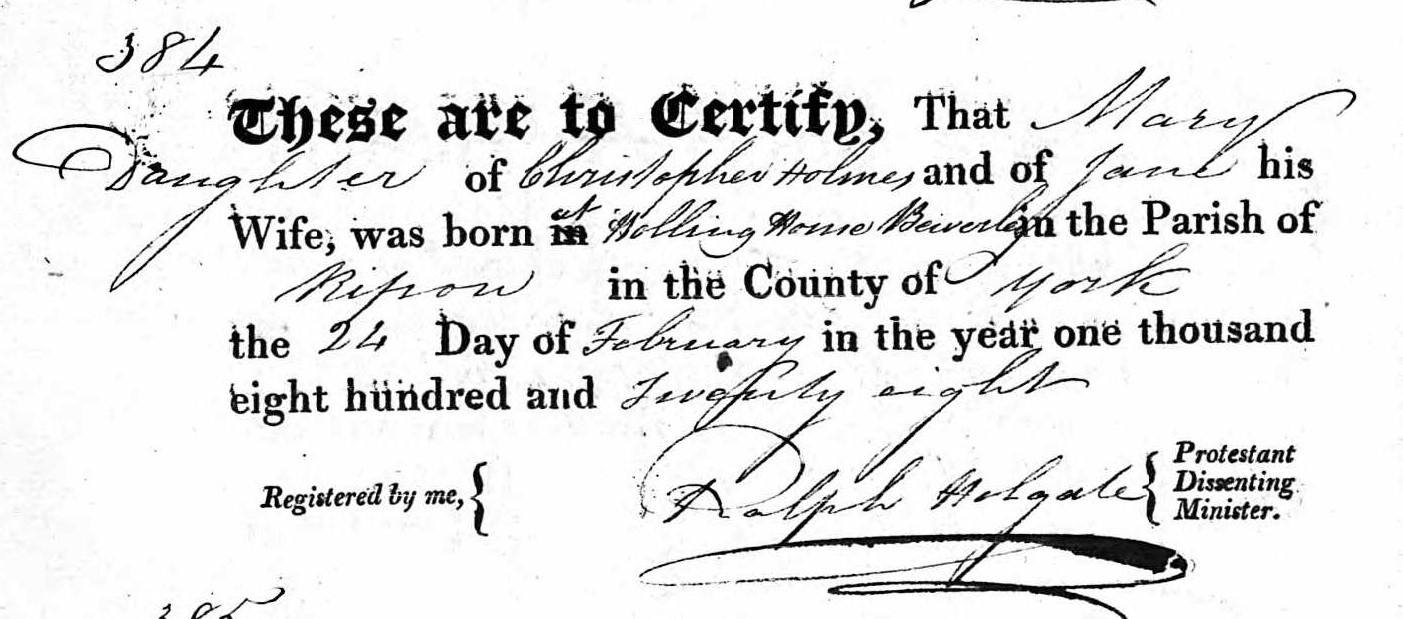
Registration of the birth of Mary Holmes by the minister of the Salem Independent chapel in Pateley Bridge. From an ancestry collection.

Importantly for my interpretation of this family, Mary & her siblings births had been registered at the Salem Independent Congregational Chapel in Pateley Bridge. There is a strong thread of non-conformist worship across our family, and I tend to associate this with a certain level of industry and temperance. It feels much more of an active choice. I wonder, though, why George’s sister Ann, had also been baptised in the Salem Chapel, but neither George nor his brothers were. Perhaps this form of worship had not been to the Brooks taste.

Mary & George settled into their new home in Bewerley. George, like his father-in-law, worked as a stonemason, Mary reared their children. I think Mary had the harder task. Jane (my great, great grandmother) was the first to arrive on 30 March 1851, a honeymoon baby. Eight more children arrived, one girl, Ann, followed by seven boys, regular as clockwork, every two years. They were a healthy bunch too. Only one, John Holmes, died in childhood (aged five).

Then at some point between the 2 April 1871 (the census) and 20 Jun 1872 (John Holmes’s death) something happened to cause the family to move to North Street, Bingley. My best guess is that this was down to opportunities for work.

George was a stonemason. Whilst pre 17th century this was considered to be a skilled profession it had broadened somewhat by the 1800s to include quarrying and basic building and construction. The evidence in George’s life suggests to me he was more likely to fall into the latter category. Quarrying for stone & lime was an important industry in Bewerley, but the area had been in slow decline over the period from 1850 to 1890 as the lead mines closed leading to pressure on other occupations. With several growing children who also needed to find work, Bingley, with its factories, may have seemed an attractive option.

It proved the be a poor choice. The aforementioned John Holmes died shortly after the move. Then Mary herself succumbed to tuberculosis on 15 February 1876, a disease far more prevalent in towns. It also marked the start of the decline in George’s own career, from stonemason to mason’s labourer (1879 marriage) to unemployed stonemason (1901 census). The latter stage was entirely predictable, for who would employ a 72-year-old to undertake work that required physical strength?

With Mary dead, and the girls gone (Jane had long since left home to work as a live-in domestic and Ann had married in 1877) George was left with a houseful of boys. By 1879 Harker, too, had possibly left home, but that still left William, George, Joseph, Christopher and Thomas. Just like so many widowers in my family, George had a solution. On 3 August 1879 he remarried, to a spinster named Ellen Emmott, a 42-year-old domestic servant. Too old in 1879 to have children of her own, Ellen would have been a wonderful asset for a household consisting only of males.

As regular readers know, one of the aims of my research is to ensure that women’s lives are recorded and with no children of her own, Ellen is at risk of being forgotten. So indulge me whilst I take a short diversion into Ellen’s own story.  

Ellen was the illegitimate daughter of Isabella Mitton born on 17 January 1837 in Addingham. It wasn’t until 28 October 1839 that Isabella married John Emmott, so he clearly wasn’t the father, and the documentation seems to suggest he never treated her as his own. John was a blacksmith, prosperous enough to leave a, still legible, York stone memorial in Addingham churchyard. His gravestone also records the death of Isabella and of their first child, Alice, born in 1841. By 1851 Ellen had left mother’s growing family and went to work as a domestic servant. At the age of 42, she married George and essentially acted as his (unpaid) housekeeper and they descended together into slums until George’s death in 1901. It seems that none of the Brooks’ brothers thought to invite her into their own homes when their father died, but she did find peace. She was taken in by her two unmarried half sisters, Ann & Phoebe (eleven and seventeen years younger than her), who were housekeepers at a boarding house at Arnside, Morcombe Bay. Phoebe, the second of the two sisters to die, left an estate of £2,400 in 1930, so the sisters were in a good place to support her Ellen until her death in 1913. I am happy to think that she lived out her last days in peace with her sisters.

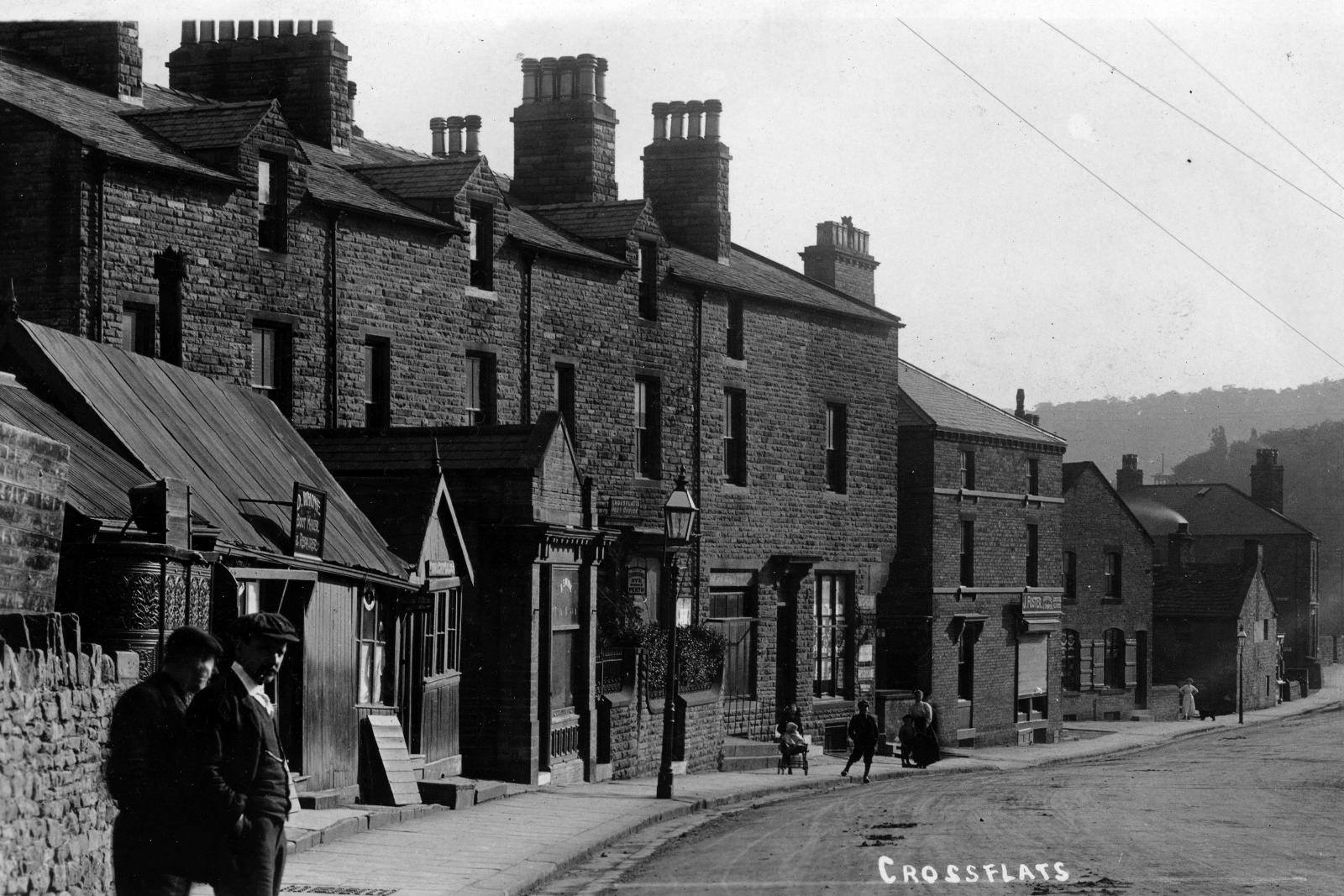
Crossflats, postcard taken from https://www.facebook.com/groups/bingleymemorylanephotos. Foster Street has been demolished, but was in the area to the South East of the junction between Canal Road and Keighley Road.

Of course, Ellen’s story has essentially given away the end of our tale. George junior died aged twenty-one in 1880 and then one by one the Brooks’ brothers left home. Thomas, the youngest, was last to leave. By 1901 George & Ellen lived alone, having moved to Foster Street in Crossflats, until on 4 September, at the age of 72, George died. He was reunited in burial with Mary and his sons, John Holmes & George in Bingley cemetery.

With much gratitude to a man named Adrian Rhodes, a descendent of Mary & George through their son, William Brooks, for sharing various documents about William on ancestry including the one which I shared at the start of this blog. Thanks to Nigel Brooks for his dedicated work on the Brooks family line which makes cross checking my work so much easier. My thanks too, go to Mary Holmes & George Brooks for reminding me to take equal care of all my ancestors.

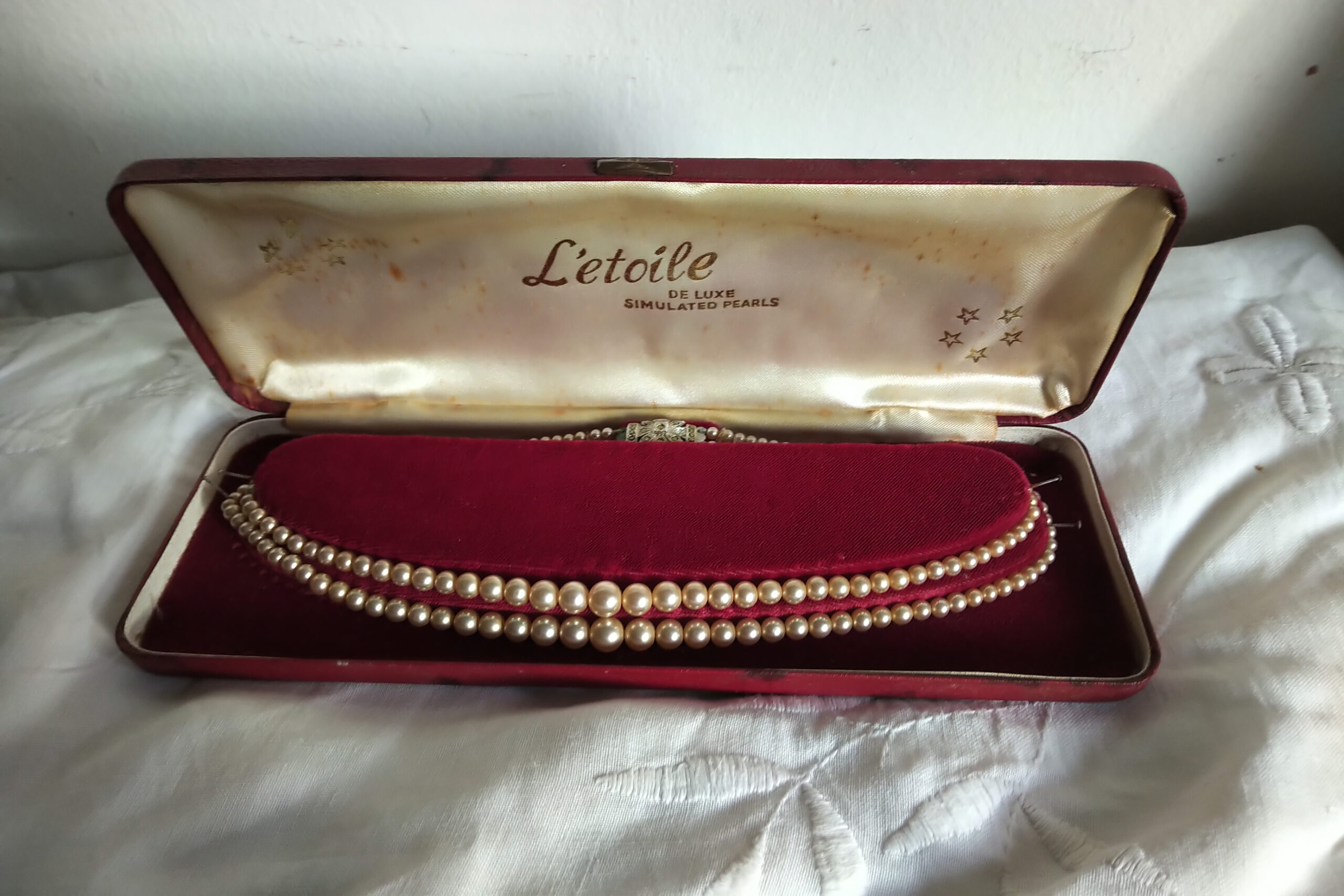
21st birthday pearls

Aunty Christine’s 21st birthday pearls. Own photo.

Mum specifically warned Dad (Bob) against buying pearls for her 21st. It was the 1970s. Being a talented dressmaker she could make her own fashionable clothes and pearls, well, they didn’t excite a modern young woman. The Housemans were far more traditional in their taste and more general approach to life. Early intervention was warranted.

When Bob handed her a smart red leather case her thoughts would have run first to silver, possibly even to gold. Until she lifted the lid. I feel certain that there was a necessary re-arrangement of her face as she hoped to look grateful for something she specifically did not want. Bob on the other hand would have been struggling to disguise a smirk as would his sister, Christine.

I wonder how long he made Mum struggle before revealing that these pearls belonged to his sister, her own 21st birthday present, and from which she had only willing parted from for the duration of the joke? It was worth it. The joke has lasted for fifty years. I don’t actually know what the real present was!

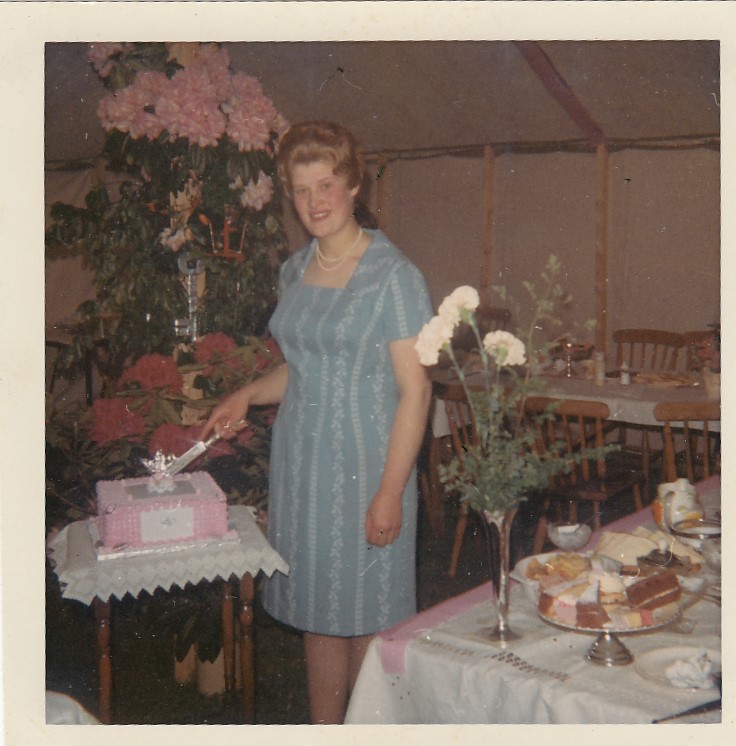
Aunty Christine at her own 21st in 1968 proudly wearing her new pearls. Own collection.

She married twice, the second time to an older man

Back in the 1980s I quizzed Nana about her ancestors, and this was the only story she had about any of her great grandparents. No names, no dates, no locations. Just one fascinating line.

Fast forward thirty plus years. I’d done a bit more research by then and knew I was looking for a couple with the surname Cooper (whilst a fairly common occupational surname I am grateful that it isn’t as prevalent as Smith!). The pandemic shut us all into our homes, and I got serious about family history.  Where else to start but to find out more about the woman who “married twice, the second time to an older man.” Her story did not disappoint and along the way, she also became the ancestor on which I honed my genealogy research skills which combined made her one of my favourite ancestors and you can hear me talk to her story in these two podcasts waffle free family stories and journeys into genealogy).

So let me introduce you to Hannah Demaine, my great, great, great grandmother through my Nana father’s mother, Sarah (Cooper). Hannah was born in Otley on 6 May 1837 the eighth of nine children born to Sarah (Swire) & Joseph Demaine. Joseph was an iterant agricultural labourer for much of his life and at the time the family were living on Bondgate. These days it’s a lovely little terraced street of shops including the delicious Bondgate Bakery but at the time it would have been dirty and crowded.

Hannah was illiterate. Schooling was not yet mandatory, and cost likely prohibited any of the children from attending. Certainly, William the eldest son never learnt to write so it wasn’t just the girls who missed out. As the only daughter still left at home by 1841, Hannah would have been helping her mother with the washing, cooking, and cleaning from an early age.

By time of her marriage in 1861, Hannah was living in Farfield on the outskirts of Addingham. For 55 years or more, Joseph, Hannah’s father, had toiled for others, but finally he had secured a farm and became his own boss supported in 1861 by his youngest son, Amos, and later by his eldest son, William.

Addingham was primarily a textile town and had gone through a period of severe decline as this work became increasingly mechanised affecting at least two of her brothers (George & Albert) who had worked as a woolsorter and woolcomber respectively.

“John Cunliffe, cloth manufacturer, and John Cockshott, glazier and wool-stapler, leased land on the side of the Wharfe and built a spinning mill in [Addingham] 1788 -1789. It enabled yarn to be spun more quickly than by hand and so increased the production of cloth. A weir was constructed on the river and a wheel installed to provide the power. It was the first successful worsted mill in the world. The first piece of worsted yarn to be seen in Bradford market was made by John Cunliffe at Low Mill. In a sense, it was the birthplace of the Bradford Worsted Trade. At the same time, others were looking at cotton and there were a number of small calico manufacturers who probably employed people with jennies to spin for them. High Mill, Town Head Mill and Fentimans (later a sawmill) were built shortly afterwards, all for spinning and the handloom weavers were kept pretty busy. There were many small workshops, and many weavers cottages built three stories high – two for domestic use and the top floors to house the looms, with inter-connecting doors along the row (e.g. in Stockinger Lane). There were other, similar, cottages with the top floors used for warehouses with cranes and pulleys over the large outside doors.

In 1831-41 there was a decline in the population and the census returns state that this was owing to the closure of Low Mill. In the 1851 census, so many houses at Low Mill were empty that it must have remained closed until after that time. By 1861 handloom weavers had practically disappeared. Samuel Cunliffe Lister re-opened Low Mill, putting Addingham back in its prosperous position” (from www.addingham.info/story-addingham-village/)

The Lowcock family from Addingham were also engaged in a combination of agriculture and textile work. Whilst Edward, the head of the household, was technically a farmer, he had only 13 acres of land and supplemented his income by weaving worsted on a hand loom. Timothy, too, Edward’s son, seemed to take what work he could with his occupation being variously listed as hand loom weaver, labourer and farmer. And so it was that Hannah met Timothy.

Parish register entry for Hannah Demaine’s first marriage to Timothy Lowcock in 1861.

There’s very little to show of Hannah’s first marriage to Timothy Lowcock. Married on 1 January 1861 at St Peter’s in Addingham, Timothy was recorded as living with his parents in the 1861 census. Hannah is missing. I have reluctantly concluded that the Timothy’s 29-year-old sister, Hannah, who had brought her illegitimate child back home to live his grandparents has caused the enumerator to exclude our Hannah from being counted. Such are trials of researching our female ancestors.

As for living happily ever after, well “ever”, in Hannah’s case, was very short-lived. Timothy died of consumption on 21 December 1861, something he’d been diagnosed with for twelve months. Was Hannah aware of this when she married him? And, more importantly, was this it? Married and widowed within a year. Hannah moved back to live with her parents.  

Timothy Lowcock’s death certificate from 1861

Hannah may have taken more than a new surname from this first marriage. The Lowcocks appeared to be staunch Wesleyan Methodists. Timothy, his parents, his sister Hannah and her son William and his wife and child are all memorialised on one stone in the Addingham Methodist Church cemetery. Neither the Demaines nor the Coopers appeared to have Methodist associations, yet Hannah’s second marriage took place in Otley’s Wesleyan chapel. I can only think that she adopted the Lowcock family’s religion. 

Moving back in with her parents was also to positively shape the second half of Hannah’s life. For Joseph was to switch farms for one in Askwith.  Hannah moved not into the tiny terrace in Otley, but onto a 50-acre farm in Askwith.

It was in Askwith that Hannah met “the older man,” John Cooper. John was born in Farnley in 1820. His father, Francis, was variously described as a joiner, carpenter and then gamekeeper. Francis & his wife, Sarah (Stubbs) had at least ten children and the dangers of childbirth should have meant Sarah was the first to die. But, no, it was Francis who died at the relatively young age of 39 in 1825, leaving Sarah with a young family to support.  Sarah must have had some fun for a half-sibling, Harriet, appeared on the scene in 1828. Henry (the eldest son) took care of his mother, but the rest of the family scattered to make their own way in the world. Thankfully for us, John’s sister Ann had married a farmer in Askwith which meant a place for John to work and was also where he met the young widow, Harriet.

Certificate from Hannah’s second marriage to John Cooper in 1873.

On 2 August 1873, 36-year-old Hannah married 52-year-old John. Two children swiftly followed, Sarah (our ancestor) in 1875 and Mary Ann in 1876.

I really hope this marriage wasn’t all about the farm, but John undoubtably benefited from an elderly father-in-law with only a middle-aged unmarried son at home. After Joseph died, William & John continued to run the farm together until John died in June 1893 aged 72. Then, when daughter Sarah married Thomas Booth in 1895, he moved in too. Hannah continued to live with her daughter until 1914 when she died, aged 77, from “malignant disease of the stomach and exhaustion”. Hannah, my favourite ancestor, is buried at Weston Church.

With much gratitude to Nana for gifting me an intriguing line about her great grandmother and to Hannah herself for being one of my wonderful widow ancestors.