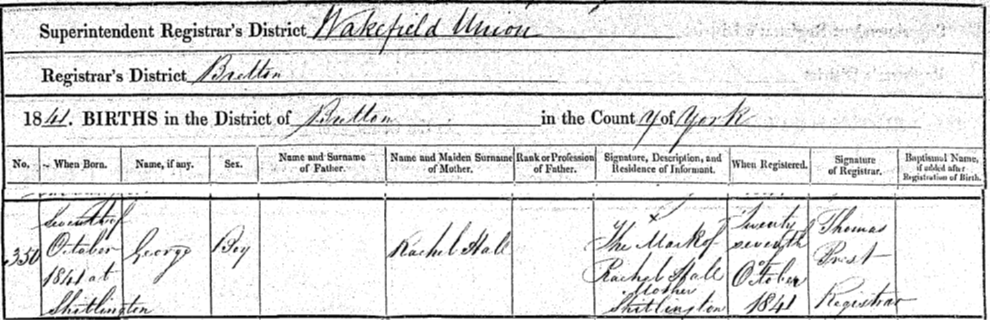
I searched for George Bentley’s birth certificate for a long time. Born c. 1841/1842, his birth should have been registered. His siblings were. Until it clocked. George parents (Rachel Hall & John Bentley) had not married until the second half of 1842. George Bentley wasn’t born George Bentley he was born George Hall.
Birth certificate of George Hall, otherwise known as George Bentley.
Whilst contraceptive methods in the 1800s were somewhat unreliable, the Bentley family appeared to have no knowledge of them: two of George’s sisters had illegitimate children and his maternal aunt, Mary Hall, had not one, but four. The Hinchcliffes were not that different. Mary Hinchcliffe’s mother, Martha (Deighton) was illegitimate, and Martha’s mother’s mother, Mary (Milnes) had also had an illegitimate son.
It was not wilfulness and lack of morals but rather poverty and lack of education which led illegitimacy to increase to around 7% in the 1840s (when about a third of women were pregnant at marriage). George’s start in life, together with that of Elizabeth Dean, makes this generation of our family statistically average. What feels more skewed is that all the illegitimacies which occurred in our family are ancestors of my Nana. Partly this is down to poverty, but this line is also the one least connected with agriculture. I can’t help thinking farmers must have had more idea of how to prevent conception than a coalminer or factory worker.
So let us meet Mary Hinchcliffe & George Bentley, parents of Nana’s maternal grandmother, Annie Bentley and the youngest of our 3xg grandparents.
George Hall was born on 7 October 1841 in the village of Midgley within the township of Shitlington, to the west of Wakefield (now, unsurprisingly, having dropped the “h” to become Sitlington). Whether or not John Bentley was the biological father is largely mute as George always considered himself to be John’s son and from now on, so will I. John was a coal miner and, by 1861, so was George and had likely been so for some time for his twelve year old brother, Alfred, was already working as a hurrier.
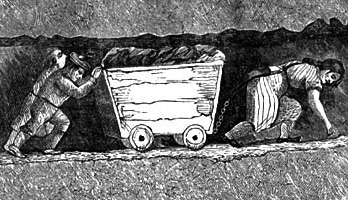
Mary Hinchcliffe was born on 16 November 1846, in Barugh, near Barnsley. Mary was the first of at least nine children born to Martha Deighton & Silvester Hinchcliffe. Silvester too laboured in the coal mines and his oldest surviving son, John, was also working in the mines by the age of twelve.
A hurrier and two thrusters heaving a corf full of coal as depicted in the 1853 book The White Slaves of England by J Cobden, Public domain, via Wikimedia Commons
Mary & George were married at Wakefield registry office on 22 October 1867. At first glance the different locations of their births and marriage didn’t add up. However, the marriage certificate contained a clue with both listing their address as East Moor being the site of Park Hill Colliery. The couple had clearly both moved there for the mine – the main mine shaft was being sunk in 1863 providing new opportunities for local miners.
With all that lack of contraceptive knowledge it is no surprise that Mary & George went on to have a large family, twelve in all, nine alive, according to the 1911 census, although I have only managed to identify eleven: John (b. 1868), Elizabeth Ann (b. 1870), Joshua (b. 1872), Henry “Harry” (b. 1874), Annie (b. 1876), Charles Hall (b. 1879), Abigail (b. 1882), Ada (b. 1884), Florence (b. 1886), Ernest (b. 1882) and Emma (b. 1893).
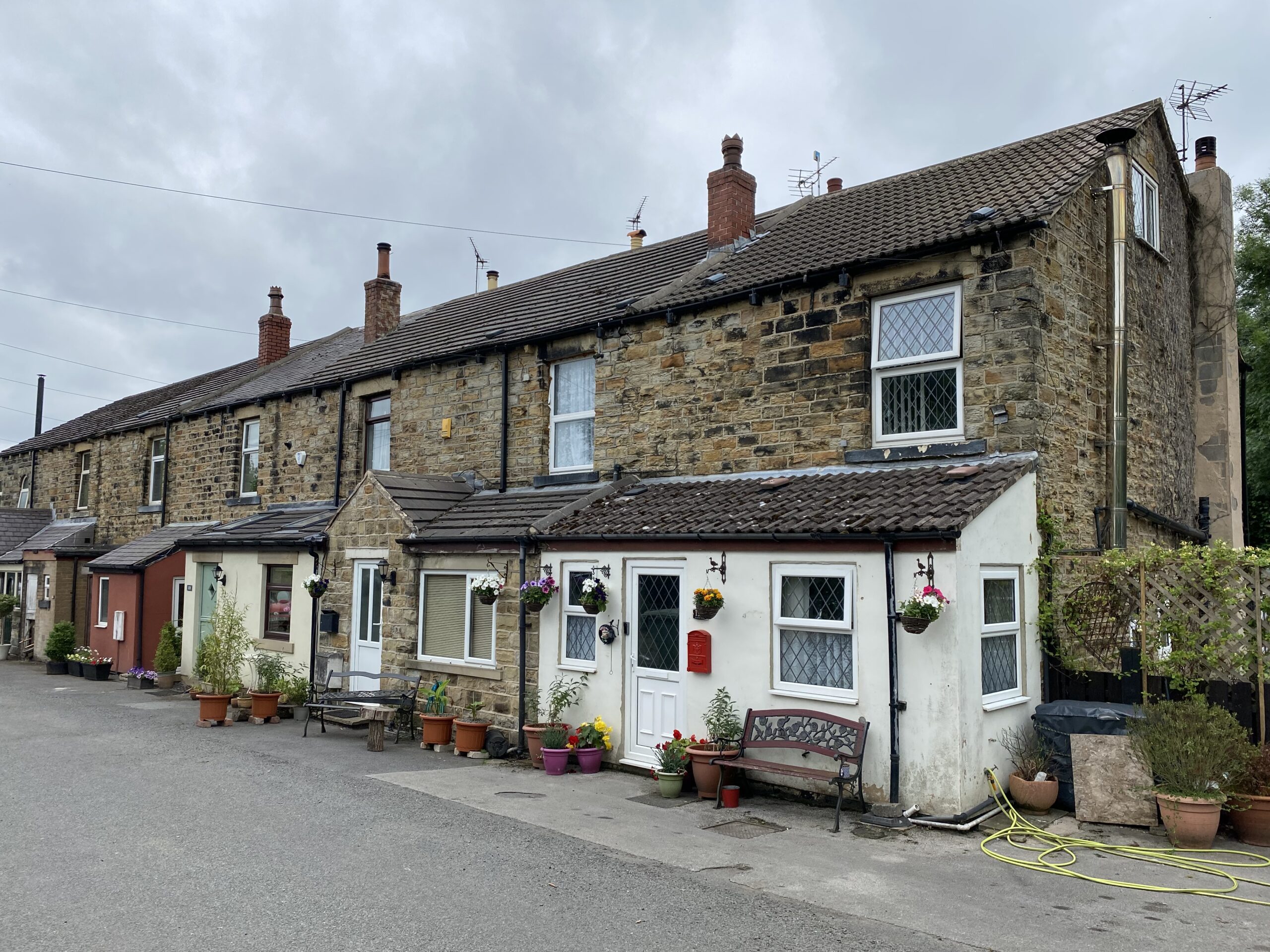
Whilst the couple’s first son, John, was born in Gawber (close to Mary’s birthplace) in 1868, he was christened in Thornhill (the parish church for Sitlington at the time) later that same year which suggests they had moved back to where George’s parents lived. The family stayed in or close to Netherton (a village within the township of Sitlington) and by 1882, Mary & George had settled Little London, about 4 miles south of Netherton, Wakefield. Little London consists of six (now ex) coal board houses and was to become for the Bentleys as Toft Gate & High Garnshaw were to the Wellocks, a multi-generational home, so I will write more about Little London in a future blog.
Little London, near Netherton. The Bentley house was probably the nearest one. Own photo.
There is little more to tell of their lives. Their remaining children (mostly) married and left home. George continued to work in the mines whilst Mary ran the household until they died, George aged 66 in 1907 and Mary aged 73 in 1919. Both are buried at St Michaels & All Angels at Thornhill, their grave seemingly unmarked. Gone, but certainly not forgotten.
I’ve been cautious about the 1921 census. £3.50 for each page. Half the price of a GRO certificate, double that of a will. And unlike both of those I know that it will be available within a standard subscription at some point in the future. (I am still considering taking out a premium subscription for findmypast – had they made this clear a couple of years ago I was ready to transfer my allegiance from ancestry, but since then I’ve invested even more in building my family tree on that platform, so it’ll be even more of an effort to transfer over).
I also had to manage my own expectations about what I would find. It wasn’t a helpful year for our family. Grandpy was a few months old, but none of my other grandparents had been born. Grandad arrived just five days later and Grandma the following month. Nana’s parents were not yet even married. All my great grandparents were around, but I knew where they were. Four of my great great grandparents would be missing, being four of the least well researched. I am grateful that the general strike which postponed this census did not affect the possibility of seeing the last of my great, great, great grandparents in the census as Martha (Handley) Clapham died on 29 March 1921. In other words, this census, unlike previous censuses, only really covered three generations about whom I already knew quite a lot.
I narrowed my purchases down to just the ten relating to direct ancestors alive at the time. One grandparent, eight great grandparents and twelve great great grandparents. Twenty one in total which is kind of apt.
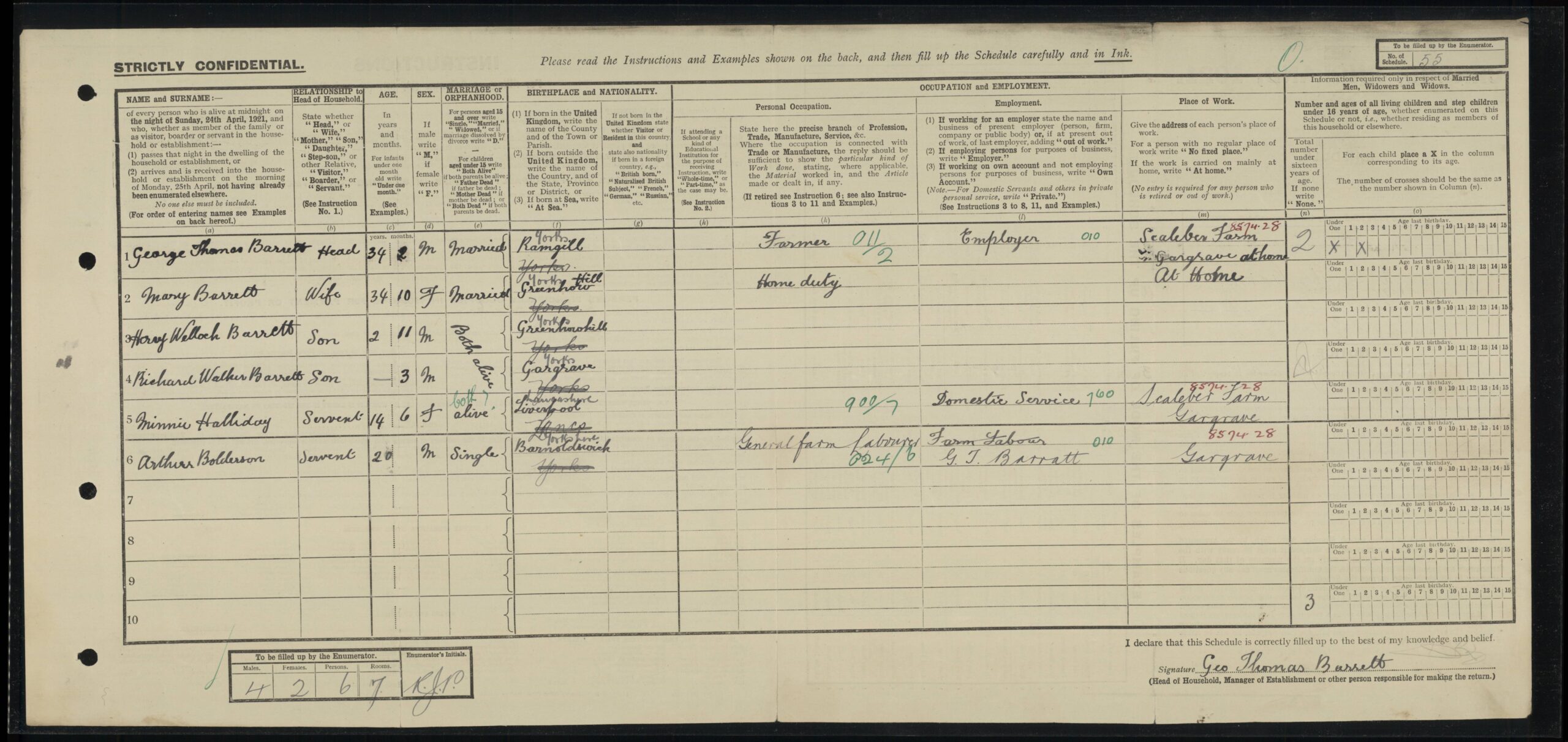
Richard Walker, Mary (Wellock) & George Thomas Barrett
1921 census from findmypast including Richard Walker, Mary (Wellock) & George Thomas Barrett
Grandpy (Richard Walker Barrett) was always going to be the first person I searched for. And yes, it was super cute to see him recorded for posterity aged just three months. It also allowed me to tick off his parents Mary (Wellock) and George Thomas Barrett. But I already knew they had lived at Scalebar Farm in Gargrave when Grandpy was born and it wasn’t either Toft Gate, Greenhow Hill nor Upper West End Farm, Stainburn the two farms with which this family is most closely associated. I didn’t know that Uncle Henry had been born at Greenhow Hill which gives me a possible date for when they might have taken on the tenancy of Scalebar, but the rest of the data on this page is all well documented elsewhere.
Mary (Walker) & Richard Wellock
1921 census from findmypast including Mary (Walker) & Richard Wellock
Possibly the least interesting was that relating to my Wellock great great grandparents. I could have filled in this entire form myself.
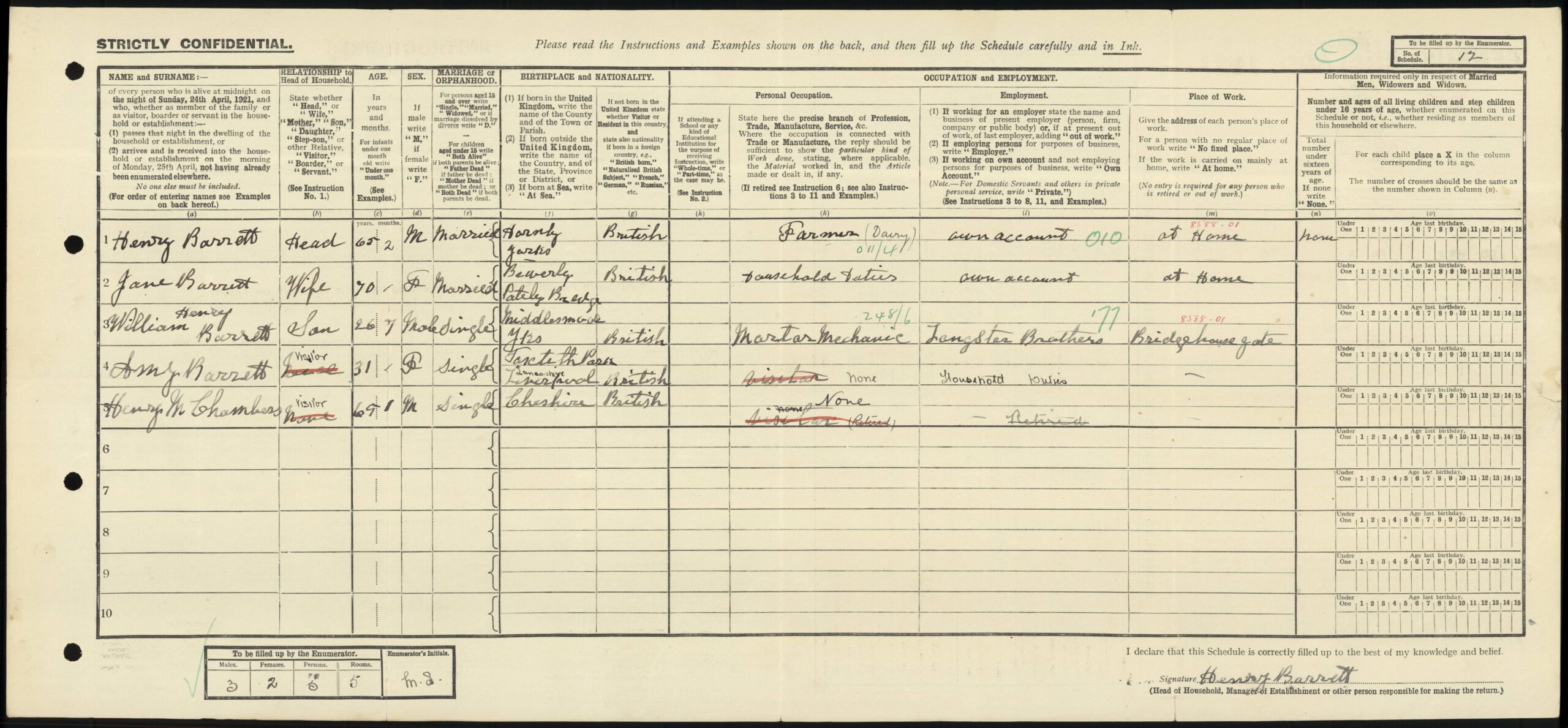
Jane (Brooks) & Henry Barrett
1921 census from findmypast including Jane (Brooks) & Henry Barrett
Whilst there was nothing new to be learnt about Grandpy’s Barrett grandparents, Jane (Brooks) & Henry Barrett, it was lovely to see a reference to William Henry Barrett. William served his country during WW1. It was only a couple of years ago that I learnt of his existence for he died from tuberculosis in 1924 and may have disappeared were it not for census records.
Then there are visitors. Amy, a niece of Henry’s went on to marry her fellow visitor, Henry M Chambers, thirty-four years her senior, but not until 1930, by which time, Henry was 74 and Amy had been his domestic help for at least twenty years. Amy suddenly made it onto my list of sibling & cousin stories to explore.
Marion, Annie (Bentley) & Ernest Moody
1921 census from findmypast including Marion, Annie (Bentley) & Ernest William Moody.
Unlike our other grandparents, Nana wasn’t even a twinkle in 1921. Her parents weren’t even to marry for another four years.
The Moody family (Nana’s maternal side) was the second census I looked for, mainly to check out the lodger. There’s a family rumour that the youngest son, George, may not have been Ernest’s and whilst I have a different interpretation it was rather satisfying to find the same Tom Atkinson, who was with the family in 1911, still living with the family on Lodge Terrace. George was born in between the two censuses so if a lodger was the father, then this was certainly he.
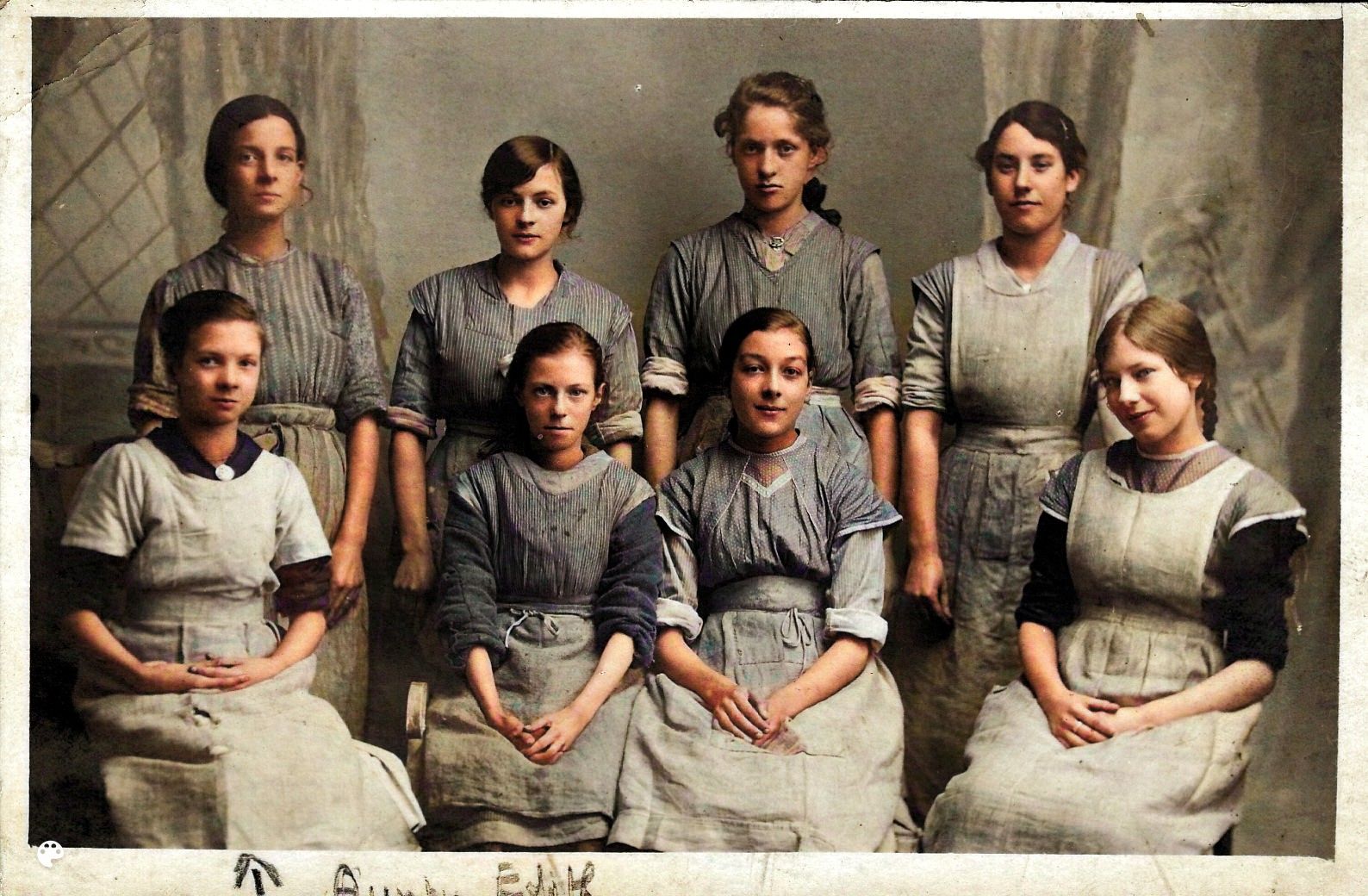
Edith Moody at work. Colourised using myheritage. Own collection.
More excitingly still (and that which I consider to be “the” finding of the 1921 census) was the listing of Aunty Edie’s occupation and workplace as blanket weaver for Clayton Brothers, Coxley, Netherton. Finally, I was able to put some context to the photo I had inherited. These were factory girls.
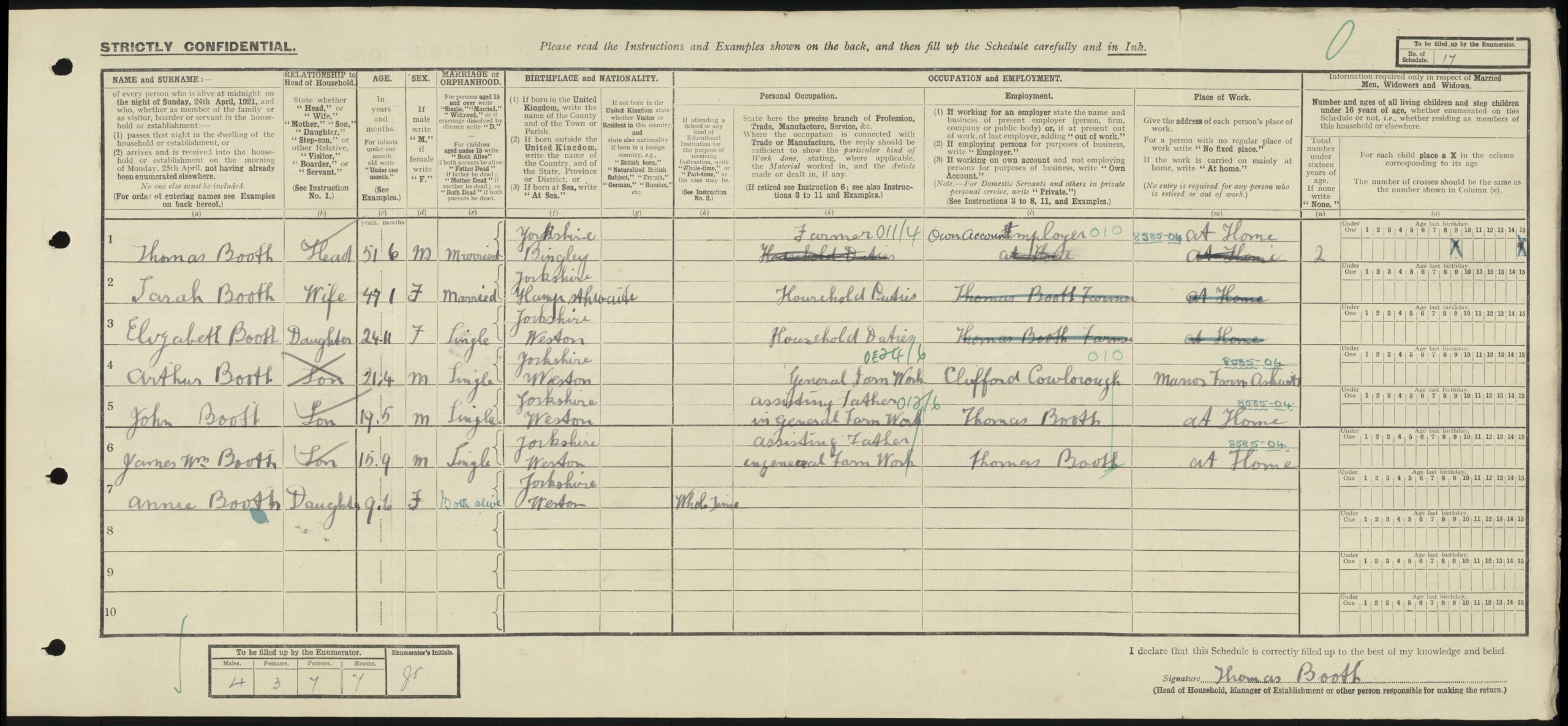
Arthur, Sarah (Cooper) & Thomas (Butterworth) Booth
1921 census from findmypast including Arthur, Sarah (Cooper) & Thomas (Butterworth) Booth
On to Nana’s father’s family, the Booths. Whilst there is very little here which I didn’t know, it was good to have further confirmation of certain details such as Sarah’s birthplace where I had previously considered different options. However, Arthur’s workplace on a nearby farm is new and something worth doing further work around. Scales Farm clearly couldn’t support the whole family. I have an intriguing photo of Arthur as a young man together with a group of men of varying ages. As much as I would love this to be of Arthur, Thomas & other relatives, it is just as likely to relate to his 1921 employer.
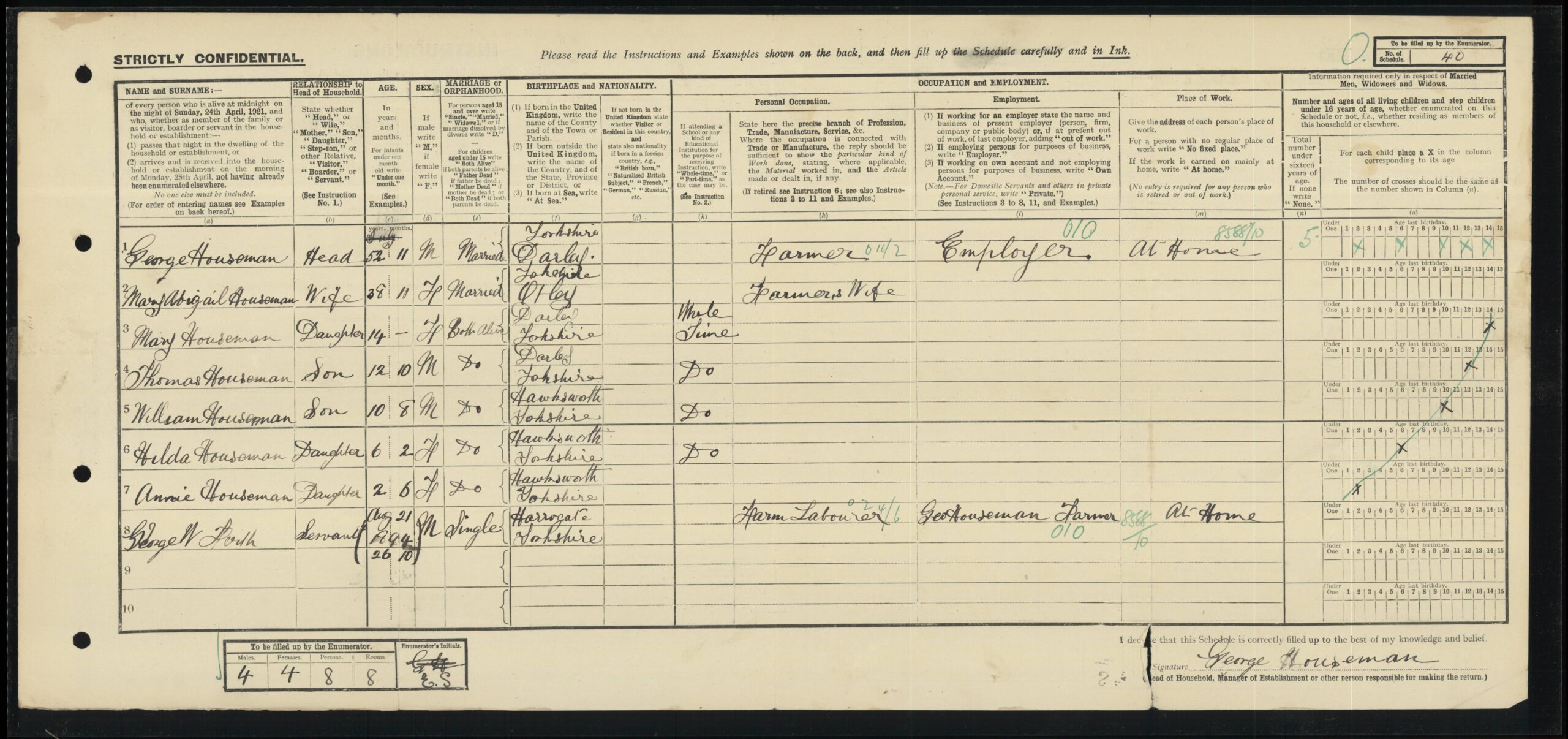
Mary Abigail (Clapham) & George Houseman, Mary Ann (Wilkinson) & Samuel Clapham
Figure 52: 1921 census from findmypast including Mary Abigail (Clapham) & George Houseman
Switching sides to my Dad’s parents.
I perhaps shouldn’t have such low expectations of Grandad’s family given that it is through Grandad that I have found both a proven link to women’s suffrage through Martha Clapham (aka Maria Greevz) and a rather more spurious link to royalty but the 1921 census did nothing to help change my opinion. If only Grandad had been born five days earlier.
Mary Abigail (Clapham) & George Houseman (Grandad’s parents) are to be found at Fairfield Farm with their children. George was the oldest of my great grandparents by some fifteen years, so it is no surprise that both his parents had died more than a decade earlier. Mary Abigail was the next youngest and her parents Mary Ann (Wilkinson) and Samuel Clapham are both to be found farming at North Rigton.
1921 census from findmypast including Mary Ann (Wilkinson) & Samuel Clapham
Hilda Mary (Scott) & Jesse Houseman
1921 census from findmypast including Hilda Mary (Scott) & Jesse Houseman
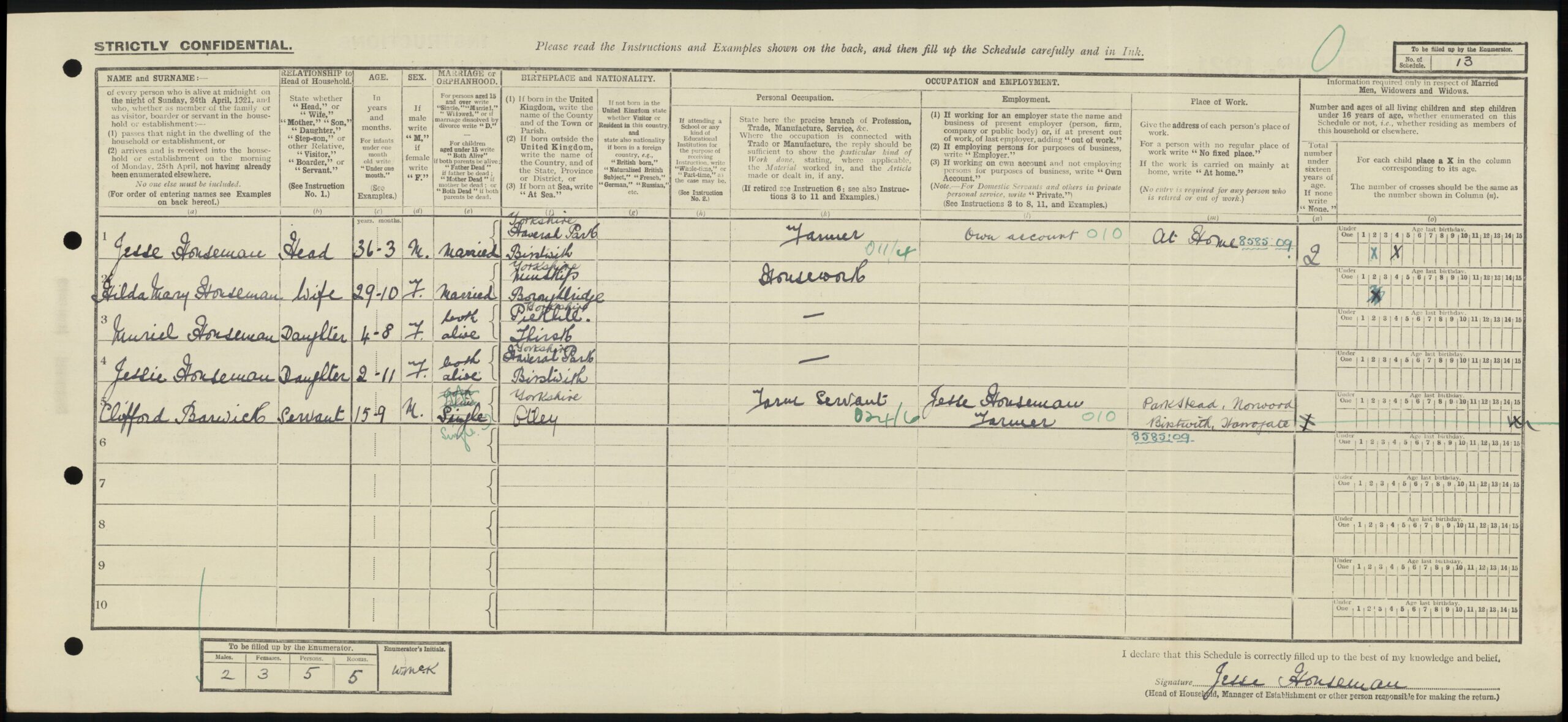
Grandma was born just over a month after the census was taken. I do rather smile at her mother, the rather smart Hilda Mary, being caught on paper at eight months pregnant – I feel certain she would never have allowed herself to be photographed at this stage. But rather more importantly are the birthplaces of Grandma’s older sisters, Muriel (born in Thirsk, home of Hilda’s parents) & Jessie (born in Birstwith) plus the actual recorded address (Park Head, Norwood). There’s potentially more movement in Hilda & Jesse’s early married years than Grandma either knew or properly recorded.
Maria (Reynard) Scott
Figure 55: 1921 census from findmypast including Maria (Reynard) Scott
Of all my great, great grandparents, Maria (Reynard) & John Scott were the only pair who came close to being upper middle class. Remember this was the generation who were born twenty years into Queen Victoria’s reign, class mattered, and Maria epitomised this age. It is from her I have inherited the classic middle-class Victorian photo album (for which I am very grateful!). Hilda, her daughter, though always smart, was also quoted, by my Grandma, to have “married down”. Here, in 1921, we see Maria in her element. She’s my only female ancestor to head a household in this census, proudly describing herself as “head” and “farmer” and her son as only “farm manager” working for “Mrs Scott.” Her husband, John, had been dead for a year and there was no sense of handing over control here.
This census also neatly links in the Housemans. Whilst I already know that Maria’s daughter, Laura, married her sister’s husband’s uncle, future generations may not and the 1921 neatly demonstrates a sister who is also an aunt.
Amelia (Bradbury) Houseman
1921 census from findmypast including Amelia (Bradbury) Houseman
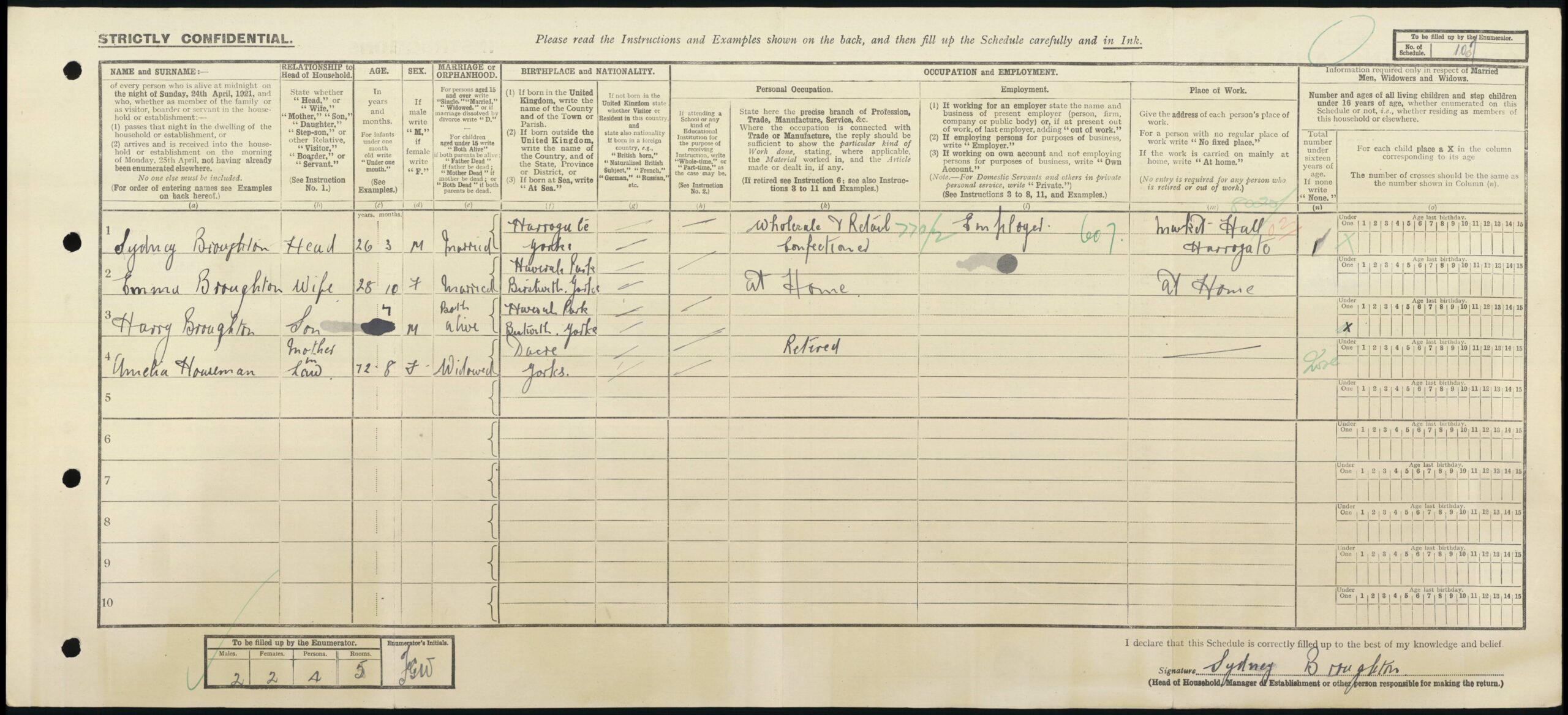
I am pretty certain that Grandma inherited her matriarchal tendencies from both her Grandmothers but Amelia (Bradbury) Houseman’s appearance in the 1921 census completely cloaks this.
I end this tour with the most unfairly represented of all my ancestors in the 1921 census. Amelia was rightly recorded as retired and living with her daughter and son-in-law, at Lime Street in Harrogate, where she was to live for the remainder of her life. The census says nothing of the thirty years following her husband’s death during which she continued to run the family farm both alone and in partnership with one or more of her sons. It is also silent of her fight against the 1920 rent increases which ultimately forced her to retire and left her, as a woman, disenfranchised in the 1922 election, the first in which women could vote.
Are the 1921 censuses worth the money? I can only speak to someone who knew a lot about her twenty-one ancestors who were living at the time. Two (Maria (Reynard) Scott & Amelia (Bradbury) Houseman) reinforced the impression I have held, that the women in our family have always been matriarchs. Two (Hilda Mary (Scott) & Jesse Houseman and Arthur Booth) will lead me to better map the places my ancestors lived and worked). One (that of Jane (Brooks) & Henry Barrett containing Amy Barrett) leads me to an intriguing story, albeit of a cousin, and one (that of the Moodys) was pure gold – helping both confirm the lodger of family legend and explain an intriguing photo.
With much gratitude to Natalie Pithers who runs the Curious Descendants for setting twenty-one as today’s challenge.
“Isabella” Thomas cried out and, not for the first time, the woman laid by his side wondered whether he called, not for her, but for his first wife.
Why did so many of my male ancestors choose to marry two women with the same name? Whether it was a subconscious act, a natural affinity due to the love of a first spouse or pure coincidence it often serves to further obscure the second wife from view. It would make more sense if the name were Mary (41,397, or roughly 17%, of all girls born in 1840, had a name that started with Mary), Elizabeth (11%), Sarah (9%) or Ann (8% including Anne & Annie) but Isabella? There were only 1,881 of those.
Fortunately for me Thomas Wellock’s first wife, Isabella Ward, was one of only two brick walls amongst my great, great, great grandparents. (The other, Elizabeth Dean, was illegitimate, married far from her home town and died after only one census making her much more difficult, although ultimately possible, to trace). Continuing to search for any clue as to her parents might be, I re-checked my research against a much wider range of websites and, thanks to Wharfegen, discovered the existence of Isabella Preston, Thomas’s second wife and my great, great, great grandmother.
Our Isabella was born c. 1814 (baptised on 11 September 1814) in Stainforth, which sits within the parish of Horton in Ribblesdale, the daughter of Agnes Sidgewick & John Preston. She was christened at Horton in Ribblesdale on 11 September 1814, the youngest of at least five children – Agnes & John were 41 & 43 at the time of her birth. Agnes & John were farm servants, agricultural labourers, and survived on the slenderest of margins.
I know little about Isabella’s early life or that of her siblings. Unusually the girls are the only ones I’ve been able to trace post their initial arrival into the world. The eldest, Dorothy (born in 1798) died, aged just sixteen. The youngest, Margaret, seems to have left more of a mark. Whilst she was married & widowed prior to civil records, she was the one who registered the deaths of both parents and must have nursed both in their final days. Then, after acting as housekeeper for her brother-in-law, Isaac Garnett, she went on to help him run the Queen’s Arms in Litton, possibly taking over when Isaac died.
Thomas’s upbringing was less precarious. Born in 1810, the ninth of eleven children of Mary Windsor & Richard Wellock. His father farmed 40 acres at High Garnshaw in Linton – not wealthy by any stretch, but comfortable enough and whilst Thomas did not inherit this particularly farm tenancy his upbringing was his apprenticeship for future.
Thomas and his first wife, Isabella (Ward) were married on 2 June 1836 in Consitone. Two children quickly followed. A little too quickly in the case of Jeffrey who was born either late in 1836 or early in 1837 in Starbotton and then Helen followed in nearby Calton in late 1837/early 1838. By the time of the 1841, the couple were both living in Gargrave although not in the same property. I would guess that Thomas, as an agricultural labourer, was living on a farm and Isabella was living in the village with their two children possibly as a result of Isabella’s health, for she was to die of consumption, aged just 26 on 10 June 1842 (by which time the family appear to have moved to Arncliffe).
Whilst the villages of Conistone, Starbotton, Calton, Gargrave and Arncliffe are all broadly in the same area, they different addresses suggest that Thomas was moving around struggling to secure a stable appointment.
1841 census from Conistone showing Isabella Preston, her parents Agnes & John as well as George Wellock, brother to Thomas. From ancestry.
They also constitute an intriguing link to our Isabella. For in 1841, our Isabella, is living in Conistone with her father who is described as an invalid. Her mother, aged 68, was still working, living a couple of doors away. Isabella’s sister, Margaret, was living in Arncliffe which was where Isabella’s parents had started life before moving to nearby Conistone. Could the two Isabellas have been friends? Also, on the same page in the 1841 census as the Preston family was a 40-year-old farmer, George Wellock, brother to none other than our Thomas. Conceivably, Thomas could have started working in Conistone and met both Isabellas there, choosing to marry the younger first and returning for the older later. Or alternatively, Isabella and her sister may have returned to Arncliffe to live with her sister Margaret, after Isabella’s father, John, died.
For Thomas didn’t wait around and just over a year after the first Isabella died, on 25 November 1843 at St Oswald’s in Arncliffe (again) our 3xg grandparents were married. Their first child, Richard (our ancestor), was born in Halton Gill in 1844 but their second child, Agnes, (born on 10 October 1846) was baptised in Burnsall and signalled the start of a new chapter for the Wellock family.
The different birthplaces of Richard & Agnes allow us to date Thomas’s appointment as farm manager for Captain Henry Blake of Manor Farm, Rylstone to between 7 April 1844 and 10 October 1846. This was to be an important appointment. Benjamin Wellock (Thomas & Isabella’s grandson through their son, Richard) wrote the following in his family memoirs. “After his [Thomas] marriage to a woman named Isabella Preston, he continued in farm work as a married man at Rylstone, his employer being one Captain Blake, an aristocratic gentleman farmer at that time. I have a photograph of Captain Blake and my grandfather holding a cow, taken at Rylstone in 1858.” Just this month, I randomly typed Wellock into The Museum of English Rural Life’s search engine and up popped an entry “Thomas Wellock and Captain Blake at Rylstone, Skipton, Yorkshire, with letter.” Bless him, great, great Uncle Benjamin had submitted the photo for publication in the Farmers Weekly as part of a series called Country Cavalcade ensuring it’s longevity. It becomes only the second 3x great grandparent for whom I have a picture. I only wish I knew who had inherited the original.
The family most probably moved into Manor Cottage. Built in the mid-17th century, Manor Cottage is a large solid house, believed to be the original manor before Manor Farm was built. This is possibly why, in addition to Thomas & Isabella’s growing family, it was also home to several boarders including, in 1861, a young woman named Nancy Serjeanston. Nancy, deaf & dumb from birth was to continue to live with the Wellock family until her death in 1891. Two more children were to arrive whilst the family lived at Rylstone, Benjamin Preston in 1851 and David in 1853.
Rylstone was to be home for over 15 years until, in 1861, Thomas took over the lease of Toft Gate, a 150 acre farm at Greenhow Hill where Thomas & Isabella were to live out their lives.
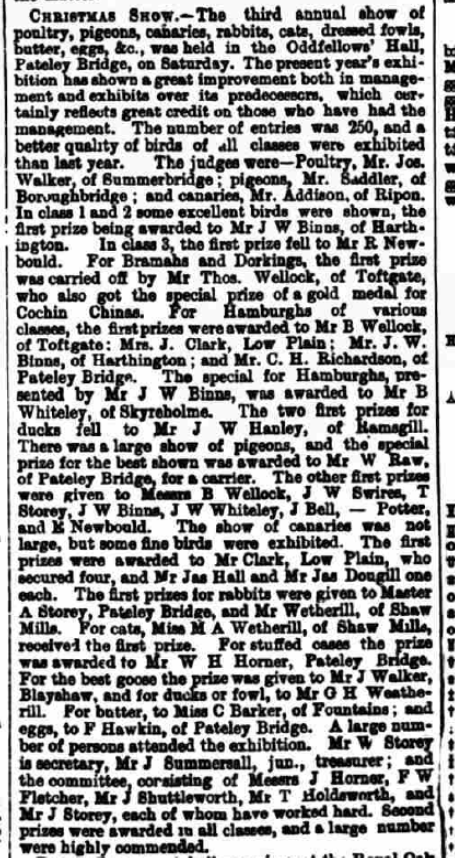
Prize winning chickens at the third annual Christmas Show in Pateley Bridge – Richmond & Ripon chronicle, 30 December 1882, downloaded from www.britishnewspaperarchive.co.uk
They were well respected members of the community with Thomas being elected as the Bewerley representative on the local board of Guardians of the Poor. But it was the prizes for best chickens at the local agricultural show with a special gold medal prize for Thomas’s Cochin Chinas which made me smile – rearing chickens and entering shows being a family tradition that has continued down the generations.
Their time at Toft Gate wasn’t without heartache. Thomas & Isabella’s youngest son, David, suffered from a congenital heart defect and died aged just 17 in 1871. Their grandson, Richard died, aged four, in 1872. Richard (son of Richard) had lived with his grandparents for a period of time in 1871 and the family still lived close by.
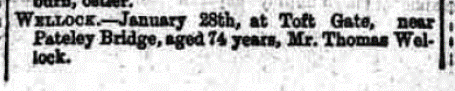
A decade later, on 3 December 1883, came the accidental death of their son, Benjamin Preston, leaving a widow and five children. Benjamin was farming with his father at the time. I feel that this tragedy may have caused Thomas & Isabella’s final declined. For just over a year later, on 28 January 1885, Thomas died, aged 75, of pneumonia. Isabella followed just over a year later on 1 May 1886, aged 72 of “senility”. They are buried together in St Mary’s churchyard, Greenhow Hill.
Thomas Wellock’s death notice – Knaresborough Post, 31 January 1885, from www.britishnespaperarchive.co.uk
There is one final part to Thomas & Isabella’s story which the couple could not have known at the time they died and that is one of emigration. At least six of their shared grandchildren and one of their great-grandchildren were to emigrate (mainly to Canada but one went to Australia and one to the US). This in turn became part of the reason I was so interested in family history and ultimately led to this blog being written!
Isabella & Thomas are my 3xg grandparents through their son, Richard, father of Mary, mother of Grandpy. With much gratitude to this couple, for somehow instilling a sense of adventure in their children, to Benjamin Wellock for ensuring Thomas’s photo was published in the farmers weekly back in 1952 thus ensuring its survival and to the Rylstone History Project for their wonderful mapping of the buildings (and inhabitants) of Rylstone.
Reader warning: what follows is a story of domestic cruelty and may be upsetting to some people. Domestic abuse still happens today. Any woman (or man) who experiences this deserves all our support. The citizens advice bureau provides an excellent list of those who you can contact for help whether you are male, female, straight, gay, young or old. Please reach out.
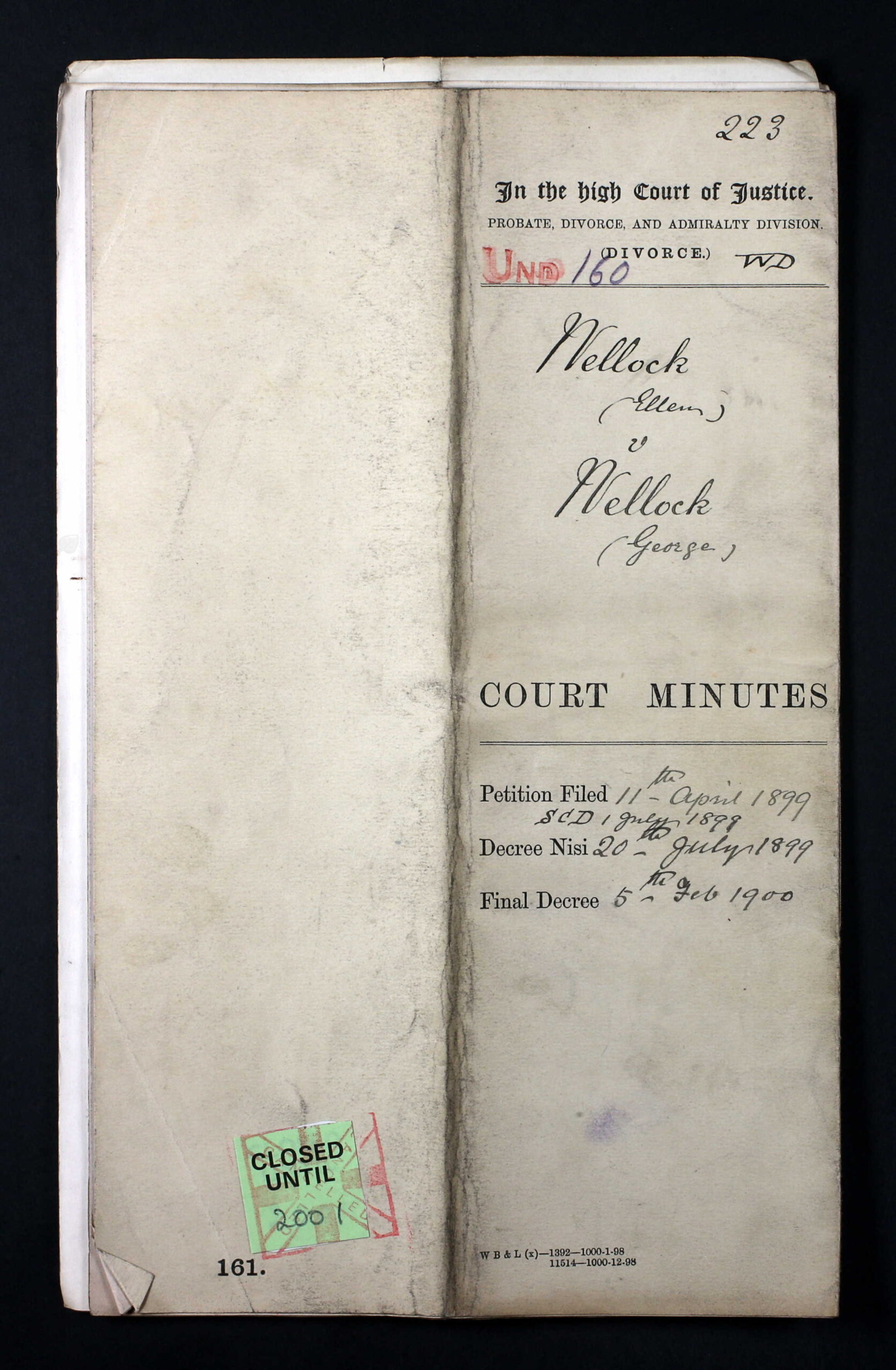
The first page of the court minutes pertaining to the divorce of Ellen & George Wellock. All court records have been taken from an ancestry.com collection.
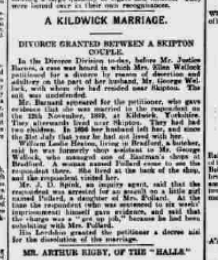
This is the story of how a young woman from Yorkshire, Ellen Richmond, succeeded in divorcing her violent, abusive, adulterous husband, George Wellock, in 1900.
“George Wellock was guilty of habitual cruelty…through his continued cruelty your Petitioner had a miscarriage on two occasions….seized your Petitioner by her neck, knocked her against the wall and threatened to jump on her and deprive her of her life and at the same time he struck her violently on the face and arms several times…apprehended…on a charge of committing indecent assault upon a young girl named Pollard”
Thus reads the 1899 petition for divorce by Ellen (Richmond) Wellock. Yet these horrific descriptions of domestic abuse were insufficient support on their own for Ellen to obtain a divorce without also providing evidence of the husband’s adultery, proof that George was to inadvertently provide through his own defence in the trial for the “indecent assault upon a young girl named Pollard”.
A brief history of divorce
First a brief canter through the history of divorce. Prior to the Matrimonial Clauses Act of 1857 divorce could only be granted by way of an Act of Parliament, passed by both houses. Unsurprisingly it was both rare and hugely scandalous. It was also almost always brought about by the man. Just four of the 324 cases of divorce granted prior to 1857 were requested by women, none of which resulted in a happy outcome. (It’s well worth reading this piece by Amanda Foreman).
Post 1857, women gained the right to petition for divorce through to do so, unlike men, they needed to prove not only adultery but some other fault such as cruelty, rape or incest. They also had to have the necessary resources to travel to London to attend court, stood an extremely high likelihood of losing custody of any children and of course, as women were deemed to be chattels, left the marriage without any assets. The annual number of divorces stood at something under 300 at this point.
The Married Women’s Property Acts of 1870 & 1882 were important staging posts. Proving divorce was still as arduous, but at least the woman stood a chance of obtaining custody of children and holding onto some of the assets she may have brought to the marriage. By the late 1890s the annual number of divorces had crept above 500, 40% of them brought by women.
According to the office of national statistics, 512 divorces were granted in 1900 of which 209 were brought before to court by women. One of these courageous, ground-breaking, women, Ellen Richmond, was somehow connected to our Wellock family, not once, but twice.
The cousins
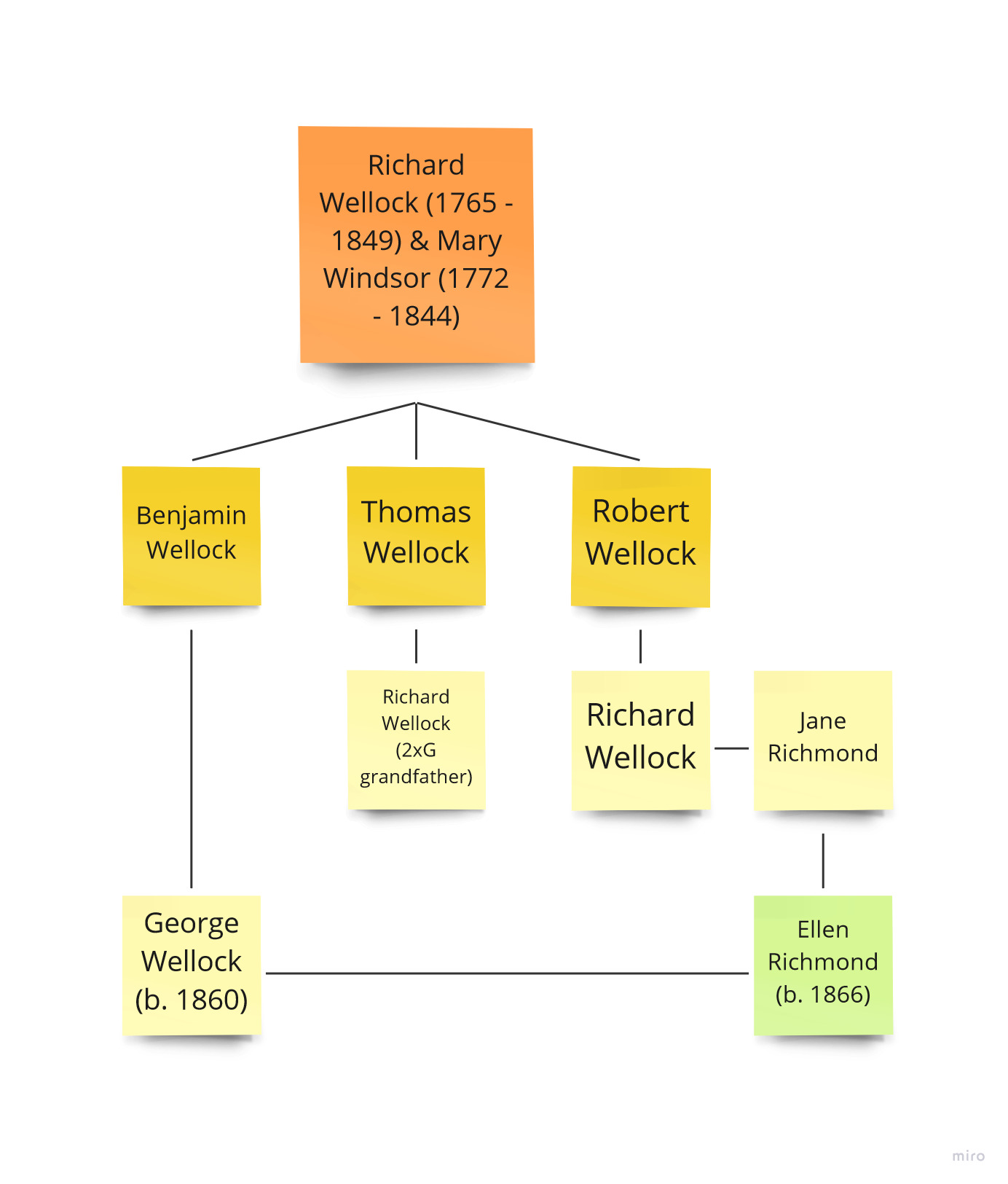
Diagram showing the relationship between Ellen Richmond, George Wellock and our own Wellock branch. Own picture produced on miro.
The story starts with three cousins. The role of my own great, great grandfather, Richard Wellock, is simply to provide a connection to the other two cousins through his father, Thomas, the ninth child of my 4x great grandparents, Richard Wellock (1765 – 1849) and Mary Windsor (1772 – 1844). Richard & Mary had eleven children over a twenty-eight-year period (as an aside Mary really deserves a medal). Benjamin (1802 – 1867), the sixth, was father to the above-named George Wellock, Robert (1817 – 1902), the youngest child, was father to Richard, stepfather (and possible biological father) to one Ellen Richmond.
My 4x great grandparents, Richard & Mary, faced a bit of an embarrassment of riches. Of their seven sons, at least six survived to adulthood and had children of their own (as did two of their daughters). Blame the healthy Craven air. In this instance it seems that the family farm at High Garnshaw passed from Richard to his youngest son, Robert, and then onto Robert’s youngest son by his second wife, Jenkinson Wellock. Benjamin & Thomas had to make their own way, as did their nephew Richard (Ellen’s stepfather) but whilst Thomas found a farm high up in the dales, Benjamin made his way closer to Bradford via Calverley, setting the scene for what followed.
Benjamin married late, aged 38, to Margaret Calvert, a woman seventeen years younger than he. George was the baby of the family, born in 1860, when his father was already 58. Whilst he had sisters closer in age, his youngest brother was eleven years older than he which I expect made him a coddled baby. That was until his father died in 1867. Whilst Margaret kept the farm running through the 1871 & 1881 censuses (no doubt with the help of George) life would have undoubtedly become harder. I can speak from my own experience of the impact losing a father before you are ten can have although thankfully none of us has chosen violence as an outlet.
Let’s get back to Ellen. She’s not without her own “family history.” Born on 28 February 1866 in Ramsgill, it wasn’t until several months later that her mother, Jane Richmond, married Richard Wellock (the cousin). Whilst Richard always treated Ellen as his own daughter (she is described as such in the 1871 & 1881 censuses) the gap between birth and marriage would suggest he wasn’t the biological father as does the lack of any further children. (Childless marriages in the 1800s always intrigue me and Jane herself had already proved fertile leading me to presume the infertility was down to Richard). Ellen was a special only child.
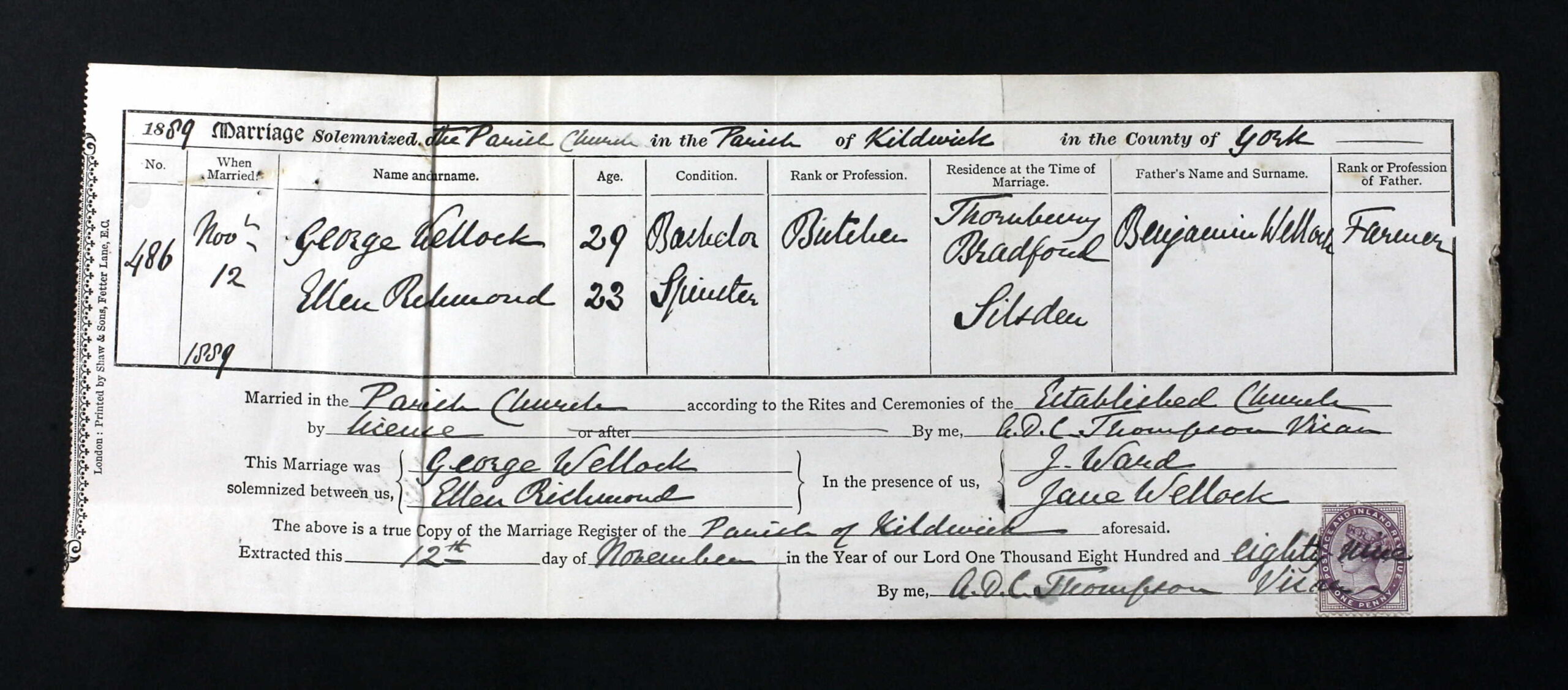
Ellen & George would have met at a family gathering. She, the protected, impressionable (and possibly spoilt) woman charmed by an elder cousin who had a way with women & already knew the ways of the impossibly metropolitan city of Bradford. Was it years of dancing at family parties or a short whirlwind romance? Who knows. Whatever the circumstances, Ellen was smitten, and they married at the beautiful ancient St Andrews of Kildwick on 12 November 1889.
The copy of Ellen & George’s 1889 marriage certificate included within the divorce papers.
Which, according to Ellen’s petition, was the day on which her life as the only beautiful, protected daughter came to a violent, abrupt halt.
The couple’s first baby, Edith Ellen Richmond Wellock, arrived safely on 17 January 1891 and was duly baptised on 27 January 1891 at Laisterdyke in Bradford, her parents living at 31 Thornhill Terrace, George working as butcher. Ellen then suffered two miscarriages as a result of George’s violence, before the arrival of Mabel Jane on 7 February 1894. Mabel Jane is baptised at Eccleshill on 28 March, the baptism record noting the family’s place of residence as 99 Killinghall Road a few minutes’ walk from Thornhill Terrace.
The cycle of violence, pregnancy, violence and miscarriage may well have continued had George not also been a serial adulterer.
Late in 1894, George flirted with a young woman called Clarissa Crossland in his butchers shop, followed her home and didn’t return for a week. Next George met a woman called Pollard with whom he frequently cohabited between the end of 1895 & 1896.
By July 1896 the violence was escalating. Ellen had been forced to flee from the house to the relative safety of a neighbour and on 30 July, George threatened to kill her with a carving knife.
The following day George left, perhaps realising he had gone too far. He moved to Colne, changed his name to George Calvert (using his mother’s maiden name) and took up with a woman named Lizzie Stansfield. Ellen took her two daughters back to the safety of her parents’ home at Cragg Top Farm in Silsden.
This might have been the end of the matter had George not assaulted a young woman called Mary Elizabeth Pollard in February 1899. Mary was the daughter of the woman George had previously cohabited with. This time he was arrested (at the house of Lizzie Stansfield) and charged with indecent assault. He was eventually convicted of “just” common assault (of an underaged girl) and sentenced to six weeks imprisonment, the judge noting that he was “not strong enough to put to hard labour.”
Bradford Daily Telegraph – 23 February 1899. From the British Newspaper archive.
During the trial George had chosen to defend himself. I had thought this was down to money, but Anna Maxwell Martin’s recent WDYTA show suggested that a man might choose to do this simply to continue his cruelty – forcing the woman to submit to angry, manipulative questioning. George claimed the charge was a “put up job” because he had been cohabiting with Mrs Pollard. Suddenly Ellen had the evidence she needed to demonstrate adultery.
Albert Victor Hammond was an influential solicitor in Bradford, the founding partner of the law firm Hammond Suddards (now part of the international firm Squire Patton Boggs) against whom, co-incidentally, my sister & I used to play football in the late 1990s/early 2000s. Together with Wynne Baxter & Keeble of 9 Laurence Pountney Hill, London, they took Ellen’s case to court.
Yet even the trial was to test Ellen’s courage as in 1899 divorce cases were all held at what is now the Royal Courts of Justice on The Strand in London.
First Ellen faced a trip to London. By 1900 London was home to 5 million people, the capital of an empire. Even today I often provide a bit of advice for rural friends daunted by their first visit to the capital on where to stay, what to eat and how to get around. Ellen was unlikely to have known anyone.
Second there’s the court itself. Again, I know from personal experience how intimidating this place can feel with it’s grand entrance packed full of barristers dashing through with arms full of papers. Even with current signage it took me a while to find the room where the appeal in relation to my husband’s death was being held. I was glad not to be on my own.
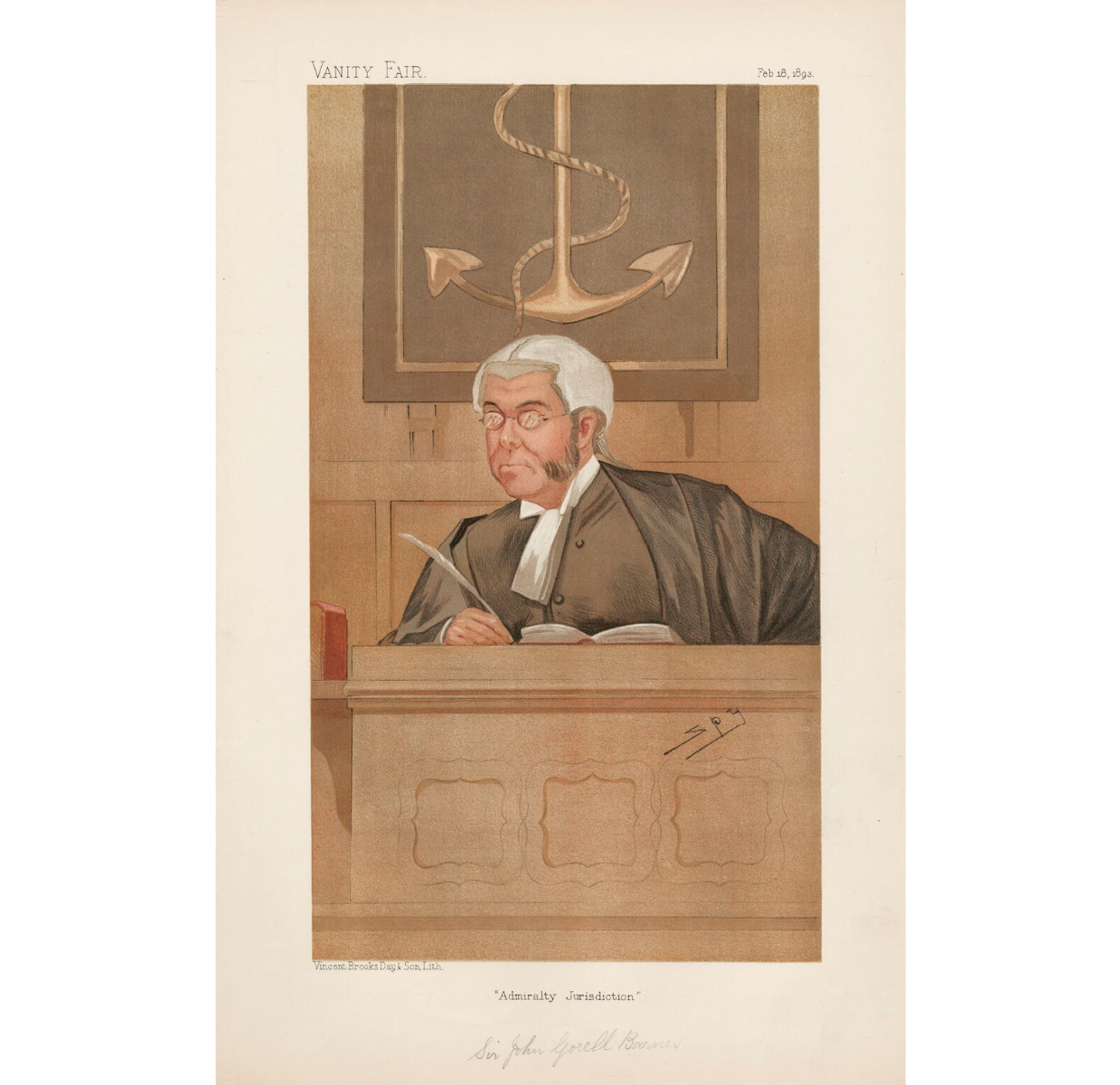
John Gorrell Barnes, 1st Baron Gorell (‘Judges. No. 39’) by Sir Leslie Ward. Chromolithograph, published in Vanity Fair, 18 February 1893. NPG D44634 (c) National Portrait Gallery, London
Finally, there was the judge, Sir John Gorrell Barnes, who presided over the case. In his wig and gown, peering down from the judge’s chair, he would have terrified all but the most worldly and privileged of petitioners.
Yet the thought of gaining her freedom from a violent, abusive husband, must have sustained Ellen throughout.
George chose not to turn up and so the decree nisi was granted on 20 July 1899.
Of course, this was not the end of the ordeal for Ellen. Divorces were rare and still made the papers. Not just one paper, in Ellen’s case, but four, ensuring full coverage across both Yorkshire & Lancashire with the news being published even before Ellen had returned to Yorkshire. What’s more the papers mentioned only desertion and adultery as if the violence Ellen had suffered was unimportant. Such were the views of the time that many people would have thought Ellen to blame for not being able to keep her husband satisfied.
Newspaper article concerning the divorce published in the Yorkshire Evening Post on 20 July 1899 and repeated in the Burnley Express, Bradford Daily Telegraph and Lancashire Evening Post. From www.britishnewspaperarchive.co.uk
The following year, on 5 February 1900, the decree absolute was granted and Ellen was finally free.
The other woman
George too, was free, and just six weeks later on 19 March 1900, he married the aforementioned Elizabeth Stansfield, calling himself a bachelor and not a divorcee.
Lizzie Stansfield has her own back story. An illegitimate child, her mother went on to a childless marriage to a Martin Stuttard, then travelled to America, had another illegitimate child Lewis Pratt, before returning to England to live with her daughter. George & Elizabeth had one son together and also appear to have raised Lewis who worked as a butcher’s assistant and died in WW1. I hope Lizzie fared better than Ellen for, unlike Ellen, she did not have a family to support her.
Ellen’s remaining story
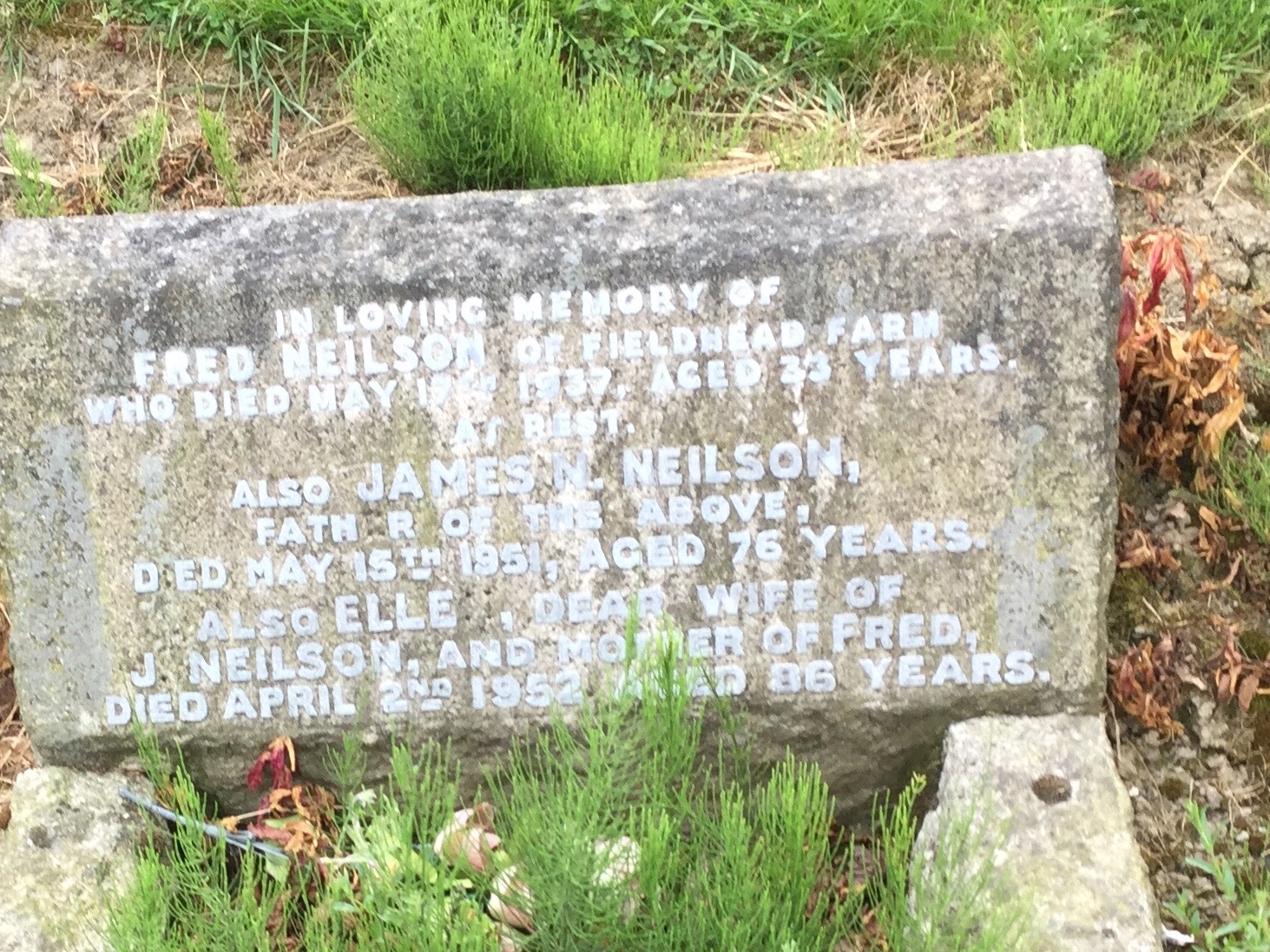
Ellen became a housekeeper before marrying a younger man from Scotland, James Neish Nielsen, in 1903.
The two daughters too fared well. Edith, the elder, married locally and had two sons and whilst the second of these died as an infant in 1932, the first went onto to have a family of his own. Mabel became a schoolteacher and a renowned educationalist, travelling the world to learn and to speak, eventually dying, unmarried, at the age of 81 in London.
Ellen’s gravestone with the description “dear wife.” Photo from findagrave.
Whilst the second half of Ellen’s life was not without further tragedy (James & Ellen’s second son, Richard, born in 1906, died in infancy and their first son died in 1937 aged 33) the relationship at least seemed a much happier one captured in the description “dear wife” on her memorial stone when she died aged 86 in 1952.
I think Ellen deserves more appreciation for the courage she showed over the course of her first marriage and divorce in part paving the way for others to hold abusive partners to account. I hope this blog goes some way to recognising this. With much gratitude to Ellen & her parents.
Whilst this is a story of Ellen’s courage, as much as it is of George’s violence, I understand that the content could be disturbing for living descendants. From online research I believe that both Ellen & George have living great grandchildren, but none who carry the Wellock surname and I have not used any of those newer surnames to avoid anyone making the connection. However, if you are a descendant and wish me to redact any part of this story, please do get in touch.
Rural Yorkshire is anything but silent. The birds arrive first, singing out as dawn approaches, then the cattle join in lowing gently ready to be milked. In winter the wind howls down the moors and if living on a village street there would be the creak of waggon wheels and welcoming words when passing a neighbour. For Nancy, though, there was only silence.
Extract from the 1861 census for Rilston showing the Wellock household including Nancy Serjeanston.
Nancy piqued my interest. I was rounding out the census details for Thomas and Isabella (nee Preston) Wellock by adding in all household members even the supposedly unrelated ones in case there was a connection I had missed. In these parts of Yorkshire, the so-called servants were often nieces, nephews or cousins. I wondered what “kept by subscription” meant?
Then I realised that the Nancy with the illegible name in the 1871 and 1881 Wellock family censuses was the same person and right at the end of the forms was the gold. “Deaf and dumb from birth.”
It appears that Nancy was “adopted” by my 3x great grandparents Thomas and Isabella Wellock and continued to live with the Wellocks for the remainder of her adult life. To begin with she was supported through parish contributions, but I can only presume from later records that she came to be considered part of the family.
I imagined that Nancy’s parents must have died when she was a child, but that was not to prove the case. Nancy (born in 1838) was the first of five girls both to Alice Litton and William Serjeanston of Skeld Gate, an area on the edge of Rylstone. Whilst Alice had died in 1854, William lived into his 80s. The feeling I had that these weren’t good parents was compounded by the 1851 and 1861 censuses. In 1851, eleven-year-old sister Mary was living with her uncle Silvester and in 1861 (by which time Nancy was living with the Wellocks) sister Alice was living with a different Uncle (and went on to marry his son, her cousin), sister Ann had died, and now it was sister Grace was working for Silvester’s son, William. But when faced with nothing but unrelenting rural poverty and a daughter who was deaf and dumb it is not fair to judge.
Nancy was in fact fortunate to be born when she was, for attitudes towards deaf children were changing. The first public school for deaf children had been established in Bermondsey in 1792 and in 1809, the first book of sign language for hearing children “Invited Alphabet: Or, an address of A to B” had been published by RR.
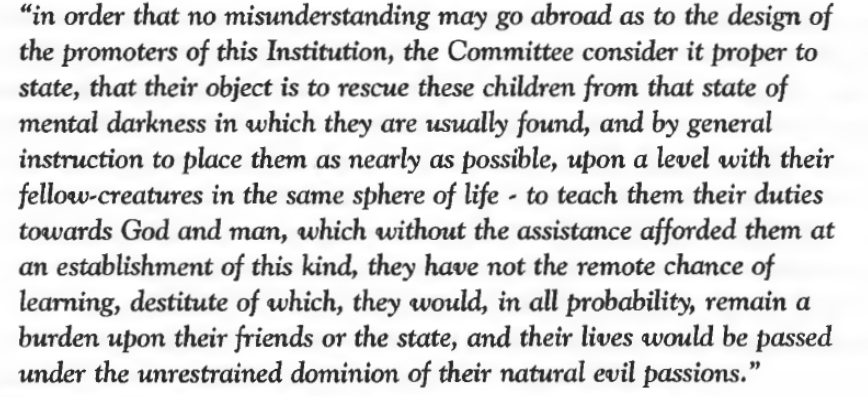
the school “mission” taken from The History of The Yorkshire Residential School for the Deaf 1829 – 1979 by Anthony J Boyce sourced from https://www.deaf-trust.co.uk/trust/who-we-are/our-history/
The Yorkshire Residential School for the Deaf, Doncaster, became the sixth such school in existence when it was founded by the Rev. William Carr Fenton 1829. The first headmaster, Charles Baker, was to lead the school for 45 years and became hugely influential in the development of education for deaf children. This included, in 1834, persuading the Earl of Harewood to endeavour to include provision for the education of deaf children in the 1834 “Poor Law Amendment Act.” The Earl was not fully successful but did manage to get a clause included to allow Boards of Guardians to contribute towards the maintenance of the blind and the deaf.
This was Nancy Serjeanston came to be one of Charles Baker’s many pupils for a period including the 1851 census.
The school focused primarily on teaching the children to read and write, supplemented by signing. There was much less effort expending teaching deaf children to speak. Whilst Nancy’s whole world must have opened up at this point in her life the lack of speech would have remained an impediment for many people at that time could not read (including Thomas Wellock at the time of his marriage).
It appears that Nancy was not as successful as other pupils in finding independent employment after school as she was kept by subscription on her return. The only document to list her as having an occupation was the 1881 census where she was noted as being a domestic servant. But what is written about women is never the full story. As part of the Wellock farming household, Nancy would have had to work as hard as the rest of the family.
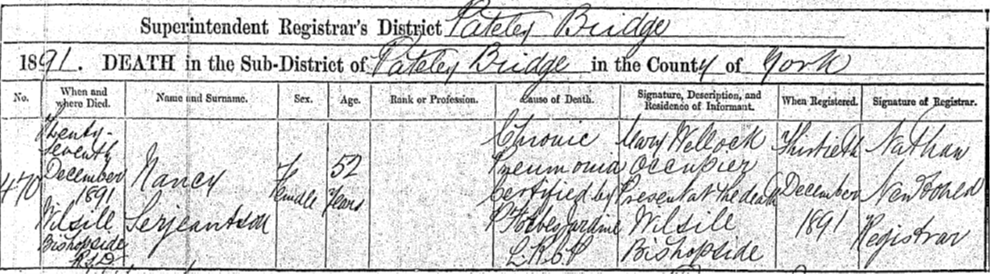
The 1880s weren’t a happy time for the Wellock family. Benjamin Preston, son of Thomas & Isabella died aged just 32 in a tragic accident in 1883 leaving a widow (Mary) and five children under the age of ten. Benjamin’s widow, Mary, moved to back to Wilsill near her own family and by 1891 Nancy had joined her. This may have been immediately after Benjamin died but I like to think it was after Nancy had nursed the elderly Thomas & Isabella who died in 1885 & 1886 respectively returning the love and support, the couple had given her. Nancy continued to live with Mary until her death from chronic pneumonia on 27 December 1891.
Nancy’s death certificate. Her death was registered by Mary (Bell) Wellock with whom she was living at the time.
Nancy has not been easy to research. Within the censuses her surname is variously recorded as Sergeanston, Serjeanston, Sangeson, Sorgson and Scrpanlton and only in the first, in 1841, is she living with her own family. Without direct descendants of her own, no-one is really looking that hard for her. It is only thanks to her long association with my own ancestors, Isabella & Thomas, who took her into their household, that I found and pulled on the tiny thread “kept by subscription.” Those with physical disabilities often feel invisible and it is a pleasure to write this short blog in the hope that it helps bring Nancy out of silence.
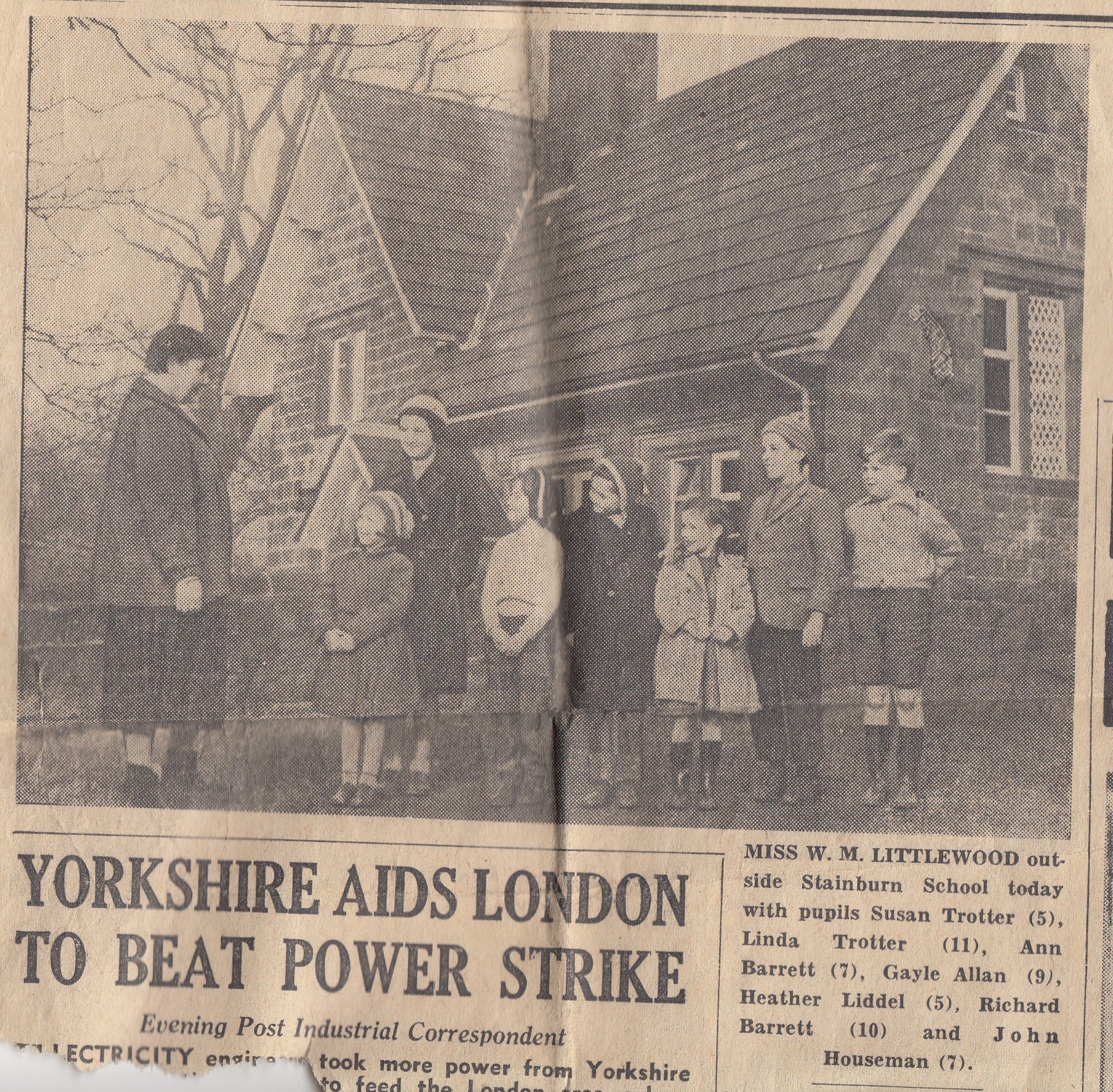
Stainburn School featured in the Yorkshire Evening Post, 30 November 1959. Own collection.
Some people know Mum as Ann, others as Liz. Mum’s quite happy to be called either; the only time she grumbles is when someone spells Ann with an “e.” The story as to why almost perfectly captures Mum’s early life.
The young Ann Barrett was a shy girl brought up by parents who were always deferential to those in authority. Fortunately, the local primary school in Stainburn was tiny, just seven pupils and one of those was Ann’s big brother, Richard, who could look out for his little sister. Faced with a diverse selection of ages and abilities Miss Littlewood used nature walks and local history projects to engage the children and ensure they all developed the basic skills of reading, writing and arithmetic.
Ann thrived.
In the last year of primary school came the eleven plus exams to sort the children between the rather imposing and ancient Prince Henry’s Grammar and Otley Secondary Modern, built to contain teenagers who were felt unlikely to pass GCEs. Richard had cheerfully headed off to the latter where he quickly established friendships which were to outlive him. However, young Ann was bright and Miss Littlewood’s teaching effective. Suddenly she was faced with prospect of a new school without her big brother there to protect her.
Having transitioned from a school with twenty-six pupils to a school with sixteen hundred I have some sense of how intimidated my Mum must have felt. And, although Harrogate Grammar was a comprehensive by that time, it had retained the buildings and traditions from an earlier age. I knew just one person in my year, and she had been placed in a different class. I, too, was on my own. It was daunting.
Had Ann ever seen that many people in one place before? The noise must have been deafening to the quiet child brought up on a remote farm in the countryside. Having finally found the right classroom Ann was ready for her first ever class register. The form teacher called out for Elizabeth Barrett and Ann may have looked around at first to see who else had the same surname until it dawned on her that the teacher was referring to her. For our Ann’s first name was Elizabeth. And that was the start. Too shy to correct the teacher it was by Elizabeth that she was known as by her fellow students.
Deference to teachers was to prove a positive force In Mum’s life when, a few years later, another teacher asked: “Which A-levels are you taking?” and then a couple of years after that “What universities are you applying to?” For Ann or indeed Liz had not thought of A-levels and certainly would never have considered studying for a degree in Mathematics at the University of Manchester.
After university Mum started work at Midland Bank in Otley and of course many of her customers and colleagues knew her as Liz, so Liz stuck. Yet family and friends from home continued to call her Ann. It’s such a strong divide that it’s easy to know when and where Mum met certain of her friends from the name she is called.
Something of that dual nature was gifted to me. Named Jenny Natasha and called Jenny for the first six months of my life, I still get confused when the doctor calls for Jenny Clayton. But I am not the shy eleven-year-old country girl facing her stern schoolteacher in the grown-up school….
Postscript: after sharing this blog with Mum I discovered the only reason she was called Ann in the first place was because big brother Richard, who was just two when his sister was born, struggled to pronounce Elizabeth. Faced with the prospect of a third name “Lilibert,” Nana & Grandpy wisely chose Ann instead!
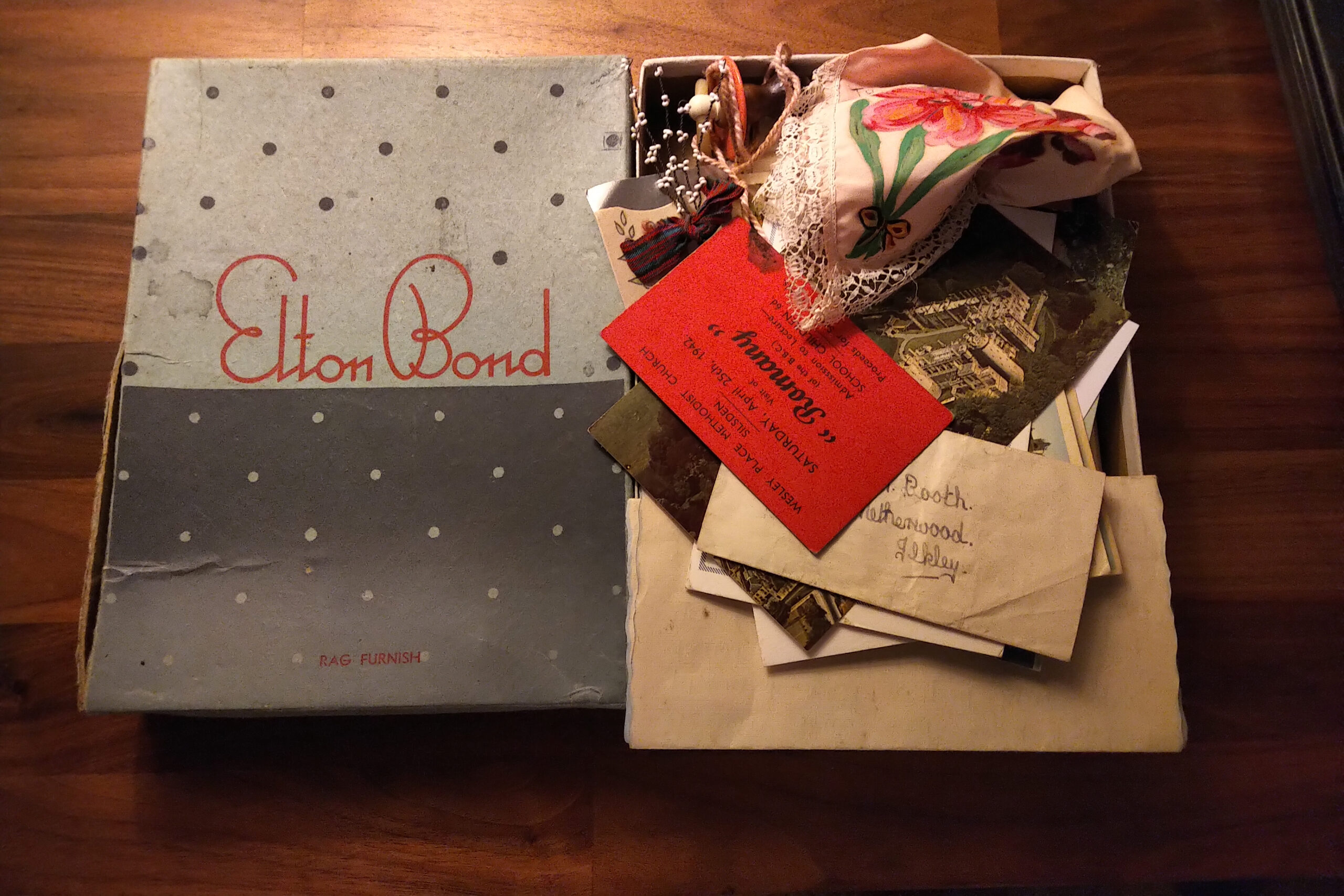
I have four decades of my own memorabilia stuffed haphazardly into three large plastic boxes. Every so often I pull out a pile of stuff and discard just enough of my random keepsakes (such as tickets to events I don’t remember and birthday cards without special meaning) to squeeze in what I’ve saved over from recent months. Despite their chaotic nature I still find myself delving into these boxes to find something that is relevant to my life right now. The night Queenie died I tipped all three boxes onto the floor of my living room to hunt for royal souvenirs and that’s when I realised it was time to bring the same order to my own archive as I was with those of my ancestors. Well, almost, the papers are now at least divided into “eras.” More excitingly I found a whole pile of family history treasures I’d inherited & forgotten about over the years including an unassuming box labelled “Elton Bond.”
Nana’s box of joy. Own photo.
Unassuming as my Nana (Mary Booth) was perhaps it’s appropriate. For this small dusty box turned out to be, like Nana, full of joy, memories of all those people she held dear during special periods of her & their lives. It covers a period of approximately thirty years from 1942 to 1973 and includes a few pieces that have left me wanting to know more. This blog is broadly in the order in which I unearthed its contents rather than being chronological. I make no apologies for its length as it’s just so full of gems.
Join me as we explore its contents.
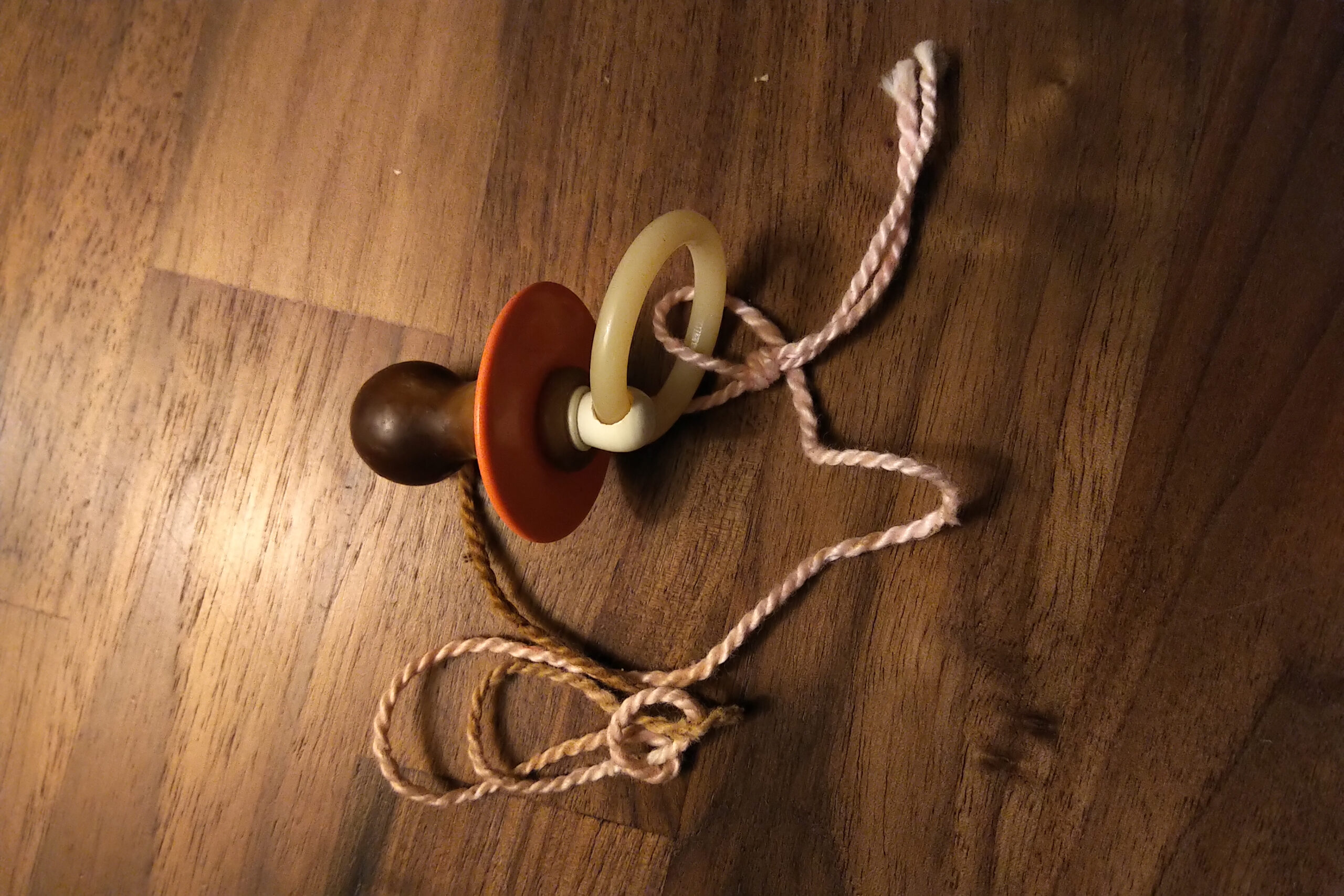
A dummy. Own photo.
I’m guessing this dummy belonged to Uncle Richard, Nana’s first born. This is how I knew this was a box of happy memories for Richard was a young man of promise who died before his time, aged just 22, and there is nothing in the box to remind Nana of his end.
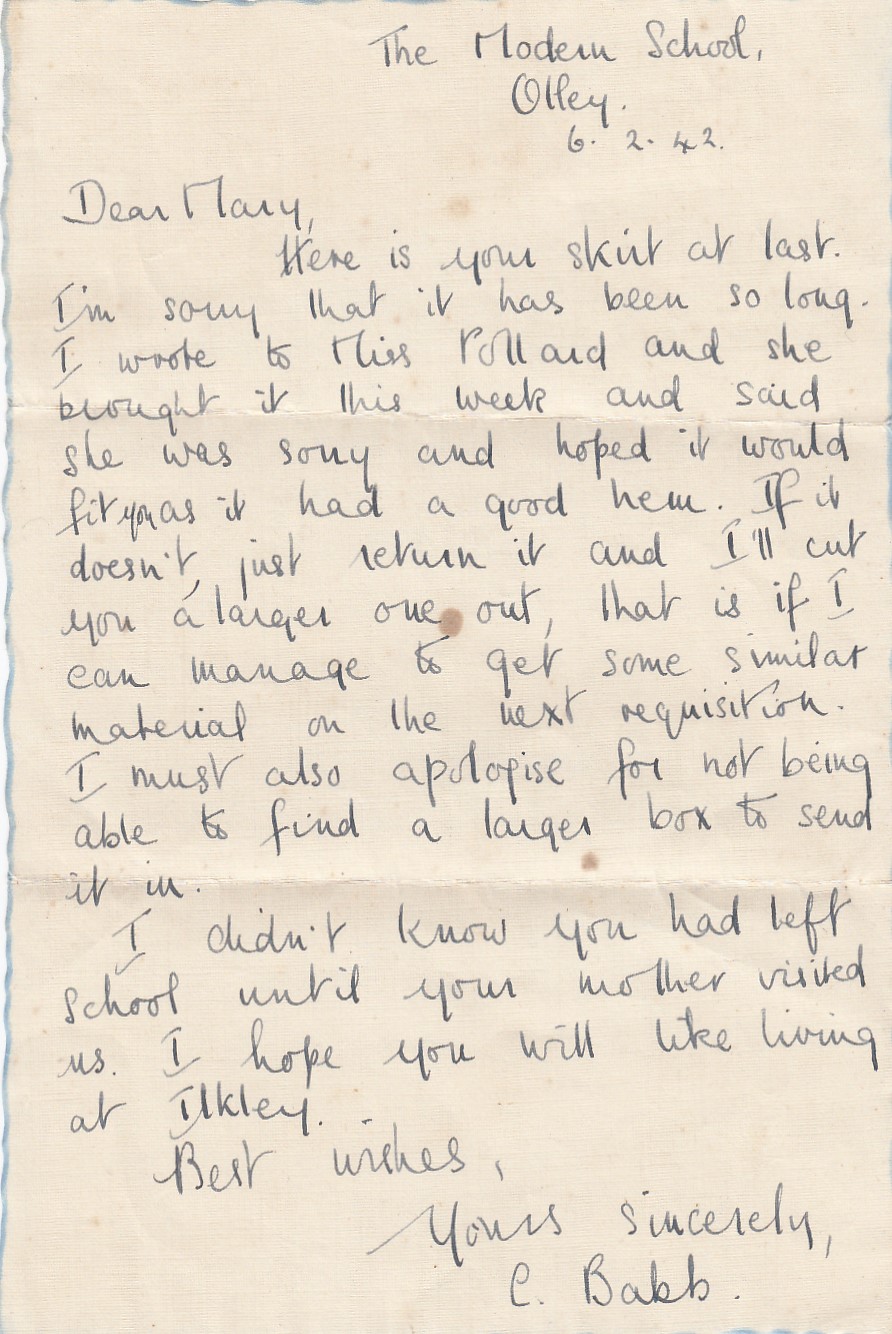
Invites and a letter from 1942 – 1943. Own collection.
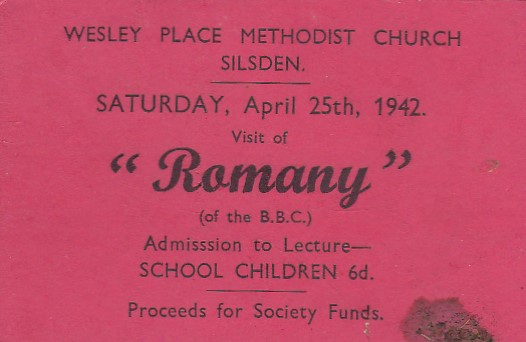
These three items from 1942/3 are the most intriguing in the box. First is a letter written to Mary about a skirt in February 1942. Was it C Babbs, or the skirt, or a reference to having left school which led Nana to keep this letter? Then there was a ticket for “Romany” to which school children were admitted for 6d on 25 April 1942. Was the event itself special or something that happened there? Finally an invite from the Ilkley Youth council to a Social Evening & Dance addressed Miss M Booth, Netherwood, Ilkley in 1943. I wondered who the fifteen-year-old Mary was living with at the time as this was not her parents’ address. And who it was she met there that might have caused her to keep the letter. I’m pretty sure that Grandpy wasn’t yet on the scene.
There’s one more letter from the pre-marriage period. A newsy piece from Maureen of 3 Kimberley Street, Ilkley dated 7 February 1946 with some wonderful snippets. “How is the old engaged couple getting on? I hope Hilda won’t welt me one when she see’s me” and “You’d better behave yourself all these boy friends of yours Walker will be telling you off.” An ex-work colleague who I hope might one day help me identify exactly which establishment in Ilkley helped my Nana learn her trade.
Postcards from Arthur Booth. Own collection.
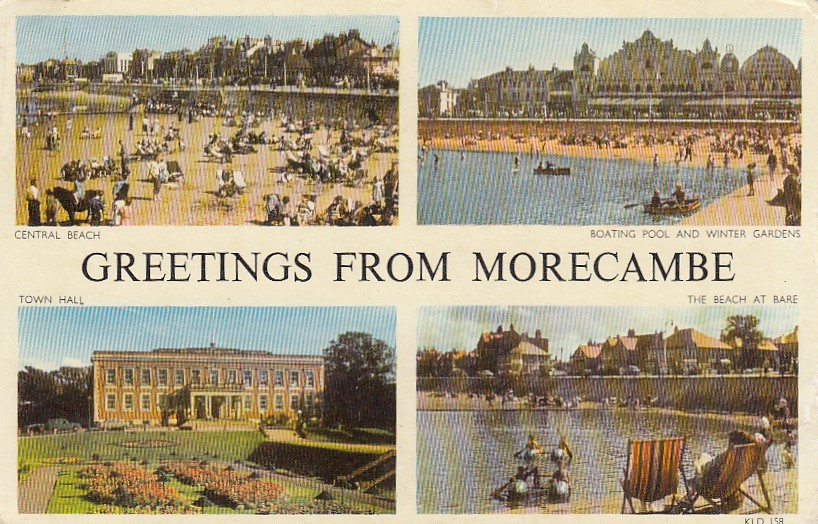
Two cards arrived at Upper West End Farm, Stainburn in September 1962 from Nana’s father, Arthur Booth. It was both the year after his wife, Nana’s Mum, had died and the year before he, too, passed away. One last holiday very different from the rest. One card was addressed to his daughter and son-in-law, the other to his grandson, Richard. It’s not difficult to guess which is which!
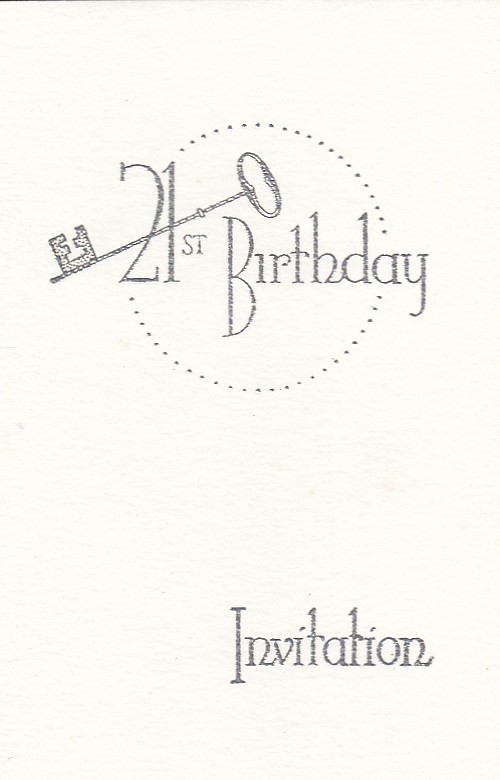
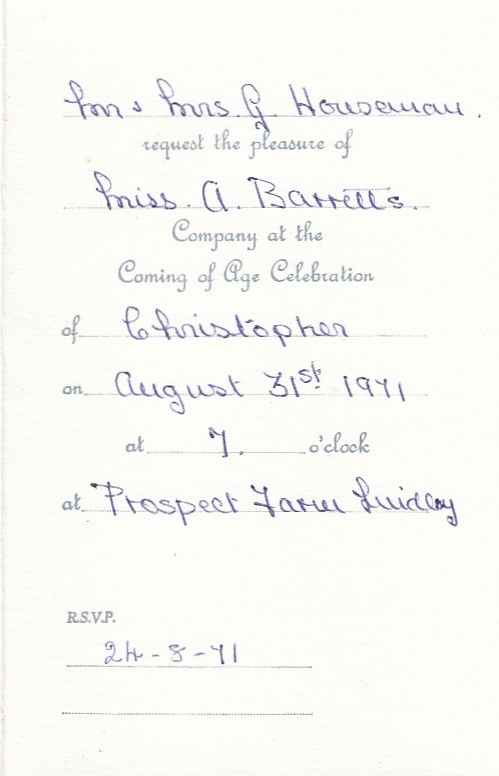
An invitation to Dad’s 21st. Own collection.
I’m not quite sure how Mum’s invite to Dad’s 21st ended up in Nana’s box of joy but it led me to learning a lot more about their engagement which was formally shared with the world at the YFC County Rally in the summer of 1972 being the anniversary of when they first became a couple. Young Farmers has a lot to answer for.
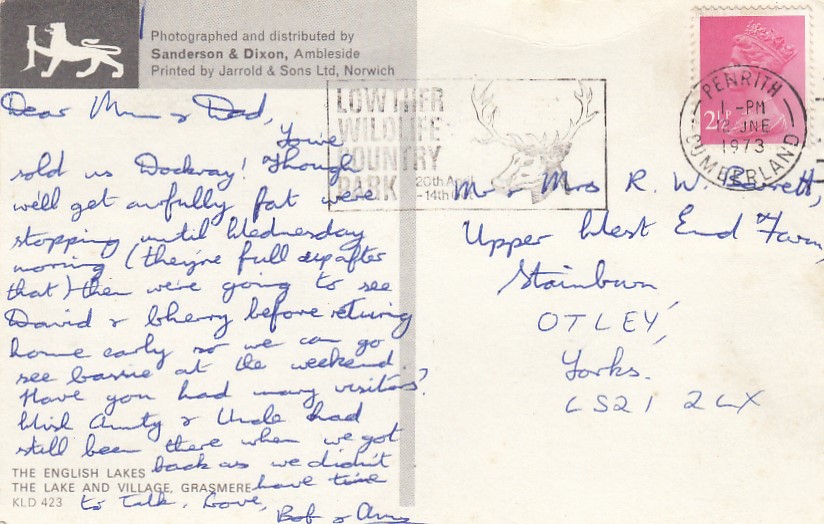
A postcard from Mum & Dad’s honeymoon. Own collection.
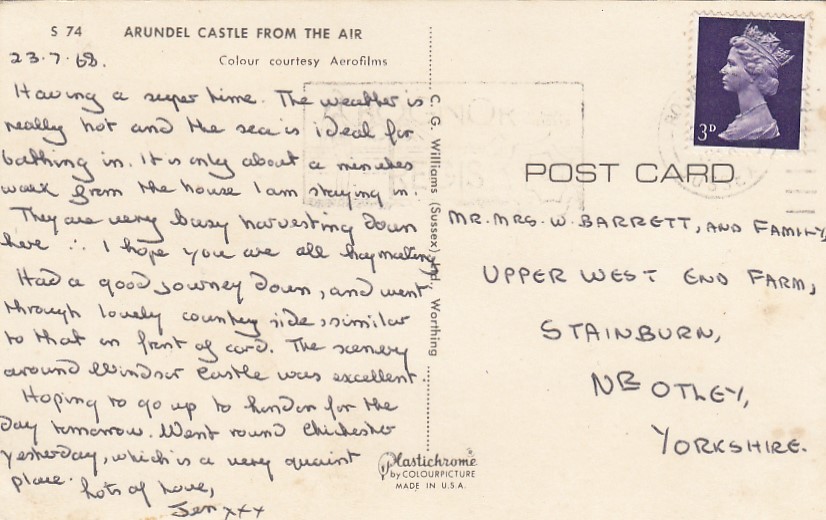
Which is why follows a postcard from Mum & Dad’s honeymoon in June 1973. Apparently, it’s a good job the left the accommodation in Dockray early as they’d only just enough cash to pay for the nights they had stayed. Mum elaborated “We were going to see Cassie as she was meant to be my bridesmaid (and go to her first wedding) but got the ‘kissing’ disease (glandular fever) and was too ill to come.”
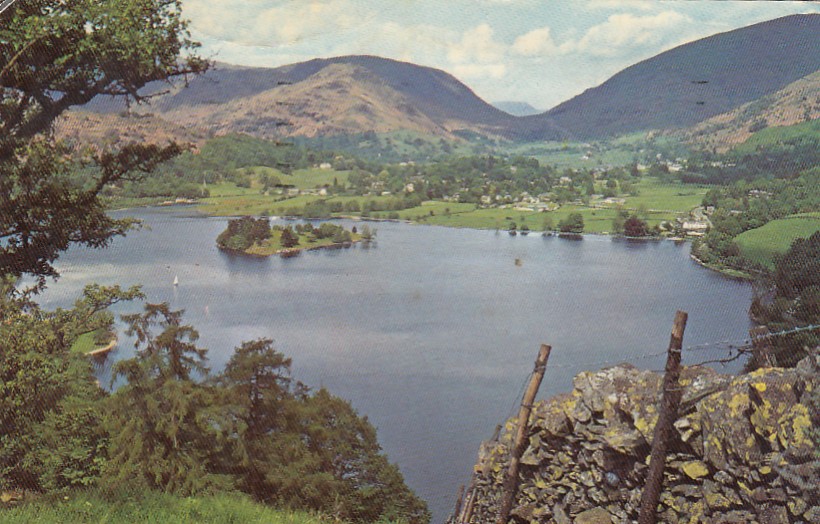
A postcard from Jenny Barrett. Own collection.
It is to my Mum’s paternal cousin, Jennifer “Jenny” Barrett, that I owe half of the credit for my first name (the other half of that credit belonging to my Mum’s maternal cousin Jennifer “Jenn” nee Nelson). Jenny Barrett has also sent me so much amazing family history paraphernalia so I was delighted she appeared in this collection. Was this a special holiday?
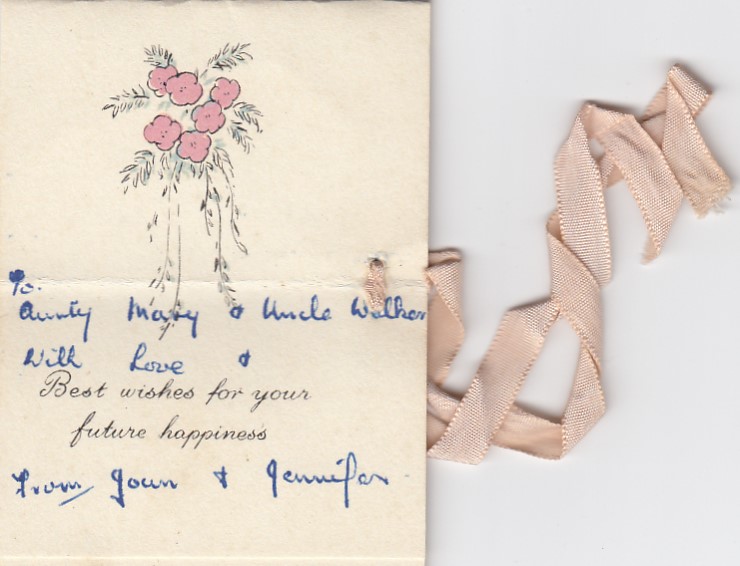
A wedding gift tag. Own collection.
Talking of Jennifers – it doesn’t surprise me which gift tag Nana kept in this box of joy, one from the, not yet one year old, twin daughters of her beloved sister Hilda, Joan & Jenn.
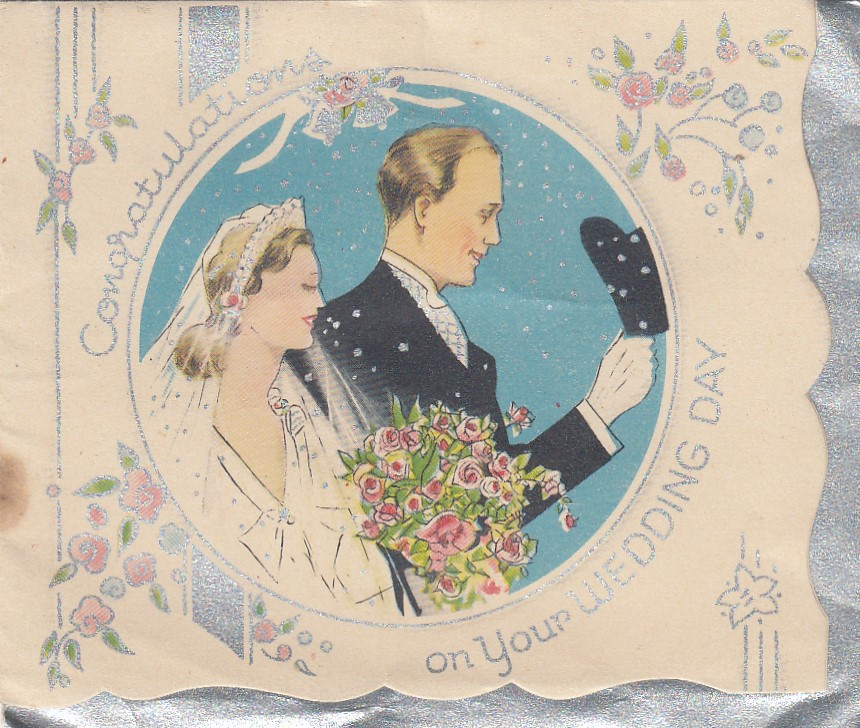
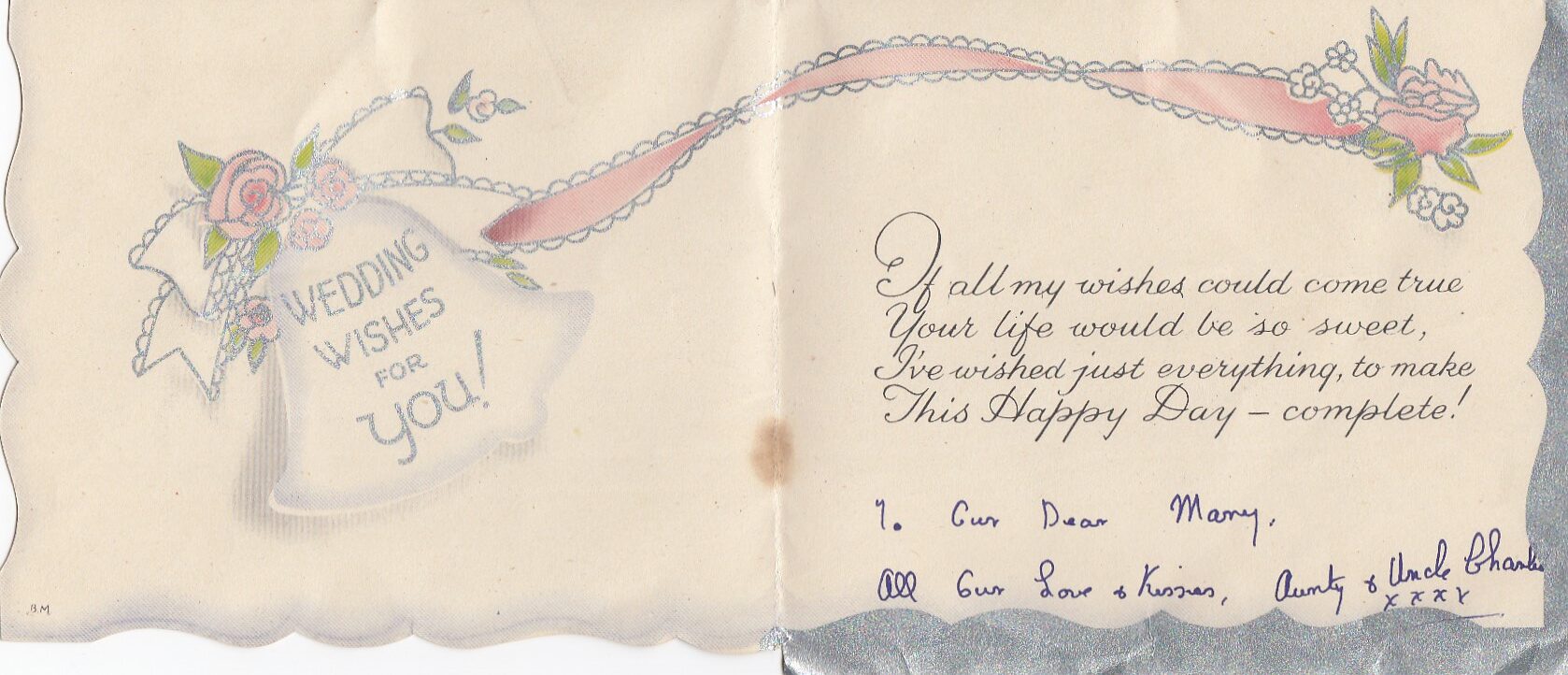
Wedding card from Aunty Edie & Uncle Charlie. Own collection.
There is also only one wedding card in the box. Aunty Edie became as close to a grandmother as a great aunt could be to my Mum after Nana’s own mother, Edie’s sister, Marion, died in 1961.
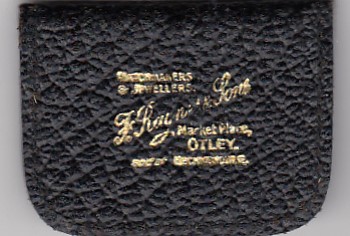
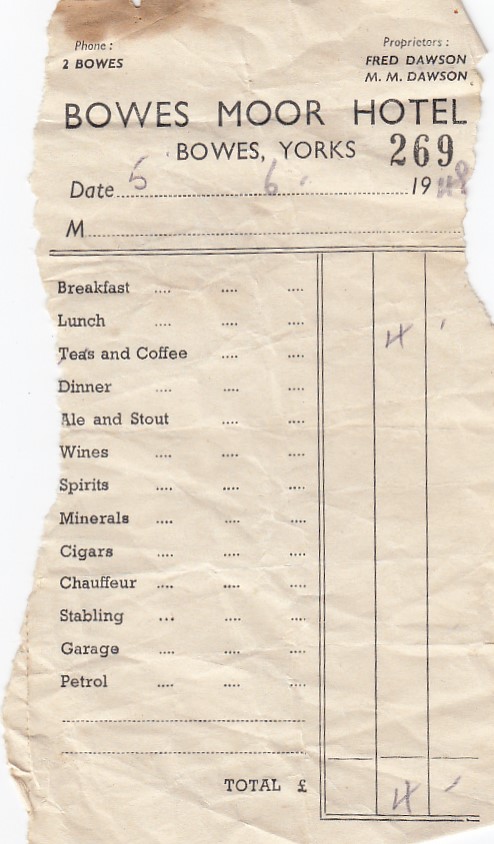
Wedding mementos. A pouch from her wedding ring and a receipt from the honeymoon. Own collection.
Staying with a wedding theme, next up are the wedding mementos. There’s a blog to be written comparing the cost of my Nana & Grandpy and Grandma & Grandad’s weddings with my own and far more joyful than that of funeral receipts I have inherited (although that, too, might make it to a blog in future….).
My favourite items amongst the receipts and charms are these two. A pouch, which I assume contained Nana’s wedding ring and a tattered receipt for teas and coffees on 5 June 1948 at the Bowes Moor Hotel. This had me scratching my head, why did Nana have a receipt for four teas and coffees from a hotel near Barnard Castle on the day of her wedding? Until I realised this must be in fact four shillings not four drinks and they were on honeymoon!
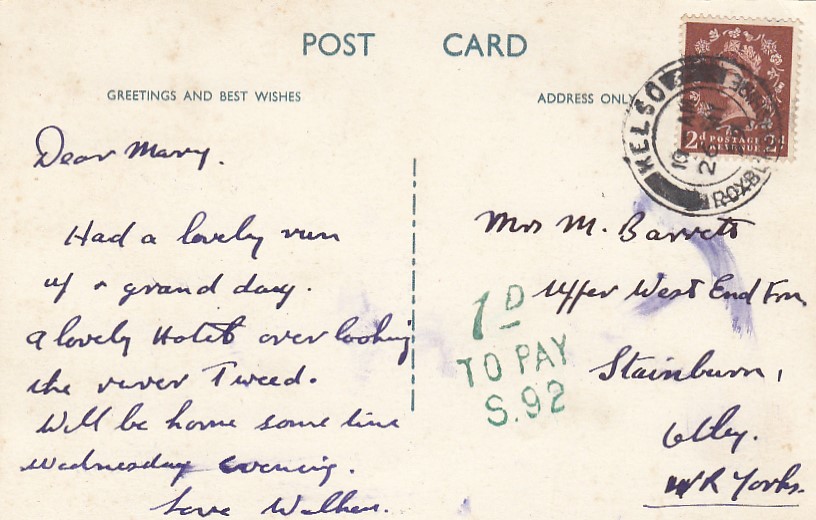
Card from Grandpy to Nana. Own collection.
I couldn’t decide whether Nana kept this 1959 postcard from Grandpy because he’d had “a grand day”, because it was the first night they’d spent time apart since marrying or because she’d been forced to pay a 1d charge to receive it!
What’s left is an interesting collection.
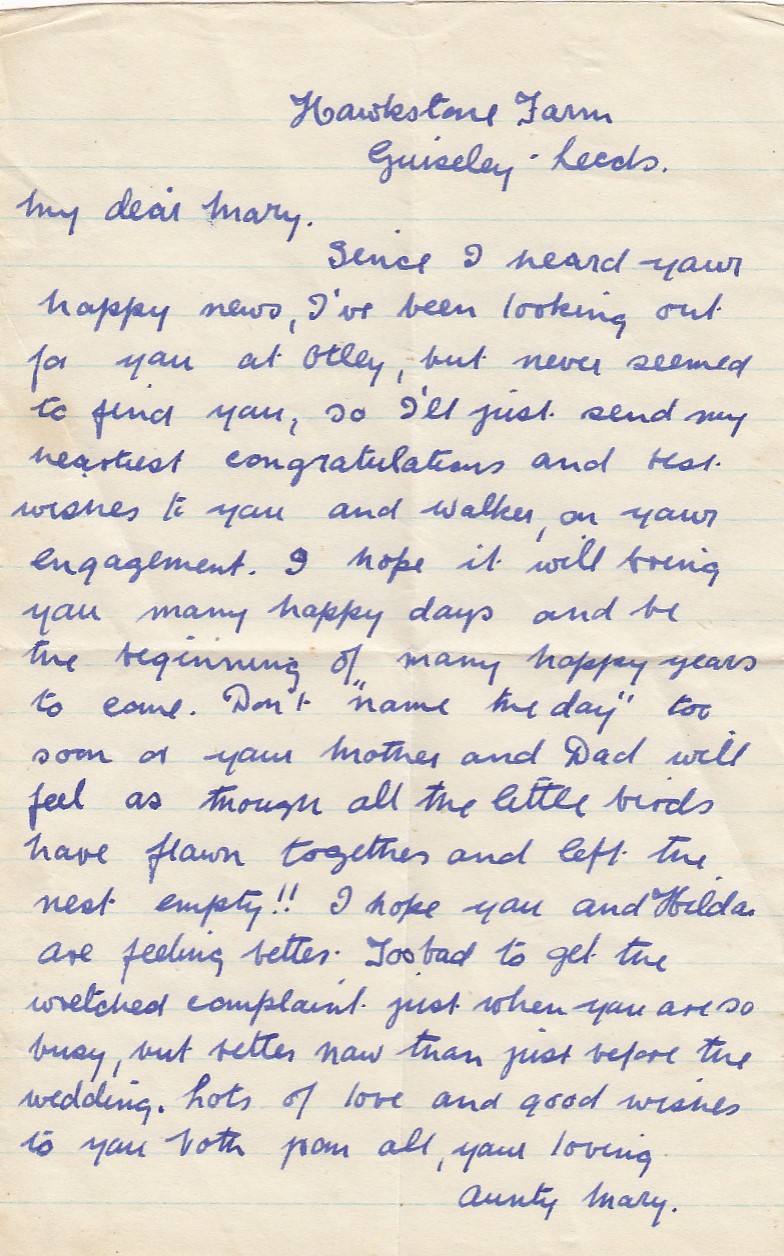
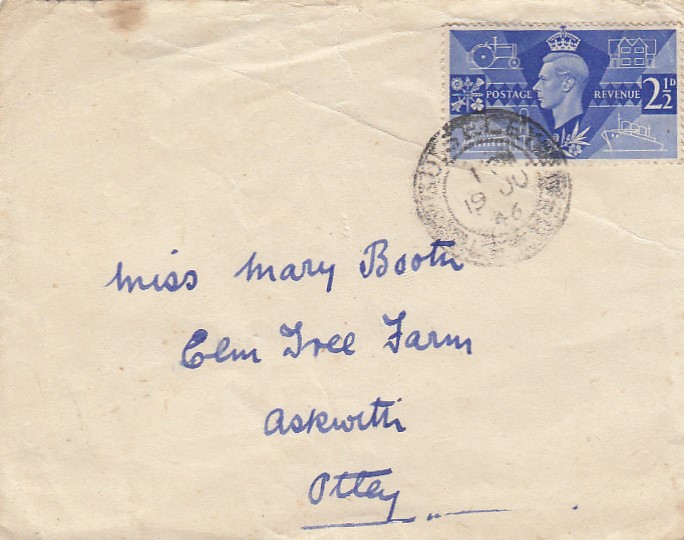
A letter from Mary (Ramsden) Booth to her daughter-in-law on the occasion of her engagement. Own collection.
First there’s a letter from “Aunty Mary” aka Mary Ramsden, wife of Nana’s uncle, Johnny Booth. Mary had a special way with words recognised locally through the publication of her poems in the Wharfedale & Airedale Observer.
Within her book of “Selected Poems” published in 1990 are two which hold a special place in my heart. The first celebrated my Uncle Richard after his early death. The second, “Your Empty Chair” was written following the death of Uncle Jonny and I found considerable solace in after my own husband died.
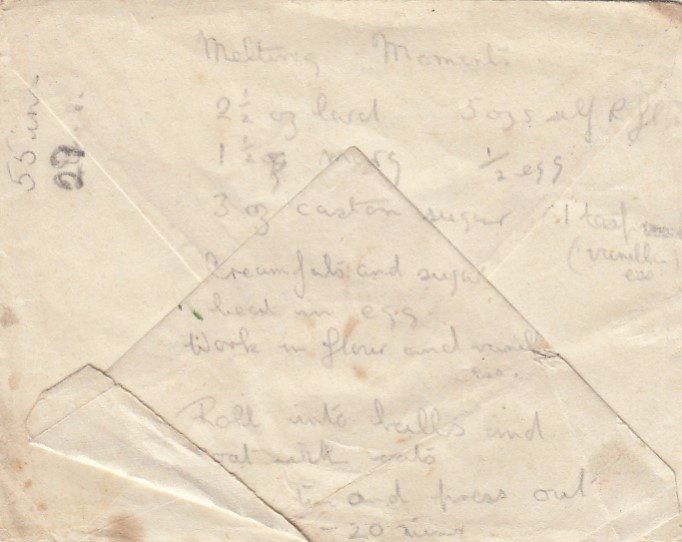
I still wonder though if this letter only made the cut because of the recipe for Melting Moments captured on the back 😉
Postcard from Arthur & Marion Booth to their prospective son-in-law, Grandpy. Own collection.
Then there is a postcard to Grandpy from his prospective in-laws just two weeks before the wedding. What were they trying to say?
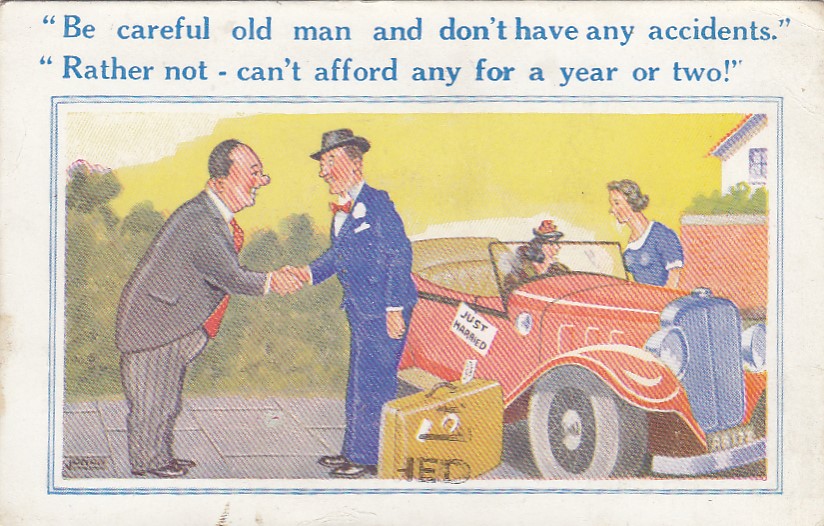
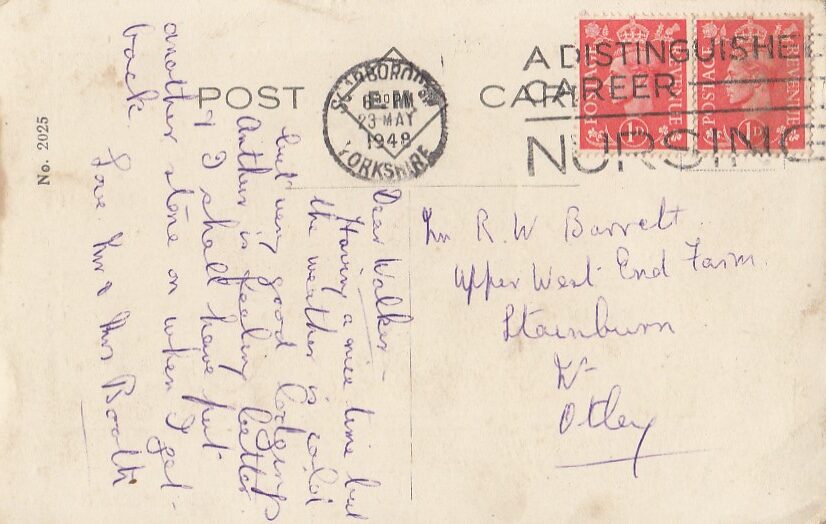
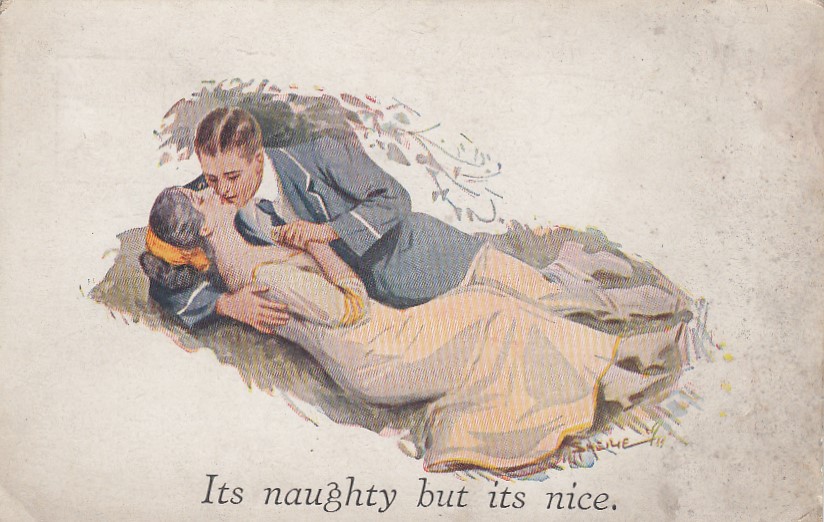
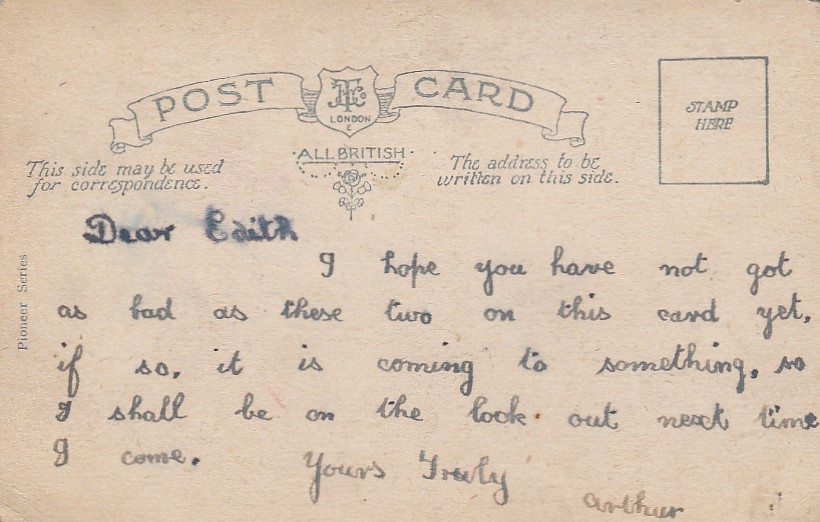
Postcard from great grandfather, Arthur Booth, to his sister-in-law, Edith Moody.
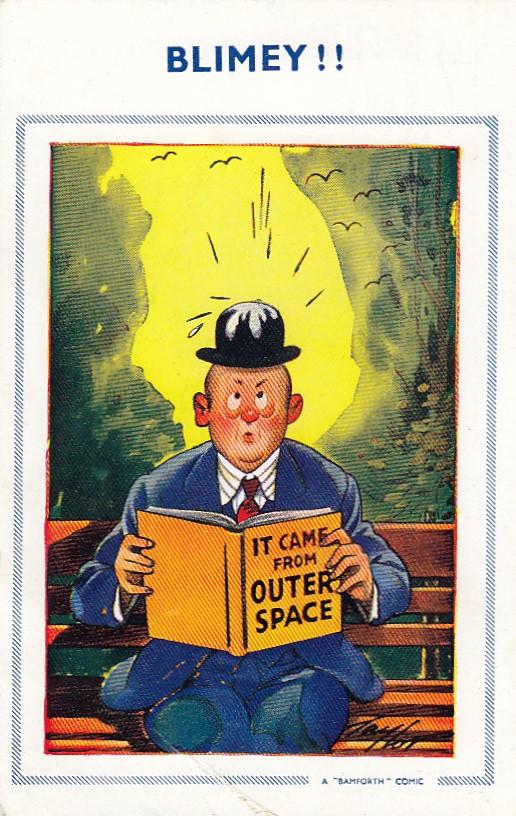
Continuing on the theme of cheeky postcards, I have by now I’ve started to get a sense of my great grandfather, Arthur’s, handwriting and sense of humour. Arthur married Marion in 1925. Marion’s sister, Edith was not to marry Charles Hardy for another decade. I’ve speculated before that Edith may have been kept at home to help, free to marry only after her mother died. Dating this card might well provide a clue. Either way I can see that Grandpy may well have shared a joke with his father-in-law……
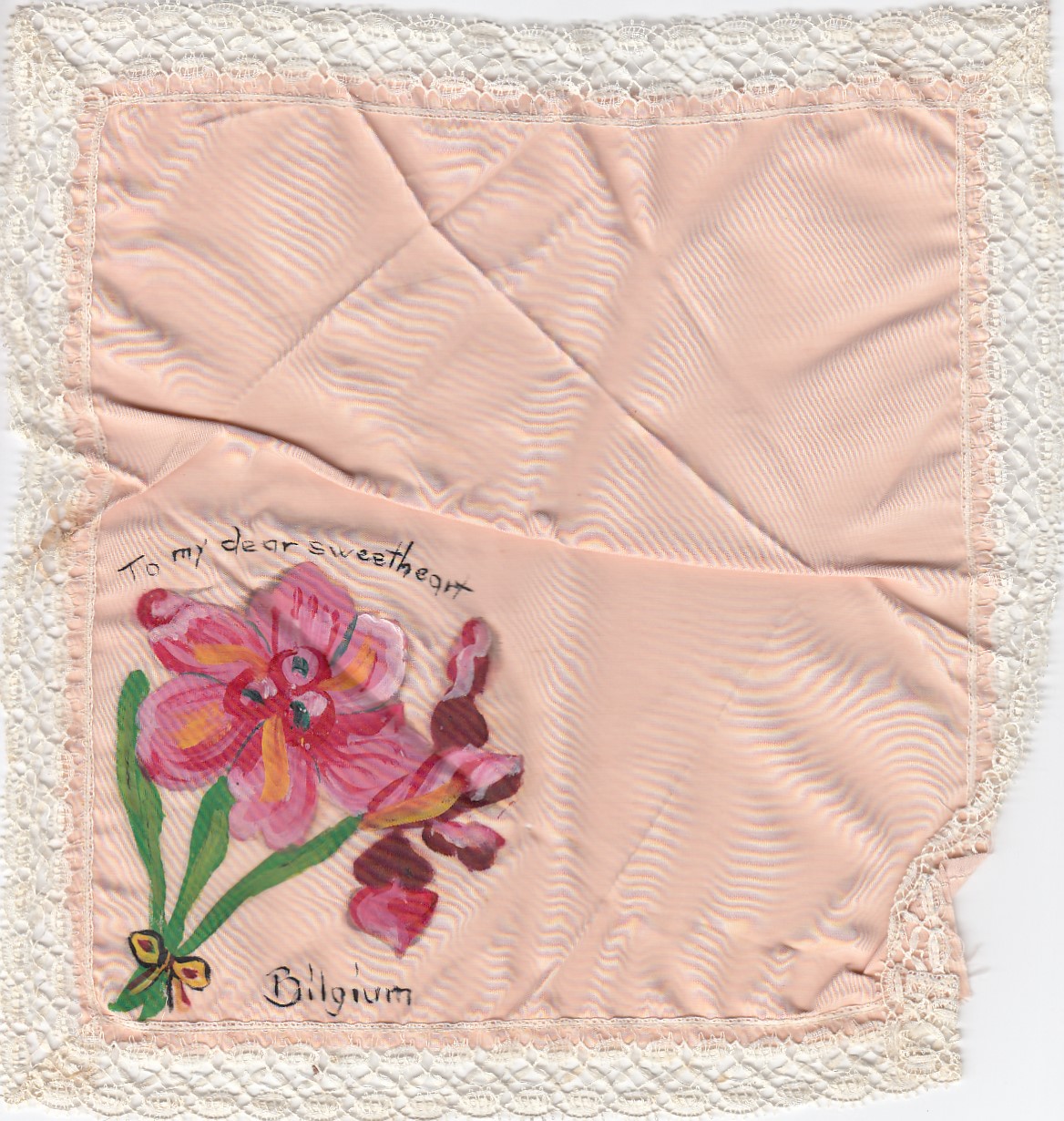
Finally, there’s the handkerchief. Mum & I have debated this one. Nana’s WI trips were to The Netherlands and Norway rather than Belgium and as Mum put it “Aunty Hilda helped Mum choose between Dad and Richard Greenwood – no Belgians!” so we didn’t think it was a sweetheart. Was it a gift from a female friend? Nana’s big sister Hilda is conspicuously absent from this box. She was also the more adventurous of the two sisters, so whatever the story behind it I’m going to associate with Aunty Hilda from now.
A painted hanky. Own photo.
I hope you enjoyed this brief peek into Nana’s life, I know I did even if it’s left me with more questions than answers! With much love & gratitude for my Nana who created such a wonderful collection.
In all the history of our Yorkshire born ancestors only two have chosen to leave “God’s Own County”. The first was Isabella Dean who crossed the border into Lancashire, had an illegitimate daughter Elizabeth (Nana’s great grandmother), married and then promptly crossed back into Yorkshire. The second was Robert Walker.
I thought of him as being a bit of a rogue. Three wives is, well, either careless or greedy. And honestly who would want to leave Yorkshire for the environs of London? (Says the woman whose postcode starts NW1).
If anything, it was Robert’s wife, Elizabeth Hornby, who had left the mark on our family as at least three grandchildren and two great grandchildren were given her maiden name as their first: Ellen Hornby Parker (b. 1882), Hornby Wellock (b. 1888), Hornby Walker (b. 1892), Hornby Moor (b. 1899) and lastly Hornby Wellock born in Canada in 1905.
Yet settling down to review the documentary evidence, I was presented with a very different story. For Robert was a man (& a boy) who’s life was beset by tragedy and emigration yet time and again he picked himself up and carried on.
So, who were Robert Walker & Elizabeth Hornby?
Robert was born in Hebden in 1823, the fifth of ten children of Anne Pratt (1793 – 1855) & Thomas Walker (1793 – 1835), nine of whom were boys and, all of whom (bar the twins, Thomas & Elizabeth born in 1826) survived infancy. Thomas & his growing brood must have felt confident. They were descended (through Thomas’s mother) from the Hebdens, Bollands & Inmans, families who had run liveable farming tenancies in the area for centuries and with an expanding free workforce, his main worry was most likely that of securing decent tenancies for his sons when they came of age. Indeed the Walker brothers had all been schooled in an age when schooling was a sign of relative affluence in the village.
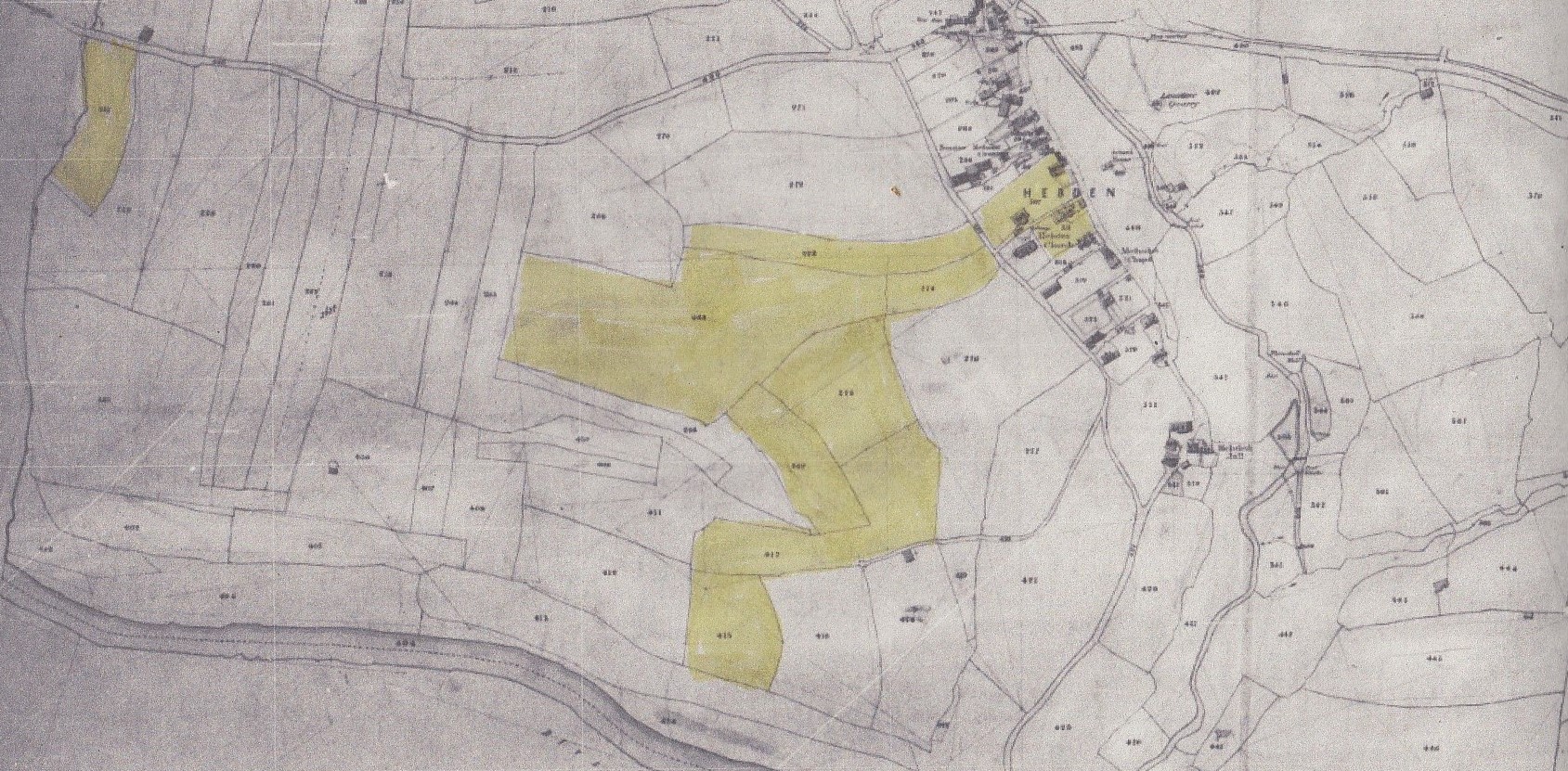
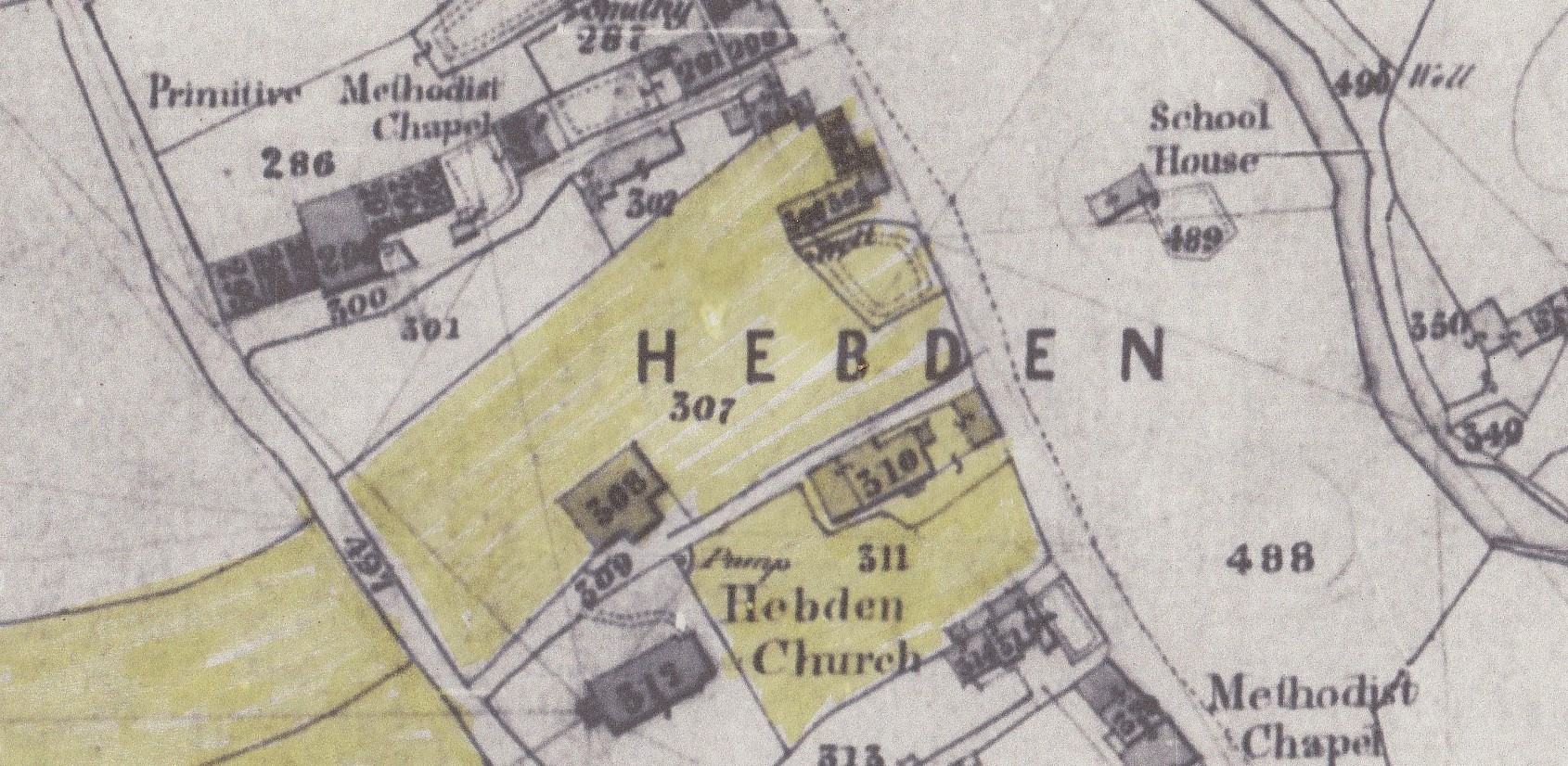
1844 tithe map of Hebden from www.hebdenhistory.uk. The highlighted plots were those occupied by James Walker and, therefore I assumed also by his father, Thomas before him and his brother Robert after. Own picture.A close up from the 1844 tithe map of Hebden from www.hebdenhistory.uk showing the village. Again, the highlighted properties are those occupied by James. Own collection.
A note to help with the rest of the article, the ten Walker siblings were: John (1815 – 1868), James (1817 – 1848), Richard (1820 – 1843), William (1822 – 1863), Robert (1823 – 1873), Thomas (1826 – 1826?), Elizabeth (1826 – 1830), Thomas (1829 – 1842), Edward (1831 – aft. 1910) and Joseph (1835 – 1927).
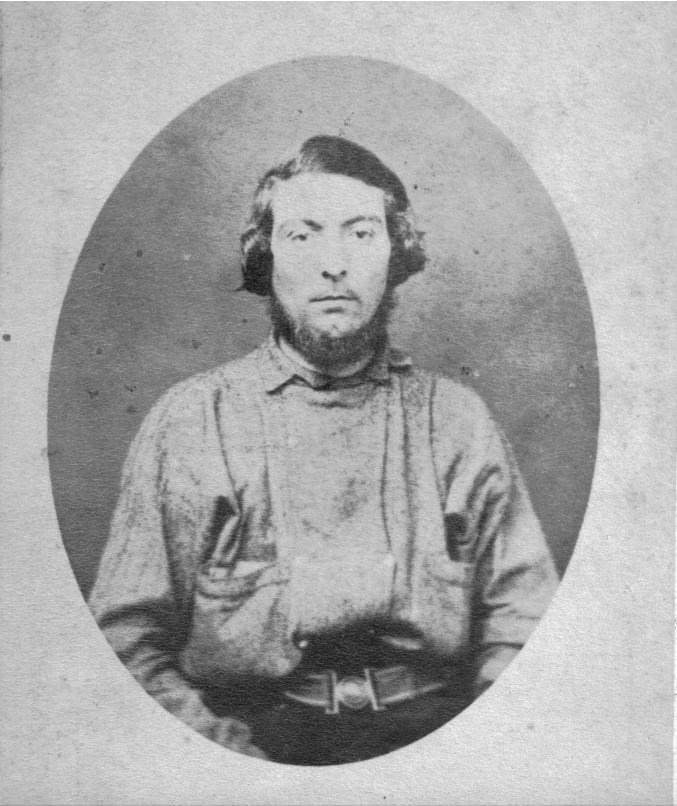
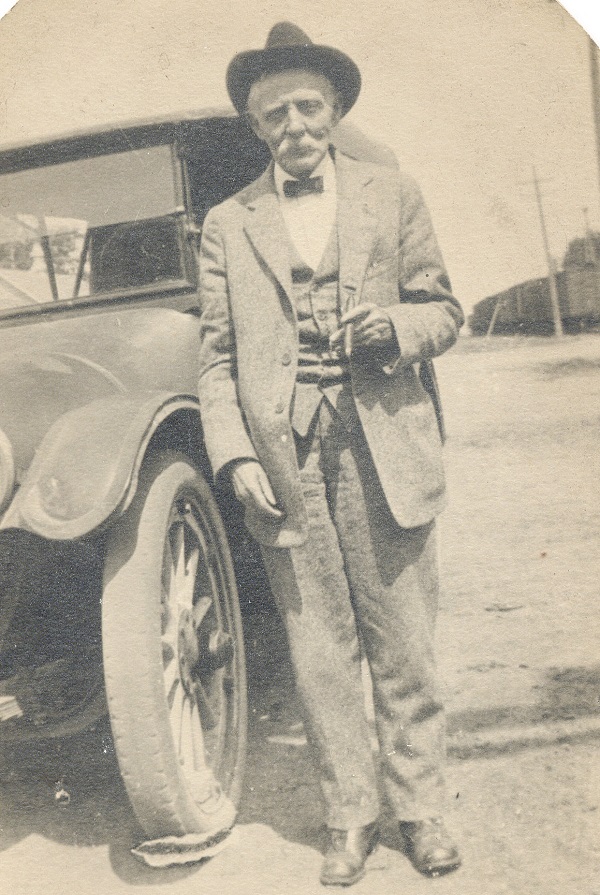
John Walker, the eldest of the Walker children. Photo courtesy of Tim Hall.Joseph Walker, the youngest of the Walker children. Photo courtesy of Tim Hall.
Then on 6 December 1835 life changed.
At the comparatively young age of 42 and just three days after the birth of his youngest son Joseph, Robert’s father, Thomas Walker, died. Frustratingly it was just before all the best records kick in, so I have no way of knowing what happened although B. J Harker provides a potential clue in his book Rambles in Upper Wharfedale “Previous to the year 1862, Hebden was very subject to typhus fever, and other epidemic diseases, through want of drainage and a proper supply of water”. This was to become a theme for the Walker family.
Life for the twelve-year-old Robert & his brothers would never be the same.
John (Robert’s eldest brother) took the opportunity to emigrate to the US leaving eighteen-year-old brother James to head up the household, together with his mother Anne (at least until 1840 when she took the only truly sensible option for a middle-aged widow at the time and married local widower, William Waddilove).
By 1841, two of the boys, Richard & Robert, had left the family farm. Richard was probably the “17-year-old” manual labourer working for the Pettys in Scosthrop, Kirkby Malham. Of Robert we can be more certain as he went to work for his maternal grandfather, James Pratt, at West Side House, Malham Moor. James ran a farm of 290 acres with two of his sons, James & William, William’s new wife, Margery Hornby, and a female servant Elizabeth Simpson (possibly also a relative). Robert would have known he had no chance of inheriting the tenancy, but for a fatherless sixteen-year-old this was a much better deal than his brother’s.
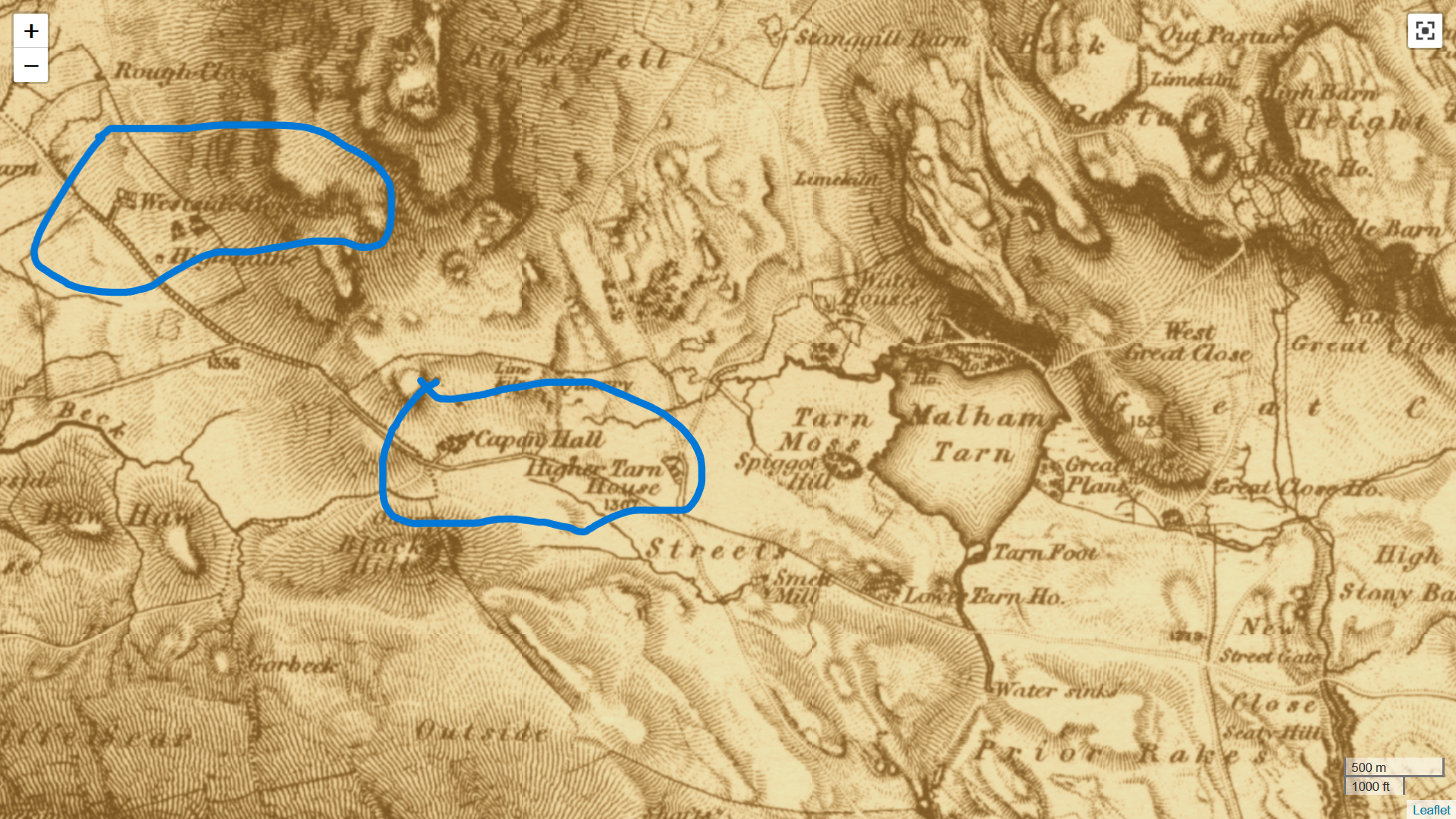
Map from archiuk.org showing the relative locations of West Side House and Capon Hall in Malham Moor. Scosthrop, where Richard could be found in 1841, is just off the south side of this map
Malham is a beautiful place – the tarn & the cove attract thousands of visitors (including my sister last year). But the moor? It’s a remote place. A sprinking of stone farmhouses can be found hunkered down in slight hollows in an attempt to escape the worst of the weather. No chance of meeting a match. Unless of course your uncle’s new wife had a younger sister, Elizabeth, living a mile down the road at Capon Hall. And if Elizabeth & Margery had only one sibling, a sister, Ellen, there had to be a shot at inheriting that tenancy? (see my sister is also my aunt)
So it was that on 23 December 1844, Elizabeth Hornby & Robert Walker were married at St Michael the Archangel, Kirkby Malham witnessed by Elizabeth’s older sister Ellen & Robert’s cousin John.
As Robert moved in with his wife & her family it’s time to talk about Elizabeth. Elizabeth was the youngest of the three daughters of Mary Coates & John Hornby. John had been born in Giggleswick & Mary in Gisburn and they’d moved to Capon Hall at some point between the birth of their first daughter, Ellen, in 1816 and their second daughter, Margery, in 1819. The Capon Hall tenancy was about 200 acres of desolate moorland. Glorious when the sun was shining, harsh when the wind and snow blew through in winter.
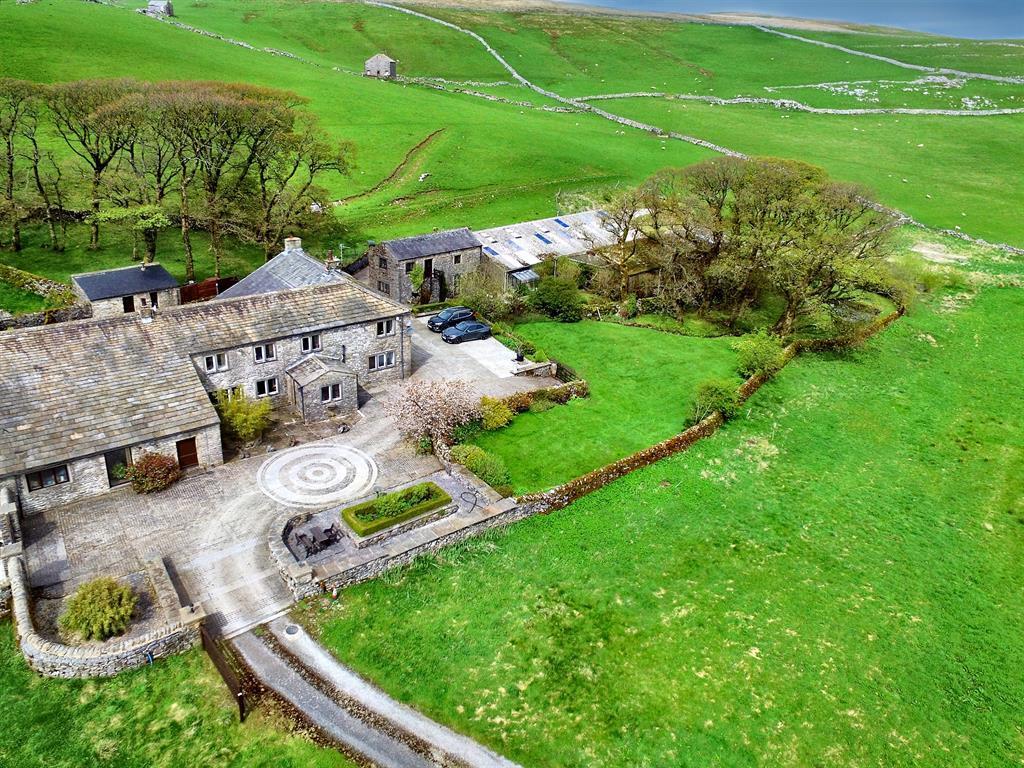
Capon Hall, Malham Moor, taken from a property listing in 2022
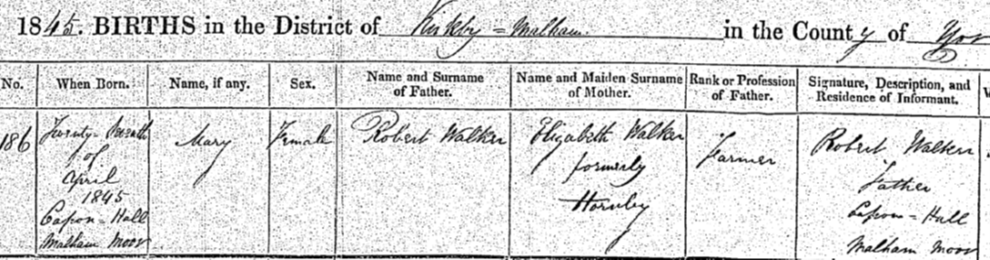
The first two of Robert & Elizabeth’s children were born at Capon Hall: Mary (my great, great grandmother) in 1845 and Thomas in 1847.
Birth certificate of Mary Walker in 1845 showing her birthplace of Capon Hall.
Their third child, John, born in 1849, was baptised back in Hebden.
So, what had happened? Well, the 1840s hadn’t been good to the Walker brothers. Thomas had died first, of measles, aged 13 in 1842. Richard died the following year, aged 23, this time the cause of death was consumption. When this same highly infectious disease killed James on 5 July 1848, a vacancy for head of Walker household appeared. Would it be 27-year-old William or 24-year-old Robert who took up the role?
Had William & his new wife had already booked the transatlantic tickets that would deposit them in New York on 6 November 1848? Where they seduced by tales of gold from their older brother John or scared away from Hebden by the infectious diseases which seemed to plague the family? Or had the two remaining older brothers sat down and amicably discussed the decision between them? I certainly hope it wasn’t a hostile takeover by Robert forcing William’s emigration.
These movements also paved the way for a much more joyous occasion – the marriage of Elizabeth’s eldest sister, Ellen, to the younger James Howarth. I can’t be sure if this was before or after the girls’ father, John Hornby, died on 12 March 1850 but no doubt both father and husband had the future of the Capon Hall tenancy in mind.
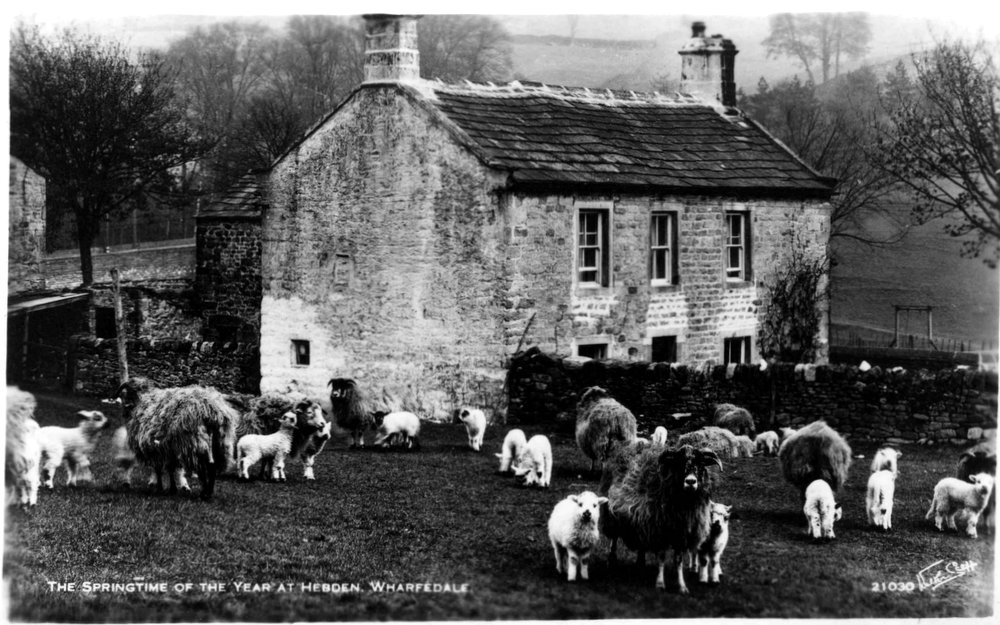
The Old School House, Publisher: Walter Scott, Bradford. Code: 21030. Date: 1930s? From the collection of Peter Hodge. From www.hebdenhistory.uk. Believed to be the home of the Walker family from the 1830s to the mid 1860s before it became the School House and then the Old School House by which name it is known today. The windows look towards Church Lane.
By 1851, Robert & Elizabeth were established in Hebden. Robert farmed 60 acres and worked as a butter factor too. Three more children, James (b. 1852), Ann (b. 1853) and Elizabeth (b. 1856) followed. The growing family was surely the prompt for the two remaining Walker brothers, Edward & Joseph, to follow John & William across the Atlantic leaving Robert the sole remaining Walker brother in Hebden.
All was going well until June 1858 when the couple’s seventh baby, named Robert for his father, was born. Peritonitis, an inflammation of the abdomen, is commonly caused by a hole in the bowel or a burst appendix. It is more rarely a complication of childbirth but the quick succession of birth and the onset of the condition which was to cause Elizabeth’s death two weeks later would suggest these were connected. She is buried, without a marker, in St Wilfred’s church in nearby Burnsall. Baby Robert was to follow just nine months later spending just the same amount of time inside Elizabeth’s womb as out of it. I hope he lies by his mother’s side.
What was a successful man in his thirties with seven children going to do? Well marry of course!
Hannah Fawcett Whitaker was twenty-nine, illegitimate, living between relatives, with no apparent occupation. Love at first sight or a practical solution for both? Robert & Hannah married on 15 November 1859 at St Michael’s and All Angels and Linton, fifteen months after Elizabeth died. Baby Edward arrived around a year later. By 1861, the family should have been prospering, Robert having doubled the size of his farm to 116 acres. He was, or was about to become, church warden for St Peter’s handily located just a couple of minutes from the farm and was respected enough to be asked to judge the butter classes in local agricultural shows.
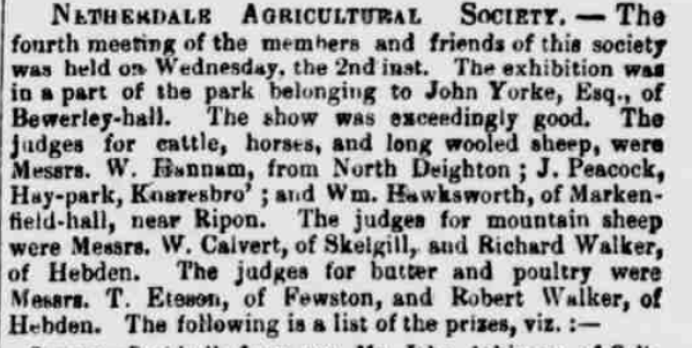
Robert Walker as the butter judge at Netherdale [Nidderdale] Agricultural Show. Article from the Leeds Mercury, 19 October 1850 accessed via www.britishnewspaperarchive.co.uk
But early death seemed to stalk the Walkers of Hebden. Robert’s daughter, Ann, died from diphtheria, aged just eight on 2 October 1861 and his son Thomas, who had reached the age (fourteen) at which he might almost be considered a man, followed just two months later. Then the birth of a son on 23 January 1863 almost immediately caused Hannah’s death from a uterine haemorrhage and nor did the second baby Robert survive beyond the night.
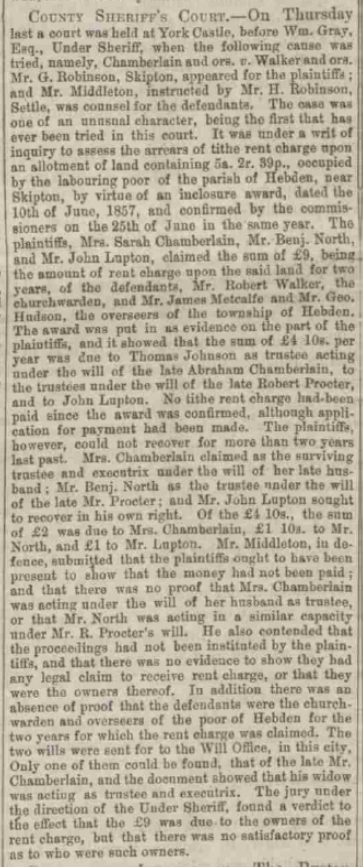
If all that wasn’t enough, Robert, in his capacity as churchwarden, was taken to court in November of the same year in a “case of unusual character, being the first that has even been tried by this [Sheriff’s County] court” (Yorkshire Gazette, 21 November 1863). The moorland enclosures in Hebden in 1857 had been contentious as had been the distribution of various charitable funds for the poor. So much so, that the charity commission had stepped in to change those who were entitled to their receipt.
Yorkshire gazette, 21 November 1863 – the “case of an unusual character” which may have been the final straw for Robert. From the British Newspaper Archive.
I believe it was at this point Robert felt Hebden just didn’t want him. He’d buried two wives and four children three siblings in less than six years. His remaining brothers had all emigrated and now village politics seemed to be against him so in 1864 Robert left Hebden for good.
What else to do but hotfoot it down to Hampshire? I really couldn’t believe this marriage – Walker is too common a name – but the later evidence fully stacks up. On 16 June 1868, when Robert is apparently living in Long Ditton, Surrey, he married one Harriett Jones at Ellisfield church on 16 June 1868. (Yup, Walker marries a Jones….)
By 1871 they were living on Wellington Road, Heston, somewhere between Flowerpot Cottage and Berkhams farm & dairy. I am guessing that latter address had more to do with the location as Robert was either a Coisman or Cowman and grocer during this period. That butter factoring knowledge is proved useful (although what exactly butter factoring and butter classes are will have to wait as I have a whole blog on butter to write).
Robert seems to have had little if any contact with any of his surviving children. His youngest child, Edward, had died in 1866 at the Anchor Inn, home of his great aunt Sarah and he doesn’t appear in any of the family records I have inherited. Indeed his grandson, Benjamin Wellock, brother to my great grandmother, who as the last surviving family member wrote some family history down in 1960, remembered only that his grandfather’s name was James…..
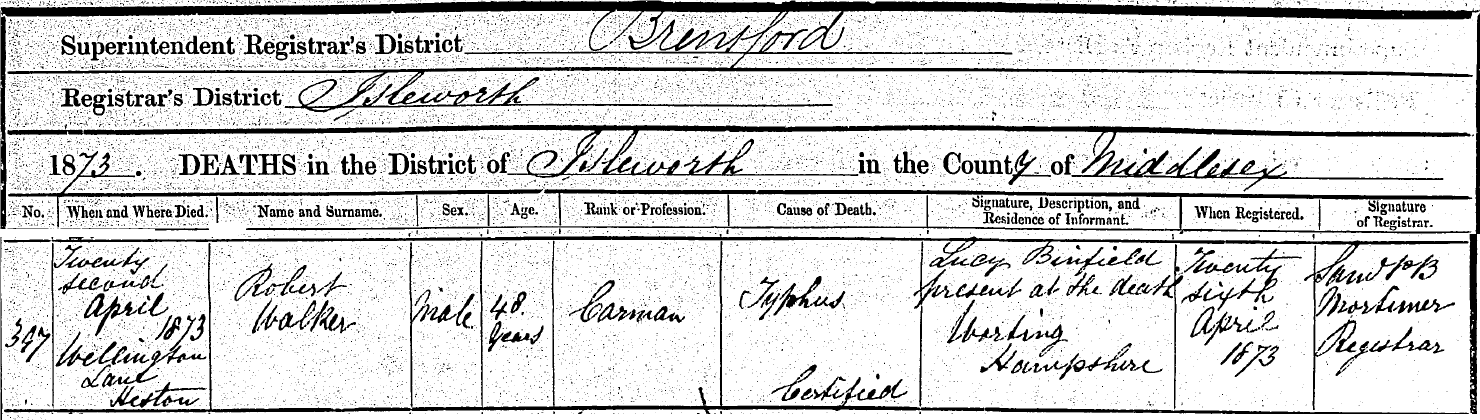
Living down South wass evidently not any better for his health than Hebden and he died, aged 49, on 22 April 1873 of typhus, the disease he perhaps fled to escape and was buried at St Leonard’s church in Heston. Our one and only ancestor buried in London. It would take me just over an hour (and five changes) to get there. It takes me two hours on one train to get back to Yorkshire.
Was he Rogue Robert? Maybe. But in the mid-1800s men had the pick of wives and maybe he was forced to be responsible, to take over the farm after his father died and his elder brothers died or emigrated. Hebden was undoubtably fractious in the early 1860s and it had not been happy place for the Walkers. Robert has left me wanting to find out more, especially in relation to the last decade of his life. Perhaps this blog is just the start of reinstating Robert back into his rightful place in our family history.
Robert Walker’s death certificate in the County of Middlesex, 1873
I could not have written this blog without the wealth of wonderful resources at https://hebdenhistory.uk/ invaluable to those of with ancestors from the village. Thanks to must go to https://curiousdescendants.co.uk/ who provide endless encouragement and guidance to “storify” these bios. Finally I must beg forgiveness of Rogue Robert, our one ancestor who moved out of Yorkshire and whom I underestimated for so long.
It was late one evening in early December when the farmer left his local pub. He’d been there a little while and a pint or two had been consumed. Living next door to his parents, he worked hard to make sure their shared farm was profitable enough to support three generations. He earned the odd evening for himself. Married at the age of 22, he was now in his early thirties and his thoughts turned to his growing family. The four girls were wonderful of course, but a farmer needs a son and heir to run the farm and continue the name. A legacy. The arrival of his fifth child, a boy, earlier that year, made him beam with delight.
The farmer was not to see his son grow up, nor even see him celebrate his first birthday. For the man was to die that very night in a tragic accident just a short distance from home, declared dead the following day.
Those of you who know our family will by now be thinking of my Dad to whom all of the facts in the above tale apply. He’d been with friends in the Sun Inn at Norwood on Sunday, 9 December 1984 and was being driven home by a (completely sober) friend when a man (who had “only” had a pint in each of the four pubs he and his friends had visited that evening) drove straight into their car. Dad was pronounced dead in the early hours of the following morning. My brother, the only boy in a family of five, was just three months old.
Newspaper article describing the inquest of Benjamin Wellock, Pateley Bridge & Nidderdale Herald, Saturday, December 8th 1883. From www.britishnewspaperarchive.co.uk
I was truly spooked when I read the newspaper article above for it was written one hundred and one years before my father died. This is in fact the story of my great, great, great Uncle, Benjamin Preston Wellock, son of my 3x great grandparents, Isabella (Preston) and Thomas Wellock.
Benjamin headed off to the Miner’s Arms in Greenhow Hill around 3pm on Monday, 3 December 1883. (In my Dad’s case it was Sunday, 9 December 1984) to see the landlord about a calf. As he hadn’t left the pub until around 10pm that evening, I rather assumed he’d had a pint or two as it was a rather longer stay than might have been required to negotiate a livestock purchase.
Ever the hardworking farmer, Benjamin stopped to feed the few cattle housed in their barn at Partridge Garth. He had climbed the ladder into the hayloft when a beam broke beneath him throwing Benjamin nine feet down onto the hard barn floor. Whether his was death was instant or he survived a few hours is not known for his father was not to find him until early the following morning.
Photo of a similar hayloft courtesy of one of my oldest friends, Georgina Beecroft.
The family survived. Mary, his wife, lived to the ripe old age of 84 outliving Annie (who died sometime before 1930), Isabella (who died in 1929) and Agnes (who died in 1890) and Benjamin had at least seventeen grandchildren although not all were to survive infancy. Then there was his son and heir. Just eight months old when his father died, John was to emigrate to Canada, around the same time as his cousins, David & Major. Unlike his cousins, he then crossed the border into Washington state and with him he took his father’s legacy, a son named Benjamin Preston Wellock.
As for us. We didn’t just survive, we thrived and whilst there is no George Christopher Houseman, Dad lives on in all of us.
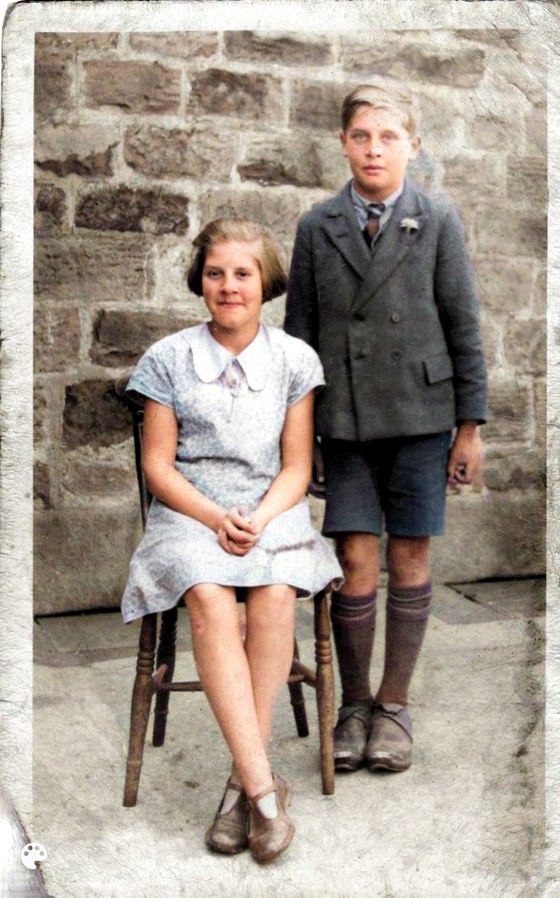
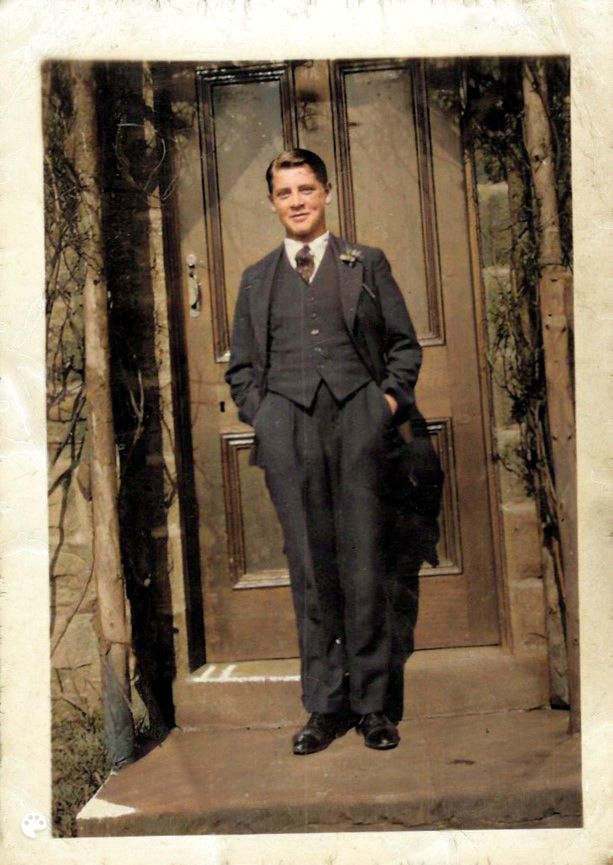
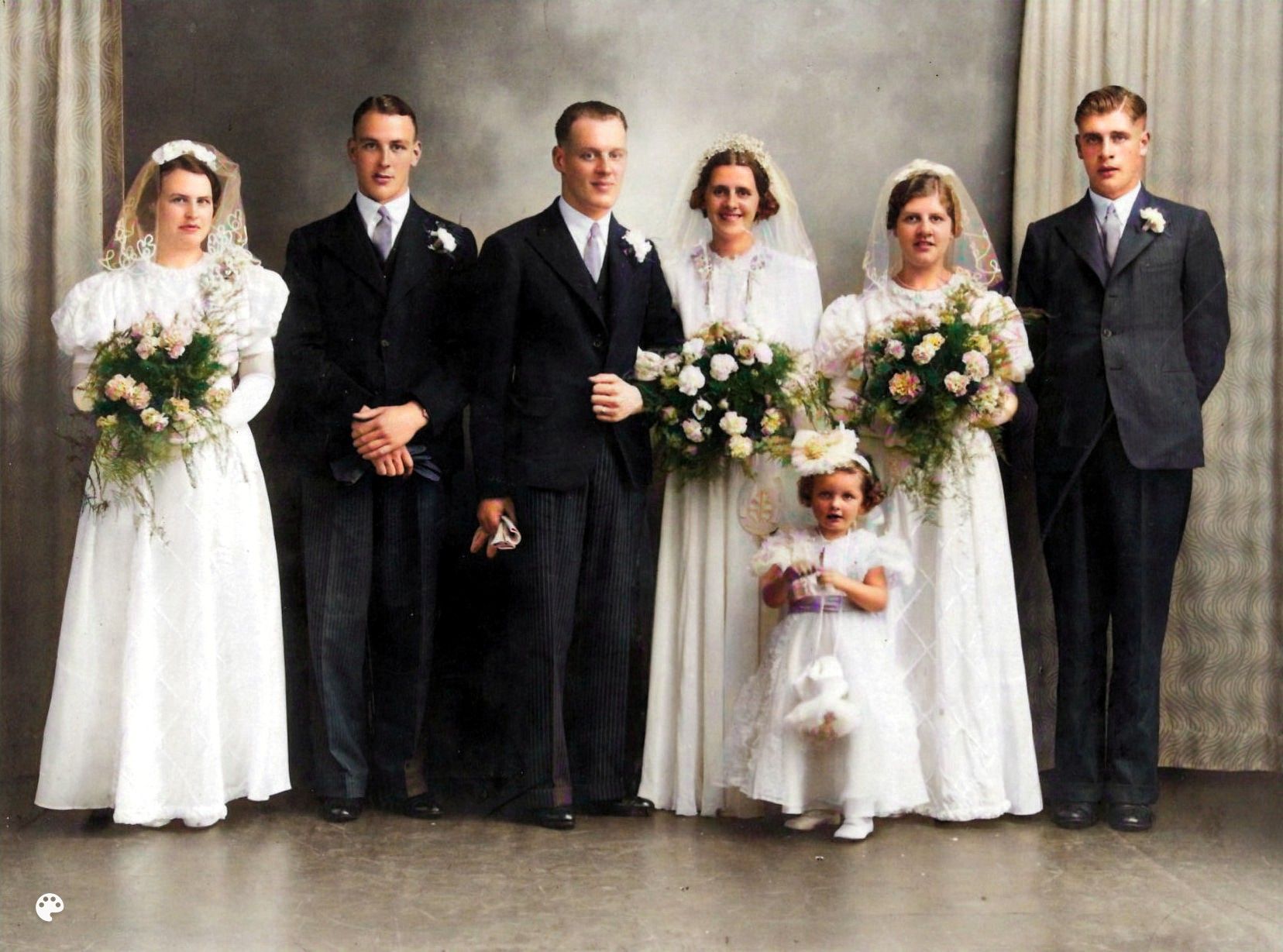
Grandad with his sister Annie. The photo of George on his own is entitled “my first cloth.” Photos colourised with myheritage. Own collection.
I can’t say I knew my Grandad as a person. I was thirteen when he died, after several years of debilitating illness and my memories are built around the sick room bed in the front room. Even now what I have learnt is very much filtered through my Grandma’s and I am only just beginning to understand how much that may have distorted what I think I know.
Which is why this photo is special, for written on the back are the words “my first long cloth.” Dapper, I think, the three-piece suit of dark cloth fits well. George has his hands in his pockets, shoes you can see a reflection in and a flower on his lapel. Even his hair shines in the light.
The contrast with the earlier photo on the left couldn’t be starker. Here George wears an ill-fitting dark grey jack, navy shorts, chocolate-coloured socks and are they clogs on his feet? It’s no wonder the “do I have to” glaze and semi clench fists of the boy have been transformed into the confident, nonchalant stance of the youth.
They must be from a wedding, but who’s?
The photo on the right provides a clue for George has written on the back “new for Mary’s wedding 19/12/37.” (Here’s a man who liked his style, although not his dates as sister Mary married in 1936).
George was born in 1921 and his brother William married in 1935, his brother Thomas in 1938. His sister Hilda married in 1939, by which point the youth was almost a man. William’s it must be and the 28 November 1935 the date where George put on his first smart trousers.
With much gratitude to Natalie Pithers and the Curious Descendents Club for sending us prompts for #NaNoWriMo.
The marriage of Hilda Houseman and Arthur Fawcett. George is stood on the right, his sister Annie the bridesmaind next to him. Colourised with myheritage. Own collection.