A brief biography of Frances Morrell (c. 1771 – 1854) & Thomas Robinson (c. 1771 – 1848)

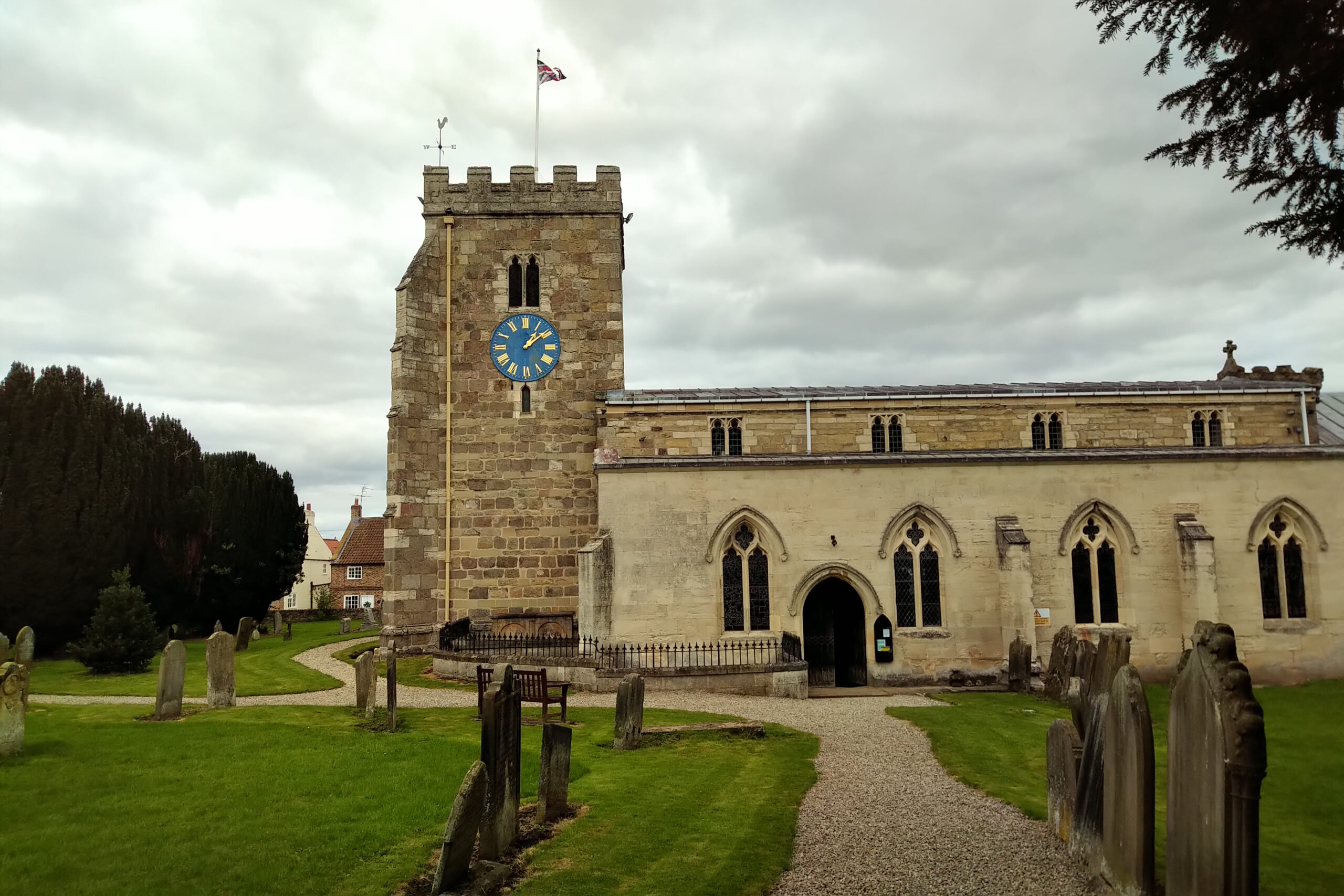
St Andrew’s Church, Aldborough, 2023. Own photo.

What lovelier question could there be to ask a family historian on her birthday weekend than “What churchyard do you want to visit today?” “Kirkby Hill” I responded promptly, as I’d long wanted to go and find the gravestone of my great, great Uncle Walter, who was killed by a shotgun at the age of seven. “Along the way we could call in and see the Roman mosaics at Aldborough?”. We found the gravestone in question, bumped into my Aunty Sue in the Oxfam in Boroughbridge (which led to a whole new set of discoveries), visited the mosaics and found ourselves unexpectedly enjoying tea and cakes on the village green of Aldborough. I left Mum and Joe chatting with strangers on the next door table and wondered off to mooch around the old church. A perfect day.

Aldborough (“old town”) feels like somewhere time stopped. Trade had long since moved to its upstart neighbour, Boroughbridge (when the Roman’s built a bridge there). By the 1700s, it had become a rotten borough, controlled by the local landowner, with parliamentary seats available for a price, more lucrative than investing in the village itself. St Andrew’s Church, though, remained the centre of a significant parish, including Boroughbridge, as late as 1866. The church was rebuilt around 1330 after being destroyed by Scottish raiders, with a chancel and tower built in the fifteenth century. The stained-glass windows were a much later addition, but it looks, and feels, largely as it would have at the end of the eighteenth century.

Largely as it did, I discovered later that week, when my 5xG Grandparents, Frances (Morell) and Thomas Robinson were married there on 25 August 1796, two hundred and twenty-seven years and four days before I walked through the same heavy oak doors.

Thomas was an agricultural labourer and although this is a potentially iterant profession, the family appear to have settled in Boroughbridge where children arrived at regular intervals to be baptised at St Andrew’s: George (11 June 1797), Thomas (27 October 1799), Mary (my ancestor) (17 December 1802), Sarah (10 February 1805) and finally William (21 March 1812).

Unlike with many other of my lines, this was not to be the start of a generational connection to Boroughbridge, for the children scattered. George moved to Marton cum Grafton where he followed in his father’s footsteps taking up agricultural labouring work, Thomas moved to Colne, Lancashire, although returned to marry Mary Dickinson in 1821 and, potentially, became a soot merchant. Mary moved to Leeds and then, following her marriage to John Howson, to North Rigton. Sarah did marry a local man, George Johnson, in 1829, but he appears to have died before they had any children, as she too, moved to Leeds where she married John Kerton in 1838. Of William there is, as yet, no sign.

THE Shelves for Bread to be distributed to the Poor of Aldborough every Sunday from the Bounty of Mark Smithson Esq

St Andrew’s holds a potential clue, a Georgian bread shelf, indicating the necessity of charity for the parish poor. Work, at least work which paid sufficiently well to support a family, was likely in short supply. The growing towns and cities of the industrial north provided a solution.
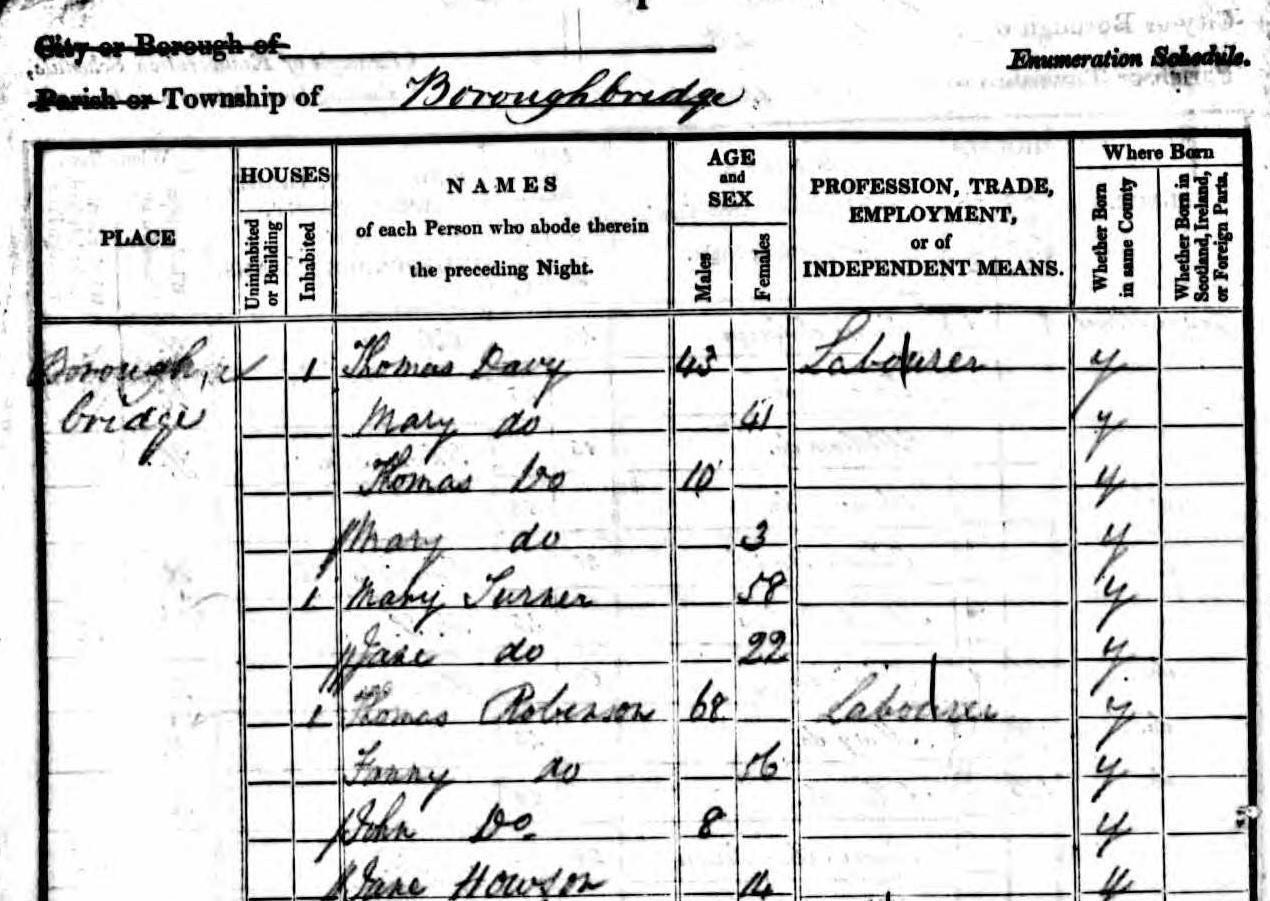
1841 census for Boroughbridge showing the Robinson household including their granddaughter, Jane Howson, the national archives via ancestry.

I’ve often wondered how, or even whether, illiterate families from the nineteenth century stayed in touch once children moved. This was too early for the train, so travel would have been expensive and time consuming, and if the parents couldn’t read, and the child couldn’t write, what was the point of a letter? In this case, it seems they must have done, for in the 1841 census, Thomas (68) and “Fanny” (56) had visitors, John Robinson (8) and Jane Howson (14), two grandchildren sent to live with and support their elderly grandparents. I am grateful they were not alone, and even more grateful that it was my 3xG Grandmother, Jane, who was there because it was her presence, together with the birthplace of her mother, Mary, which had led me to identify Frances and Thomas in the first place.

Thomas Robinson’s death certificate. Note age and place of death. General Registry Office.

Not that grandchildren took away the need to work. By his seventies, Thomas would have been struggling to find employment, yet still he laboured. For on the 16 August 1848, he died, of a palsy fit, in Spring Field in Hutton Conyers. In his death certificate, an illiterate co-worker gave Thomas’s age as sixty-six. In his burial record, at Aldborough two days later, his more likely age of seventy-seven was listed. It was harvest time, when any physically able ag lab should be able to find work and yet Thomas was working nearly eight miles from home and, it appears, had felt it necessary to knock a decade off his age in order to secure the position.

Frances struggled on alone in Boroughbridge, which is where we find her in 1851, aged 76, her occupation listed simply as “poor” perhaps struggling to make the weekly service at St Andrew’s in order to claim some bread for the week. Eventually though, she must have moved in with her son George, for it was in his home in Marton cum Grafton where she died, aged 83, of nothing more specific than “old age” on 19 July 1854. I like to hope that she is buried back at St Andrew’s, with Thomas and where her records start, but her burial remains untraced.

Despite records surviving from the 1770s in Aldborough, there are no obvious baptisms. Morrell should have been a traceable family, especially as George also married a Mary Morrell, but I have found nothing that fits. Thomas was an agricultural labourer and, with only the 1841 census to go on, could have been born anywhere in Yorkshire. Illiterate, it is no surprise that the ages given in the various records are not entirely consistent. So, I’ve called it. They are not a brick wall but can be celebrated and written about as an end of the line, being as far back as I am expecting to trace. With much gratitude to my 5xG Grandparents, Frances Morell, Thomas Robinson and their granddaughter Jane Howson for being together on 6 June 1841 and to my Mum’s husband who suggested a spontaneous trip to Aldborough which supported the writing of this story.
End of the line…..or not!

Hermione screamed in pain, and Harry turned his wand on her in time to see a jewelled goblet tumbling from her grip. But as it fell, it split, became a shower of goblets, so that a second later, with a great clatter, the floor was covered in identical cups rolling in every direction, the original impossible to discern amongst them.”

Harry Potter and the Deathly Hallows, chapter 26.

The Doubling Charm or Gemino Curse is a wonderful analogy for family history. Each ancestor we identify creates two new people to research. Go beyond the basics and each person you add to your tree creates a multiplicity of avenues to follow: parents and children, villages and towns, occupations and religions, local history and world changing events.

Most of the time it’s why I love family history; there’s always a new direction to explore, a new connection to make. But for the completer-finisher part of me it can be a bit of a curse. The stories increase exponentially and I’m barely managing to systematically capture the basics. I am starting to drown in the genealogical gold.

This is why I was weirdly excited to get to know Frances (Morrell) and Thomas Robinson, two of my 5xG Grandparents. I have their marriage (on 25 August 1796 at St Andrews Church in Aldborough), their children’s baptisms, their burials and a story idea linking them back to the present. But neither were baptised in Aldborough, there is no record of a Frances Morrell being baptised anywhere in the locality and there are so many potential options for Thomas that I am never going to be able to identify which one is mine. They are officially the end of the line, and it feels powerful.

I thought Frances and Thomas’s story will be the first of a new blog series entitled “the end of the line,” but then as I started to the ancestors to which this might apply and found that almost every short line offered some plausible hints as to the next generation and, often, the bones of a story. Hence the “…or not,” to recognise that those exploding goblets just don’t want to be contained!

The official end of line stories are listed below.

NANA

Wid Swinden (remembered in poetry) – 7xG Grandmother, mother of Ann Swinden, mother of Martha Bottom, mother of Rachel Hall, mother of George Bentley, mother of Annie Bentley, mother of Marion Moody, mother of Nana.

GRANDPY

Sarah Dickinson and John Windsor (in a tale of the impact of an Icelandic volcano eruption on a remote village in Yorkshire) – 5xG Grandparents, being parents of Mary Windsor, mother of Thomas Wellock, father of Richard Wellock, father of Mary Wellock, mother of Grandpy. I do have a clue on the Windsor side, as John may have been baptised on 27 October 1745 at Arncliffe, the son of a Thomas Windsor.

Mary and James Sympson (the beginning of our connection with Garnshaw) – 9xG Grandparents, being parents of Agnes Symson, mother of William (3) Wellock, father of William (2) Wellock, father of William Wellock, father of Richard (2) Wellock, father of Thomas Wellock, father of Richard Wellock, father of Mary Wellock, mother of Grandpy.

GRANDMA

GRANDAD

Frances Morrell and Thomas Robinson – 5xG Grandparents, being parents of Mary Robinson, mother of Jane Howson, mother of Mary Ann Wilkinson, mother of Mary Abigail Clapham, mother of Grandad.

The toffee crunch tin

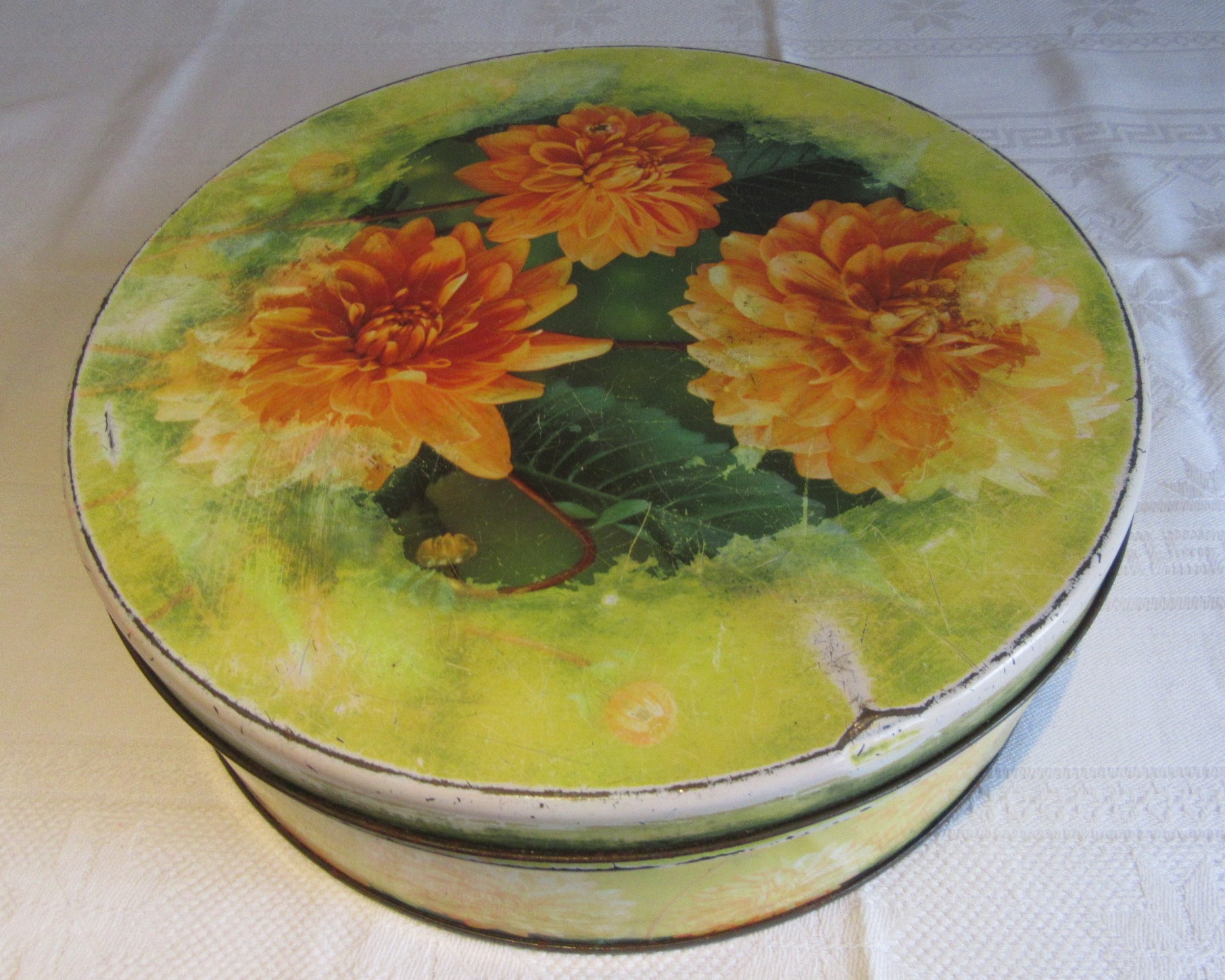
The toffee crunch tin. Own photo.

The tin is old and worn, the once bright orange dahlias on the side have been scrubbed to a mottled yellow or even further to white, there’s a ding on the lid and rust spots on the bottom.

And yet, of all the objects we sorted through after Grandpy died, it was the one all five siblings coveted. For love, and toffee crunch, had filled it for many years.

The logo on the botton of the tin. Own photo.

Once upon a time it must have been filled with Jacob’s Cream Crackers, for W.&R. Jacob & Co (L’Pool) Ltd, Biscuit Manufacturers, Liverpool, England is emblazoned across the bottom. Cheese and crackers, the perfect afternoon tea in front of the fire, with wrestling on the tv. At least that’s how I remember it, but the crackers from this tin would have been long gone before I arrived on the scene. Instead, my first memory is of it being filled with Nana’s perfect crumbly flapjack. Flapjack so good, that I almost never choose to eat it nowadays, for nothing can match it.

It’s toffee crunch though (or possibly toffee crispie depending on which family member you ask) for which this tin was famous for containing. Lined with greaseproof paper, stacked sideways with golden squares of deliciousness.

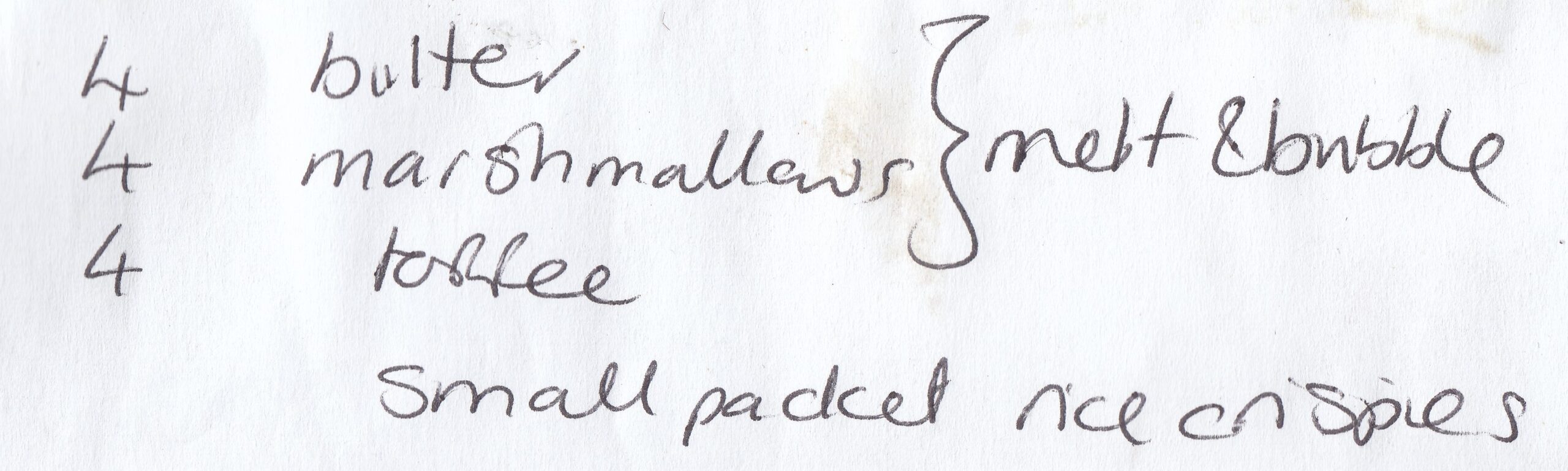
The recipe is super simple. My version is just thirteen words long. Apparently, I didn’t even think I needed to specify units of measurement.

Recipe for toffee crunch, Natasha’s version.

The secret was in the toffee. Mum was always on the look out for slab toffee (which normally came in 4oz packs). Werther’s Originals could, with a lot of unwrapping, be deployed as a slightly inferior alternative.

Heading back to university each term, I was presented with a large plastic bag of toffee crunch to take with me and after Nana died, Grandpy kept up the tradition, never failing to open the cupboard and pull out the tin to send me back to Leeds with sustenance. It never lasted long. One bite of the sweet, chewy, crunchy square quickly led to another and then another.

After Grandpy died we managed a fairly amicable split of his possessions. In the early days we put aside anything that two or more of us wanted and left it for a few months until the memory of his death had lost some of its sharpness that could have caused disagreement. Somehow, I ended up with the tin. It was only when I got home and opened that discovered Grandpy had been prepared until the end as it was full of the very last toffee crunch Grandpy would ever make.

With much gratitude to my Nana and Grandpy for all their love and toffee crunch.